Bring back some good or bad memories


ADVERTISEMENT
Showing posts with label skating. Show all posts

February 25, 2025

A Group of Roller Skating Friends Pose for a Photo, England, 1926

In 1926, a group of roller-skating friends in England gathered for a photograph, capturing a joyful moment during the height of the Roaring Twenties. With laughter and camaraderie, they showcased a popular pastime that brought people together in an era of excitement and change.


By the early 20th century, roller skating had become a favorite recreational activity across England and beyond. Skating rinks were opening in cities and towns, offering a lively space for social gatherings, music, and fun. Outdoor skating was just as popular, with promenades and smooth streets providing the perfect setting for skaters to glide along, enjoying the fresh air and freedom of movement.

The young friends in the photograph would have been dressed in the latest 1920s styles. Women likely wore elegant flapper-style dresses, featuring flowing fabrics and intricate beading, along with their fashionable bobbed hairstyles. Men might have sported smart suits, complete with ties and hats, or opted for more relaxed attire suitable for an afternoon of skating. Their roller skates, typically made of sturdy leather with metal wheels, represented the best in skating technology at the time.

The 1920s were an era of cultural transformation, with new forms of entertainment sweeping across England. Jazz music, dance halls, and motion pictures were captivating young people, and roller skating fit perfectly into this energetic lifestyle. It provided an opportunity to exercise, socialize, and express individuality through graceful movements and daring tricks.

October 19, 2024

Linda Ronstadt on Roller Skates From the Photo Session for the “Living in the USA” Album, 1978

In 1978, the skating craze was at full force, and Linda Ronstadt had to learn to skate for the photo session for the album cover of Living in the USA. The album was Ronstadt’s third and final No. 1 on the Billboard 200 album chart.

The cover photoshoot was done in Venice Beach and the boardwalk shots were for the video. One of the main issues that day was keeping the crowds at bay while the shoot was taking place. The photos were taken by legendary photographer Jim Shea.

Below are some outtakes from the photo session for the Living in the USA album:


February 12, 2024

Pedal Skates From the 1910s

Roller skating tends to go in and out of style with each decade. Roller discos died out in the 1980s before roller-blades made a comeback in the 1990s.

Pedal skates, however, will forever be the coolest means of transportation for modern man. According to The Atlantic, this variation on the classic roller skate was patented by Charles A. Nordling of Suisun, California in August 1913. The primary object of Nordling’s contraption was “the provision of a roller skate in which the wheels thereof will be rotated on pedal action by the feet of the user, thereby avoiding the necessity of excessive exertion on the part of the skater.” Since the skates required significantly less force, the skater would be less likely to drag his feet or lift the skate from the ground, thus enabling, as Nordling writes in his application, “the production of high speed.”

Nordling’s initial patent would later provide the basis for future mechanical roller skates, including Hyman Suroff’s 1983 self-propelled roller skate and Zygmunt Piotrowski’s 1991 step action wheel skate.


The patent drawing for Nordling’s pedal skates/U.S. Patent Office.

February 3, 2024

Amazing Photographs of Farrah Fawcett Skateboarding in “Charlie's Angels” (1976)

Perhaps the coolest thing about these pictures of Farrah Fawcett skateboarding has little to do with her fantastic all-American looks. Yes, of course, the iconic Farrah Fawcett hairstyle is in fine form and she sports a pair of old school Nikes that would be worth a heap today.


You see they are associated with a specific episode of the originals Charlie’s Angels called “Consenting Adults,” wherein Jill (Farrah) mastered the skateboard to elude a racketeer’s henchman. Just knowing this was not just a random photo shoot or public relations effort but, rather, a visual documentation of how angel Jill Munro got away from the bad guys, makes it so much more satisfying.

As anyone who remembers the original show will confirm, Farrah escaping danger on a skateboard is a very typical Charlie’s Angels plot device and part of what gave the original series its old-school charm. Every single episode had them and they were nothing more than excuses to see Farrah and fellow angels Jaclyn Smith, Kate Jackson and, later, Cheryl Ladd and Tanya Robers, showing off a special skill and, usually, wearing as little clothing as prime time TV would then allow. Hence we have these wonderful pictures of Farrah on a skateboard.


October 10, 2023

Infamous 16ft. Water Tower Ollie by Jeremy Wray, 1997

What drew you to skate off such huge roof tops?
“I was able to ignore the drop and just focus on the gap itself. If you could do certain tricks if the gap was the same size as a grass gap or set of stairs, then with the right mindset you should be able to do the same tricks on a roof gap. Most of the danger would be from not going fast enough to clear the gap, but I would always try to go faster and clear everything by enough to be confident that I wasn’t going to hang up.” – Jeremy Wray

In 1997, Jeremy Wray pulled off one of skateboarding’s most unfathomable stunts when he ollied between two water towers outside of Los Angeles. This moment has gone down in skateboarding history, and the 16-foot gap between the towers is enough to scare away the most experienced skater. Although the Ollie does give the skater as many run-ups as needed, but judging by the speed that Jeremy was going by any other less talented skater would fall from the top of the tower to flat.

October 1, 2023

Motorized Roller Skates From the 1960s

The self-propelled skates that were produced by the Motorized Roller Skate Company of Detroit, beginning in 1956. The company was founded in 1955 by an intractable inventor from Lincoln Park, Michigan, named Antonio Pirrello. Retailing for $250, that’s an astounding $2300 in today’s economy, these skates feature a 19-pound gasoline motor that is worn like a backpack. The gas connects to the right skate to push while the skater holds her left foot out in front to steer. A second cable connects to the hand-held clutch to regulate speed. Quite a lot of speed. These skates can roll at up to 40 miles per hour!

Mr. Pirrello and his motorized skates were featured in the magazines Life and Popular Mechanics and were guests on You Asked for It and The Today Show.


May 29, 2023

Third Skate Lets You Coast Sitting Down, 1939

A third skate designed for use with a hockey stick has a long, handlelike extension provided with an adjustable saddle which permitted the roller-skater to coast sitting down, in 1939. A built-in brake, operated by means of a convenient hand lever, enables the coaster to slow down or stop easily. The hockey stick can be removed for use.

Roller-skating de luxe. The hollow frame holds a hockey stick.

January 24, 2023

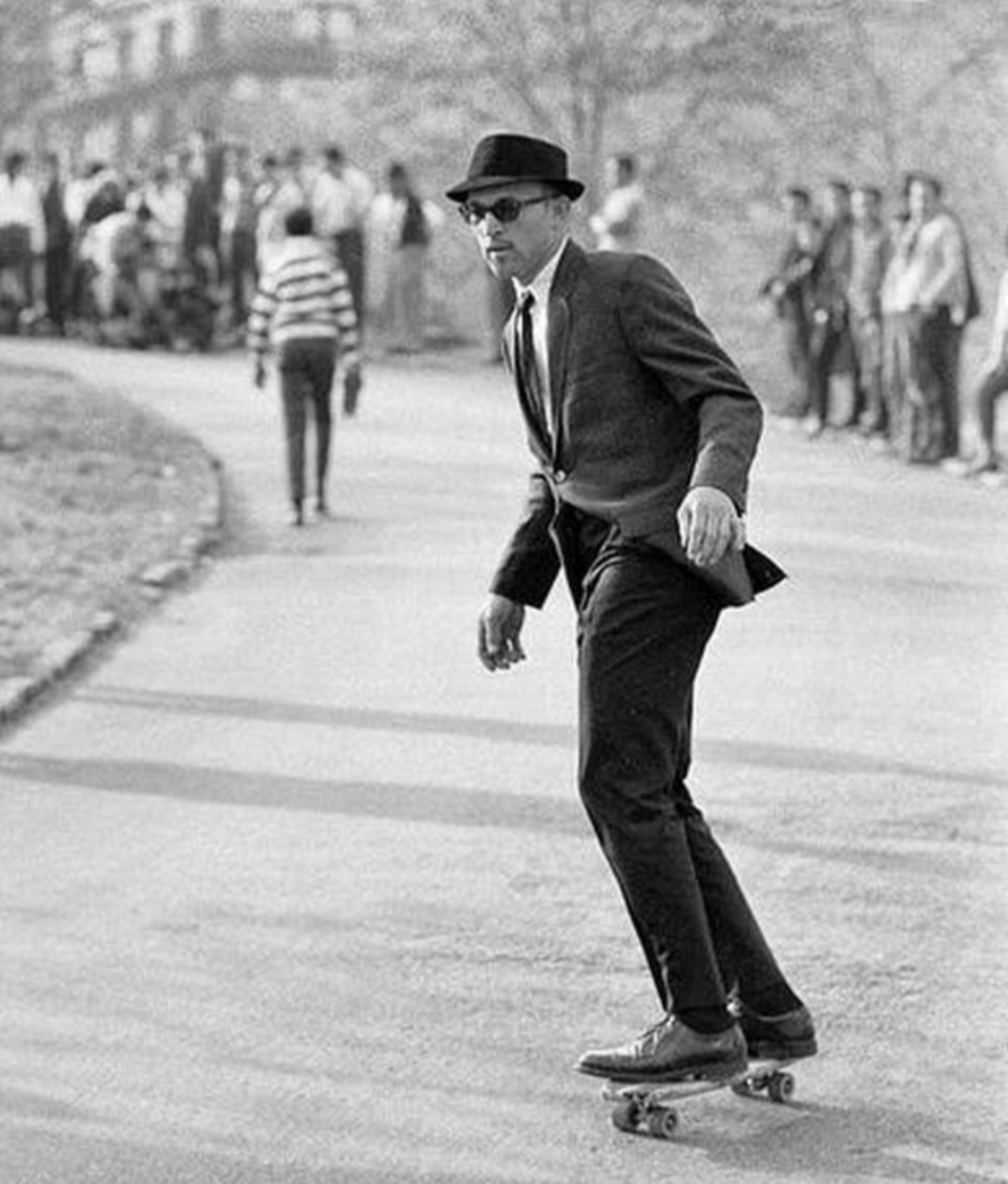
A Skateboarder Zipping Through Central Park, 1965

A businessman in a suit and sunglasses was photographed skateboarding in Central Park in 1965, to the amazement of passersby. The photographs were taken by Bill Eppridge for LIFE magazine.


Skateboarding, LIFE opined in 1965, is “the most exhilarating and dangerous joyriding device this side of the hot rod. A two-foot piece of wood or plastic mounted on wheels, it yields to the skillful user the excitements of skiing or surfing. To the unskilled it gives the effect of having stepped on a banana peel while dashing down the back stairs. It is also a menace to limb and even to life.”

November 22, 2022

Midget Skis Set on Rollers, 1938

Combining the best features of skiing and roller skating, a new sport of “ski-skooting” has developed through the adaptation of midget skis on rollers in 1938. Two rubber-tipped poles are used to propel the skier along the pavement. The midget skis are fastened to the user’s feet by means of stout straps.

Providing plenty of thrills, midget skis equipped with rollers have created a new sport––“ski skooting”. Propulsion is achieved by means of two rubber-tipped ski poles.

May 12, 2022

Martin Sweeney’s 1991 Slalom Skateboarding World Record

Martin Sweeney was the UK’s finest slalom racer and an exponent in tight slalom. In the early 1980s he could regularly be seen skating 4 foot courses at London’s Southbank and Hyde Park.


Sweeney is best remembered for setting the original, Guinness certified World 100 cone record at Brands Hatch in 1991. A record he held for many years to come. The record run was filmed as part of BBC TV’s Record Breakers series hosted by Roy Castle, as featured in the clip.

March 27, 2022

Wonder Woman on a Skateboard in “Skateboard Wiz” (1978)

Wonder Woman (Lynda Carter) does a spin change into a skateboard outfit that consists of a helmet, elbow pads, and knee pads. Then, on skateboard, she chases some bad guys in a car. Clip is from the TV show “Wonder Woman” titled “Skateboard Wiz” (1978).


“Skateboard Wiz” is the eighth episode of season three of the superhero fantasy series The New Adventures of Wonder Woman and the forty-fourth episode of the series overall. It was directed by Leslie H. Martinson with a script written by Alan Brennert. It first aired on CBS on Friday, November 24, 1978.

This is the only episode in which Wonder Woman uses a skateboard (to catch up with the henchmen’s car as they try to escape), and the only appearance of her skateboarding costume (which adds gloves, elbow pads, knee pads, and a helmet with her crest to her regular costume). The red skateboard helmet is much different from her gold motorcycle helmet. Lynda is initially shown wearing her usual high-heeled boots, but subsequent shots of her skateboarding stunt double all show her wearing flats.

Wonder Woman, Lynda Carter learning to skateboard with some guest stars in the season three episode “Skateboard Whiz”.

November 25, 2021

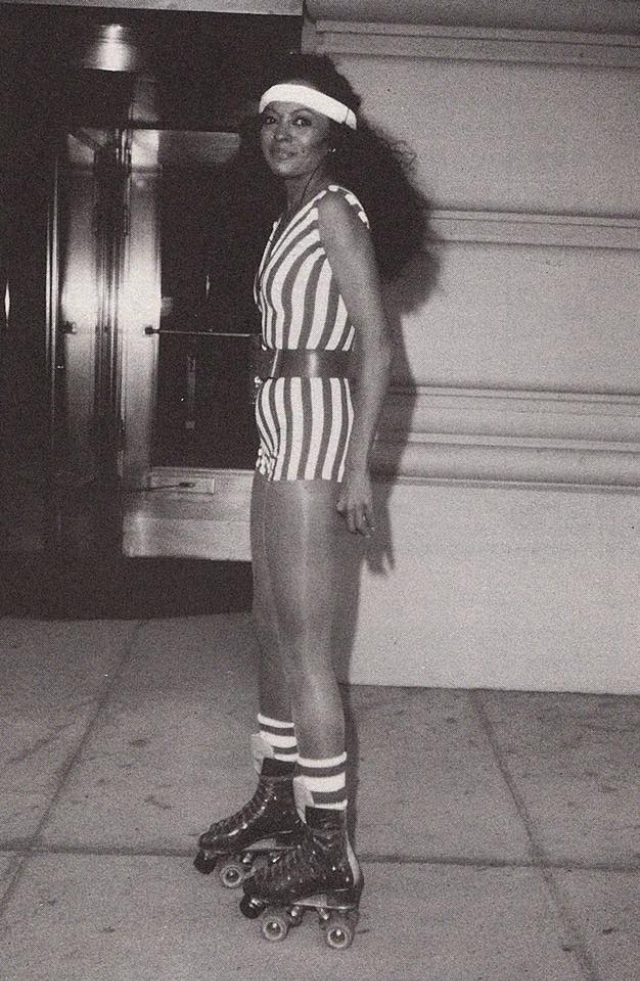
Diana Ross Roller Skating in New York, ca. 1981

Diana Ross is a singer and actress, starring in one of the most successful girl groups of the 1960s – The Supremes. As you can see from her photographs, she was absolutely gorgeous, even when exercising! These photos show her with roller skates on, a sport she loved to do.


Roller skating is a brilliant form of cardio, causing much less stress to joints than running does. This might be a sport to consider if you have issues with joint pain. Like other forms of exercise, the benefits of this exercise on mental health include improved mood. Not only this, but it’s fun! There’s nothing worse than doing exercise and absolutely hating every minute – roller-skating combines exercise and fun, so what more can we ask for?

(Photos by Oscar Abolafia)

September 17, 2021

Japanese Rollerblades: Skates for Rough Surfaces Are Built Like Army Tank, 1938

Constructed with several sets of wheels along the lines of an army tank, skates introduced in Japan may be used on unusually rough surfaces, 1938. The multiple wheel skate tends to level out the rough spots. Braces attached to the leg help to hold the skates on the feet.

Trying out the tractorlike skates. Note the multiple-wheel construction and the heavy braces with which the skates are attached.

July 24, 2021

Fritz Dietl the Stilt-Man

Born on July 11, 1911 in Vienna, Austria, Fritz Dietl was educated in the Vienna schools and held a Master’s Degree in Engineering. An internationally known and respected figure skater, professional skating instructor and judge, Dietl began ice skating at age 12 on the Old Danube River in his hometown of Vienna. Though he trained to become a professional tennis player, he chose a career in skating, spending winter months as a skating instructor in Austria and later in Switzerland and England.

In the 1930s, Dietl had his own European ice skating show where he was featured as a stilt skater. He was also an original member of the Ice Capades. He came to the United States in 1940 and began skating with the Olympic champion, Sonja Henie. Together they toured the nation.

Walking on stilts is already impressive enough, but this man pushed it one step further and skated on stilts! Fritz Dietl, who was better known as the Stilt-man, was photographed practicing his skills with four-year-old Pat Kemp at the Empire Pool in Wembley.


In 1958, he opened the Fritz Dietl Ice Skating Rink, which is still in operation today in Westwood, NJ. Dietl coached Scott Allen, who won an Olympic bronze medal in 1964 at the age of 14.

He was a charter member of the Ice Skating Institute of America and was named to the association’s Hall of Fame. He also was a founding member of the International Professional Skating Union and a board member of the Professional Skaters Association who recognized him with the Honorary Member and Lifetime Achievement Award. The PSA Fritz Dietl Ice Arena Award of Excellence was also named after him.


Although retired, Mr. Dietl continued to be active in figure skating until his last month. He was 91 when he died of complications of heart trauma on March 29, 2003.

July 21, 2021

Natalie Wood Roller Skating in ‘The Last Married Couple in America’ (1980)

The Last Married Couple in America is a 1980 comedy film released in the US. It was directed by Gilbert Cates, whose most successful film Oh, God! Book II, was released in the same year.


The film starred George Segal and Natalie Wood as a California couple in the late 1970s struggling to maintain their “happily married” status as all their friends begin to get divorces and seem to be caught up in the decadence of the sexual revolution and the “ME” era. This is the last completed theatrical release Natalie Wood made before her death in 1981.

Natalie Wood (July 20, 1938 – November 29, 1981) shot to stardom at 16 when she co-starred with James Dean in Rebel Without a Cause (1955). In 1961, she played Maria in West Side Story and was nominated for an Academy Award for her performance in Splendor in the Grass. She died tragically, drowning during a boating trip in 1981. The circumstances of her death remain controversial.


July 13, 2021

Debra Jo Fondren Roller Skating in 1979

Debra Jo Fondren, who was Playmate of the Year in 1978, skating at Playboy’s Roller Disco and Pajama Party in 1979.


Debra Jo Fondren’s knee-length hair was so iconic that she was not allowed to cut it as long as she was under contract to Playboy Models. She was discovered by Playboy photographer Robert Scott Hooper during lunch at the Desert Inn Hotel on her first trip to Las Vegas.

April 21, 2021

The Story of Buster, the Rooster Who Can Skate in the 1950s

If you’re strolling along the sidewalk and a big red rooster whizzes past on roller skates, don’t rush to the nearest eye doctor. It’s only Buster, out for his daily spin.

In 1952, Times photographer Leigh Wiener was sent to the scene of a reported hit-and-run car crash on South Alvarado Street, Los Angeles. He found little of note at the scene, only a man who asked him to take his photo, a relatively frequent occurrence. Wiener later wrote that he joked to the man, “Sure, I’ll take you picture, Mister, if you have a dog that can roller-skate.”

The man didn’t have a dog, but he did have a rooster — specifically, a skating rooster. Wiener agreed to meet the bird, named Buster, on his day off, August 17, 1952. When he arrived, Buster wore “a clean pair of “You Can't Bust ’Ern” overalls, and his custom-made roller skates simply shined.” Wiener took Buster’s photo and later photographed him again at an ice rink. Buster could apparently ice skate, too.

Buster, whose owner was teaching him to be a roller-skating rooster, glided under a playmate’s legs during a practice run on a Los Angeles sidewalk.

Billy Lehr has put Buster on ice skates, and he glided along clad in his special skating trunks to the amused astonishment of Cathy Henderson at Pasadena, California.

Buster the Rooster

A lively potful of Rhode Island Red, Buster was one of several chickens owned by William Lehr, a retired circus clown. The August 22, 1952 issue of The San Bernardino County Sun from San Bernardino, California, reported:

“Buster uses five-inch long baby skates, made of aluminum and taped to his big feet. Lehr usually gives Buster a push to get him started. Once under way, the bird makes out all right. He uses his wings to push himself forward and to keep his balance.

“Buster, who is three years old, has been skating for six months. Lehr is grooming him for a stage debut. The ex-clown figures his pet has a great theatrical career ahead of him. While Buster may get the bird, at least he can’t lay an egg.”

January 5, 2021

January 4, 1863: 4 Wheeled Roller Skates Are Patented in the United States by James Plimpton of New York

In 1863, James L. Plimpton changed the skating world forever when he patented the forerunner of the modern roller skate. Safer and easier to use than existing versions, which were little more than wheels attached to rigid boards, his “rocker skate” allowed skaters to steer simply by leaning left or right.


Roller-skating boomed! In the 1860s, Plimpton set up a skate factory and opened America’s first roller-skating rinks in New York City and Newport, Rhode Island, where he leased skates to customers. Skating soon became a popular family activity. The New York Roller-Skating Association—the first of its kind—and other clubs held speed and distance competitions in cities across the United States.

James Leonard Plimpton was born in 1828 in Medfield, Massachusetts. His first 16 years he lived on a farm where he discovered his talent as mechanic. He invested his savings in tools, drawing styles and books about mechanic. He built up an atelier in the farm of his father. When he was 16 years old, he left the farm for one year to learn in trade. He left it for a better offer in a bigger establishment in New-Hampshire.

Before turning 18 he already became factory manager. During this time, he continued his studies and collected experiences as mechanism. In the age of 21, he funded a firm with his brother in Westfield, Massachusetts in which they built machines. Plimpton moved to New-York to get in charge of his store.

As he wasn’t a very athletic nature, his doctor recommended him to practice sport; to be correct, he recommended him to start ice skating to stay in shape. Plimpton was convinced that roller skating would have the same effect on his body as ice skating. That’s why he began to improve the usual quad- system to skate better in the corners. His weak ankles caused that he only was able to skate under good conditions.

An article in the Revue of Sport was saying that Plimpton met the outstanding ice skater M. Cook on the sea in the Central Park, New York. This encounter lead Plimpton to the idea to invent an ice skate with better grip:
“... because he reached a high age without ever having tied ice skating. This weird skate is having four blades, two in front and two in the back: a small sled. The blades stay flat. Due to an mounted feather the skater was able to bend to the sides easily. If you look close to this invention, you can see the modern quad. When the ice began to melt, Plimpton's dream grew to keep on skating also in summer. That’s how he invented the quad.”

Even if his ice skate wasn’t successful, his quad got very popular.
Plimpton first quads were made of the same system as the ice skates. Just the wheels were made out of boxwood were fixed with a plastic piece and a feather on two axels.


In 1863 he built his first quad “Wipp-Skates”. The first prototypes came out in 1860. Plimpton got the idea to separate the wheels like in train waggons.

Plimpton sold his skates only to skating rinks and not to private people. You can say that Plimpton got many innovative ideas. He was building several skating rinks so more people would skate under good conditions.


FOLLOW US:
FacebookTumblrPinterestInstagram

CONTACT US


Browse by Decades

Popular Posts

Advertisement

09 10