Bring back some good or bad memories


ADVERTISEMENT
Showing posts with label Oregon. Show all posts

January 3, 2026

The Infamous Exploding Whale Incident in Florence, Oregon in November 1970

On November 9, 1970, a 45-foot, 8-ton sperm whale washed ashore near Florence, Oregon. Because Oregon’s beaches were technically classified as public highways at the time, the responsibility for removal fell to the Oregon State Highway Division (now ODOT) rather than a wildlife agency. The carcass was rotting quickly, and the stench was becoming unbearable. Burying it was considered, but officials feared it would just be uncovered by the tide.


The engineer in charge, George Thornton, consulted with the U.S. Navy and decided the best course of action was to treat the whale like a large boulder. He figured that a massive blast with 20 cases (half a ton) of dynamite would “atomize” the whale into tiny pieces that seagulls and crabs would then finish off. A military veteran in the crowd reportedly warned Thornton that 20 sticks would have been plenty and that 20 cases was a recipe for disaster. He was ignored.

At 3:45 p.m. on November 12, they pushed the plunger. The result was captured in a now-famous news report by KATU’s Paul Linnman. A 100-foot-high column of sand and blubber erupted into the air. Instead of disintegrating, the whale broke into large, heavy chunks. Spectators who thought they were at a safe distance (about a quarter-mile away) had to run for cover as “meaty” rain began falling. The most famous casualty was a brand-new car parked nearby, which was completely crushed by a massive chunk of flying blubber. Ironically, the car had been purchased at a “Whale of a Deal” promotion. The seagulls that were supposed to eat the remains were scavenged away by the explosion and didn’t return for some time.

While Thornton later claimed the operation was a success because the whale was “removed” from its original spot, the state never tried it again. When 41 sperm whales beached themselves nearby in 1979, the state opted to bury them instead.

Today, Florence embraces the history. In 2020, the city officially named a new park the Exploding Whale Memorial Park to commemorate the 50th anniversary.


October 18, 2025

Jewish Immigrant Nessim Menashe Standing in Front of His New and Secondhand Shoe Store in Portland, Oregon, 1916

Nessim Menashe, a Jewish immigrant, opened his secondhand and new shoe store in Portland, Oregon, around 1916, contributing to the vibrant immigrant community that helped shape the city’s early 20th-century economy.


Menashe, part of one of the first Sephardic Jewish families to settle in Portland, was among a wave of immigrants who arrived from Turkey and the Isle of Rhodes. These Sephardic Jews brought with them a rich cultural heritage, establishing small businesses that served the growing needs of their community. Portland’s early Sephardic immigrants, including the Menashes, played an essential role in the city's commercial landscape, especially in the retail and food sectors, as they found opportunities to build new lives far from their homelands.

The Menashe family’s involvement in Portland’s business scene was not limited to just this shoe store. As early pioneers of the Sephardic Jewish community, they ran various small shops throughout the area, becoming fixtures in the city’s multicultural fabric. Their contributions, along with those of other Jewish immigrants, helped lay the groundwork for Portland’s expansion and diversity. The city’s Jewish population, especially the Sephardic Jews, had a significant impact on the development of retail businesses, which served both their community and the broader Portland area. Their businesses, including Menashe’s shoe store, not only provided essential goods and services but also fostered a sense of community among Jewish immigrants who had left their homelands in search of new opportunities in America.

Menashe’s shoe store operated for several years, providing affordable footwear to the people of Portland until it closed in 1921. The legacy of Menashe’s entrepreneurial spirit lives on in the broader context of immigrant-driven businesses that contributed to Portland’s cultural and economic development. The store itself stands as a symbol of the many small businesses that defined the immigrant experience in early 20th-century America.

November 16, 2024

30 Vintage Photos of the 1956 Portland Rose Parade

The 1956 Portland Rose Parade was part of the annual Portland Rose Festival, a tradition that dates back to 1907. The parade, which took place in Portland, Oregon, showcased a colorful display of floats, marching bands, and various community groups, all celebrating the city's vibrant history and the beauty of the rose, which is Portland’s official flower.

The Portland Rose Festival itself is a celebration of Portland’s status as the “City of Roses,” and the Rose Parade is one of the most prominent events during the festival. In 1956, the parade featured a variety of floats decorated with roses and other flowers, as well as performances by marching bands from schools across the region. The event usually attracts thousands of spectators from Portland and beyond, and it serves as an important part of the city’s cultural identity.

The Rose Parade was an important event in the 1950s, and it was part of a growing tradition that included the crowning of the Rose Festival Queen and various other festivities that celebrated Portland’s blooming rose culture. Here below is a set of vintage photos that shows the Portland Rose Parade in 1956.


November 2, 2024

Driving an American Austin Bantam on Cables 120 Feet Across the Pudding River near Barlow, Oregon, 1932

A 1932 American Austin Bantam that was used for ferry service over the Pudding River in Oregon. The operator removed the tires and placed rubber bands on the rims for traction. Three cables were strung, two for the wheels and the third attached through the top of the car for stability. It was said that one gallon of gas was enough for 1500 trips across the 120 foot span.


March 9, 2024

Vintage Photographs Capture Everyday Life of the Rootworks Lesbian Commune in the 1970s

Ruth Mountaingrove (1923–2016) was a photographer, writer, poet, and artist who moved to Oregon in 1971. She joined the community of Mountain Grove, a lesbian commune where she lived for two years with her partner, Jean. She eventually co-founded Rootworks, a lesbian land in Southern Oregon. At Rootworks, Ruth and others led photography workshops aimed at empowering women through art. Photos were a way for these women to examine the differences between the way men pictures women and the way women saw themselves.

The land was used as a safe, creative, intentional space for women to host events, from retreats to spiritual festivals, a place for women to learn new and useful skills, a refuge from daily patriarchal oppression, and a space for building connections with other women and nature, with an emphasis on personal growth.

Materially, these lands went without amenities, including electricity, bathrooms, running water, and heating. Women on the land struggled with fighting their personal battles with sexual, physical, and emotional violence, internalized misogyny, and finding their own identities, while attempting to create an oppression-free space. This led to endless conversations on racism, sexism, and homophobia, as well as the necessity of navigating a community forum in which all issues could be honestly, openly, and equitably discussed. Through communes like Rootworks, women were able to lead a rural and safe life among like-minded women.


February 27, 2023

Portlander Lives Frozen in Ice Block for Thirty Minutes, 1931

A scientific experiment that bewildered thousands was performed when A. Moro, of Portland, Ore., allowed himself to be frozen up in a solid cake of ice for thirty minutes at an annual newspapermen’s midnight frolic held in Portland, in 1931. At the end of the half hour of imprisonment, the ice block was chopped open and Mr. Moro emerged bright and healthy, a little chilled, perhaps, but otherwise unaffected.


Mr. Moro is enabled to accomplish this remarkable feat because of his ability to get along with a minimum supply of oxygen for an unusual length of time. In performing the stunt, he crawls into the cavity formed in two blocks of ice as shown at right. Ice is then melted around him to inclose his body in the cavity.

June 20, 2022

Photographs of Norma Jeane in the Snow at Mt. Hood, Oregon in December 1945

Photographs of Marilyn Monroe, here as Norma Jeane in 1945, taken by Andre de Dienes in Mt. Hood, Oregon during their first collaboration together.

Fashion photographer Andre de Dienes’s life was changed forever one day in 1945 when he met a lovely young aspiring model named Norma Jeane Dougherty. He instantly fell in love with her innocence and charm and the two were briefly engaged. They took many adventurous road trips together in those early years, de Dienes shooting Norma Jeane in every possible natural setting in his original, inspired style.

These photos were taken in 1945 in Mt. Hood, Oregon after a blizzard what got them stranded at “Government Lodge.”


May 22, 2022

30 Vintage Photographs Capture Everyday Life in Junction City, Oregon From the 1940s

Junction City is a city in Lane County, Oregon, United States. Its population was 5,392 at the 2010 census. According to the United States Census Bureau, the city has a total area of 2.36 square miles (6.11 km2), all of it land.

Junction City, Oregon in the 1940s

Junction City is home to a large and eclectic farming community, the bulk of which is made up of several large family-owned farms. The city was the home of Country Coach, a large luxury motorcoach manufacturer, which went bankrupt in November 2009. It was also the home of Monaco Coach Corporation prior to their move to nearby Coburg.

Junction City is also home to the Scandinavian Festival, an annual four-day event which pays homage to the cultures of Denmark, Finland, Norway, Sweden, and Iceland; held mid-August.

These vintage photographs from Gregory Schultz were taken by his father, Francis Rudolph “Dutch” Schultz (1921-2002), that show life of Junction City in the 1940s.

Family picnic, near Junction City, Oregon, 1946

Home to grandma's house. Mary Wing's front yard taken on her farm near Junction City, Oregon, 1946

Dinner at my grandmother's, Junction City, Oregon, circa 1947-48

Aerial shot of the farm on River Road about 4 miles south of Junction City on River Road, Oregon, 1948

Lion's Club Carnival general view, Junction City, Oregon, 1948

April 28, 2022

American Prospects: Beautiful Color Pictures of Life in America in the 1970s and 1980s

Joel Sternfeld was born in New York City in 1944, and earned a BA in Art from Dartmouth College. Sternfeld began taking photographs in 1970 having studied the colour theory of artists Johannes Itten and Josef Albers. Early work included street photography on small and medium format cameras. 

In 1978, Sternfeld embarked on a road-trip which traversed the United States. Using an 8 x 10 inch camera, Sternfeld photographed the communities, culture, landscapes and quotidian life he encountered along the way.

Kansas City, Kansas, May 1983

American Prospects is seen as a continuation of the American documentary tradition established in the 1930s by Walker Evans and continued by Robert Frank twenty years later. Sternfeld expanded the trajectory of the medium by photographing scenes rich in implied narrative, which were also distinct in their colour and composition. Laced with a touch of irony, his photographs from the project explore American identity in a thought-provoking yet humorous manner. 

His masterful use of colour heightens the tensions in these comic depictions of everyday life in America. First exhibited at the Museum of Modern Art, New York and then published in book form in 1987, American Prospects is regarded as one of the most influential bodies of photographic work from this period. Sternfeld’s later work has continued to experiment with colour and put it to use in documenting everyday events and the people he encounters. 

McLean, Virginia, December 1978

The Space Shuttle Columbia Lands at Kelly Air Force Base, San Antonio, Texas, March 1979

Beverly Hills, California, May 1979

Beverly Hills, California, May 1979

February 10, 2022

DOCUMERICA: Snapshots of America in Crisis in the 1970s

By the late 1960s, the American landscape was ravaged by decades of unchecked land development, blighted by urban decay in the big cities, and plagued by seemingly unstoppable air, noise, and water pollution. 

In November 1971, the newly created Environmental Protection Agency (EPA) announced a monumental photodocumentary project to “photographically document subjects of environmental concern” in the United States. The collection, now at the National Archives, resulted in a collection of more than 20,000 photographs by its conclusion in 1978.

With support from the first EPA administrator, William Ruckelshaus, project director Gifford D. Hampshire contracted well-known photographers to work for the EPA on the project. Estimates of the number involved range between 70 and 120, and they were organized geographically, with each photographer working in a particular area in which they were already active.

Subjects photographed include urban cityscapes, small towns, rural areas, beaches and mountains. They show people going about their everyday lives as well as working in farms; waterfronts; mining and logging, industry and heavy industry. Images document junk yards, highways, Amtrak trains, air and water pollution; and environmental protection and pollution control measures. 

The earliest assignments were closely aligned to the EPA's proposed areas of concern: air and water pollution, management of solid waste, radiation and pesticides, and noise abatement.  However, photographers had considerable creative freedom about what they shot.  Among the areas depicted are national parks and forests, including environmentally sensitive areas that were under development or considered for government protection.

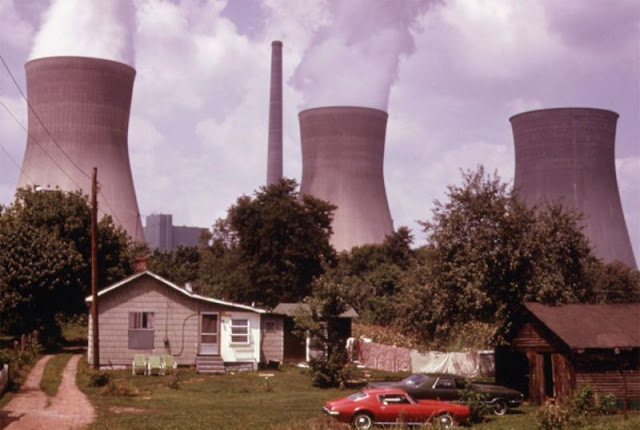
Water cooling towers of the John Amos Power Plant loom over a home located across the Kanawha River, near Poca, West Virginia, August 1973. (Harry Schaefer)

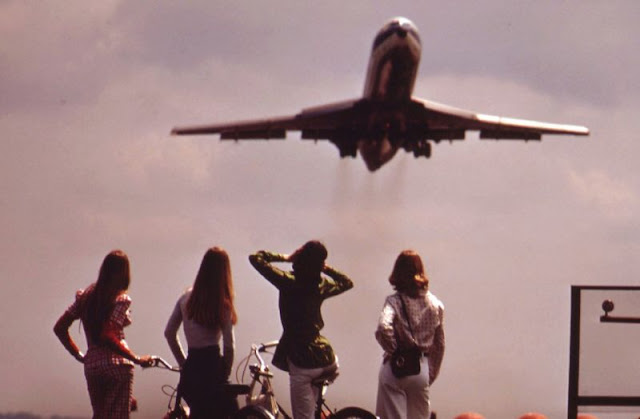
One of four bicyclists holds her ears against the roar of the jet taking off from National Airport in Washington, District of Columbia, May 1973. (John Neubauer)

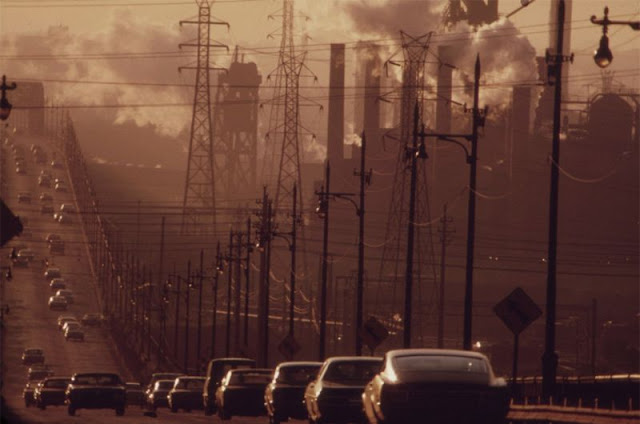
Clark Avenue and Clark Avenue bridge, looking east from West 13th Street, obscured by industrial smoke, in Cleveland, Ohio, July 1973. (Frank J. Aleksandrowicz)

Balloon logging in the Culp Creek drainage area of Oregon, near Eugene.

A mountain of damaged oil drums lies in a heap in an Exxon refinery near Baton Rouge, Louisiana, December 1972. (John Messina)

October 29, 2021

The World’s Largest Log Cabin: The History of the Forestry Building in Portland, Oregon

Organizers of the Lewis and Clark Centennial Exposition boasted that the Forestry Building was the world’s largest log cabin, measuring 206 feet long, 102 feet wide and 72 feet high (approximately 7 stories). Its construction was said to have cost approximately $30,000 (about $935,000 today). The lumber baron Simon Benson (1851-1942) paid for most of the giant logs that comprised the building, selected from old-growth trees in Columbia County, Oregon.

Exterior view of the Lewis and Clark Exposition Forestry Building, Portland, 1905.

Architect Ion Lewis (1853-1933), of the noted Portland architectural firm of Whidden and Lewis, designed the Forestry Building for the massive log cabin. Architectural historian Henry Matthews, in his biography of the architect Kirtland K. Cutter said of the Forestry Building: “The Forestry Building at the Lewis and Clark Centennial Exposition of 1905 in Portland, Oregon, designed by Ion Lewis of Whidden and Lewis and his young assistant Albert E. Doyle, offered another precedent for rustic architecture on a grand scale. This building, described as the “world’s largest log cabin” or the “Parthenon of Oregon” had an interior “nave” of unpeeled logs forty-eight feet high. This veritable cathedral of giant trees was by far the most popular attraction of the exposition and confirmed the public taste for such architecture.”

The interior of the Forestry Building featured colonnades of 54 massive, unpeeled Douglas Fir logs. The logs supports a 2-story center aisle, cruciform in plan, lit by skylights. The building housed an exhibit highlighting the forestry industry, local flora and fauna and Native American photos and artifacts.

After the 1905 exposition, the building was purchased by the city of Portland, which for many years let it decline and decay. It was nearly lost to fire several times when embers fell on the roof, either from nearby building fires or from wood-stove embers, but quick responses by the fire department kept it going.

In the 1940s, there was talk of actually demolishing the building, which by then had turned into a safety hazard; the balconies had been built with whole logs, which had warped, making them dangerous, and the whole building was like a banquet hall for wood-destroying organisms like bark beetles and termites.

Finally, in the 1950s, the Chamber of Commerce took up a collection to restore the place. By this time, people were starting to realize it was completely irreplaceable. Old-growth timber like what had gone into its construction could still be found, but it was deeper in the forest and less uniform. Finding 52 matching trees would be prohibitively expensive if not impossible to do, and – since the logs would have to be trucked to the site rather than just floated up the river – log-handling systems would have to be engineered to prevent the bark from being scarred by logging equipment.

By the time of the state’s sesquicentennial celebration in 1959, the building was mostly restored to its former glory. It now boasted a “priceless collection of logging and lumbering exhibits, both antique and modern,” according to an Oregonian report. Also on display was another bit of history, the first sheet of commercially produced Douglas Fir plywood ever made, a product of the Autzen family’s Portland Manufacturing Company, produced in 1904.

On August 17, 1964, the Forestry Building’s caretaker locked up for the night at around 5:30. Within 45 minutes, neighbors were noticing that something was wrong. Specifically, the place was on fire, and when the fire crews arrived at around 6:15 it was clear that nothing short of direct divine intervention was going to put it out.

“There was never a hope of saving the building,” the Oregonian reported the next day. “Nothing was saved from the inside.”

Construction of the old Forestry Building, 1904.

A 1904 postcard showing the interior scene in the Forestry Building, with the central colonnade of matched old-growth fir trees.

The immense Forestry Building is shown in 1905 during the Lewis & Clark Centennial Exposition, for which it was built.

Two women sitting in the upper balcony of the Forestry Building, 1905. This image really displays how massive the support logs were.

The interior of the Forestry Building, ca. 1905.

December 19, 2020

Vintage Photographs of the Skiway Sky Bus Lift Used on Mt. Hood, Oregon From the 1950s

Using a modified city bus, a twin-engine design powered the wheels to turn cables in a pulley system that moved the tram back and forth above the slope.

Recreation in the Mt. Hood National Forest increased after the end of World War II. Skiing was a popular wintertime activity and Dr. J. Otto George envisioned a tramway connecting two popular skiing destinations: Government Camp and Timberline Lodge, which was 7,300 ft (2,200 m) higher up the mountain. He formed a corporation called the Mt. Hood Aerial Transportation and started looking for investors. In 1948 after he’d finally gathered enough money to get started and he’d gotten a conditional use permit to build on Forest Service land, clearing and logging of the 3.2-mile right-of-way began. After the right-of-way was cleared concrete was poured and the 38 steel towers were installed, along with 25 miles of 1.5-inch diameter cables.

The tram was originally going to be called the “Skyway” but when they ran into copyright problems they changed it to “Skiway” (the tram buses were also nicknamed “cloudliners” and “flying buses”). The tramway was promoted as the longest and largest in the world and the first of its type ever to be constructed. The tram cars were actually converted city buses and they each seated 36 people, with room for 14 more to stand. The tram did not operate like other trams did. The buses each had two 185-horsepower gas engines.

After more than two years of construction, the tram was tentatively scheduled to opened in April 1950, but it wasn’t ready until early the following year. In advance of the grand opening, a promotional run on January 3, 1951 carried newsmen, radio announcers, and cameramen up the mountain. The January 4, 1951 Oregonian article – which called the tram the “Timberline Trolley” – reported that the trip took 20 minutes. Although the interior of the tram greatly resembled a city bus, the article said “the cloudliner makes considerably more noise than a wheeled bus. The clanking and grinding of its cables make conversation aboard impossible.” One reporter – who had been a WWII Air Corps officer – described riding in the back of the tram car “as similar to to the tail gunner’s spot in a B-17 bomber.” Riding in the front was like “riding the front end to a helicopter.”

Finally, after more than three and a half years, on February 2 the newspaper reported that the tram would begin operating the next day. One-way fare was 75 cents; round-trip was $1.50. The lower terminal in Government Camp had a restaurant and snack bar operated by Thomas Johnson and his wife, who operated the restaurant at Multnomah Falls Lodge. The terminal also had a gift shop, ski shop, and guest lounge. The tram entered the terminal on the building’s third floor where the loading/unloading platforms were located.

In January 1951, the Mt. Hood Skiway tram climbed for the first time from below Government Camp to Timberline Lodge.

It was the longest of its kind in the world and attracted the attention of newspapers, popular magazines, and newsreel producers on its preview voyage. Despite this excitement, the tram was short-lived and ceased operating five years later.

Two skiers stand on a snowy ski slope below a Skiway tram car on November 25, 1951.

The Skiway route took 25 minutes one way and could transport up to 72 people per hour.

The Skiway tram.


FOLLOW US:
FacebookTumblrPinterestInstagram

CONTACT US


Browse by Decades

Popular Posts

Advertisement

09 10