Bring back some good or bad memories


ADVERTISEMENT
Showing posts with label New South Wales. Show all posts

May 29, 2026

Carrington Hotel, Katoomba: Beautiful Vintage Kodachrome Slides From 1970

The Carrington Hotel in Katoomba is one of the most iconic and historic landmarks in Australia’s Blue Mountains. Originally opened in 1883 as the Great Western Hotel, it was later renamed The Carrington in honor of Lord Carrington, the Governor of New South Wales. This grand Victorian-era hotel quickly became the premier social destination for wealthy Sydney residents and international visitors seeking the cool mountain air.

With its elegant architecture, sweeping verandas, ornate interiors, and luxurious ballrooms, the Carrington remains a symbol of Edwardian grandeur and old-world charm. Even today, the hotel stands as a living piece of history, offering visitors a nostalgic glimpse into the golden age of Blue Mountains tourism.

Taken in 1970, these beautiful Kodachrome slides offer a beautiful, nostalgic window into one of Australia’s most historic and atmospheric mountain hotels during the final years of its classic era.

Guests enjoying the pool and front lawn, Carrington Hotel, Katoomba, April 1970

View from the balcony showing the pool and Katoomba Street. Also visible: Penfolds Wine Bar, Aroney's Cafe, Mercantile Mutual Insurance Co., ANZ Bank and St Hilda's church, Carrington Hotel, Katoomba, April 1970

Hotel entry foyer with guests. The bronze statue was traditionally thought to be the Greek philosopher Diogenes with his lamp, looking for an honest man, Carrington Hotel, Katoomba, April 1970

Hotel forecourt with pool and lawn facing Katoomba Street, Carrington Hotel, Katoomba, April 1970

Twin room with bar, Carrington Hotel, Katoomba, April 1970

September 20, 2025

Sydney in the Late 19th Century Through Fascinating Photos

In the late 19th century, Sydney underwent a dramatic transformation from a colonial port to a thriving metropolis. The period was marked by an economic boom that fueled rapid urban expansion and an architectural renaissance. Grand Victorian buildings like the Sydney Town Hall and the Queen Victoria Building were constructed, reflecting the city’s newfound wealth.

While the city’s landscape was changing, so was its society. New tram lines and railways connected a growing number of suburbs to the city center, but stark social contrasts remained between the wealthy and the working class.

Despite these divisions, Sydney was a vibrant and lively place. Its bustling harbor was filled with ships, and its streets buzzed with a mix of horse-drawn carriages and pedestrians. The city also saw significant technological progress with the introduction of electric lighting and modern sanitation systems, solidifying its place as a sophisticated urban center on the global stage.

These photographs of Sydney in 1892–93 are from Fred Hardie – Photographs of Sydney, Newcastle, New South Wales and Aboriginals for George Washington Wilson & Co., 1892–1893. Fred Hardie was the company photographer for G. W. Wilson & Co. of Aberdeen, Scotland, the world’s largest view photography company at the time.

Castlereagh Street, Sydney, from near King Street, 1892-93

Circular Quay, Sydney, 1892-93

Circular Quay, Sydney, 1892-93

City of Sydney, 1892-93

Darling Harbour from Balmain, Sydney, 1892-93

June 18, 2024

Photos of the Grand Prix at Bathurst, New South Wales in 1946

In October 1946, the New South Wales 100-mile Grand Prix motor race was run at Bathurst, attracting a field of 32 cars, including five from Victoria and two from Queensland. On the day, around 30,000 people turned out for the race which was won by AS Najar of Sydney, with JP Hind in second place and AV Johnson third. This was a spectacular win for the first-time entrant, who drove a modified standard touring model MG, with a specially built monoposto (single-seater) body, shaped to fit the driver.

The over-1500cc handicap was won by F Kleinig, driving a Hudson Special. WB Murray, also driving a Hudson Special, crossed the line in second place. The track took its toll on the cars, with five of the 15 starters retiring with engine trouble.

Apparently the race also marked the first time a female driver, Joan Richmond, competed in the event. She was behind the wheel of a Q-Type MG fitted with a super-charged engine. Unfortunately, there are no recorded photographs in this collection from State Library of New South Wales.

John Crouch in a Delahaye 135 followed by Alby Johnson in a an MG TC, Grand Prix, Bathurst, October 1946

Alf Najar in an MG TB racing car, Grand Prix, Bathurst, October 1946

Alf Najar, Grand Prix winner at Bathurst, October 1946

Belf Jones in a Buick Special in front of Bill MacLachlan in a modified MG TA, Grand Prix, Bathurst, October 1946

Bill Conoulty and his Austin 7 Comet, Grand Prix, Bathurst, October 1946

June 13, 2024

Bohemian Sydney Through Brian Bird’s Lens

From the late 19th century to the early 1970s, there was a distinctive bohemian subculture in Sydney. Alternative thinkers gathered in private houses, clubs and coffee houses. Some of the best known bohemian hangouts were Kings Cross and the area around Rowe Street (demolished in the 1970s to make way for the MLC Centre).

One of these Rowe Street cafes, the Lincoln Coffee Lounge, is considered the birthplace of the “Sydney Push” movement in its early days, just after the war. A popular meeting place for artists and writers, it comprised a mixture of university students, lecturers, Bohemians & Libertarians.

These fascinating photos from State Library of New South Wales were taken by Brian Bird that show Bohemian life in Sydney around 1948 and 1951.

‘Johnno’ Robert Johnson; unknown from Lincoln Coffee Lounge & Cafe, Rowe Street, Sydney, 1948-1951

Anne Barrett from Lincoln Coffee Lounge & Cafe, Rowe Street, Sydney, 1948-1951

Dick Gooding (on right of door) from Lincoln Coffee Lounge & Cafe, Rowe Street, Sydney, 1948-1951

Dick Gooding, journalist from Lincoln Coffee Lounge & Cafe, Rowe Street, Sydney, 1948-1951

Ede Cohen (usually on cash register); or Martin Edie from Lincoln Coffee Lounge & Cafe, Rowe Street, Sydney, 1948-1951

May 19, 2024

Beautiful Photos of the Jenolan Caves around 1900

The Jenolan Caves are limestone caves located within the Jenolan Karst Conservation Reserve in the Central Tablelands region, west of the Blue Mountains, in Jenolan, Oberon Council, New South Wales, in eastern Australia. The caves and 3,083-hectare (7,620-acre) reserve are situated approximately 175 kilometers (109 mi) west of Sydney, 20 kilometers (12 mi) east of Oberon and 30 kilometers (19 mi) west of Katoomba (74 kilometers (46 mi) by road). Dating back to 340million years ago, it is the oldest known and dated open cave system in the world.

The caves are the most visited of several similar groups in the limestone caves of the country, and the most ancient discovered open caves in the world. They include numerous Silurian marine fossils and the calcite formations, sometimes pure white, are noted for their beauty. The cave network follows the course of a subterranean section of the Jenolan River. It has more than 40 kilometers (25 mi) of multi-level passages and over 300 entrances. The complex is still being explored. The caves are a tourist destination, with eleven illuminated show caves open to paying visitors.

The caves and conservation reserve are one of the eight protected areas that was inscribed in 2000 to form part of the UNESCO World Heritage-listed Greater Blue Mountains Area. Here below is a set of beautiful photos from Powerhouse Museum that shows the Jenolan Caves around 1900.

'The Garden Palace', Jenolan Caves, New South Wales, circa 1900

'Madonna', Imperial Cave, Jenolan Caves, New South Wales, circa 1900

'Architect's Studio', Jenolan Caves, New South Wales, circa 1900

'Architect's Studio', Left Imperial Cave, Jenolan Caves, New South Wales, circa 1900

Cave Road, Jenolan Caves, New South Wales, circa 1900

May 8, 2024

Amazing Photos of Beaches in New South Wales Around 1900

New South Wales is a state on the east coast of Australia. It borders Queensland to the north, Victoria to the south, and South Australia to the west. Its coast borders the Coral and Tasman Seas to the east. The Australian Capital Territory and Jervis Bay Territory are enclaves within the state. New South Wales’ state capital is Sydney, which is also Australia’s most populous city.

In the early 1900s, many beaches in New South Wales were already popular destinations, though perhaps not as developed as they are today. Places like Bondi Beach, Coogee Beach, and Manly Beach were starting to attract visitors for swimming and seaside activities. However, the infrastructure and amenities were likely more basic compared to what we see today.

Here below is a set of amazing photos from Powerhouse Museum that shows beaches in New South Wales around 1900.

Bondi Bay, Sydney, New South Wales, circa 1900s

Cathedral Rock, Kiama, Sydney, New South Wales, circa 1900s

A bit of the Illawarra Coast, New South Wales, circa 1900s

Coogee Bay, Sydney, New South Wales, circa 1900s

Coogee Beach, Sydney, New South Wales, circa 1900s

October 3, 2022

30 Fascinating Photos of the Blue Mountains Around 1900

The Blue Mountains are a mountainous region and a mountain range located in New South Wales, Australia. The region borders on Sydney's metropolitan area, its foothills starting about 50 kilometres (31 mi) west of centre of the state capital, close to Penrith on the outskirts of Greater Sydney region.

As defined in 1970, the Blue Mountains region is bounded by the Nepean and Hawkesbury rivers in the east, the Coxs River and Lake Burragorang to the west and south, and the Wolgan and Colo rivers to the north. Geologically, it is situated in the central parts of the Sydney Basin.

The Blue Mountains Range comprises a range of mountains, plateau escarpments extending off the Great Dividing Range about 4.8 kilometers (3.0 mi) northwest of Wolgan Gap in a generally southeasterly direction for about 96 kilometers (60 mi), terminating at Emu Plains. For about two-thirds of its length it is traversed by the Great Western Highway, the Main Western railway line and the soon to be completed, Blue Mountains tunnel. Several established towns are situated on its heights, including Katoomba, Blackheath, Mount Victoria, and Springwood. The range forms the watershed between Coxs River to the south and the Grose and Wolgan rivers to the north. The range contains the Explorer Range and the Bell Range.

The Blue Mountains area includes the local government area of the City of Blue Mountains. The Blue Mountains and Southern Highlands Basalt Forests is a prominent forest community within the ecoregion. Here is a set of fascinating photos from Powerhouse Museum that shows what Blue Mountains looked like around 1900.

A Lookout, Katoomba, New South Wales, circa 1900

Blue Mountains Scenery, Wentworth Falls, New South Wales, circa 1900

Breakfast Point, Wentworth, New South Wales, circa 1900

Bridal Falls, Leura, New South Wales, circa 1900

Caves House, Jenolan Caves, New South Wales, circa 1900

January 16, 2022

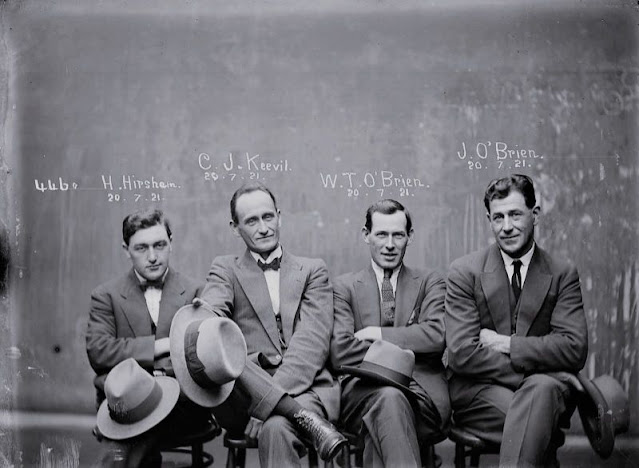
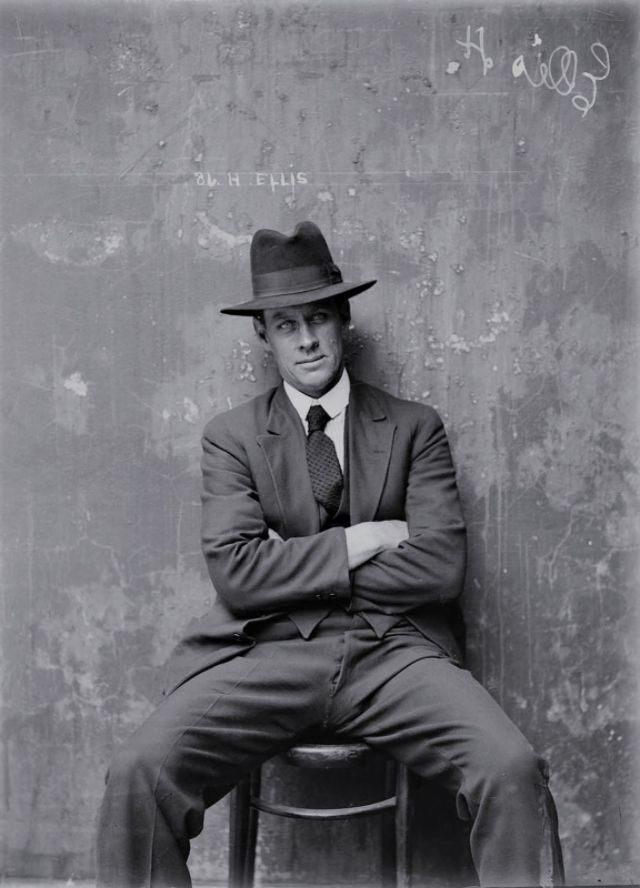
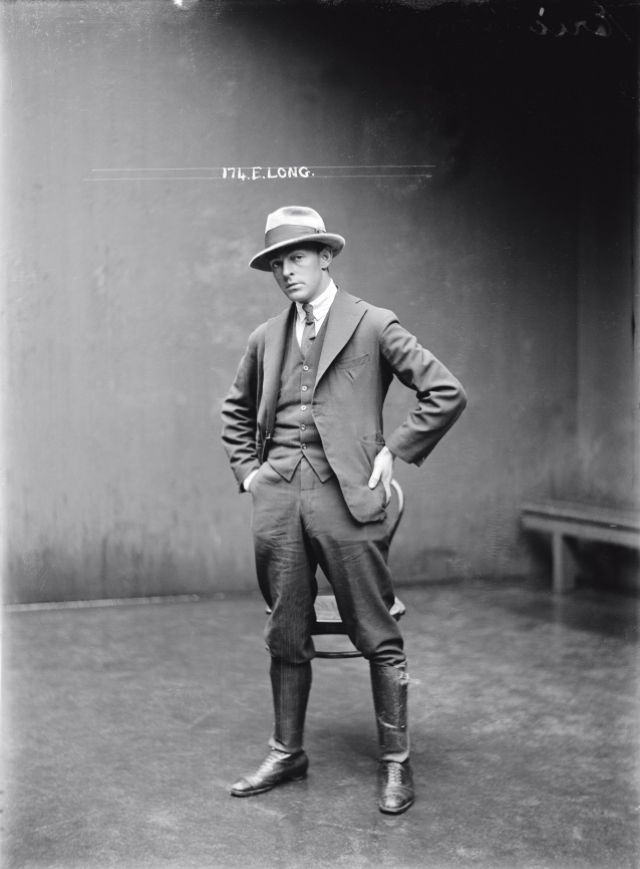
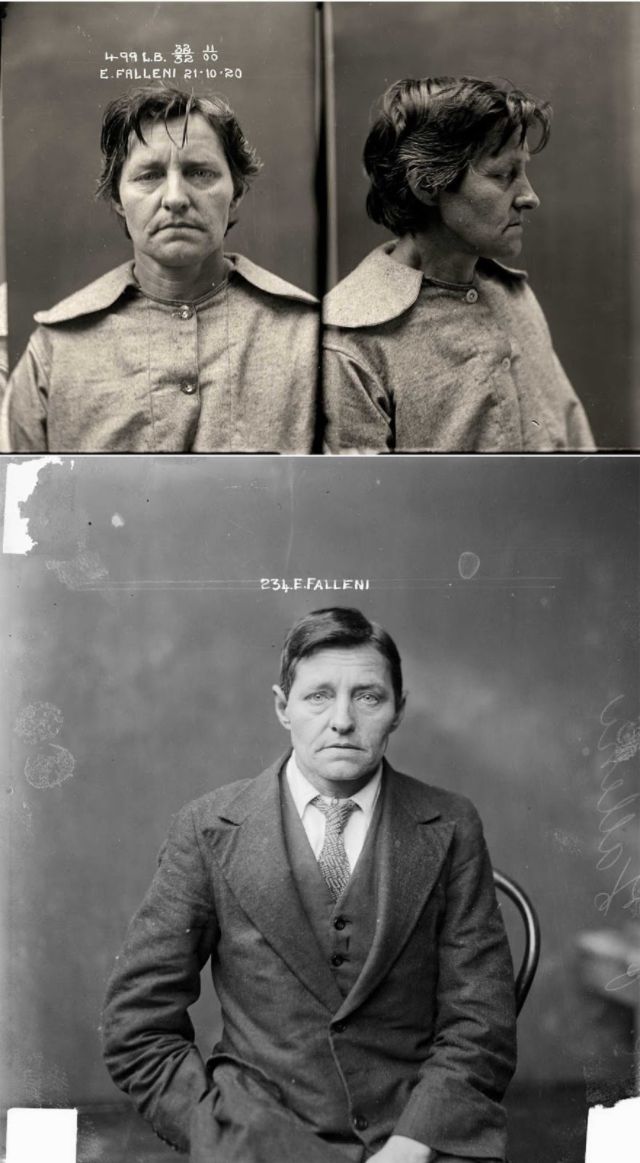
35 Candid and Stylish Mugshots From the Roaring Twenties

The Roaring Twenties was a golden era for criminals when rapid societal change led to the opening up of new illicit markets for entrepreneurial felons. Fast times bred new crimes creating policing challenges ranging from reckless joyriders to the emergence of the Mafia and razor gangs.

Hampton Hirscham, Cornellius Joseph Keevil, William Thomas O’Brien & James O’Brien, 1921

New South Wales Police Department photographers captured the zeitgeist of the era in these unexpectedly candid mug shots of cocaine sellers and addicts, sly-grog purveyors and small-time criminals, who frequented the cells of the Central Police Station in Sydney.

Herbert Ellis, 1920

William Frederick Long, circa 1920

Eugenia Falleni, 1920

Gilbert Cochrane Burleigh & Joseph Delaney, 1920

March 22, 2021

Three Women on Skis, Snowy Mountains, New South Wales, ca. 1900

A little shorter than most skirts of the period, ca. 1900, these three women skiing in New South Wales are fashionably dressed for skiing in a socially acceptable manner. It looks as though they may have some form of bloomers or pants under their skirts which may have been both for modesty purposes as well as for warmth.

(Photo by Charles Henry / National Library of Australia)

March 3, 2021

30 Vintage Photos Capture Albury Houses in the 1940s

Albury is a major regional city in New South Wales, Australia. It is located on the Hume Highway and the northern side of the Murray River. Albury is the seat of local government for the council area which also bears the city’s name – the City of Albury.

Albury is separated from its twin city in Victoria, Wodonga, by the Murray River. It is 554 kilometres (344 mi) from the state capital Sydney and 326 kilometres (203 mi) from the Victorian capital Melbourne.

Said to be named after a village in England, Albury developed as a major transport link between New South Wales and Victoria and was proclaimed a city in 1946.

Here below is a set of vintage photos from Foto Supplies that shows houses in Albury in the 1940s.


March 27, 2020

32 Amazing Found Photos Show Australian Post Offices in the Late 19th and Early 20th Centuries

A cool set of found photos from NSW State Archives that shows what New South Wales post offices looked like from between the 1880s and early 1900s.

Adamstown Post Office

Adamstown Post Office

Albury Post and Telegraph Office

Annandale Post Office

Balmain Post Office and Court House


FOLLOW US:
Facebook • Tumblr • Pinterest • Instagram

CONTACT US


Browse by Decades

Popular Posts

Advertisement

09 10