Bring back some good or bad memories


ADVERTISEMENT
Showing posts with label Kansas. Show all posts

February 24, 2025

30 Amazing Photos of Buildings in Kansas From the Late 1940s

In the late 1940s, Kansas architecture featured a mix of styles. Art Deco and Streamline Moderne influenced some urban buildings, particularly theaters and banks. The Mid-Century Modern style began emerging with clean lines, large windows, and open spaces, becoming more popular in the 1950s.

Colonial Revival homes, with brick facades and gable roofs, were common in suburban areas. Additionally, Craftsman bungalows continued to be built, characterized by low-pitched roofs and exposed beams, especially in suburban neighborhoods. These styles reflected the post-war optimism and growing suburban development.

These amazing photos from Lou Horacek were taken by his father Leo Horacek that show buildings in Kansas around 1947-49.

First Baptist Church, Topeka, Kansas, October 1947

304 Indiana St. house, Lawrence, Kansas, November 1947

603 Ohio St., Lawrence, Kansas, 1947

615 Louisiana St. house, Lawrence, Kansas, November 1947

701 Louisiana St., Lawrence, Kansas, November 1947

April 30, 2023

40 Amazing Photos of ‘Across the Continent on the Kansas Pacific Railroad’ in 1867

The Kansas Pacific Railway (KP) was a historic railroad company that operated in the western United States in the late 19th century. It was a federally chartered railroad, backed with government land grants. At a time when the first transcontinental railroad was being constructed by the Central Pacific and the Union Pacific, it tried and failed to join the transcontinental ranks.

It was originally the “Union Pacific, Eastern Division”, although it was completely independent. The Pennsylvania Railroad, working with Missouri financiers, designed it as a feeder line to the transcontinental system. The owners lobbied heavily in Washington for money to build a railroad from Kansas City to Colorado, and then to California. It failed to get funding to go west of Colorado.

It operated many of the first long-distance lines in the state of Kansas in the 1870s, extending the national railway network westward across that state and into Colorado. Its main line furnished a principal transportation route that opened up settlement of the central Great Plains, and its link from Kansas City to Denver provided the last link in the coast-to-coast railway network in 1870. The railroad was consolidated with the Union Pacific in 1880, and its mainline continues to be an integral part of the Union Pacific network today.

Here below is a set of amazing photos of ‘Across the Continent on the Kansas Pacific Railroad’ in 1867.

Massachusetts Avenue, Lawrence, Kansas, 38 miles West of Missouri River, circa 1867

2d Division of Engineer Corps, in the Sierra Madre, New Mexico, (Water Shed of Continent), 1,000 miles west of Missouri River, November 1867

At Fort Mojave, on the Colorado River, 1,450 miles west of Missouri River, circa 1867

Banks of the Kaw, near Fort Riley, 135 miles west of Missouri River, 1867

Camp of surveying party at Russell's Tank, Arizona, on eastern slope of Laja Range, 1,271 miles from Missouri River, 1867

December 11, 2022

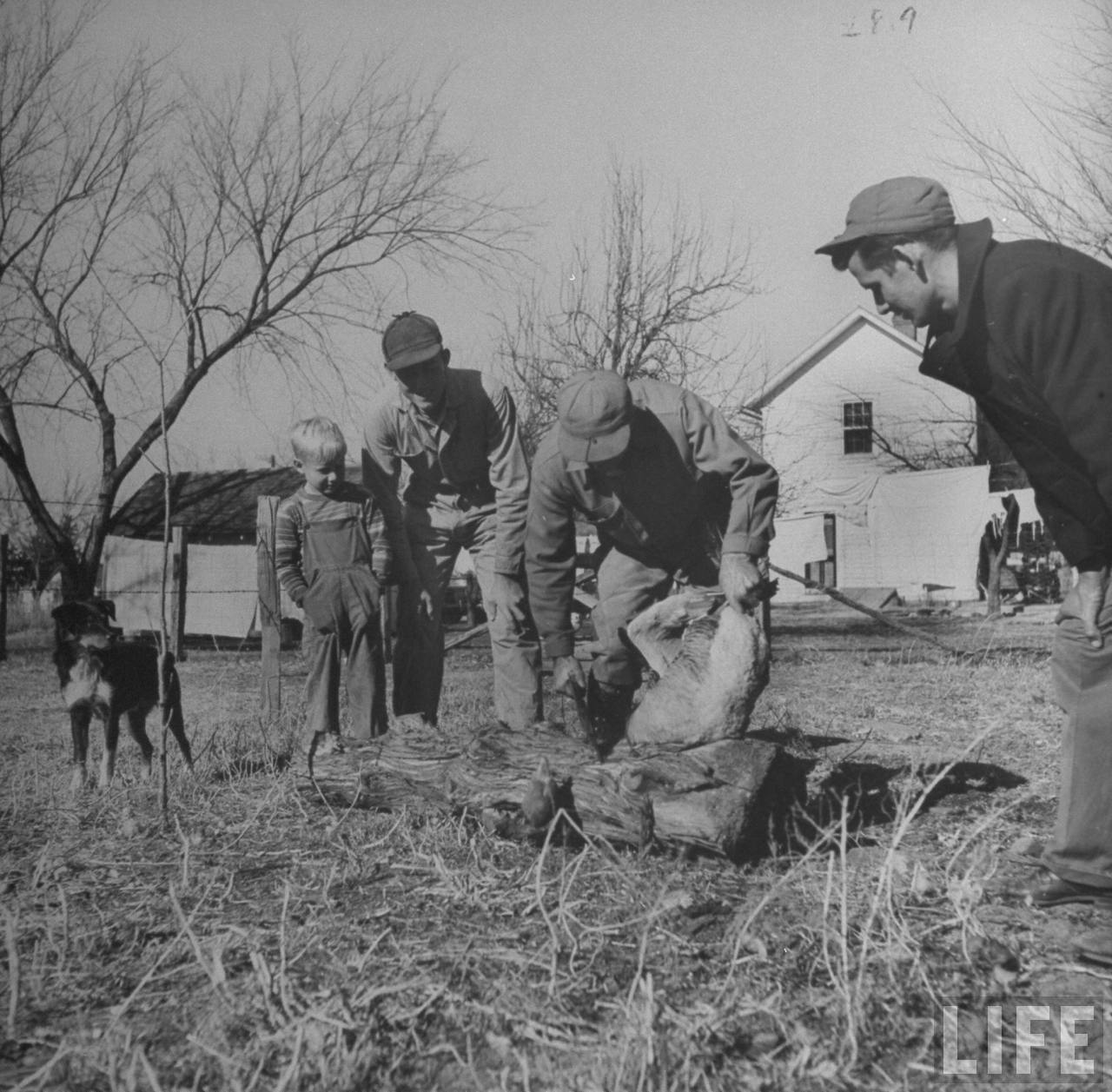
Christmas at Home: Vintage Photos Show a Family Enjoying a Happy Reunion in a Small Kansas Town in 1945

Everywhere across the land last week the railroad trains were jammed with servicemen and ex-servicemen bound for their first Christmas at home in many a long year. As they pounded eastward, the crowded, crack trains of the Santa Fe slowed down only a little for the curve on the northwest edge of Neosho Rapids, Kansas. In this Rule town, Christmas and its joyous reunion had already come and gone for the Irwin family.

The fact that they had to hold their celebration early did not dim the Irwins’ joy. Their 20-year-old son Jack, Navy aviation ordnanceman second class, had to be back on duty by December 14. James Ferdinand Irwin, who is a farmer and carpenter, talked it over with his wife and they decided to have Christmas presents and Christmas dinner Sunday, December 9. For the first time in three years all their seven children were present. In addition there were four grandchildren, two sons-in-law and Uncle Fred Andrews, seagoing Navy brother of Mrs. Irwin, who had come to Neosho Rapids for the hunting season. Only sad note was the absence of Lieut. Clyde Roush, husband of Betty, oldest Irwin daughter. A bombardier on a B-29, he was reported miming over Japan last spring.

The Irwins’ Christmas party followed tradition in every detail. The men went hunting for rabbits and quail. The women cleaned house, did the washing, prepared food. A goose, fat and ready, was killed and plucked. The tree was cur and carried triumphantly home. Carols were sung around the piano. On “Christmas Day” the Irwins attended the Methodist Church. Then Uncle Fred, family humorist, dressed up in a Santa Claus outfit and distributed presents to all the children. They were terrified. 

Son watching James F. Irwin (R) selecting a goose for an early Christmas dinner to celebrate safe return of sons and sons-in-law from WW II.

James F. Irwin (R), his wife and son preparing a goose for an early Christmas dinner to celebrate safe return of sons and sons-in-law from WW II.

Mrs. James Ferdinand Irwin (L) standing on porch watching the men in her family, most recently returned fr. service in WWII, carrying home freshly shot rabbits and a cedar tree for Christmas family reunion.

Family members watching James F. Irwin (C) killing a goose for an early Christmas dinner to celebrate safe return of sons and sons-in-law from WW II.

Members of farmer James Ferdinand Irwin's family trimming native cedar Christmas tree in living room during family reunion and early Christmas celebration marking the return of Irwin's sons and sons-in-law from service in WWII.

April 28, 2022

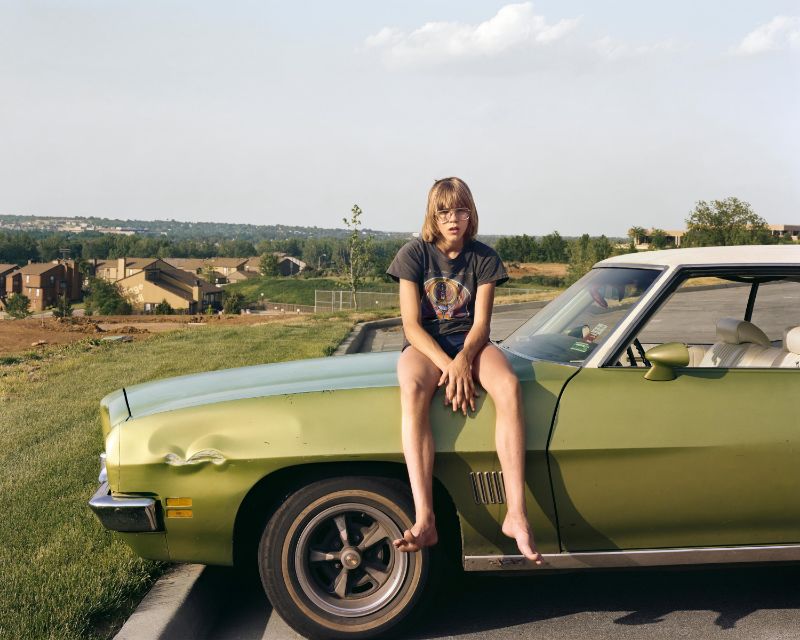
American Prospects: Beautiful Color Pictures of Life in America in the 1970s and 1980s

Joel Sternfeld was born in New York City in 1944, and earned a BA in Art from Dartmouth College. Sternfeld began taking photographs in 1970 having studied the colour theory of artists Johannes Itten and Josef Albers. Early work included street photography on small and medium format cameras. 

In 1978, Sternfeld embarked on a road-trip which traversed the United States. Using an 8 x 10 inch camera, Sternfeld photographed the communities, culture, landscapes and quotidian life he encountered along the way.

Kansas City, Kansas, May 1983

American Prospects is seen as a continuation of the American documentary tradition established in the 1930s by Walker Evans and continued by Robert Frank twenty years later. Sternfeld expanded the trajectory of the medium by photographing scenes rich in implied narrative, which were also distinct in their colour and composition. Laced with a touch of irony, his photographs from the project explore American identity in a thought-provoking yet humorous manner. 

His masterful use of colour heightens the tensions in these comic depictions of everyday life in America. First exhibited at the Museum of Modern Art, New York and then published in book form in 1987, American Prospects is regarded as one of the most influential bodies of photographic work from this period. Sternfeld’s later work has continued to experiment with colour and put it to use in documenting everyday events and the people he encounters. 

McLean, Virginia, December 1978

The Space Shuttle Columbia Lands at Kelly Air Force Base, San Antonio, Texas, March 1979

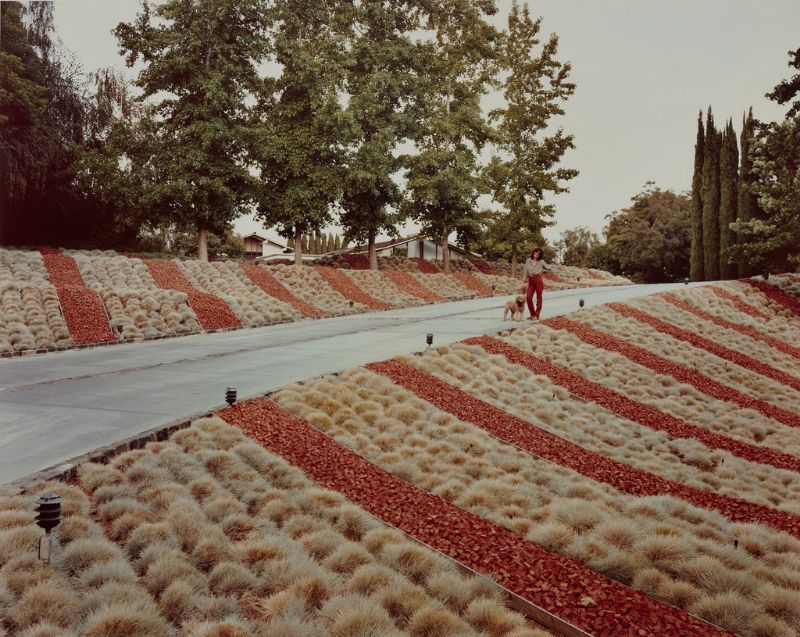
Beverly Hills, California, May 1979

Beverly Hills, California, May 1979

April 15, 2022

40 Amazing Photos Capture Kansas Houses and Buildings in the Late 1940s

Kansas is a state in the Midwestern United States. Its capital is Topeka and its largest city is Wichita. It is a landlocked state bordered by Nebraska to the north; Missouri to the east; Oklahoma to the south; and Colorado to the west. Kansas is named after the Kansas River, which in turn was named after the Kansa Native Americans who lived along its banks.

Houses and buildings around Lawrence, Kansas from 1947 to 1949

For thousands of years, what is now Kansas was home to numerous and diverse Native American tribes. Tribes in the eastern part of the state generally lived in villages along the river valleys. Tribes in the western part of the state were semi-nomadic and hunted large herds of bison.

Kansas, which has an area of 82,278 square miles (213,100 square kilometers) is the 15th-largest state by area and is the 34th most-populous of the 50 states. Residents of Kansas are called Kansans. Mount Sunflower is Kansas's highest point at 4,039 feet (1,231 meters).

These amazing photos from Lou Horacek were taken by Leo Horacek that show houses and buildings around Lawrence, Kansas (and maybe also in the Topeka area) from 1947 to 1949.

9th and Alabama St., Lawrence, Kansas, November 1947

304 Indiana St., Lawrence, Kansas, November 1947

603 Ohio St., Lawrence, Kansas, circa 1947

615 Louisiana St., Lawrence, Kansas, November 1947

701 Louisiana St., Lawrence, Kansas, November 1947

October 8, 2020

Operation of the Kansas Pacific Railway in 1873 Through Amazing Photos

Began in 1855 as the Leavenworth, Pawnee and Western Railroad, and was later reorganized in 1863 as the Union Pacific Eastern Division, The Kansas Pacific Railway (KP) was a historic railroad company that operated in the western United States in the late 19th century.

It operated many of the first long-distance lines in the state of Kansas in the 1870s, extending the national railway network westward across that state and into Colorado. Its main line furnished a principal transportation route that opened up settlement of the central Great Plains, and its link from Kansas City to Denver provided the last link in the coast-to-coast railway network in 1870.

The railroad was consolidated with the Union Pacific in 1880, and its mainline continues to be an integral part of the Union Pacific network today.

On the Kansas Pacific Railway, 1873, held by Southern Methodist University’s DeGolyer Library, consists of a series of photographs by Robert Benecke (1835-1903), taken along the Kansas Pacific line for the railroad company.

Included are views of Kansas, Colorado, and Missouri of railroads, depots, machine shops, roundhouses, locomotive with snow plow, bridges, towns, landscapes, buffalo hunters, cattle, horse race track, the University of Kansas, and a Kansas Pacific Railway “buffalo head” advertising photograph.

Also, includes a posed studio self-portrait of photographer Robert Benecke holding a rifle.

No. 1. General Offices of the Kansas Pacific Railway corner Fifth Street and Broadway, Kansas City, Mo.
No. 2. Taxidermist's Department of the Kansas Pacific Railway. Buffalo Heads used for advertising purposes
No. 3. General view of Kansas City, Mo., from corner of Tenth Street and Broadway
No. 4. Railway Bridge over the Missouri River at Kansas City, Mo.
No. 5. Railway Bridge over the Kansas River near Kansas City, Mo.
No. 6. General view of the Kansas Pacific Railway Machine Shops at Armstrong, Kansas
No. 7. Machine Shops at Armstrong, Kansas
No. 8. Roundhouse at Armstrong, Kansas
No. 9. General view of Lawrence, Kansas
No. 10. State University of Kansas, on Mount Oread, Lawrence, Kansas
No. 11. Stud Farm and Race Track, Lawrence, Kansas
No. 12. Passenger Bridge over the Kansas River and Waterworks Dam in course of construction, Lawrence, Kansas
No. 13. Hotel and Railway Station at Topeka, Kansas
No. 14. Passenger bridge over the Kansas River, Topeka, Kansas
No. 15. The Mid-Day rest. Quail shooting at St. George
No. 16. The Valley of the Kansas River, looking East from St. George, Kansas
No. 17. The Kansas River, looking West from St. George, Kansas
No. 18. Manhattan, Kansas. Taken from the summit of Mount Prospect
No. 19. Bridge over the Blue River, Manhattan, Kansas
No. 20. Kansas River and Passenger Bridge looking west, Manhattan, Kansas
No. 21. A Valley of the Kansas River from Mount Prospect, Manhattan, Kansas
No. 22. The Texas Cattle Trade. Train of Empty Stock Cars at Junction City, Kansas
No. 23. Freight Engine number 22
No. 24. Railway and Passenger Bridge over the Republican River, Junction City, Kansas
No. 25. Junction of the Kansas Pacific and Junction City and Fort Kearney Railways. Junction City, Kansas
No. 26. Grist Mill at Solomon City, Kansas
No. 27. Falls of the Solomon River at Solomon City, Kansas
No. 28. Salt Works at Solomon City, Kansas
No. 29. Brookville, Kansas
No. 30. Kansas Pacific Railway Roundhouse and Company's Buildings at Brookville, Kansas
No. 32. Mushroom Rocks at Elm Creek
No. 33. Ellsworth, the great shipping point for Texas Cattle
No. 34. Stock Yards and Shutes for loading cattle at Ellsworth, Kansas
No. 35. Frouher Settlements. No. 1. Wilson, 240 Miles west of the Missouri River
No. 36. Arboriculture on the prairie - 2 1/2 years from the seed at Wilson, Kansas
No. 37. View on the Smoky Hill River at Wilson, Captain Matthew's House and Coal Mine Bluff
No. 38. Coal Canon at Wilson, Kansas
No. 39. No. 2, Frontier Settlements, Bunker Hill
No. 40. Valley of Cedar Creek, Bunker Hill, Kansas
No. 41. The ''Burnt City'' near Bunker Hill, Kansas
No. 42. Valley of the Saline River and old Buffalo Trails near Bunker Hill, Kansas
No. 43. No. 3, Russell, Kansas
No. 44. View on Big Creek, Russell, Kansas
No. 45. Duck Shooting on Big Creek, Russell, Kansas
No. 47. General view of Victoria Railway Bridge over North Fork of Victoria River
No. 49. Railway Hotel at Ellis, built of stone from the Ellis Quary
No. 50. Quary of White Magnesian Limestone at Ellis, Kansas
No. 51. The ''Hog Back'' at Ellis, Kansas
No. 52. Kansas Pacific Railway Roundhouse at Ellis, Kansas
No. 53. Main Street of Ellis, Kansas
No. 54. The Kansas Pacific Railway Photograph Car at Ellis, Kansas
No. 55. In Case of Emergency. Snow plow
No. 56. The Buffalo Hunters' Home at Sheridan, Kansas
No. 57. Wallace Station and Railway Hotel 400 miles west of the Missouri River
No. 58. Carson, the Northern Terminus of the Arkansas Valley R. W.
No. 59. Railway Hotel and Station at Hugo, Colorado
No. 60. Kansas Pacific Railway Depot at Denver, Colorado
No. 61. General View of Denver looking North-West
No. 62. Highland View Hotel and Denver looking East
No. 63. Kansas Pacific Railway Machine Shops at Denver
No. 64. Wild Buffalo in Colorado
The Photographer Mr. Benecke


FOLLOW US:
FacebookTumblrPinterestInstagram

CONTACT US


Browse by Decades

Popular Posts

Advertisement

09 10