Bring back some good or bad memories


ADVERTISEMENT
Showing posts with label Nebraska. Show all posts

May 2, 2022

Fascinating Vintage Photographs of Scooter Enthusiasts in Nebraska, 1945

The Cushman scooter company started in 1903 in Lincoln, Nebraska, by Everett and Clinton Cushman. The company incorporated as Cushman Motor Works in 1913. Cushman began production of their four-stroke Husky engine in 1922.

Cushman produced engines for farm equipment, pumps, lawn mowers, and boats. Cushman began making Auto-Glide scooters in 1936 as a means to increase the sale of Husky engines during the Great Depression. Cushman scooters were widely used by the United States Armed Forces in World War II and as an alternative to automobiles before and after the war.

The days after World War II saw the rise of a different kind of scooter. The scooters that took off in the post-war years have this in common with e-scooters: their burst in popularity was tied to the societal shifts of its day.

In 1945 as the war was nearing its end, LIFE photographer Wallace Kirkland documented the Cushman Motor Works in Nebraska, showing both the plant where scooters were made and also the locals enjoying their products.

A scooter rider in Nebraska, 1945.

Outside the Cushman Motor Works scooter plant in Nebraska, 1945.

Outside the Cushman Motor Works scooter plant in Nebraska, 1945.

Scooter enthusiasts in Nebraska, 1945.

Scooter enthusiasts in Nebraska, 1945.

April 28, 2022

American Prospects: Beautiful Color Pictures of Life in America in the 1970s and 1980s

Joel Sternfeld was born in New York City in 1944, and earned a BA in Art from Dartmouth College. Sternfeld began taking photographs in 1970 having studied the colour theory of artists Johannes Itten and Josef Albers. Early work included street photography on small and medium format cameras. 

In 1978, Sternfeld embarked on a road-trip which traversed the United States. Using an 8 x 10 inch camera, Sternfeld photographed the communities, culture, landscapes and quotidian life he encountered along the way.

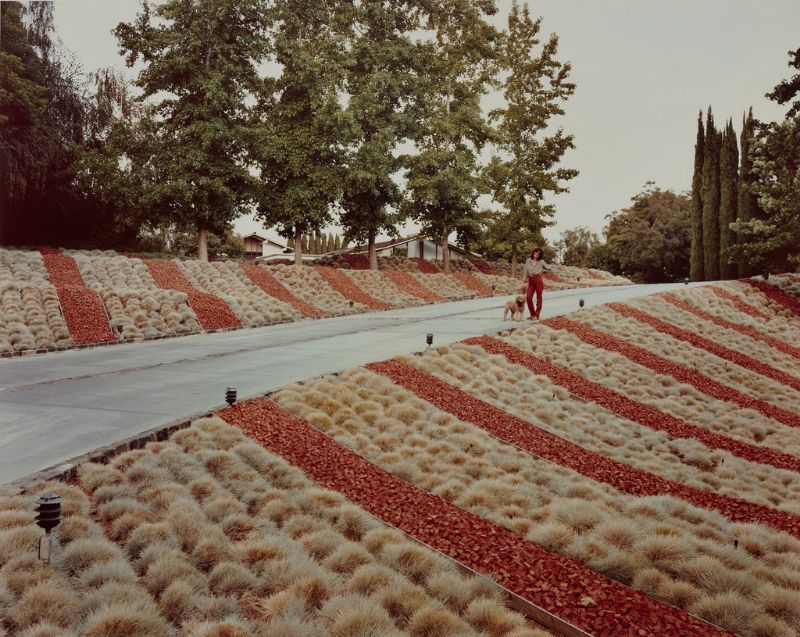
Kansas City, Kansas, May 1983

American Prospects is seen as a continuation of the American documentary tradition established in the 1930s by Walker Evans and continued by Robert Frank twenty years later. Sternfeld expanded the trajectory of the medium by photographing scenes rich in implied narrative, which were also distinct in their colour and composition. Laced with a touch of irony, his photographs from the project explore American identity in a thought-provoking yet humorous manner. 

His masterful use of colour heightens the tensions in these comic depictions of everyday life in America. First exhibited at the Museum of Modern Art, New York and then published in book form in 1987, American Prospects is regarded as one of the most influential bodies of photographic work from this period. Sternfeld’s later work has continued to experiment with colour and put it to use in documenting everyday events and the people he encounters. 

McLean, Virginia, December 1978

The Space Shuttle Columbia Lands at Kelly Air Force Base, San Antonio, Texas, March 1979

Beverly Hills, California, May 1979

Beverly Hills, California, May 1979

February 22, 2022

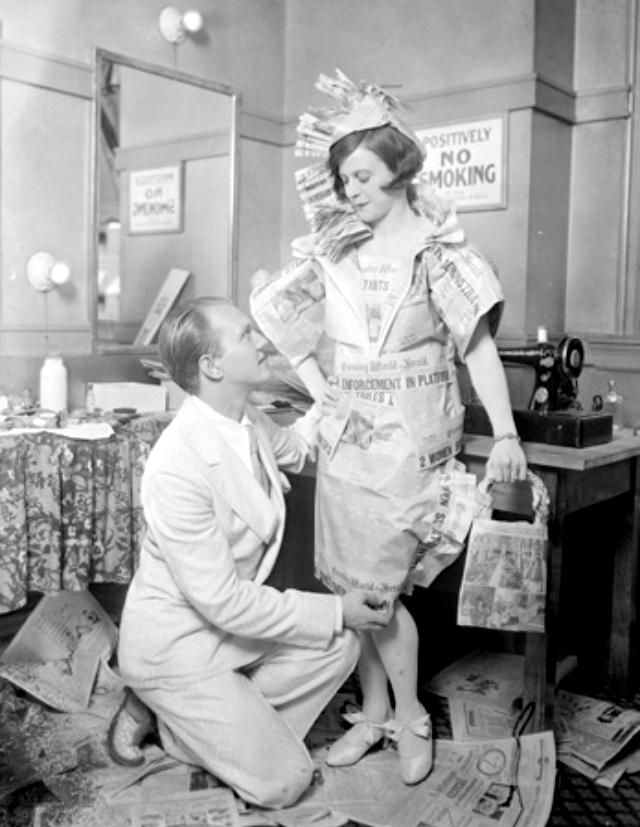
Newspaper Dress, 1928

This unidentified young woman gives new meaning to “being in the news.” She is wearing a dress made from Omaha’s Evening World-Herald newspaper. Most of the newspapers date from June 1928.

Woman wearing a dress made from Evening World-Herald, an Omaha newspaper, June 1928. (via History Nebraska)

February 19, 2022

Corn Goddess, 1907

Nebraska photographer Solomon Butcher photographed this an unnamed young woman in 1907 likely in Kearney, Nebraska. Her dress is made of corn husks and she wears a necklace of popcorn and berries. Several of Butcher’s photographs are displayed on the table to the left.

June 8, 2021

Scalped in 1867 by Cheyenne in Nebraska, Here’s the Story Behind William Thompson’s Scalp

Scalping is often depicted in old-timey cowboy-and-Indian movies with lots of quavering music and dramatic pauses. But then you see the real scalp under a bell jar and it isn’t so melodramatic anymore.

William Thompson’s scalp, archived at the Main Library in Omaha, Nebraska, looks more like some sort of rodent than an impactful part of history. However, Thompson’s story—surviving a scalping, holding on to the coiffure in question—makes it all the more remarkable.


On a hot and muggy evening in August of 1867, as the railroad was being built. Union Pacific officials realized they were not getting any telegraph feed west of the Plum Creek Station. Four railroad telegraph workers and a foreman went to Plum Creek Station, which later evolved into the city of Lexington. They arrived on a handcar. They came around a curve and ran into a bunch of railroad ties. The handcar was derailed. At this time, there were 25 Cheyenne warriors that were waiting in ambush, and they came down and attacked the repair party. Working on the railroad was a dangerous job.

William Thompson was a victim in the attack. He suffered a wound to the upper arm, and one of the Cheyenne braves scalped him. He was awake, and alive at the time. There is much debate on how he managed to stay quiet, but apparently he did.


Earlier in the day, another train left Omaha. It arrived after the attack, and it ran into the same bunch of railroad ties as the handcar. That derailed the entire train, 17 cars, the engineer, the fireman, the conductor were killed, and it was the first successful derailment of an entire train by a Native American tribe in U.S. history.

Then UP realized they had a serious issue. They sent out a second rescue train the next day. They rescued Thompson who was quite a sight at that time. Infection had started to set in, but he was alive, and they took him back to Omaha where they tried to re-attach the scalp. Dr. Richard Moore tried to do that in August of 1867, but they were unsuccessful. But the doctor did believe Mr. Thompson was a strong individual, and he would survive the infection, which he did.

Thompson was from England and he hung on to the scalp. His fellow countrymen were not as enamored with the scalp as he was. Thompson donated his scalp to the doctor who had tried to help him. He did decide to donate it to Dr. Moore in 1900. Dr. Moore then decided to donate it to the Omaha Public Library since he assumed the local interest would be piqued.

The scalp is now kept in an acid-free box at the W. Dale Clark Library in Omaha. It’s always handled carefully with gloves. It’s been the subject of some several national TV shows, and people often request to see it.


(The original story was told by Lynn Sullivan, a library specialist at the W. Dale Clark Library in Omaha, via KOLN)

January 31, 2021

William Roentgen Demonstrates X-ray Machines at the Trans-Mississippi and International Exposition in Omaha, 1898

In the late 19th century, X-rays set America’s imagination ablaze. Only three years after its discovery by William Roentgen, the mysterious radiation went on display in this free-standing pavilion at the Trans-Mississippi and International Exposition of 1898 in Omaha, Nebraska.

Here, X-ray machines let attendees glimpse the interiors of everyday objects as well as their own bodies, blissfully unaware the devices were zapping them with 1,500 times as much radiation as contemporary X-ray machines. Even when their hair fell out, they embraced the rays as an early – and effective – depilatory.

The Collections of the Omaha Public Library

June 3, 2020

A Young Girl Posing in Front of a Tornado in Nebraska, 1989

There have been thousands of fantastic tornado photographs and videos but none quite like this one. The view of this is enough to send most people scrambling to their basement. Yet this girl was confident enough to pose for a picture with this massive tornado behind her. You would assume her mother would come yelling after her to stop playing around and to get indoors, but her mother is the one who took the photo!


Marilee Thomas of Beaver City, Nebraska took this photograph of her daughter Audra about two miles from a Furnas County tornado in April 1989. The tornado did cut across her farm and destroyed a barn structure on the property but no lives were lost, thankfully.

“The picture of the tornado is a picture that I took in 1989 and entered into a Kodak contest,” Marilee wrote. “I won second place in the National contest. It has taken its own amazing ride around the world. My youngest daughter, Audra, is in the photo. She is always being called ‘the tornado girl’.”

(Photo © Merrilee Thomas)

April 5, 2020

The Mugshot of Goldie Williams, aka Meg Murphy, Nebraska, 1898

Arrested on January 29, 1898, in Nebraska, USA, the police notes tell us that Goldie Williams, also known as Mag Murphy, stood just 5 feet tall and weighed 110 pounds. She refused to unfold her arms and stop making this face for her mugshot.

(Image via Nebraska History Museum)

She listed her home as Chicago and her occupation as a prostitute. According to her arrest descriptions, her left index finger was broken and she had a cut below her right wrist. Williams sports an elaborate hat with satin ribbons and feathers. She also wears large hoop earrings. She was arrested for vagrancy.

According to Risa Goluboff (dean of the University of Virginia School of Law), the police during this time had the authority to arrest pretty much anyone for vagrancy:⁣
“Two features of vagrancy laws made them especially attractive. First, the laws’ breadth and ambiguity gave the police virtually unlimited discretion. Because it was almost always possible to justify a vagrancy arrest, the laws provided what one critic called “an escape hatch” from the Fourth Amendment’s protections against arrest without probable cause. As one Supreme Court justice would write in 1965, vagrancy-related laws made it legal to stand on a street corner “only at the whim of any police officer.”

Second, vagrancy laws made it a crime to be a certain type of person—anyone who fit the description of one of those colorful Elizabethan characters. Where most American laws required people to do something criminal before they could be arrested, vagrancy laws emphatically did not.”

August 26, 2016

Doing Hard Time: 14 Historical Nebraska Mug Shots From the Late 19th and Early 20th Centuries

Photography revolutionized crime investigations. Beginning in the mid 1800s, police photographed the faces of known criminals. Called “mug shots” (after the British slang word “mug” meaning “face”) these images replaced drawings and descriptions on wanted posters. Scientists even studied mug shots to see if physical traits could predict criminal behavior.


The Nebraska State Penitentiary used photography beginning in 1867 to record the likeness of the state's most infamous residents. The Omaha police photographed suspects when arrested. Whether the people depicted were guilty or innocent, behind every photograph is a human story. This glimpse back at some of the thousands of photographs in the Nebraska State Penitentiary and Omaha Police Court Collections at the Nebraska State Historical Society and their accompanying tales offer insights into how earlier Nebraskans ran afoul of the law, and how some attitudes about crime and punishment may have changed.

1. Mrs. H. C. Adams - Blackmail


Looks can often be deceiving. Mrs. H.C. Adams looks every bit the typical Victorian lady. Her elegant hairstyle and wire-rimmed glasses hide a dark secret. Mrs. Adams was arrested in Omaha on April 12, 1900 for blackmail. She listed her residence as Palisade, Nebraska, and her occupation as prostitute. The police record describes her as 5 feet, 1 inch tall with a medium build and a sallow complexion.


2. Minnie Bradley - Larceny from a person


Minnie Bradley refuses to look at the camera in her Omaha Police Court mug shot. Minnie, 27, and 5 foot 2 inches tall was arrested in Omaha on December 13, 1902 for larceny from a person. She listed her residence on north 11th Street in Omaha and her occupation as prostitute. The description also noted that Minnie wore a wig.


3. Charles Martin - Safe blowing and burglary


Three burglars blew up a safe in a bank vault in Sheridan, Missouri, on the night of February 15, 1898. They got away with about $2,400. The bank's insurance company hired the famed Pinkerton Detective Agency and sent Assistant Superintendent F.H. Tollotson to hunt down the burglars. Tollotson tracked one of the wanted men through Missouri to Council Bluffs and eventually to a room at the Sheridan Hotel in Omaha. With the aid of the Omaha police, Tollotson apprehended a gun-welding fugitive after a brief struggle. The alleged bank robber gave his name as Charles Martin, but had several letters addressed to Charles Davis. Martin was unknown to Omaha police, but some detectives speculated to newspaper reporters he could be the notorious safe blower and bank robber Sam Welsh. At the time of his arrest, Martin had a gold watch and $565 in cash believed to be his share of the spoils of the Missouri bank robbery. Martin was taken to the police court where he was measured, photographed, and locked up while he awaited his transfer to Missouri.


4. Albert Johnson - Grand larceny


In March 1885, Albert Johnson arrived at the Nebraska State Prison sporting an impressive handlebar mustache. Johnson was sentenced to 1 year and 6 months for grand larceny. Because of prison policy to reduce lice, authorities shaved Johnson's head and facial hair.


Detailed descriptions and mug shots were important to police and prison authorities. Criminals easily changed names and created numerous identities. Typically, three mug shots taken of each prisoner. One before their heads were shaved and a full-faced and profile image after their hair was removed. Women only had a full-face and profile image. Their hair was not cut.


5. Herbert Cockran - Burglary


An unidentified member of the Omaha police force holds Herbert Cockran in a headlock during his mug shot. Cockran was arrested on November 24, 1899, for burglary. A tailor from Fairmont, Nebraska, Cockran had a slightly stooped build with a fair complexion and his eyebrows met at the root of his nose, according to the police description.


July 1, 2016

Everyday Life in Nebraska During the 1960s Through Beautiful Color Photos

Nebraska's name is derived from transliteration of the archaic Otoe words Ñí Brásge, or the Omaha Ní Btháska, meaning "flat water", after the Platte River that flows through the state.

Nebraska is a state that lies in both the Great Plains and the Midwestern United States. Its state capital is Lincoln. Its largest city is Omaha, which is on the Missouri River. The state is crossed by many historic trails and was explored by the Lewis and Clark Expedition. The California Gold Rush brought the first large numbers of non-indigenous settlers to the area. Nebraska was admitted as the 37th state of the United States in 1867.

Check out these stunning color pictures below and see what life of Nebraska looked like in the 1960s.


November 28, 2011

Amazing Vintage Photographs Capture Everyday Life in Omaha, Nebraska in November 1938

“I spent a cold November week in Omaha and walked a hundred miles. Was it Kearney Street where unemployed men sat all day on the steps of cheap hotels? A tattoo parlor, and the city mission with its soup kitchen. Men hanging around the stockyards. One morning I photographed a grain elevator: pure sun-brushed silo columns of cement rising from behind CB&Q freight car. The genius of Walker Evans and Charles Sheeler welded into one supreme photographic statement, I told myself. Then it occurred to me that it was I who was looking at the grain elevator. For the past year I had been sedulously aping the masters. And in Omaha I realized that I had developed my own style with the camera. I knew that I would photograph only what pleased me or astonished my eye, and only in the way I saw it.”

John F. Vachon (May 19, 1914 – April 20, 1975) was an American photographer. He worked as a filing clerk for the Farm Security Administration before Roy Stryker recruited him to join a small group of photographers, including Esther Bubley, Marjory Collins, Mary Post Wolcott, Jack Delano, Arthur Rothstein, Walker Evans, Russell Lee, Gordon Parks, Charlotte Brooks, Carl Mydans, Dorothea Lange and Ben Shahn, who were employed to publicize the conditions of the rural poor in America.

Cars and parking meters

Nebraska is the white spot of the nation

Danbaum armored car

On a streetcar

Unemployed men who ride the freight trains from Omaha to Kansas City and St. Louis and back


FOLLOW US:
FacebookTumblrPinterestInstagram

CONTACT US


Browse by Decades

Popular Posts

Advertisement

09 10