Bring back some good or bad memories


ADVERTISEMENT
Showing posts with label shopping. Show all posts

November 22, 2024

Andy Warhol Shopping at Gristede’s Supermarket on Second Avenue, New York, 1964

Andy Warhol at Gristede’s on 2nd Avenue in New York City, taken by Bob Adelman for Esquire, 1964.


“When I photographed Andy for Esquire, I’d only been making a living as a professional photographer for a year or two. I took him into Gristede’s on 47th & 2nd Avenue, this tiny bodega around the corner from the silver studio, his first Factory. It was not a large supermarket. It was poorly lit with fluorescent lights. I asked Andy to fill up the cart with his things. He walked around [picking up Campbell’s soup cans and Brillo boxes| saying, ‘Beautiful... beautiful!’ in this grim place. I guess he was putting me on.

“As a journalist, I’d wander over to The Factory and hang out there. It was the Sixties and people were off the charts. I went to parties with Andy. I have like 50-60 rolls of him, mostly candids. Andy’s first studio was a big loft, a big workplace with silver foil on the walls to give it the allure of glamour. I photographed Andy and Gerard, his assistant, in the silver bathroom. I don’t think there was anything going on [between them]; Gerard was heterosexual.

“I first met Andy in the Sixties at Leo Castelli’s townhouse apartment on Madison & 78th, when Leo was selling art on the first floor. I lived on 72nd. Leo had openings on Saturday afternoons and all sorts of people would turn up, especially his artists. I saw Andy’s importance immediately, but I never found him someone who magnetized me. He seemed like a very strange human being.” — Bob Adelman via “Warhol: Dylan to Duchamp.”

November 12, 2024

Grace Kelly Shopping at the Cartier Jewelry Store in New York City, 1956

On March 29, 1956, a fine spring day, Hollywood royalty Grace Kelly visited the Cartier store in New York City. Grace exuded elegance as she perused through the fine collections and later headed to Saks Fifth Avenue to look for some shoes.

A month later, on April 19, 1956, the world watched in awe as Grace Kelly walked down the aisle of the majestic Saint Nicholas Cathedral in Monaco to marry Prince Rainier III. Her beauty and poise that day continue to captivate the world, making her the epitome of elegance.


August 1, 2024

The Story of The Beatles’ Apple Boutique, Which Only Lasted Eight Months

The Apple Boutique was a retail store located in a building on the corner of Baker Street and Paddington Street, Marylebone, London. It opened on December 7, 1967 and closed on July 31, 1968. The shop was one of the first business ventures by the Beatles’ fledgling Apple Corps.


The concept of the shop was that everything in it was for sale. The aim, as described by Paul McCartney, was to create “a beautiful place where beautiful people can buy beautiful things.” In practice, the stock was overwhelmingly fashion garments and accessories. John Lennon vetoed the use of the word “boutique,” but the venture has come to be popularly called the “Apple Boutique.”
The launch party on December 5, 1967 was attended by Lennon, George Harrison and their wives, as well as Eric Clapton, Jack Bruce, Cilla Black and Kenneth Tynan, who were all sipping apple juice as the shop had no alcohol license. Invitations read “Come at 7.46. Fashion Show at 8.16.” suggesting a degree of precision and planning not subsequently realized in the management of the business. Footage of the event shows Simon Posthuma playing Arabic music on a flute, Barry Finch playing a small drum, and Josje Leeger playing finger cymbals to the guests. A free gift of an Apple money clip was given to the first 50 guests.


Lennon’s friend Peter Shotton managed the store with Pattie Boyd’s sister Jenny Boyd. The Apple shop was a financial disaster, because theft was endemic and customers helped themselves to the stock, as did staff members, who had difficulty determining which things people had come in with and which they had picked up in the shop. The ethos of the venture and those operating it was antithetic to making accusations of shoplifting or calling for the London Police. The Fool’s members also made a habit of taking their choice of the merchandise.

June 5, 2024

The World’s First Shopping Carts Were Introduced at Humpty Dumpty Grocery Stores in Oklahoma City on June 4, 1937

On June 4, 1937, Sylvan Goldman introduced the shopping cart, in the Humpty Dumpty supermarket chain in Oklahoma City, of which he was the owner. With the assistance of a mechanic named Fred Young, Goldman constructed the first shopping cart, basing his design on that of a wooden folding chair. They built it with a metal frame and added wheels and wire baskets. Another mechanic, Arthur Kosted, developed a method to mass-produce the carts by inventing an assembly line capable of forming and welding the wire. The cart was awarded patent number 2,196,914 on April 9, 1940 (Filing date: March 14, 1938), titled, “Folding Basket Carriage for Self-Service Stores.” They advertised the invention as part of a new “No Basket Carrying Plan.”


The invention did not catch on immediately. Men found them effeminate; women found them suggestive of a baby carriage. “I’ve pushed my last baby buggy,” offended women informed him. After hiring several male and female models to push his new invention around his store and demonstrate their utility, as well as greeters to explain their use, his folding-style shopping carts became extremely popular and Goldman became a multimillionaire by collecting a royalty on every folding design shopping cart in the United States.


Sylvan Goldman also manufactured the more familiar and more modern “nesting cart” under a license granted by Telescope Carts, Inc. In 1946, Orla Watson, co-founder of Telescope Carts, Inc. developed an innovative “nesting” shopping cart that did not require disassembly after each use as Goldman’s designs did, and which allowed for the shopping carts to telescope, or “nest,” by simply shoving the carts together. Goldman patented his own “Nest-Kart” over a year later in 1948, so an interference investigation was ordered by Watson of Telescope Carts, Inc. for alleged patent infringement during the same time period. In a compromise solution, Goldman agreed to relinquish his rights on his existing patent and agreed to pay the sum of $1 for counterfeit damages. In return, Telescope Cart, Inc. agreed to an exclusive license granted to Goldman’s company for the production of the telescoping, or “nesting,” cart. The telescoping cart, based on the patent issued to Watson, forms the basis of the shopping cart designs used to the present, and all royalties for the new design were paid to Telescope Carts, Inc. until their patent expired.

March 18, 2024

MadonnaLand at Macy’s, 1985

Long before there was the Truth or Dare or the Material Girl line at Macy’s there was MadonnaLand back in 1985. Andy Warhol was there at the opening as well as Maripol, MTV and, of course, Madonna lookalike JeanAnne DiFranco.

The Virgin Tour was responsible for generating a new brand of female fan called a Madonna Wannabe. Madonna’s trademark lace attire, rubber bangles, and crucifix earrings became a fashion trademark for Madonna Wannabe’s all over the world. 

Macy’s department store in New York stocked an array of Madonna-inspired lacy garments, together with rubber bangles and large crucifix earrings. There was a somewhat frenzied copying of Madonna’s style during this period, among young women. Women were dressing like Madonna to attend The Virgin Tour. It seems that the whole world wanted a piece of Madonna.

Debbi Voller, in her book Madonna – The Style Book, says “Hundreds of thousands of young girls came to the concert dressed like her, with bleached and tousled hair, see-through tops, bras, fingerless gloves and crucifixes. Magazines and TV shows ran lookalike competitions.”

Madonna herself has said, “I never set out to be a role model. I am a strong woman, a successful woman and I don't conform to a stereotype. For so long, women have been told that there are certain ways they mustn't look if they want to get ahead in life. And there I was, dressing in a forbidden way and yet obviously in charge of my life. It was then I realized why were all of them out there in their seats, dressing like me.”

Sam Gower, writing in Rolling Stone, said “In the sixties, women burned their bras, now they wear five at a time and bare their belly buttons. Madonna has done for the corset and crucifix what punk did for the safety pin. Macy’s New York department store was flooded with buyers who bought the tour merchandise like the crucifix earrings and fingerless gloves.”


December 22, 2023

Christmas Shopping in the 1940s Photographed by Leslie Jones

Born 1886 in Cotuit, Massachusetts, photographer Leslie Jones was orphaned at an early age and attended the Boston Asylum and Farm School for Indigent Boys on Thompson Island. He was interested in photography while in school.

Jones worked as a wooden pattern maker at the Sturtevant Aeroplane Company since at least 1917. He freelanced as a photographer for the Boston Herald-Traveler starting in 1917. By 1920 he was still working as a pattern maker, but for a ship builder.

After losing two fingers in an industrial accident he joined the Herald-Traveler staff as a full-time photographer by at least 1930. He spent 39 years at the newspaper both as a freelancer and as a full-time employee.

His photographs document both everyday life and portraits of newsmakers and celebrities in Boston, Massachusetts. Jones died in 1967, in Boston, Massachusetts, aged 81. These vintage photos were taken by Leslie Jones that show Boston ladies go Christmas shopping in the 1940s.


October 5, 2022

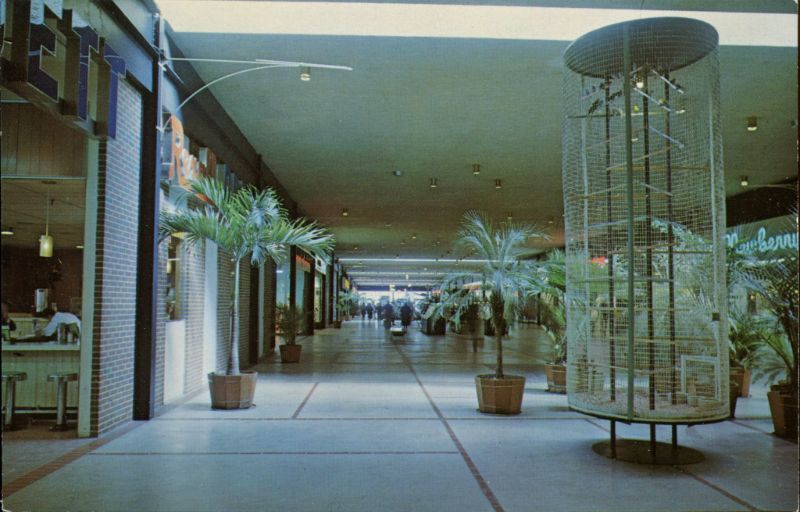
50 Vintage Postcards Capture Shopping Malls of the U.S. in the Mid-20th Century

The first shopping mall was technically an outdoor shopping plaza that opened in 1922 in Kansas City. However, the first indoor shopping mall that mirrored how we think of malls today was opened in 1956 in Edina, Minnesota. Malls were often anchored by a large department store with a cluster of other stores around it.

The mall was envisioned as a cultural and social center where people could come together and not only do their shopping but also make an activity of it. By 1960, there were more than 4,500 malls accounting for 14% of all retail sales.

Here below is a set of vintage postcards that shows what shopping malls of the U.S. looked like in the 1950s and 1960s.

Alabama. Eastwood Mall, Birmingham

Arizona. Chris-Town Shopping Centre, Phoenix

Arizona. Court Of Birds, Chris-Town Shopping Center, Phoenix

Arizona. Thomas Mall, Phoenix

Arizona. West Mall, Chris-Twown Shopping Center, Phoenix

June 30, 2022

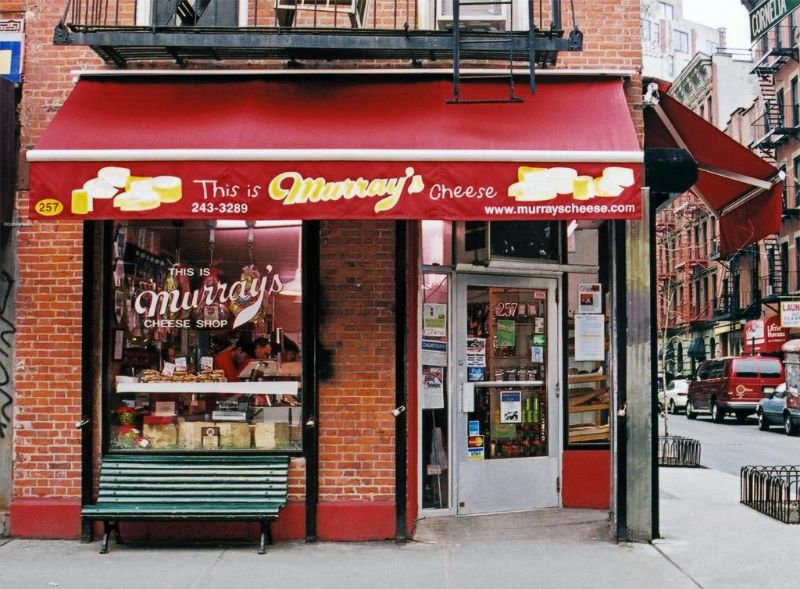
The Disappearing Face of New York: 27 Wonderful Photos of Old Storefronts in New York

James and Karla Murray, specialists in urban photography, spent more than ten years photographing the distinctive facades of family-run shops in neighborhoods throughout the five boroughs. Their brilliant documentation of New York's irreplaceable, generations-old storefronts has made headlines all over the world. For many of these establishments, the photographs mark the end of a legacy. In the wake of gentrification, vital facets of New York's cultural heritage are disappearing at an alarming rate. 

The influx of big box retailers and chain stores pose a serious threat to these humble institutions, and neighborhood modernization and the anonymity it brings are replacing the unique appearance and character of what were once incredibly colorful streets. Store Front is a visual guide to New York City's timeworn storefronts, a collection of powerful images that capture the neighborhood spirit, familiarity, comfort and warmth that these shops once embodied.

Ralph's

Amy's Bread

Murray's Cheese

CBGB'S

Lolly Pop

February 24, 2022

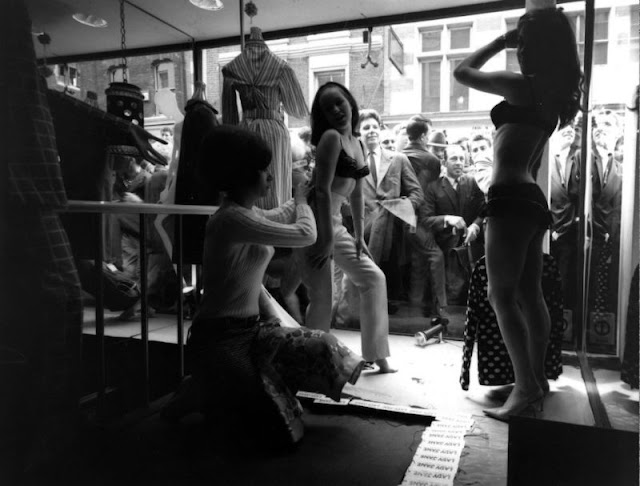
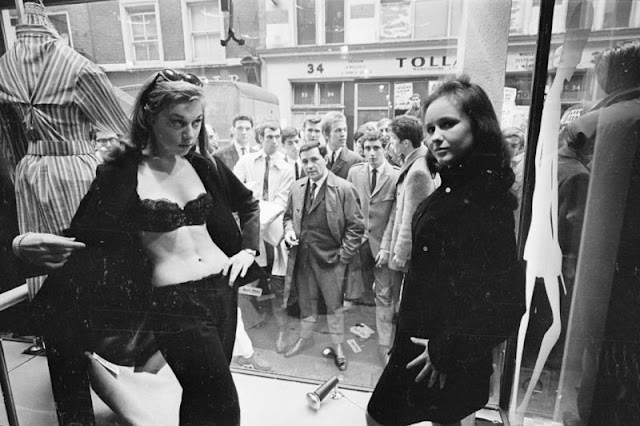
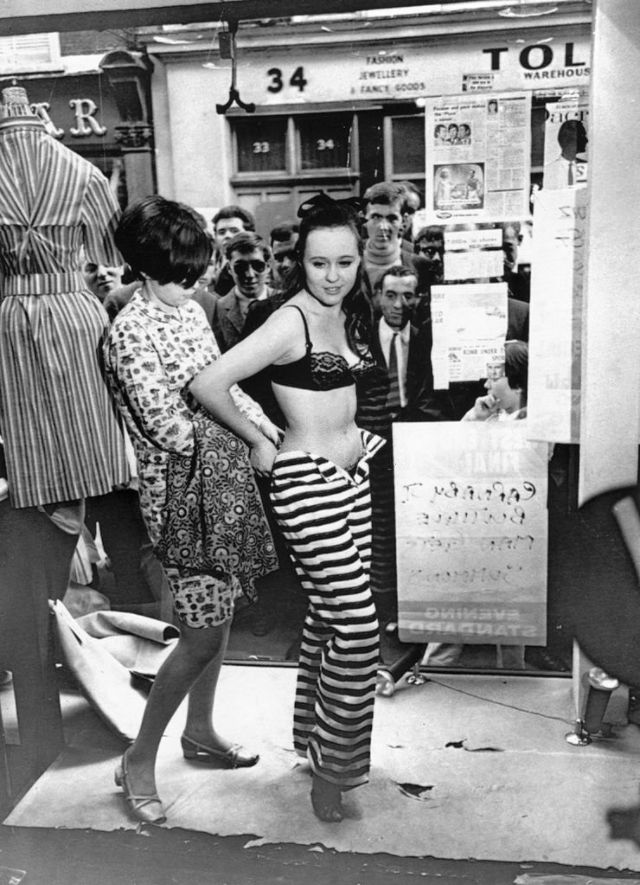
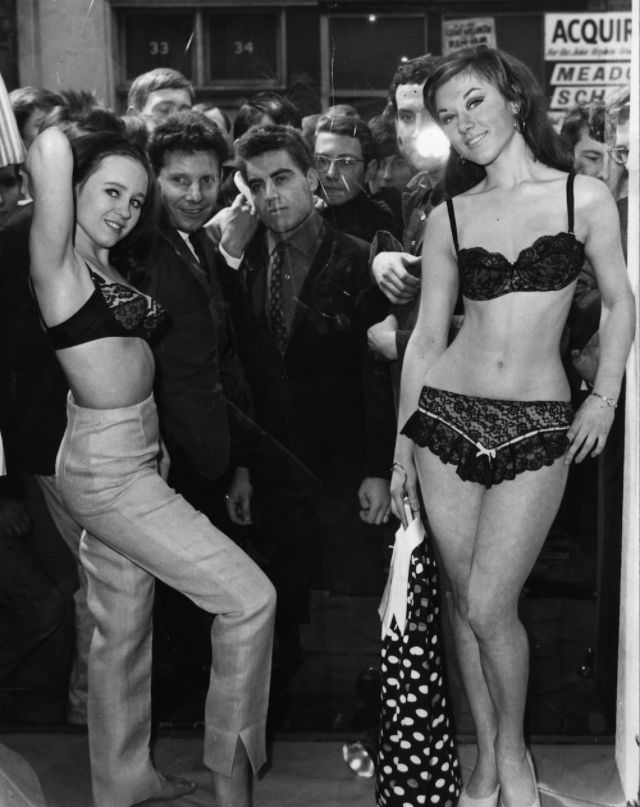
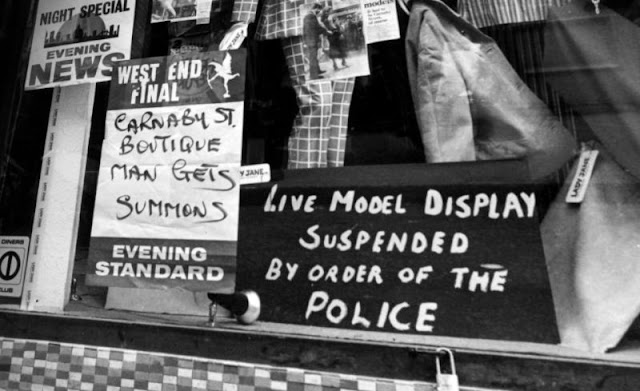
Living Mannequins on London’s Carnaby Street in 1966

Lady Jane was the first women’s fashion boutique on London’s Carnaby Street. It was opened by Henry Moss and his partner Harry Fox in April 1966.

On May 11, 1966, Fox had a pair of models take part in a risqué publicity stunt in the boutique’s window. The two models, Diane James and Jina Baker, became living mannequins by changing in the shop window for three days.


The shop gained great publicity from the national press, and attracted the attention of crowds of potential customers by having models changing in the shop window for three days. Henry Moss was quoted as saying “Then I got arrested. I thought it was for indecency, although the girls were wearing underwear. I was tried at Gt. Marlborough Street Court and fined £2 for obstructing the highway.” A visit by Jayne Mansfield garnered further publicity.

Take a look at the publicity stunt through these vintage pictures below:


January 18, 2022

Flashback to the Glory Days of American Malls in the 1980s

In the winter of 1989, 20-year-old photographer Michael Galinsky began driving across the country to document the seismic change in shopping malls, which at the time were central to American culture. They represented suburban consumerism in its most basic form and provided a place for families and teens to shop and socialize.

These pictures lay forgotten until Galinsky revisited his work in 2010. Initially posted online, the interest in his photos suddenly exploded. After a successful Kickstarter campaign, Galinsky’s selected work was published in the book Malls Across America by the renowned publisher Steidl in 2013.


In 2018, Galinsky decided to revisit his archive once more, aware that there was still a strong appetite for the project. “That book is now very expensive, and it didn’t include all the work by any means. So this summer I did a Kickstarter to raise funds to print an entirely new book with no repeat images.” Galinsky described his book The Decline of Mall Civilization. “It’s a very different book in that it is almost entirely double page spreads where the pictures play off of each other. I’m so happy that people keep finding meaning in the work. (and themselves!)”

Take a look back at the glory days of shopping malls and the style of shoppers that defined a generation through these 35 fascinating color pictures taken by Galinsky in 1989:


FOLLOW US:
FacebookTumblrPinterestInstagram

CONTACT US


Browse by Decades

Popular Posts

Advertisement

09 10