Bring back some good or bad memories


ADVERTISEMENT
Showing posts with label police. Show all posts

August 24, 2024

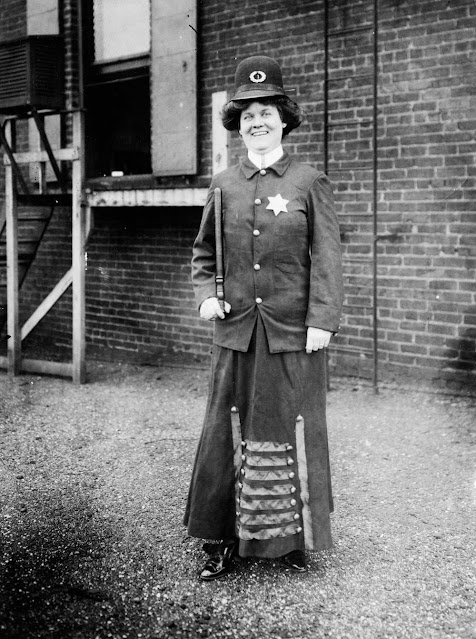
Leola King, America’s First Female Traffic Cop

It’s a big city policewoman directing traffic. Her name is Leola N. King, America’s first female traffic cop. These pictures were taken in Washington D.C, somewhere between 1918 and 1920.


In 1918, thirty female traffic officers were hired in Washington D.C. Leola was one of the first to hit the street. Her job kept things moving in the nation’s capital. At that time, horse-drawn carriages were still in use, and early cars were still sparse but catching on. Henry Ford’s Model T made its debut around 1908.

News reports indicate that she was later injured after being struck by a passing truck. There are later records of Private King when she was assigned to the Women’s Bureau under Lieutenant Mina Van Winkle.

In that assignment Private King investigated dance halls, complaints of child neglect and spousal abuse into the early 1920s.

August 5, 2024

Los Angeles Policemen in Drag, 1960

Members of the Los Angeles Police Department’s robbery squad are shown dressed as women as part of an operation to catch a purse snatcher who murdered an elderly woman while she was on her way to church. Photograph dated October 15, 1960.


It’s interesting to see how the costume (for most, a dress, overcoat and headscarf) might subconsciously affect the way the officers present themselves. Most in the back row have their hands pressed together demurely, with a faint smile and eyes slightly downcast.

But a few in front are squatting with either one knee up or knees spread wide apart. Somebody should have given them lessons re how to hold a handbag, and pose with their knees pressed together.

June 14, 2024

Members of the NYC Women’s Machine Gun Squad Police Reserves Riding a Sidecar-Mounted Machine Gun, ca. 1918

Harley-Davidson’s military motorcycle history spans over a century. In 1917, the United States entered World War I. American companies stood up to the plate to assist in the war effort. This included American motorcycle manufacturers including Harley-Davidson, Indian, Henderson, Excelsior, and others. Motorcycles were formed into all sorts of vehicles from mobile gun platforms to compact ambulances.

Here’s a Henderson outfitted with a sidecar-mounted machine gun for the New York City Women’s Machine Gun Squad Police Reserves. Motorcycle-based combat was serious business.


Captain Elise Reigner in action with the Lewis Machine Gun (gas driven, 600 to 800 shots per minute), operating from the sidecar of a motorcycle chauffeured by Mrs. Ivan Earasoff, with Miss Helen M. Striffler overseeing things from the rear seat, during WWI. Photo taken in 1918.

April 29, 2024

Vintage Photos of the First Columbus Mounted Police Unit in 1922

The first mounted police unit in Columbus, Ohio was formed in 1922. The horses were purchased using donations and the donors were allowed to name the horses. The Columbus Automobile Club facilitated the donations and purchase of the horses.

The primary task of the mounted unit was to assist with downtown traffic. The Ohio State Journal noted at the time that: “Mounted officers are more efficient in handling traffic, in the opinion of Auto Club officials, because the mounted defenders are able to see traffic.”

These photo were taken around 423 Short St. in the Brewery District of Columbus, Ohio in 1922.


April 26, 2023

Bullet-Proof Shield Protects Police Officers in Gun Battles, 1933

Collapsible armored shields to protect the bodies of police in gun battles have been invented to aid Uncle Sam in his war on crime. The shields were designed following the slaying of four officers in front of the Union station in Kansas City, Missouri, in 1933.


The collapsible armor permits free movement of the body. The shield is made in three sections, the two end sections hinging to the center body piece. At the top is an opening fitted with bullet-proof glass through which the officer can see ahead.

The center section has an opening at the right through which the gun barrel projects. A strap hung over the shoulders holds the shield in place, while the left hand keeps the shield at the desired distance from the body. The shield leaves only the legs from the knee down exposed to gun fire.

November 27, 2021

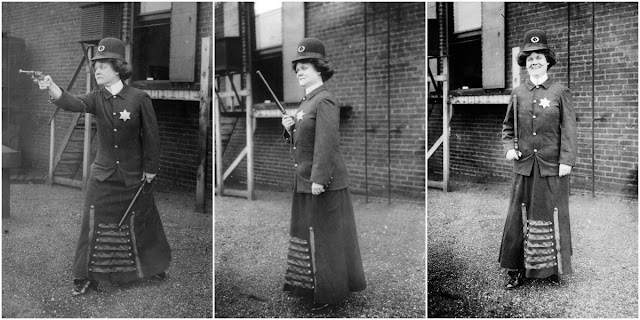
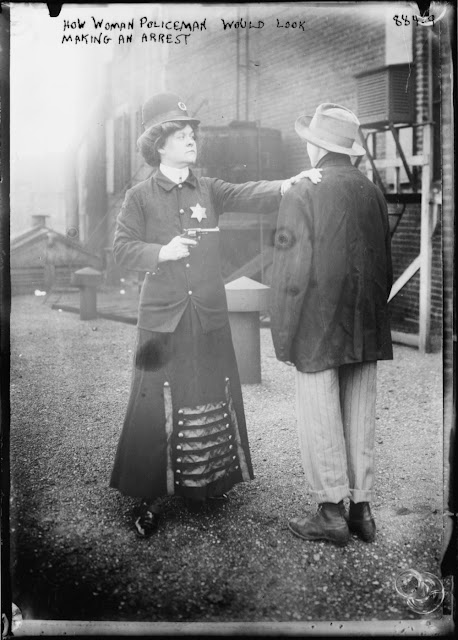
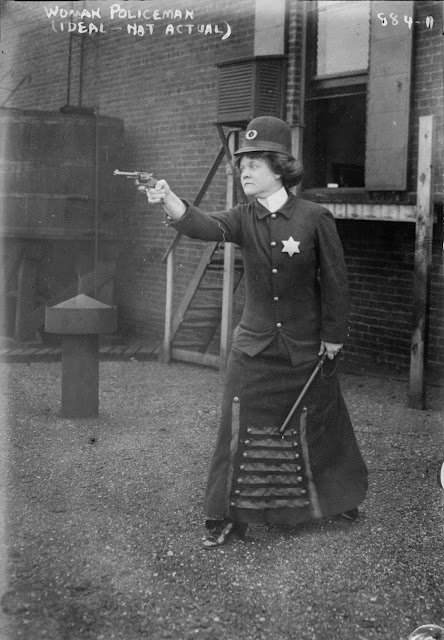
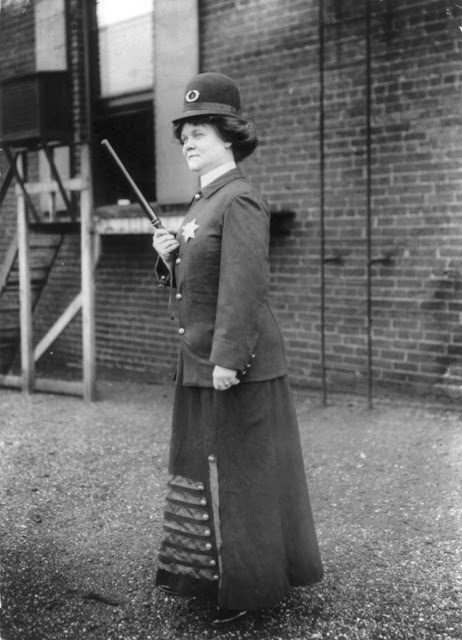
Photographs of a Woman’s Dream of Becoming America’s First Police Woman, 1909

Vintage photographs of a suffragette posed to illustrate woman police concept in Cincinnati, Ohio, 1909.


In 1854, the first police matrons were hired by New York City to search and guard female prisoners, but they were civilians with no law enforcement powers. From this beginning, women became encouraged to apply for similar positions in various parts of the United States.

In 1910, the Los Angeles Police Department appointed the first regularly rated policewomen, Mrs. Alice Stebbins Wells. Her appointment refuted the popular notion of matrons as being masculine and not very bright, because she was a college graduate, a social worker, and had deliberately sought the position of police officer.

Mrs. Wells soon became a pioneer in the national movement to have police departments hire women as officers. However, from the inception of this movement, women were hired by quotas and encountered discrimination, silent contempt, and double standards. Several court cases are discussed to illustrate the hurdles women had to fight to reach equality of employment in police agencies.

Today policewomen are involved in all aspects of police work. Cases in which policewomen have been prominent in various police departments are enumerated.

Many people could not even imagine what a female police officer would look like so this Ohio suffragette demonstrated what a policewoman would look like making an arrest.


(Photos: Library of Congress)

August 11, 2020

Canadian Police Officer Guarding the Pharmacy in Waist-High Flood Waters in Galt, Ontario, 1974

Even as the flood waters rose, the sun shone bright on May 17, 1974. Earlier rains and a decision to open reservoirs upstream had sealed downtown Galt’s fate. An already-swollen Grand River could take no more, pouring fast-flowing water over its banks toward an unsuspecting community. Miraculously, no one was killed, but hard lessons were learned in ‘the Great Flood of 1974’.

Const. John Shuttleworth wore waders as he stood waist-deep in Cambridge on May 17, 1974. (Mike Hanley/Canadian Press)

Pots and pans floated out the back door of George’s Chinese restaurant. Shoes of all styles and sizes bobbed around like little leather canoes, riding the rising rapids out of The Right House department store. Const. Jack Shuttleworth stood stoically at the submerged corner of Ainslie and Dickson streets.

He stared straight ahead as the Grand River washed through downtown Galt with surreal ferocity early on a blue-sky afternoon on the 17th of May. He watched the furious flow of the Great Flood of 1974. Power boats, fences and cars spun by in the waist-deep water.

The waders he borrowed from a downtown sporting goods store kept him dry. His presence let the soggy citizens of the newly created City of Cambridge — a melding of Galt, Preston and Hespeler — know the law still existed in the sunshine of the swirling mayhem.

“The whole idea was to be a deterrent,” Shuttleworth once recalled. “So nobody would be picking this stuff off.”

(via The Spec)

February 28, 2019

Porsches, BMWs, and Mercedes: Photos of Western-Spec Police Cars Used in the USSR

The first foreign car joined the Soviet State Automobile Inspectorate in the late 1960s. It was Ford Galaxie Wagon, which was even produced with American police equipments, including a dash light, loudspeaker, and spotlight.

In early the 1970s Soviet police received a luxury car from Western Germany - the Mercedes W108. After Mercedes, it was BMW’s time. In 1973, the German car company organized its first exhibition in the USSR, and after that dozens of BMWs were purchased by the Soviet “to protect and to serve.”

Mercedes and BMW cars were among the fastest in the Soviet police force and much more comfortable than their USSR-made vehicles. Even the Volga 24-24 cars with a top speed of 170 km/h, often used in chases by policemen and secret services, were no match for BMWs that easily accelerated to over 200 km/h.

Foreign vehicles looked pretty exotic compared to Soviet motors. Beside Mercedes and BMW, from the 1960s to 1980s the Soviet Union also imported Nissans, Opels, Audis, Renaults, Volvos, and Fords.

When the Soviet Union fell, Russia opened its gates to Western car designers, and it wasn’t long before more streamlined, sportier models became the norm.

1967 Ford Galaxie Wagon

Mercedes-Benz W108/W109 family

Mercedes-Benz SE/SEL W116 was used by some units of Moscow’s traffic police.

Mercedes-Benz amongVolga models GAZ-24 and GAZ-21, 1974.

The power structures of the USSR (most often talking about the KGB) also received Czech sedans with a V8 engine - Tatra 613. Some of them served in the police.

October 17, 2018

Abandoned Baby Sleeping in Desk Drawer at Los Angeles Police Station, 1971

Policewoman Pat Johnson, 28, tends a baby girl, about 9 months old, who was found alone and crying in a downtown hotel room in Los Angeles, California.

(Photo by Cal Montney/Los Angeles Times via Getty Images)

Baby was placed in file drawer for a nap after she was fed milk, Jell-O and cottage cheese. She later was taken to a foster home. The hotel manager called police after receiving complaints that the baby had been crying for hours.

The photo of the sleeping baby was taken by Times staff photographer Cal Montney on July 8, 1971.

In 2006, the Safely Surrendered Baby Law took effect in California.

November 8, 2017

18 Incredible Colorized Photos of American Police Cars From Between the 1920s and 1940s

Here is an incredible collection of colorized photos from Willie Brown that shows American police cars from between the 1920s and 1940s.

1926 Kearny, NJ Police Vehicle

1932 Columbus, Ohio Police Car (a new high tech radio equipped cruiser)

1935 Ohio State Highway Patrol Ford

1937 Ford with large speakers

1940 Kansas State Highway Patrol Vehicle

April 20, 2017

80 Historical Photos Of The Greater Manchester Police Vehicles Through The Years

These historical photos are from the collection of the Greater Manchester Police Museum and Archive that show vehicles police officers often used in the past.


Four officers of Bolton Borough Police sit astride their motorcycles

Officers of Salford City Police pose proudly with their sidecars on a cobbled street, ca. 1920s

The first car in police use on the region's roads, Bolton, 1925

 A Manchester City Police Alvis patrol car along with a motorcycle and sidecar in 1930s

 A Manchester City Police vehicle sits outside one of the force's police boxes in the 1930s

January 9, 2017

Police Stopped New York City Traffic for a Cat and Her Kitten in 1925

In 1925 two subway lines were held up for hours to spare a couple of kittens, a police officer stalled traffic on Centre Street in downtown Manhattan to let a mother cat and her kitten cross the street.

This was the No. 1 news story of 1925. (Photo: Harry Warnecke/NY Daily News Archive via Getty Images)

Harry Warnecke, a photographer for the New York News, got a phone tip about a cat trying to carry its kittens home who was tying up traffic because a policeman had stopped the cars on a busy street to allow it to cross. Warnecke arrived after the event was over, but he convinced the policeman and cat’s owner to allow him to recreate the scene. Despite the policeman’s initial reluctance, the cat’s inclination to cross the street diagonally instead of in front of the cars, and furious honking motorists, Warnecke finally got his shot –– after three attempts.

It was the craziest thing that happened that year!

November 3, 2016

Did You Know: In the 1920s, Police Could Arrest Women for Exposing Their Legs in One Piece Bathing Suits?

Young women in these photographs below are being arrested for exposing their legs in one-piece bathing suits, which was forbidden by ordinances in many U.S. communities in the 1920s. These women were probably either fined or released soon after arrest without charge: few women (or none) served jail time for wearing bathing outfits that violated indecent exposure or "public indecency" laws. Many violators of beach dress codes were fined on the spot by special enforcement officers, "beach censors," rather than being arrested.

Thousands of women were arrested in the 1920s for wearing leg-revealing swimming suits, which were a new development in the history of human clothing. In antiquity, swimming suits did not exist: bathing was done in the nude. However, for most of the last two thousand years open-water bathing or immersion for pleasure essentially did not exist in European societies.

Throughout the nineteenth century, bathing costumes remained bulky and restrictive for women, often made out of flannel or other opaque fabrics and even weighted with lead to keep the skirts from floating upward in the water. "Bathing machines" were standard at seaside resorts in England, essentially closets or booths on wheels that could be rolled down to the water's edge to minimize exposure to the public gaze.

By the 1920s, women's bathing skirts had shortened, in many cases, to just above or below the knee. Further, several forms of gender equality were being sought at the time: the vote, more equitable divorce laws, and broader career choices for women. To some women, it seemed unjust that men should be allowed to wear one-piece bathing suits that exposed their legs to the upper thigh while women must still wear skirts. Crystal Eastman, one of the founders of the American Civil Liberties Union, wrote in 1927 that as early as 1900, as a young girl, she "was a ringleader in the rebellion against skirts and stockings for swimming" in their summer community, and shocked her father by wearing a man's one-piece costume into the water. Yet he allowed her to do so: "he himself had been a swimmer," Eastman wrote, and "he knew he would not want to swim in skirt and stockings. Why then should I?"

In Chicago, a woman is being arrested for defying a Chicago edict banning "abbreviated bathing suits" on beaches, 1922.

Washington policeman Bill Norton measuring the distance between knee and suit at the Tidal Basin bathing beach after Col. Sherrill, Superintendent of Public Buildings and Grounds, issued an order that suits not be over six inches above the knee, 1922.

Women found to be breaking the rules were either asked to leave the beach or made to cover up.

A policeman measuring the swimming costumes of women on the beach in the 1920s.

Two bathers being escorted off the beach by a police woman, Chicago, 1922.

October 16, 2016

A Police Officer Issuing a Woman a Ticket for Wearing a Bikini on a Beach at Rimini, Italy in 1957

The policeman in the photo is nattily attired and appears to have a slight smirk as he writes out a ticket for the woman standing before him awkwardly in her offending swimwear; perhaps he enjoys making her feel uncomfortable.

The photo dates from 1957. The woman is wearing a bikini on the beach at Rimini on Italy’s Adriatic coast. At the time, Italy prohibited the revealing bathing suit; it was too immodest to be worn in public.


French engineer Louis Réard introduced the modern bikini, modeled by Micheline Bernardini, on July 5, 1946, borrowing the name for his design from the Bikini Atoll, where post-war testing on the atomic bomb was happening. French women welcomed the design but the Catholic Church, some media, and a majority of the public initially thought the design was risqué or even scandalous. Contestants in the first Miss World beauty pageant wore them in 1951, but the bikini was then banned from the competition.

More revealing than a one-piece swimsuit, the bikini was slow to be adopted, and in many countries it was banned from beaches and public places. The Vatican declared it sinful. While still considered risqué, the bikini gradually became a part of popular culture when film stars—Brigitte Bardot, Raquel Welch, Ursula Andress, and others—began wearing them on public beaches and in film.

The bikini design had become common in Western countries by the mid-1960s as beachwear, swimwear, and underwear. By the late 20th century it had also become common as sportswear, particularly in sports such as beach volleyball and bodybuilding. By the early 2000s, bikinis had become a US$811 million business annually, and boosted spin-off services such as bikini waxing and sun tanning.

November 23, 2015

Lovely Vintage Photos Prove that Polices Are Always Needed on Streets for Children

They chat, play, and help children for everything.

U.K. Police Sergeant Johnson stands along with six little girls dressed as angels outside the Saville Theatre, London,
where they are taking part in a matinee given in aid of the Children's League of Pity, 1947

Children on a tandem bicycle in Dublin, Ireland

Faith and confidence, 1958

Police officer playing with the children in Harlem, 1978

Police officers chat with a boy outside the Main Street Cinema during opening day at Disneyland, July 17, 1955

August 2, 2015

Amazing Pictures of FBI’s Colossal Fingerprint Filing System During World War II

The following photos give us a fascinating look inside the FBI’s overflow filing system. Housed during World War II in the Washington, D.C. Armory, the FBI’s archive collected over 23 million cards and 10 million fingerprint records, with around 400,000 new cards added every month.

Around the war, the federal government invested huge resources into the FBI to investigate potential defectors and spies. President Roosevelt, for one, was concerned about the lure of Communism and the subsequent threat to democracy. By the end of 1943, the FBI employed around 13,000 people.

The French scientist Paul-Jean Coulier developed a method to transfer latent fingerprints on surfaces to paper using iodine fuming. It allowed the London Scotland Yard to start fingerprinting individuals and identify criminals using fingerprints in 1901. Soon after, American police departments adopted the same method and fingerprint identification became standard practice in the United States.


FOLLOW US:
Facebook • Tumblr • Pinterest • Instagram

CONTACT US


Browse by Decades

Popular Posts

Advertisement

09 10