Bring back some good or bad memories


ADVERTISEMENT
Showing posts with label Washington D.C.. Show all posts

July 28, 2025

Intimate Photographs of Jacqueline Kennedy as a Student at Georgetown University in 1954

In May 1954, photographer Orlando Suero captured an intimate and elegant photo series of Jacqueline Kennedy (then Jackie Bouvier), just a year after her marriage to John F. Kennedy. These photos were taken over the course of five days at the future Kennedys’ home in Georgetown, Washington, D.C. Some of the images show Jackie attending classes at Georgetown University.

This photo series is now considered a rare and charming portrait of Jackie’s life before the White House, showing her grace, intelligence, and natural poise in a more relaxed, personal setting. Jackie Kennedy herself reportedly expressed her fondness for these pictures, stating that they were “the only pictures I’ve ever seen of me where I don’t look like something out of a horror movie.”


November 2, 2024

Washington, D.C. in the Early 1990s Through Fascinating Photos

Washington, D.C. in the early 1990s was a vibrant time marked by significant political, social, and cultural changes. The early part of the decade saw the tail end of the Cold War, which shaped much of the political landscape. Bill Clinton was elected president in 1992, bringing a wave of new policies and a focus on domestic issues.

Culturally, the city was alive with a burgeoning arts scene, including music genres like go-go and hip-hop, and a growing emphasis on diverse artistic expression. The revitalization of neighborhoods like Adams Morgan and U Street was underway, attracting new residents and businesses.

Socially, the early ’90s also faced challenges, including rising crime rates and economic struggles, but there was a strong community spirit and activism, particularly around issues like civil rights and education reform.

Overall, D.C. was a city in transition, reflecting broader national changes and a mix of tradition and innovation. These fascinating photos were taken by Steven Martin that show street scenes of Washington, D.C. in 1991 and 1992.

People before White House, Washington, D.C., July 1991

Looking northeast from the observation deck of the Washington Monument. Construction was taking place in the Federal Triangle, Washington, D.C., July 1991

Row houses, Capitol Hill. A group of row houses to the east of the Capitol in the Capitol Hill neighborhood of Washington, D.C., July 1991

U.S. Capitol, view from southeast. Cars were still allowed to park on the Capitol grounds, Washington, D.C., July 1991

U.S. Capitol, Washington, D.C., from the reflecting pool to the west of the building. The west facade was undergoing renovation, July 1991

September 6, 2024

Vintage Photographs Show Car Showrooms in Washington D.C. in the 1910s and 1920s

Automobile showrooms have come a long way since their inception, evolving into a significant part of the global automotive industry. Today, car showrooms are much more than just spaces to showcase cars; they serve as hubs for customer engagement and interaction with the brand.

The early automobile showrooms were simple spaces with a few cars displayed on the street or in a garage. However, with the growing popularity of cars in the 20th century, car showrooms became larger and more prominent. The first automobile showroom in the world was opened in Europe in of 1890s late specifically in Paris, by the 1920s, car dealerships had become a common sight in most major cities around the world, and from that time USA became one of the pioneers in this industry through Ford, Chevrolet and others.

In the 1920s, car showrooms became larger and more elaborate, with luxurious interiors, air conditioning, and even lounges for customers to relax in. Here, below are some vintage photographs show car showrooms in Washington D.C. in the 1910s and 1920s:

Automobile showroom (Hudsons on the left), probably in Washington D.C., ca. 1910s.

Automobiles and wallboard manufactured by The Beaver Co., 1911.

Exhibits at the Washington, D.C. auto show, March 3-10, 1917.

Westcott automobiles at the Washington, D.C., auto show, 1917.

Westcott automobiles at the Washington, D.C., auto show, 1917.

August 24, 2024

Leola King, America’s First Female Traffic Cop

It’s a big city policewoman directing traffic. Her name is Leola N. King, America’s first female traffic cop. These pictures were taken in Washington D.C, somewhere between 1918 and 1920.


In 1918, thirty female traffic officers were hired in Washington D.C. Leola was one of the first to hit the street. Her job kept things moving in the nation’s capital. At that time, horse-drawn carriages were still in use, and early cars were still sparse but catching on. Henry Ford’s Model T made its debut around 1908.

News reports indicate that she was later injured after being struck by a passing truck. There are later records of Private King when she was assigned to the Women’s Bureau under Lieutenant Mina Van Winkle.

In that assignment Private King investigated dance halls, complaints of child neglect and spousal abuse into the early 1920s.

November 2, 2023

Princess Diana Look-alike Contest in Washington D.C., 1985

Maureen Murray (#18) of Alexandria, Virginia won the local Princess Diana look-alike contest which took place at the “Champion Sports Bar” in Washington D.C. on November 5, 1985. The contest was held because the Prince and Princess of Wales will be in Washington a week later.


When Prince Charles and Princess Diana touched down at the Andrews Air Force base on November 9, 1985, they were greeted by mass hysteria from Americans, and the political elite of Washington. Thousands descended upon the city to see the royal visitors and, in particular, the almost mythical Princess Diana. Indeed, Washingtonians watched her every move – and what she wore – with great interest as she made the usual circuit of glamorous parties and embassy dinners.

April 6, 2023

Candid Photographs of Young Girls Go Wild at the First Beatles Concert in America, Washington, DC in 1964

Beyond the influence their music had on everyone from Bob Dylan and the Beach Boys to Jimi Hendrix and The Rolling Stones, The Beatles also sparked the era-defining phenomenon known as Beatlemania—the seemingly spontaneous unleashing of (largely) female adoration and erotic energy that certainly had its pop-culture precedents, but remains notable for the sheer scale of the hysteria that greeted The Beatles everywhere. In fact, one of the reasons the band stopped touring so early in its career, and retreated to the studio for the last four years of its remarkably short life, is that the sound erupting from their frantic fans made concerts an exercise in futility: the lads literally could not hear themselves play.

These photographs taken by LIFE photographer Stan Wayman at the Beatles’ first concert in America, a performance at the Washington Coliseum on Feb. 11, 1964, two days after their historic appearance on the Ed Sullivan Show in New York. It was a surprisingly intimate affair, with the band playing on a small stage literally feet from the fans—albeit behind a loose phalanx of cops.

The pictures don’t focus on the Fab Four. Instead, they’re portraits, made in the moment, of young women who are alternately transfixed, driven to tears and virtually unhinged with excitement. Here are the faces of the first Americans to see the Beatles in concert. Here is Beatlemania looked and felt like as it landed in the United States.


January 5, 2023

Notorious Drug Kingpin Pablo Escobar Posing in Front of the White House With His Son, 1981

This infamous photo shows Colombian drug lord Pablo Escobar in front of the White House. Next to him is his only son, Juan Pablo Escobar. The photograph was taken by his wife Maria Victoria in 1981. Escobar took his family to Disneyland on this same trip.


During the time the photo was taken, Pablo Escobar was at the peak of his powers and, ironically, would’ve been several times wealthier than the President of the United States. Escobar was in the process of trying to become a legitimate politician in his native country at the time. He held a diplomatic passport, yet it is unknown if this was legitimate or simply a fake. After all, Escobar did begin his criminal career by counterfeiting documents.

He became a substitute congressman and then joined the City Council in his hometown of Medellin. However, he was detested by the Colombian government and was considered extremely dangerous. He also was accused of turning the nation of Colombia into a giant stereotype – one that remains to this day.

At the height of his power, Escobar brought in an estimated $420 million a week in revenue, supplied 80% of the world’s cocaine, and smuggled 15 tons of cocaine into the US per day.

Escobar’s legacy remains controversial; while many denounce the heinous nature of his crimes, he was seen as a “Robin Hood-like” figure for many in Colombia, as he provided many amenities to the poor, while his killing was mourned and his funeral attended by over 25,000 people.

July 31, 2022

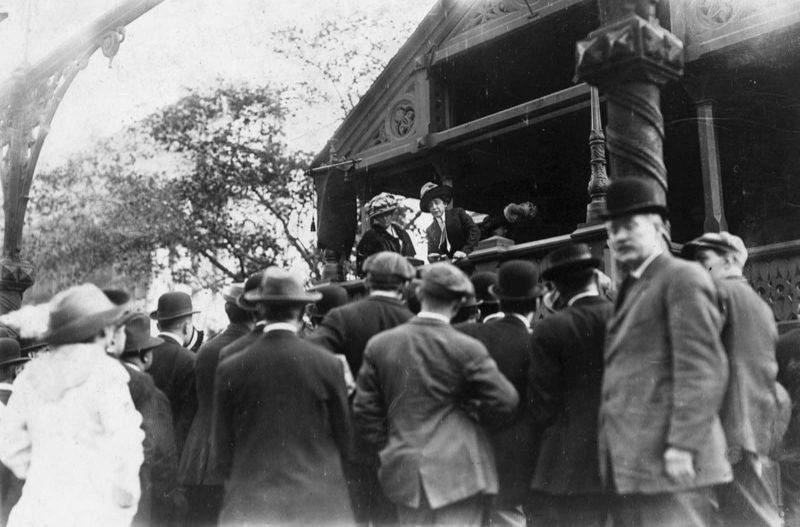
Rare and Incredible Photos of the Woman Suffrage Parade of 1913

On March 3, 1913, over 5,000 women marched down Pennsylvania Avenue in Washington, D.C. for universal women’s suffrage. The event was scheduled on the day before President Woodrow Wilson’s inauguration to “march in a spirit of protest against the present political organization of society, from which women are excluded,” as the official program stated. The march and the attention that it attracted were monumental in advancing women’s suffrage in the United States.

German actress Hedwig Reicher wears the costume of “Columbia” with other suffrage pageant participants standing in background in front of the Treasury Building in Washington, District of Columbia, on March 3, 1913. The performance was part of the larger Suffrage Parade of 1913.

The event was organized by Alice Paul, who was born in New Jersey and earned an M.A. and Ph.D. from the University of Pennsylvania. She traveled to England and became involved with the suffrage movement. Upon her return to the United States, she joined the National American Woman Suffrage Association. The Washington parade was her first duty as part of the suffrage association.

Suffragist Alice Paul, in a 1913 photograph. Paul was born in New Jersey, earned an M.A. and Ph.D. from the University of Pennsylvania, then traveled to England and became friends with members of the women’s suffrage movement there. She soon became very active herself, and, on returning to the United States soon after, joined the National American Woman Suffrage Association (NAWSA). Her first actions as part of NAWSA were to organize a massive parade in Washington, District of Columbia, to promote a new constitutional amendment that would guarantee women’s right to vote in the U.S.

The parade included nine bands, four mounted brigades, 20 floats, and an allegorical performance near the Treasury Building. The marchers were separated into different categories.

Leading the parade, wearing a crown and long white cape on top of a white horse, was labor lawyer Inez Milholland. Women from countries that had already enfranchised women were first, along with officers in the National American Woman Suffrage Association.

The “Pioneers”, women who have been working on suffrage for decades, came after. Celebration of working women followed the Pioneers section and included nurses, farmers, homemakers, doctors, college women, and more. Other sections included the National Association of Colored Women, individual state delegations, and male supporters.

Cover of the program for the 1913 women’s suffrage procession.

Elizabeth Freeman of the New York State Suffrage Association, with horse and carriage, on her way to join the March 3, 1913 suffrage march in Washington, District of Columbia.

Mrs. E.R. Smith practicing speechmaking from a covered platform before a small crowd, a ‘school for suffragette speakers’ in Union Square.

April 1, 2022

In 1934, Fearless Thieves Hit the Top of the Washington Monument and Stole the Lightning Rods

During the fall and winter months of 1934, the Washington Monument was prepped for repairs and cleaning, due to cracking at the base. Scaffolding was built around the 550-foot monument to allow the workers to make the repairs with Public Works Administration funding. The restoration lasted 140 days, during which time the Monument remained open to visitors.

National Bureau of Standards engineer William M. Greig (left) and an unidentified man examine the aluminum tip and lighting rods at the top of the Washington Monument in 1934.

Workmen install new platinum lightning rods atop the Washington Monument, Washington, DC.

However, on December 28, 1934, someone scaled the scaffolding to remove 107 of the 170 gold-plated, platinum-tipped lightning rod points from the top of the monument. The points were valued at $8 each, which totaled $856 (about $24,000 in today dollars). That’d buy quite a lot of beer during the Great Depression.

Construction on the Washington Monument began in 1848, and by 1854, it had reached a height of 156 feet (48 meters). Political squabbling and a lack of funds then stalled the project, leaving an unfinished landmark as a national embarrassment for the next 22 years. The structure was finally completed on December 6, 1884, when an aluminum tip was placed atop the capstone—the same section that would be examined 50 years later by National Bureau of Standards engineers.

The 1934 refurbishment with workmen setting larger rods into the copper bar girdle.

Workmen replacing stolen lighting rods, 1934.

The tubular steel scaffolding for the Washington Monument’s 1934-1935 restoration project was the highest ever constructed up to that time. The erection and dismantling of the scaffolding cost three-and-a-half times more than the cleaning, painting and repair work.

Aluminum cap of Washington Monument with lightning rods.

Aluminum cap of Washington Monument with lightning rods.

Aerial view of Washington Monument, ca. 1930s.

March 10, 2022

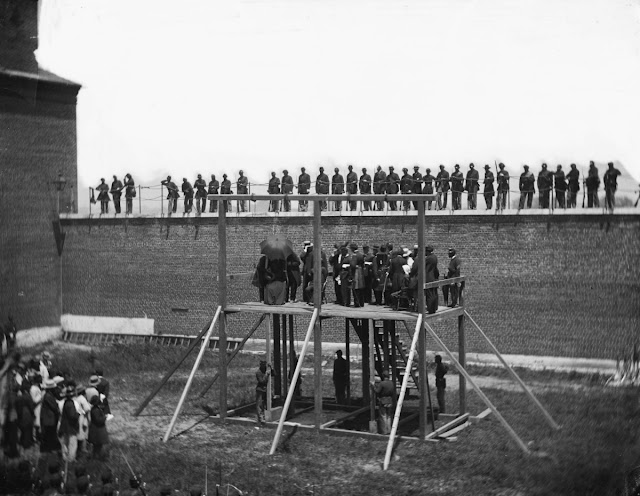
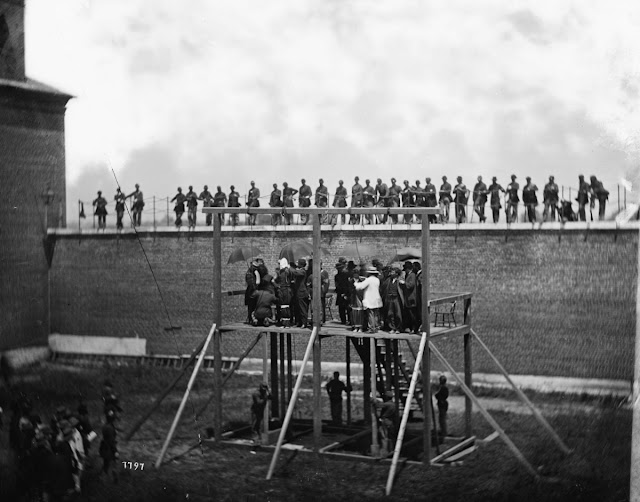
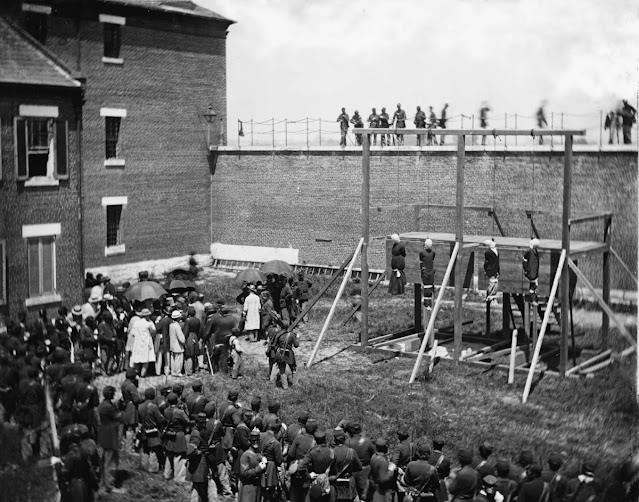
Photographs of the Execution of Conspirators in the Assassination of U.S. President Abraham Lincoln, 1895

On April 14, 1865, Lewis Thornton Powell, alias Payne, was the (Live Oak?) Florida native who was part of Booth’s conspiracy to assassinate President Lincoln, Vice President Johnson and Secretary of State Seward. Powell entered Seward’s home, stabbed him in the throat, inflicted dangerous wounds on other members of the household. He escaped and hid in the woods near Washington, returned to the home of Mary Surratt, a fellow conspirator. As he reached the house it was being searched by officers. Powell said he had been hired to dig a drain. Surratt, when questioned raised her hand and swore :“Before God I do not know him, never saw him, and never hired him.”

Thus was the conspiracy indicated; and evidence soon forthcoming led to the conviction and execution of Surratt, Powell, George Atzerodt and David Herold. Shortly after the afternoon of July 7, 1865, the four condemned conspirators were forced to climb the hastily built gallows that they had heard being tested the night before from their prison cells.

It was hot that day, reportedly a hundred degrees (38 degrees Celsius). Sweat surely dripped down the accused’s faces as they passed by the cheap pine coffins and shallow graves that had been dug for them. Alexander Gardner was the only photographer permitted for the execution of the Lincoln assassination conspirators. More than 1,000 people—including government officials, members of the U.S. armed forces, friends and family of the accused, official witnesses, and reporters—had come with their exclusive tickets to see this execution.

Nooses were placed around the accused’s necks and hoods over their heads. Ever since the sentences had been handed down a week ago, Surratt’s lawyers and her daughter Anna had been fighting and pleading for her death sentence to be changed. In fact, many in attendance thought that Surratt would be saved from the gallows at the last minute. It was not to be. She was the first woman executed by the United States government.

After the last rites and shortly after 1:30 PM, the trap door was opened and all four fell. It was reported that Atzerodt yelled at this very last moment: “May we meet in another world”. Within minutes, they were all dead.


(Photos via the Library of Congress)

March 12, 2021

“Safety First” Is the Motto of Miss Mary Jayne of Keith’s Circuit

Miss Mary Jayne, prominent in Washington and society circles has adopted a novel plan to protect herself against possible holdup when she is out late in the evening. She carries a small but business like automatic just below her knee, where the modish short skirt allows her to get at the shooting iron should occasion demand.

Here, Mary Jayne, seated in rocking chair with pistol strapped to her knee in 1922, claiming exemption from concealed weapon regulation by saying her thirty-two isn’t a concealed weapon in these days of knee-length skirts.


February 23, 2021

Krazy Kat Klub: A Bohemian Speakeasy and Nightclub With a Treehouse in Washington D.C in the 1920s

The Krazy Kat Klub (or The Kat) was a Bohemian cafe, speakeasy, and nightclub that operated at No. 3 Green Court near Washington D.C.’s Thomas Circle during the early decades of the 20th century. The club was run by portraitist and theatrical scenic designer Cleon “Throck” Throckmorton and its name was borrowed from the title character of a comic strip that was popular at the time.

The Krazy Kat Klub’s entrance was in an alley that led out to Massachusetts Avenue, and during 1921 the entrance door bore a small sign reading “The Krazy Kat” along with a chalk-written warning at the top of the door that read, “All soap abandon ye who enter here.” The club included both an indoor dance floor and an outdoor courtyard for al fresco dining and art exhibitions. The courtyard featured a small tree-house, accessed by a ladder. The Club was also the site of painting classes during the 1920s. In 1919, a reporter for the Washington Post described the Krazy Kat Klub as being “something like a Greenwich Village coffee house,” featuring “gaudy pictures created by futurists and impressionists.”

According to Throckmorton himself, the avant-garde venue “proved not only a club for artists, but a source of supply for musicians and playwrights,” and he claimed that several plays were written on its premises. Writer Victor Flambeau noted that, by 1922, “in imitation of the Krazy Kat, other bohemian restaurants sprang up in Washington to supply the demand” such as the Silver Sea Horse and Carcassonne in Georgetown. Over time, The Kat became one of the most vogue locations for Washington's intelligentsia and aesthetes to congregate.

During its tumultuous half-decade existence, The Kat was declared to be a “disorderly house” by municipal authorities and was raided by the metropolitan police on several occasions during the Prohibition period. One particular raid in February 1919 reportedly interrupted a violent brawl inside the club, during which a shot was fired. The surprise raid resulted in the arrests of 25 krazy kats—22 men and 3 women—described in a Washington Post report of February 22nd as “self-styled artists, poets and actors.” The article specifically noted that several arrested patrons “worked for the [federal] government by day and masqueraded as Bohemians by night.”

The club presumably closed at some time prior to 1928 when Throckmorton relocated to Hoboken, New Jersey. During this same period, Throckmorton divorced his first wife (and model) Katherine Mullen and subsequently married screen actress Juliet Brenon, the niece of Irish-American motion picture auteur Herbert Brenon who directed the first cinematic adaptation of The Great Gatsby (1926). Throckmorton would later become one of the most prolific scenic designers for Broadway plays, and his Greenwich Village apartment that he shared with Juliet Brenon would become an after-hours salon for thespians, artists, and intellectuals such as Noël Coward, Norman Bel Geddes, Eugene O’Neill and E.E. Cummings. Their politically leftward salon would notably raise funds for the Republican faction during the Spanish Civil War.

Cleon Throckmorton, Katherine Mullen, and others chat over coffee and cigarettes.

Cleon Throckmorton and his wife Katherine Mullen relaxing with a friend

A model, presumably Katherine Mullen, poses for Cleon.

A waiter ascends a ladder to serve patrons in the club’s tree-house.

Cleon, Katherine, and others arrive at the back-alley entrance of The Kat.

Another angle of guests arriving at the entrance of The Krazy Kat Klub.


FOLLOW US:
Facebook • Tumblr • Pinterest • Instagram

CONTACT US


Browse by Decades

Popular Posts

Advertisement

09 10