Bring back some good or bad memories


ADVERTISEMENT
Showing posts with label Yugoslavia. Show all posts

January 1, 2023

Yugoslavia in the 1960s Through Fascinating Photos

Yugoslavia was a country in Southeast Europe and Central Europe for most of the 20th century. It came into existence after World War I in 1918 under the name of the Kingdom of Serbs, Croats and Slovenes by the merger of the provisional State of Slovenes, Croats and Serbs (which was formed from territories of the former Austria-Hungary) with the Kingdom of Serbia, and constituted the first union of the South Slavic people as a sovereign state, following centuries in which the region had been part of the Ottoman Empire and Austria-Hungary.

Peter I of Serbia was its first sovereign. The kingdom gained international recognition on 13 July 1922 at the Conference of Ambassadors in Paris. The official name of the state was changed to Kingdom of Yugoslavia on 3 October 1929.

These fascinating color photos from Dave's old slides that show street scenes of Yugoslavia in the 1960s.

Vlaška ulica, Zagreb, Croatia, Yugoslavia, 1960

Ban Jelačić Square, Zagreb, Croatia, Yugoslavia, 1960

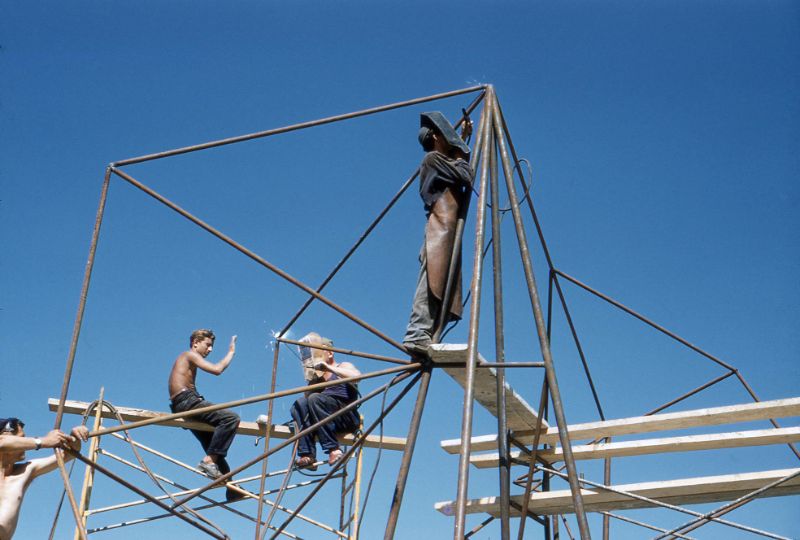
Building work, Zagreb Trade Fair, Croatia, Yugoslavia, 1960

Construction at USA pavilion, Zagreb Trade Fair, Croatia, Yugoslavia, 1960

Dubrovnik, Croatia, Yugoslavia, 1960

June 6, 2021

The Story of Baba Anujka, the World’s Oldest Serial Killer

Known variously as the Banat Witch or the Witch of Vladimirovac, but best known as Baba Anujka, Ana di Pištonja was an accomplished amateur chemist and a convicted killer from the village of Vladimirovac, Yugoslavia (in Serbia). She poisoned at least 50 people and possibly as many as 150 in the late 19th and early 20th centuries. She was apprehended in 1928 at age 90 and sentenced to 15 years in prison in 1929 as an accomplice in two murders. She was released due to old age after spending eight years in prison.


Not a lot is really known about Anujka’s youth as records are incomplete or just missing as many are for that time period. According to some sources, she was born in 1838 in Romania to a rich cattleman and moved to Vladimirovac in the Banat Military Frontier province of the Austrian Empire around 1849. However, she claimed that she was born in 1836. She attended private school in Pančevo with children from rich families, and later lived in her father’s house.

Baba Anujka allegedly became a misanthropist at age 20 after being seduced by a young Austrian military officer; she contracted syphilis from him before he left her broken-hearted. After that, she sought seclusion and started to show interest in medicine and chemistry. She spoke five languages. She later married a landowner named Pistov or di Pištonja with whom she had 11 children, only one of whom survived to adulthood. Her husband was much older than she, and died after 20 years of marriage. She continued to pursue her chemistry studies after his death.


Anujka made a laboratory in one wing of her house after her husband died, and she earned a reputation as a healer and herbalist in the late 19th century. She was popular with wives of farmers who sought her help for health problems, and she earned a respectable income which enabled her to live comfortably. She produced medicines and mixtures which would make soldiers ill enough to escape military service, and she also sold poisonous mixtures which she branded “magic water” or “love potions”. She sold the so-called “magic water” mostly to women with abusive husbands; they would give the concoction to their husbands, who would usually die after about eight days.

Anujka’s “love potion” contained arsenic in small quantities and certain plant toxins that were difficult to detect. When told about a marriage problem, Anujka would ask her client, “How heavy is that problem?”, which meant, “What is the body mass of the victim?” She was then able to calculate the dose needed. Anujka’s victims were usually men, typically young and healthy. Her clients claimed at her trial that they did not know that her “magic water” contained poison, but that they believed that she had some kind of supernatural powers to kill people using magic. Anujka’s potions killed between 50 and 150 people.

In the 1920s, Anujka had her own “sales agent”, a woman named Ljubina Milankov, whose job was to find potential clients and take them to Anujka’s house. The price of Anujka’s “magic water” fluctuated between 2,000 and 10,000 Yugoslav dinars.


Her downfall came through one of her regular clients, a woman named Stana Momirov who had previously killed her husband with one of Anujka’s love potions, as well as frequently purchasing herbal remedies from her. When Momirov remarried and a rich relative of her new husband died in similar circumstances she was arrested and questioned, implicating Anujka in the two killings.

A second death occurred nearly a year later, after Anujka sold a woman a potion with which to murder her husband’s father. After the man’s 16-year-old granddaughter was duped into administering the poison, the man fell ill and died. Nearly 18 months later Anujka was arrested, along with six others involved in the two killings. Her co-defendants turned the blame on her, claiming that they never knew the potions were poison and that they believed the deaths had been caused by Anujka’s supernatural powers. In response, Anujka denied ever selling them potions of any kind, insisting the entire case was an attempt to shift the blame onto her.

Ultimately, Anujka was sentenced to 15 years in prison for her role in the two murders. She was released after serving eight years on compassionate grounds. She died in 1938 in her home in Vladimirovac at the age of 100.


March 5, 2021

26 Funny Vintage Album Covers Released by Šaban Bajramović From Between the 1960s and 1990s

Šaban Bajramović (April 16, 1936 – June 8, 2008) was a Serbian vocalist and recording artist of Romani ethnicity. He was one of the most internationally critically acclaimed Romani singer-songwriters. Due to his eminent impact on music in Eastern Europe, he was dubbed the “King of Romani music.” During his career, which spanned over four decades, he recorded 50 singles and 20 albums, and he is believed to have written 700 songs.


At 19 years he ran away from the army, out of love. As a deserter, he was sentenced to three years prison on the island Goli Otok. He spent his time as a good goalkeeper in the prison football team. Because of his nimbleness and speed, they called him “Black Panther.” Soon he forced his way into the prison orchestra that played, among other things, jazz (mostly Louis Armstrong, Frank Sinatra, and sometimes John Coltrane) with Spanish and Mexican pieces.

After Goli Otok, his intensive music career began. He made his first record in 1964, with the recording act Crna mamba (Black Mamba). He continued to produce music with Crna mamba for 20 years. The highlight of their career was their performance for Indira Gandhi in India, where he gained the title “King of Romani music.” He also performed to Yugoslav politician Josip Broz Tito.

In the early nineties, he recorded “Đelem, Đelem,” which is considered the Romani people’s ethnic anthem. At the time, he decided to change his stage presence, starting to wear sunglasses while performing.

Bajramović was a prominent figure in Serbian music presenting Romani music in modern Serbian. Due to his enormous influence, on 12 August 2010, a statue to honor his impact was built. The statue had been vandalized multiple times. Time Magazine polled Bajramović in the top 10 best jazz musicians.


November 2, 2020

20 Black and White Photographs Capture Scenes of Knez Mihailova Street, Belgrade in 1983

Knez Mihailova Street is the main pedestrian and shopping zone in Belgrade, and is protected by law as one of the oldest and most valuable landmarks of the city. Named after Mihailo Obrenović III, Prince of Serbia, it features a number of buildings and mansions built during the late 1870s.

The street follows the central grid layout of the Roman city of Singidunum, as one of the main access roads to the city corresponds to the modern street today. The main axis of urban development was along the street, which was the main route of communication (via cardo).

One kilometer long Knez Mihailova Street was in 1979 included on the list of Spatial Cultural-Historical Units of Great Importance, and as such is protected by the Republic of Serbia.

These black and white photographs of Knez Mihailova Street below were taken by Bane Djordjevic in the spring of 1983.


August 30, 2020

20 Amazing Vintage Photographs That Capture Women’s Street Styles of Belgrade in the 1960s and 1970s

During the 1960s and 1970s, Belgrade was masterfully immortalized by photographer Branislav Bane Djordjevic, who paid special attention to female beauty, elegance, and fashion.


Djordjevic was a local music professor who has left a deep mark in the world of domestic photography since he was a patient observer of everything that was happening in Knez Mihailova Street.

As a member of the Belgrade Photo Club, he often photographed life on the streets and, thanks to his keen eye and sense of aesthetics, built a recognizable style and captured the time, fashion and beauty of the time.


April 23, 2019

18 Vintage Album Covers of Ex-Yugoslavia Singer Saveta Jovanović, Who Was't Afraid to Flaunt Her Hairy Legs

There was a time in Europe when it was considered un-ladylike for women to shave their legs and only prostitutes did that. Not sure of the time period of that or of this singer. Apparently, a singer from ex-Yugoslavia Saveta Jovanović had special kind legs.

For decades, women have been expected to tirelessly groom their bodies for the appeasement of others. Why? Daring to let nature take its course is somehow deemed lazy, ugly, or plain unfeminine.

Saveta is gorgeous. More women need to be more like her. Women are hairy just like men. And they should not be be required to shave just because the Caucasian White male says he does not like women with hair on her legs.


January 22, 2018

40 Rare and Fantastic Photographs of Yugoslavia From the 1920s

Kurt Hielscher was a German photographer who traveled around the Europe in the early 1900s. During his travels, he recorded amazing photographs. He is the author of several successful books containing photographs of Italy, Spain, Germany and Yugoslavia.

During 1920s, Hielscher traveled all over Yugoslavia, making a book with amazing photographs of landscapes, country and nation. In Belgrade, he was assigned an interpreter, he was allowed to enter the properties of all local authorities, and he got a car to use. Zeiss-Ikon and Agfa factory gave him cameras and lenses.

On his way from the Slovenian Alps to the border with Bulgaria, Hielscher made a total of 1,200 images. From all photographs recorded he chose 191 photos and explained that he tried to show diverse landscapes, architecture and way of life of the population of Yugoslavia. He stated that his intention was not to make postcards, but photographs.

His collection was published in 1926 in Berlin. This valuable book has not been printed for a long time, and all photos are saved on Agfa Chromo Isorapid board.


November 29, 2017

Beautiful Photos That Document Everyday Life of Yugoslavia in the Early 1980s

These fascinating photographs were taken by Cynthia Hilsden while traveling to Yugoslavia in the early 1980s. Cities include Postojna, Ljubljana, Trogir, Split, Dubrovnik, Zagreb, Kolocep, Neum, Blagaj, Mostar, Sarajevo.


May 16, 2017

40 Hilarious and Really Bad Vintage Album Covers From Yugoslavia in the 1970s and 1980s

As you probably already know the Balkan area composed today by Slovenia, Croatia, Macedonia, Bosnia and Herzegovina, Montenegro and Serbia was in the past a unified country called Yugoslavia. These are all beautiful countries, with a strong and ancient culture.


But what caught our attention is its pop and folk music from the 1970s and ’80s. We don’t really know the artists we are reporting in this post, but their album covers are simply hilarious, authentic pieces of art in their ingenuity.

Amateurish lighting, badly cut out faces pasted in place of other people, unexplainable poses and a totally flashiness are just few of the things you will find in these photos.


FOLLOW US:
Facebook • Tumblr • Pinterest • Instagram

CONTACT US


Browse by Decades

Popular Posts

Advertisement

09 10