Bring back some good or bad memories


ADVERTISEMENT
Showing posts with label Warsaw. Show all posts

March 25, 2022

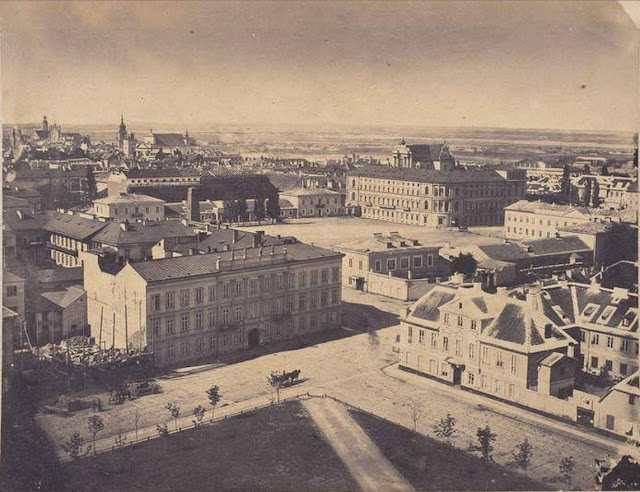
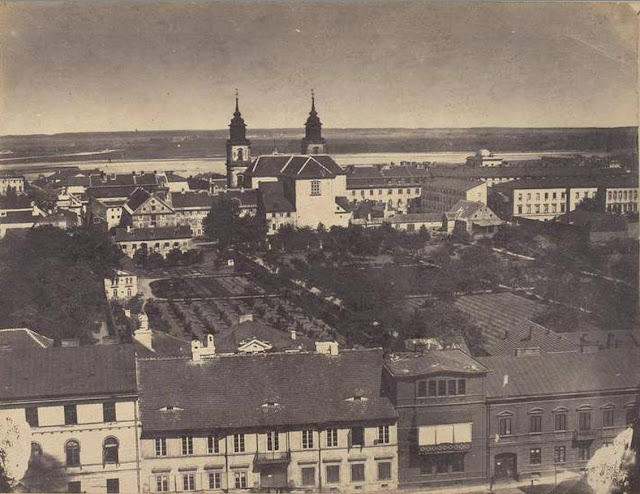
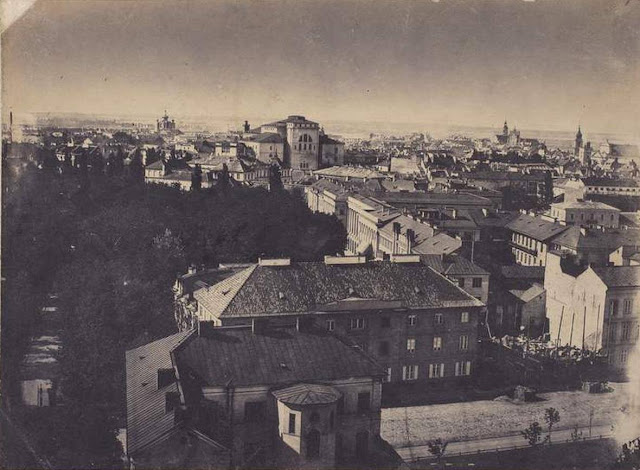
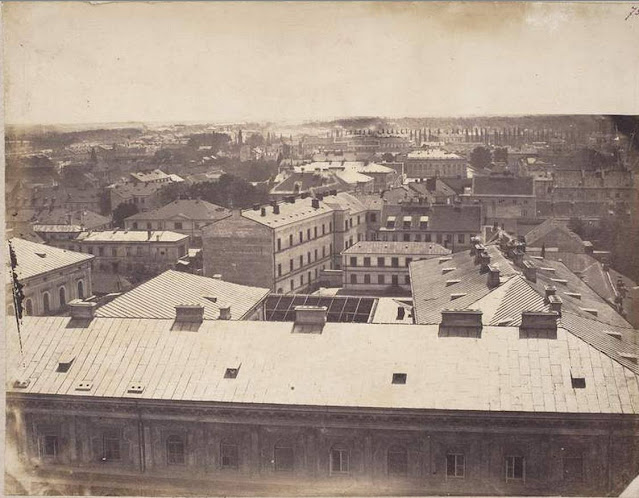
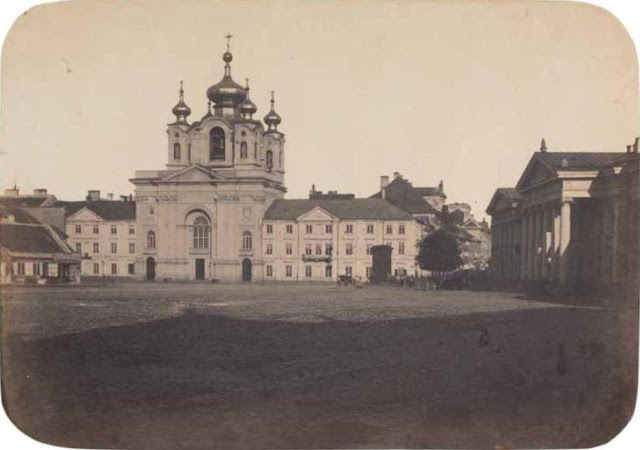
Rare and Amazing Photographs of Warsaw, Poland From the 1850s

Warsaw is the capital and largest city of Poland. The city area measures 517 km2 (200 sq mi) and comprises 18 boroughs, while the metropolitan area covers 6,100 km2 (2,355 sq mi). Warsaw is an alpha- global city, a major cultural, political and economic hub, and the country’s seat of government.

Warsaw flourished throughout the 19th century under Mayor Sokrates Starynkiewicz (1875–92), who was appointed by Alexander III. Under Starynkiewicz Warsaw saw its first water and sewer systems designed and built by the English engineer William Lindley and his son, William Heerlein Lindley, as well as the expansion and modernization of trams, street lighting, and gas infrastructure.

Between 1850 and 1882, the population grew by 134% to 383,000 as a result of rapid urbanization and industrialization. Many migrated from surrounding rural Masovian towns and villages to the city for employment opportunities. The western borough of Wola was transformed from an agricultural periphery occupied mostly by small farms and windmills to an industrial and manufacturing centre. Metallurgical, textile and glassware factories were commonplace, with chimneys dominating the westernmost skyline.


December 3, 2021

22 Amazing Photochrom Prints of Warsaw in the 19th Century

Warsaw flourished throughout the 19th century under Mayor Sokrates Starynkiewicz (1875–92), who was appointed by Alexander III. Under Starynkiewicz Warsaw saw its first water and sewer systems designed and built by the English engineer William Lindley and his son, William Heerlein Lindley, as well as the expansion and modernisation of trams, street lighting, and gas infrastructure.

Between 1850 and 1882, the population grew by 134% to 383,000 as a result of rapid urbanisation and industrialisation. Many migrated from surrounding rural Masovian towns and villages to the city for employment opportunities. The western borough of Wola was transformed from an agricultural periphery occupied mostly by small farms and windmills (mills being the namesake of Wola's central neighborhood Młynów) to an industrial and manufacturing centre. Metallurgical, textile and glassware factories were commonplace, with chimneys dominating the westernmost skyline.

Like London, Warsaw's population was subjected to income segmentation. Gentrification of inner suburbs forced poorer residents to move across the river into Praga or Powiśle and Solec districts, similar to the East End of London and London Docklands.[46] Poorer religious and ethnic minorities such as the Jews settled in the crowded parts of northern Warsaw, in Muranów.

The Imperial Census of 1897 recorded 626,000 people living in Warsaw, making it the third-largest city of the Empire after St. Petersburg and Moscow as well as the largest city in the region. Grand architectural complexes and structures were also erected in the city centre, including the Warsaw Philharmonic, the Church of the Holiest Saviour and tenements along Marszałkowska Street.

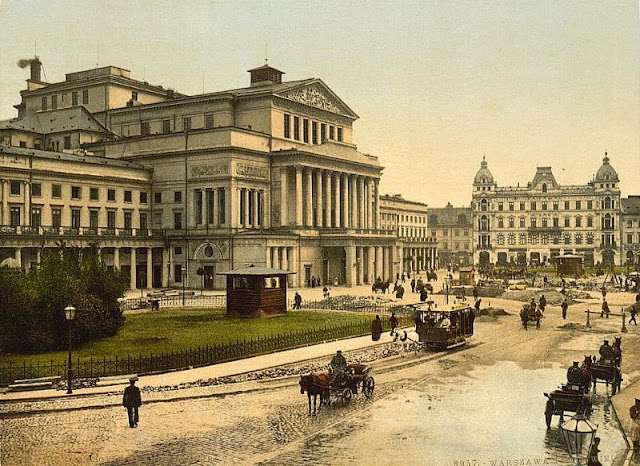
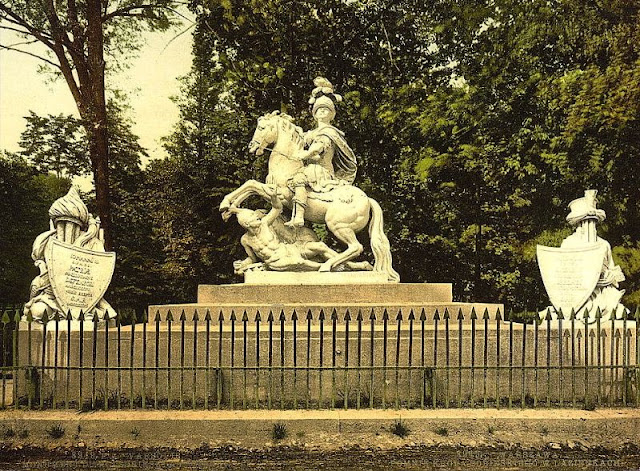
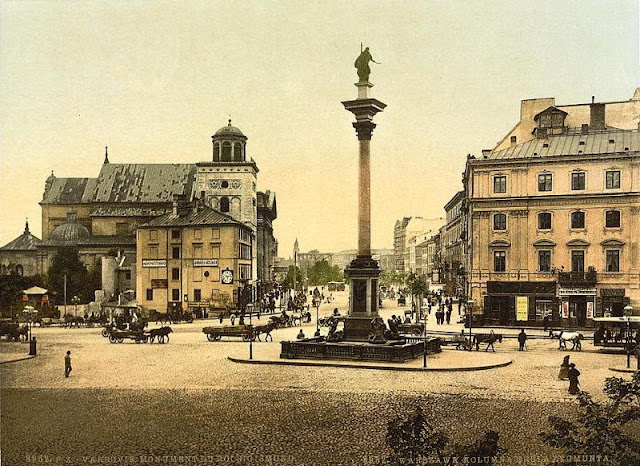
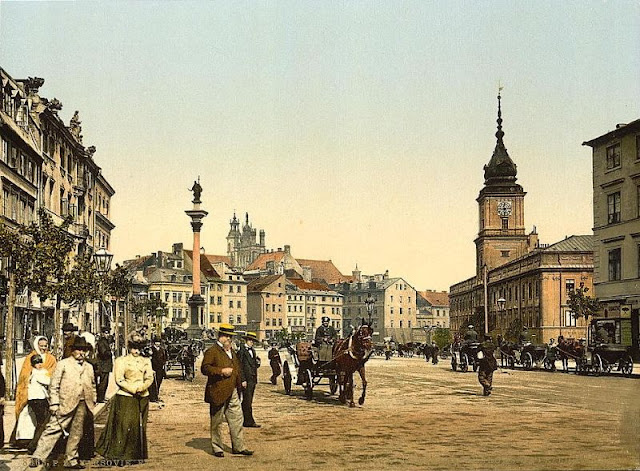
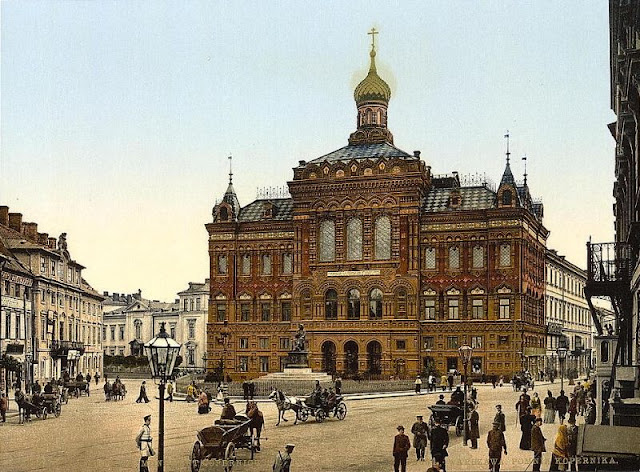
These amazing Photochrom prints from Library of Congress captured street scenes of Warsaw in 1890.

Faubourg de Cracow, Warsaw

Copernicus Monument, Warsaw

Grand theatre, Warsaw

John III Sobieski Monument at Łazienki Park, Warsaw

King Sigismund's monument, Warsaw

June 28, 2020

Warsaw in the Mid-1950s Through Amazing Color Photos

After World War II, the “Bricks for Warsaw” campaign was initiated and large prefabricated housing projects were erected in Warsaw to address the major housing shortage. Plattenbau apartment blocks were a solution to avoid Warsaw's former density problem and to create more green spaces. Some of the buildings from the 19th century that have survived in a reasonably reconstructible form were nonetheless demolished in the 1950s and 1960s, like the Kronenberg Palace.

The Śródmieście (central) region's urban system was completely reshaped; former cobblestone streets were asphalted and significantly widened for traffic use. Many notable streets such as Gęsia, Nalewki and Wielka disappeared as a result of these changes and some were split in half due to the construction of Plac Defilad (Parade Square), one of the largest of its kind in Europe.

Much of the central district was also designated for future skyscrapers. The 237-metre Palace of Culture and Science resembling New York's Empire State Building was built as a gift from the Soviet Union.

Warsaw's current urban landscape is one of modern and contemporary architecture. Despite wartime destruction and post-war remodelling, many of the historic streets, buildings, and churches were restored to their original form.

These amazing color photos from Gorm Helge Grønli Rudschinat captured street scenes of Warsaw in 1956.

Krucza Street into Bracka Street

Barbakan

Buildings of the Embassy of the People's Republic of China from Świętojerska Street

Copernicus Statue, Krakowskie Przedmieście 

Dziekania Street

January 13, 2020

30 Incredible Vintage Photos of Warsaw Uprising Have Been Brought to Life After Colorized

The intricate process of coloring black and white photographs has been carried out by Mikołaj Kaczmarek. The photographs presented here come from collections of, among others, the Warsaw Rising Museum, the Polish Press Agency, the KARTA Center as well as private collections. They are part of an exhibition prepared by the IPN’s National Education Office entitled “Warsaw Uprising 1944. Battle for Poland”.


Artist Mikołaj Kaczmarek from Gostyń, Wielkopolska, has spent years painstakingly recreating some of the key moments of the Uprising. Now the breath-taking colorized images have earned his Facebook page, Mikołaj Kaczmarek – Kolor Historii, over 54K followers, who are drawn by the shocking immediacy that color brings to people and scenes that have been known only in black and white.

However, Kaczmarek admitted that his interest in history came as a surprise to him. “I was never particularly interested in history. In fact I nearly didn’t complete the year on two occasions.”

Kaczmarek first became interested in photo colorization when he saw the film Warsaw Rising, which told the story of the battle using colorized footage. “The film made a huge impact on me,” he told The First News. “They lived in a time of apocalypse and whether they wanted to or not they had to fight and they often died. The colorization made me realize that they were people just like us, they just happened to live at that time.”

“The first photo I tried was the girl next to a grave. When I finished, I was in shock – the past just came right out at me. You might see an image of a pretty girl that looks like it was taken a week ago, but she fought in the war and died,” he added.


The Warsaw uprising began on August 1, 1944 at 5 p.m. That moment is now named in the Polish history as “Godzina W” (the W hour) with W standing for Warsaw.

Approximately 45,000 members of the AK under commandment of general Antoni Chruściel “Monter” joined the combat. They were supported by 2,500 soldiers from other resistance movements, such as the National Armed Forces (Narodowe Siły Zbrojne, NSZ) and the communist People's Army (Armia Ludowa, AL). Only a quarter of the partisans had access to weapons, fighting against 25,000 German soldiers equipped with artillery, tanks, and air forces.

Within the first few days of the uprising, Polish forces took over several districts of Warsaw, including downtown and the Old Town. After the initial success of the AK, German troops gradually recaptured the city. They surrounded the Old Town and other areas. On September 2, after more than two weeks of combat, the last Polish soldiers left the Old Town through the sewers. Warsaw’s historical district was turned into ruins. In mid-September, the Red Army took Praga, the district of Warsaw on the east bank of the Vistula River, but did not cross the river to intervene.

Towards the end of September 1944, German forces took control over further parts of Warsaw, systematically destroying most of the city to the ground. On October 2, 1944, the uprising ended. The number of victims exceeded 180,000 people. More than 11,000 AK soldiers were captured as prisoners of war, including “Bór” and “Monter.” Soviet troops resumed their offensive much later, liberating devastated Warsaw on January 17, 1945.
December 20, 2019

Shocking Photos of Germans Cutting Jews’ Beards in an Effort to Dehumanize and Psychologically Destabilize Their ‘Enemies’

Male Orthodox Jews considered their beards and sidekicks an important aspect of their religious identity. Shaving these off not only took away their ‘identity’ and served as a source of great embarrassment, but their hairless faces and shaved heads (the latter also true of women) made them look other-worldly and less human. This dehumanization made it easier for the ‘civilized’ German soldier to perceive of the Jew as an untermensch, some lower form of human, or even as non-human, ripe for isolation and/or extermination.


Most of the 1.5 million German soldiers who participated in the attack on Poland had been socialized in the Nazi state and had also undergone ideological indoctrination in the party’s mass organizations. In late 1939, 31 percent of the solders in an average German infantry division were members of a Nazi organization. One-fifth were former Hitler Youth members, between one-third and one-half had served in the Reich Labor Service (Reichsarbeitsdienst or RAD), and all had done at least one year of military training. Members of the SS and the police, most of whom had an affinity for Nazi doctrine anyway, underwent special ideological training. Propaganda and indoctrination were used to strengthen and radicalize the already widespread resentment of Poles and Jews in German society.

After the German invasion of Poland, aggressive anti-Semitism found release in “lightning pogroms” (Blitzpogrome), during which so-called Eastern Jews (Ostjuden), in particular, were humiliated, abused, and also murdered. In addition to subjecting these Jews to drills and forced labor, the regime’s henchmen often mocked them by cutting or burning off their beards – a practice that was later continued during the military campaign against the Soviet Union.

After WW II, the French were known to have shaved the heads of women who collaborated/ fraternized with the Germans.


March 25, 2017

75 Breathtaking Photographs Describe the Warsaw Uprising of 1944

The Warsaw Uprising of 1944 – a heroic and tragic 63-day (1 August – 2 October 1944) struggle to liberate World War II Warsaw from Nazi/German occupation. Undertaken by the Home Army (Armia Krajowa, AK), the Polish resistance movement, at the time Allied troops were breaking through the Normandy defenses and the Red Army was standing at the line of the Vistula River.


Warsaw could have been one of the first European capitals liberated; however, various military and political miscalculations, as well as global politics – played among Joseph Stalin, Winston Churchill and Franklin D. Roosevelt – turned the dice against it.

These breathtaking photos show a part of the fighting, also everyday life of Polish civilians during the Warsaw Uprising of 1944.

The Victoria Hotel on Jasna Street was in insurgent hands within the first hour of the uprising and soon became their headquarter

A machine gun crew on the balcony of a townhouse on Aleje Jerozolimskie

A man carrying two suitcases running across a street behind a barricade

A Polish partisan carrying a Błyskawica submachine gun and a radio

A Polish partisan from Anna company of the Gustaw battalion, throwing a grenade towards German positions

January 27, 2017

Jewish Boy Surrenders in Warsaw, 1943

The terrified young boy with his hands raised at the center of this image was one of nearly half a million Jews packed into the Warsaw ghetto, a neighborhood transformed by the ­Nazis into a walled compound of grinding starvation and death.

Photograph by unknown, 1943

Beginning in July 1942, the German occupiers started shipping some 5,000 Warsaw inhabitants a day to concentration camps. As news of exterminations seeped back, the ghetto’s residents formed a resistance group. “We saw ourselves as a Jewish underground whose fate was a tragic one,” wrote its young leader Mordecai Anielewicz. “For our hour had come without any sign of hope or rescue.” That hour arrived on April 19, 1943, when Nazi troops came to take the rest of the Jews away.

The sparsely armed partisans fought back but were eventually subdued by German tanks and flame­throwers. When the revolt ended on May 16, the 56,000 survivors faced summary execution or deportation to concentration and slave-labor camps.

SS Major General Jürgen Stroop took such pride in his work clearing out the ghetto that he created the Stroop Report, a leather-bound victory album whose 75 pages include a laundry list of boastful spoils, reports of daily killings and dozens of heart-­wrenching photos like that of the boy raising his hands.

This collection proved his undoing, for besides giving a face to those who died, the pictures reveal the power of photography as a documentary tool. At the subsequent Nuremburg war-crimes trials, the volume became key evidence against Stroop and resulted in his hanging near the ghetto in 1951. The Holocaust produced scores of searing images. But none had the evidentiary impact of the boy’s surrender. The child, whose identity has never been confirmed, has come to represent the face of the 6 million defenseless Jews killed by the Nazis.

See some pages from the Stroop Report


September 6, 2016

Warsaw in the 1930s: A Look Back at Poland's Capital Just Before World War II

The city of Warsaw, capital of Poland, flanks both banks of the Vistula River. A city of 1.3 million inhabitants, Warsaw was the capital of the resurrected Polish state in 1919.

Before World War II, the city was a major center of Jewish life and culture in Poland. Warsaw's prewar Jewish population of more than 350,000 constituted about 30 percent of the city's total population. The Warsaw Jewish community was the largest in both Poland and Europe, and was the second largest in the world, second only to New York City.

Following the German invasion of Poland on September 1, 1939, Warsaw suffered heavy air attacks and artillery bombardment. German troops entered Warsaw on September 29, shortly after its surrender.

Take a look at the capital of Poland in the 1930s to see everyday life of Warsaw before World War II.


June 4, 2015

Rising From the Ruins: Pictures of Warsaw, Poland in 1950

Most of Warsaw was destroyed by the German forces during the Second World War. The city of Warsaw was rebuilt between the 1950s and 1970 without any help from outside. Some of the landmarks had been finally reconstructed as late as the 1980s.


FOLLOW US:
Facebook • Tumblr • Pinterest • Instagram

CONTACT US


Browse by Decades

Popular Posts

Advertisement

09 10