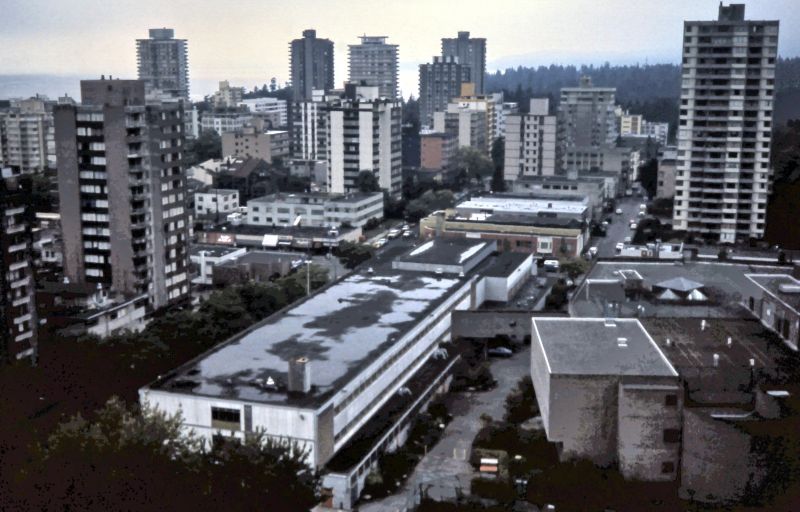
“In the winter of 1989, I was in Vancouver, British Columbia, doing a television series. It was a very difficult situation: bound by a contract doing assembly-line stuff that, to me, was borderline Fascist, (cops in school . . . Christ!). My fate, it seemed, lay somewhere between Chips and Joanie Loves Chachi. There were only a limited number of choices for me: (1) get through it as best I could with minimal abrasion; (2) get fired as fast as I could with slightly more abrasion; (3) quit and be sued for not only any money I had, but also the money of my children and my children’s children (which, I imagine, would have caused severe chafing and possible shingles for the rest of my natural days and on through the next few generations of Depps to come). Like I said, this was truly a dilemma. Choice (3) was out of the question, thanks to extremely sound advice from my attorney. As for (2), well, I tried and they just wouldn’t bite. Finally, I settled on (1): I would get by as best I could.”
ADVERTISEMENT
Showing posts with label Vancouver. Show all posts
June 10, 2023
March 21, 2022
45 Fascinating Photos Capture Street Scenes of Vancouver in the 1980s
Vancouver is a major city in western Canada, located in the Lower Mainland region of British Columbia, and the most populous city in the province. It has the highest population density in Canada, with over 5,400 people per square kilometer. Vancouver is one of the most ethnically and linguistically diverse cities in Canada: 52 percent of its residents are not native English speakers, 48.9 percent are native speakers of neither English nor French, and 50.6 percent of residents belong to visible minority groups.
![]() |
| Vancouver in the 1980s |
Vancouver is one of the most livable cities in Canada and in the world. In terms of housing affordability, Vancouver is also one of the most expensive cities in Canada and in the world. Vancouver plans to become the greenest city in the world. Vancouverism is the city's urban planning design philosophy.
As of 2016, Port Metro Vancouver is the fourth-largest port by tonnage in the Americas, the busiest and largest in Canada, and the most diversified port in North America. While forestry remains its largest industry, Vancouver is well known as an urban centre surrounded by nature, making tourism its second-largest industry. Major film production studios in Vancouver and nearby Burnaby have turned Greater Vancouver and nearby areas into one of the largest film production centers in North America, earning it the nickname “Hollywood North”.
These fascinating photos from CanadaGood Gregory that captured street scenes of Vancouver in the 1980s.
![]() |
| PR railway trestle and the Burrard Street bridge as seen from Granville Street Bridge, Vancouver, 1980 |
![]() |
| Flying Karamazov Brothers at Vancouver Folk Festival in Jericho Beach Park, Vancouver, 1982 |
![]() |
| Looking east from 1200 block of West Broadway in Vancouver, 1982 |
![]() |
| View of back laneway parking and apartment building lawn as seen from Burnaby Street apartment, Vancouver, 1982 |
![]() |
| View west from apartment on Barclay Street, Vancouver, 1983 |
August 24, 2021
‘Sad Town’: Extraordinary Vintage Color Photos of Vancouver From 1972 to 1982
A renowned photographer and a brilliant documenter, but before Greg Girald became widely known he was just a teenager prowling the streets of a pre-globalized Vancouver with his camera. To his eyes at the time, despite it was the early seventies, somehow parts of the Terminal City and its residents seemed to get trapped in the ‘50s or earlier. “When I started making these photographs, especially the pictures of people in the mid-1970s, I felt like I was photographing a world nobody knew anything about, apart from the people living it, of course.” Girald said. “I was something of an interloper, but my youth protected me. It’s curious to consider these pictures now, practically unseen since they were made, in terms of a Vancouver they might have some potential to invent.”
“A sad town” was how Girald felt about Vancouver. “It maybe had something to do with the way the natural beauty surrounding the city was at odds with the more down-at-the-heel parts of town where I was spending time. In those days, Vancouver was more obviously a port town, the last stop at the end of the rail line. ‘Terminal City’ as they say, a place where people ended up. Something that most port cities probably have in common.” He added. “When Nina Simone did her rendition of ‘Baltimore,’ singing about a ‘hard town by the sea’ where it was ‘hard just to live,’ I felt she was singing about the place I was living. Which might sound odd, considering the Vancouver of today. It would be like a mournful song about Aspen or Honolulu. Though why not? The prettiest places can be the most ruthless.”
Girald’s early work of the city ended in 1982, when he left for Asia, and did not return after a few decades. His photographs from that era were collected in his book Under Vancouver: 1972-1982. For more of Girald’s brilliant work, check out his website.
“A sad town” was how Girald felt about Vancouver. “It maybe had something to do with the way the natural beauty surrounding the city was at odds with the more down-at-the-heel parts of town where I was spending time. In those days, Vancouver was more obviously a port town, the last stop at the end of the rail line. ‘Terminal City’ as they say, a place where people ended up. Something that most port cities probably have in common.” He added. “When Nina Simone did her rendition of ‘Baltimore,’ singing about a ‘hard town by the sea’ where it was ‘hard just to live,’ I felt she was singing about the place I was living. Which might sound odd, considering the Vancouver of today. It would be like a mournful song about Aspen or Honolulu. Though why not? The prettiest places can be the most ruthless.”
Girald’s early work of the city ended in 1982, when he left for Asia, and did not return after a few decades. His photographs from that era were collected in his book Under Vancouver: 1972-1982. For more of Girald’s brilliant work, check out his website.
November 16, 2020
Mattie on a Hot Stove, 1902
November 16, 2020
1900s, British Columbia, Canada, female, humor & hilarious, photography, Vancouver
This vintage photo shows photographer Mattie Gunterman being punished for some transgression at the Nettie L cookhouse near Ferguson, British Columbia by sisters Annie and Rose Williams, ca. 1902.
![]() |
| Mattie Gunterman (on stove) and Ann and Rose Williams, Nettie L mine cookhouse, Ferguson, ca. 1903. (Vancouver Public Library) |
The photo has appeared in numerous books and magazines since it was first published in Bruce Ramsey’s Ghost Towns of British Columbia in 1963. Ramsey was there when the glass plate negative was salvaged from a barn in Beaton in July 1961. It’s now held by the Vancouver Public Library.
At the turn of the 20th century, portraits were usually stiffly posed and subjects showed no emotion or frowned (smiling was either illegal until the 1920s or hadn’t been invented yet). So humorous images from that era are something of a revelation.
October 27, 2020
22 Rare and Amazing Photographs Capture People Crossing Capilano Suspension Bridge in Vancouver, Canada From the Early 20th Century
October 27, 2020
1900s, 1910s, 1920s, architecture & construction, Canada, event & history, life & culture, people, Vancouver
The Capilano Suspension Bridge is a simple suspension bridge crossing the Capilano River in the District of North Vancouver, British Columbia, Canada. The current bridge is 140 meters (460 ft) long and 70 meters (230 ft) above the river. It is part of a private facility with an admission fee, and draws over 1.2 million visitors per year.
In 1888, George Grant Mackay, a Scottish civil engineer and land developer, arrived in the young city of Vancouver in Canada. Mackay purchased 6,000 acres of dense forest on either side of Capilano River and built a cabin on the very edge of the canyon wall. In 1889 he suspended a footbridge made of hemp rope and cedar planks across the canyon with the help of August Jack Khahtsahlano and a team of horses who swam the ropes across the river. The ropes were then pulled up the other side and anchored to huge buried cedar logs.
The bridge, and Mackay’s cabin, became a popular destination for adventurous friends, dubbed Capilano Tramps, who made a long journey by steamship before ‘tramping’ up the rough trail to Mackay’s property. After his death, the hemp rope bridge was replaced by a wire cable bridge in 1903.
Edward Mahon arrived in Vancouver in 1888 and began mining operations in the Nelson-Slocan area, naming the camp Castlegar after his ancestral home in Ireland. Returning to Vancouver, he purchased and developed land and businesses on the North Shore, among them Capilano Suspension Bridge.
In 1910, 48 year old Mahon met and fell in love with Lilette, the 19 year old daughter of his deceased friend, James Rebbeck. He arranged for Lilette’s mother, Elizabeth to manage his bridge property. The plan worked – he married Lilette a year later. Mahon built the Tea House in 1911 and continued to improve the Capilano Suspension Bridge property, reinforcing the bridge with additional cables in 1914.
Elizabeth was lonely after Lilette married, until she met a handsome young forest ranger, “Mac” MacEachran, who was 20 years her junior. Mac swept her off her feet and they married in 1921. Mac was an aggressive promoter, advertising the bridge as the ‘eighth wonder of the world’. Meagre earnings forced Mac to seek employment elsewhere in the off-season and for several winters he managed warehouses in Tahiti for rum-running friends.
In 1934 Mac announced to Elizabeth that he had a 19 year old daughter, Irene, whom he wished to bring to Capilano. Arrangements were made to build a new and larger house across the street from the bridge but sadly, Elizabeth died. Mac purchased the Bridge from Mahon in 1935 and invited local First Nations to place their totem poles in the park. In 1945, he sold the bridge to Henri Aubeneau and moved to California.
In 1953 Rae Mitchell purchased the bridge property from Henri Aubeneau and aggressively promoted his attraction world-wide. He completely rebuilt the bridge in 5 days in 1956, encasing the cables in 13 tons of concrete at either end. He developed the trails on the west side of the bridge and converted the Tea House into the Trading Post Gift Store.
July 11, 2020
30 Amazing Photos Capture Billboards of Vancouver in the 1970s
Vancouver is a major city in western Canada, located in the Lower Mainland region of British Columbia. It has the highest population density in Canada and it is one of the most ethnically and linguistically diverse cities in Canada.
Vancouver is consistently named as one of the top five worldwide cities for livability and quality of life, and the Economist Intelligence Unit acknowledged it as the first city ranked among the top ten of the world's most well-living cities for ten consecutive years.
While forestry remains its largest industry, Vancouver is well known as an urban centre surrounded by nature, making tourism its second-largest industry.
Major film production studios in Vancouver and nearby Burnaby have turned Greater Vancouver and nearby areas into one of the largest film production centres in North America, earning it the nickname “Hollywood North”.
These amazing photos were taken by POP SNAP that show billboards of Vancouver in the 1970s.
Vancouver is consistently named as one of the top five worldwide cities for livability and quality of life, and the Economist Intelligence Unit acknowledged it as the first city ranked among the top ten of the world's most well-living cities for ten consecutive years.
While forestry remains its largest industry, Vancouver is well known as an urban centre surrounded by nature, making tourism its second-largest industry.
Major film production studios in Vancouver and nearby Burnaby have turned Greater Vancouver and nearby areas into one of the largest film production centres in North America, earning it the nickname “Hollywood North”.
These amazing photos were taken by POP SNAP that show billboards of Vancouver in the 1970s.
December 9, 2019
Fascinating Snaps Captured People Walking on Vancouver's Streets in the 1950s
“When I started back in 1934,” Foncie Pulice recalled in that interview, “there were six companies in Vancouver, but when we really started to go was during the war. The public couldn’t get film, you see, so the street photographers were all they had. Servicemen would come home on leave, they’d have pictures taken. Families would get together, we’d take their picture. At one time, I was taking 4,000 to 5,000 pictures every day.”
On September 27, 1979, street photographer Foncie Pulice took his last picture. He and his Electric-Photo camera had been a familiar sight on city streets for a jaw-dropping 45 years. He’d begun as a 20-year-old away back in 1934 as an assistant to street photographer Joe Iaci, and had taken millions of photographs since. (It is possible Foncie Pulice photographed more people than anyone who ever lived.) “I said I’d retire at 65, and I kept my word,” Foncie said in a November 21, 1979 interview in the Province.
Foncie Pulice was the last of the street photographers. He died January 20, 2003 at age 88, but his work lives on . . . everywhere.
These fascinating snapshots are part of his work that Foncie captured people walking on streets in Vancouver from the 1950s.
November 27, 2019
40 Fascinating Pics Capture Street Scenes of Vancouver From Between the 1930s and '50s
Vancouver is a coastal seaport city in western Canada, located in the Lower Mainland region of British Columbia, as the most populous city in the province and the fifth-most densely populated city in North America, behind New York City, Guadalajara, San Francisco, and Mexico City.
Vancouver is one of the most ethnically and linguistically diverse cities in Canada. It is consistently named as one of the top five worldwide cities for livability and quality of life.
Port Metro Vancouver is the fourth-largest port by tonnage in the Americas, the busiest and largest in Canada, and the most diversified port in North America. While forestry remains its largest industry, Vancouver is well known as an urban centre surrounded by nature, making tourism its second-largest industry.
Take a look at these fascinating black and white pics from Vancouver Public Library Historical Photographs to see street scenes of Vancouver from between the 1930s and 1950s.
![]() |
| Street scenes of Vancouver from between the 1930s and '50s |
Vancouver is one of the most ethnically and linguistically diverse cities in Canada. It is consistently named as one of the top five worldwide cities for livability and quality of life.
Port Metro Vancouver is the fourth-largest port by tonnage in the Americas, the busiest and largest in Canada, and the most diversified port in North America. While forestry remains its largest industry, Vancouver is well known as an urban centre surrounded by nature, making tourism its second-largest industry.
Take a look at these fascinating black and white pics from Vancouver Public Library Historical Photographs to see street scenes of Vancouver from between the 1930s and 1950s.
![]() |
| Beacon Theatre in old Pantages Theatre location, 20 West Hastings Street, Vancouver, BC, 1932 |
![]() |
| Capitol Theatre, 820 Granville Street, Vancouver, BC, 1934 |
![]() |
| Granville Street looking South from Dunsmuir, Vancouver, BC, 1936 |
![]() |
| Globe Theatre 800 block of Granville Street, Vancouver, BC, 1937 |
![]() |
| Granville Street, Vancouver, BC, 1937 |
December 25, 2018
55 Impressive Photos That Capture Street Scenes of Vancouver in the Late 1970s
These impressive photographs were taken by Canadian photographer POP SNAP that shows street scenes of Vancouver from 1977 to 1979. Take a look to see how it has changed for over 40 years.
![]() |
| Vancouver, July 1977 |
![]() |
| 195 W. 23rd Ave., Vancouver, 1977 |
![]() |
| E.Hastings at Vernon, Vancouver, December 1977 |
![]() |
| Eye Scream/N.E.Thing, Vancouver, July 1977 |
![]() |
| Firebird at Spanish Banks, Vancouver, 1977 |
June 18, 2018
The Lost Vancouver: Fred Herzog's Early Color Street Photographs of Canada From the 1950s and 1960s
Fred Herzog arrived in Vancouver in 1953. The young German immigrant was fascinated by all aspects of Canadian life, and set out to document it with his camera. He worked as a medical photographer by day, and on evenings and weekends he took his camera to the streets, documenting daily life.
A pioneer of color photography, Herzog largely worked with Kodachrome, a slide film that was tricky to use in a spontaneous fashion, and required expensive developing in specialist labs. He was never able to make satisfactory prints from his slides, but digital inkjets have enabled him to print and exhibit early work.
![]() |
| Family on Lawn, 1959 |
![]() |
| Elysium Cleaners, 1958 |
![]() |
| Hastings and Columbia Street, 1958 |
![]() |
| Paris Cafe, 1959 |
![]() |
| Squatter, Railroad Tracks, 1961 |