Bring back some good or bad memories


ADVERTISEMENT
Showing posts with label Syria. Show all posts

June 16, 2023

A Pair of 2,000 Year-Old Roman Children’s Shoes Found in the Ruins of Palmyra, Syria

The discovery of a pair of 2,000-year-old Roman children’s shoes in the ruins of Palmyra provides valuable historic context to the ancient city and the broader Roman Empire. Palmyra, located in present-day Syria, was once a flourishing oasis city on the Silk Road, serving as a vital center of trade and culture.
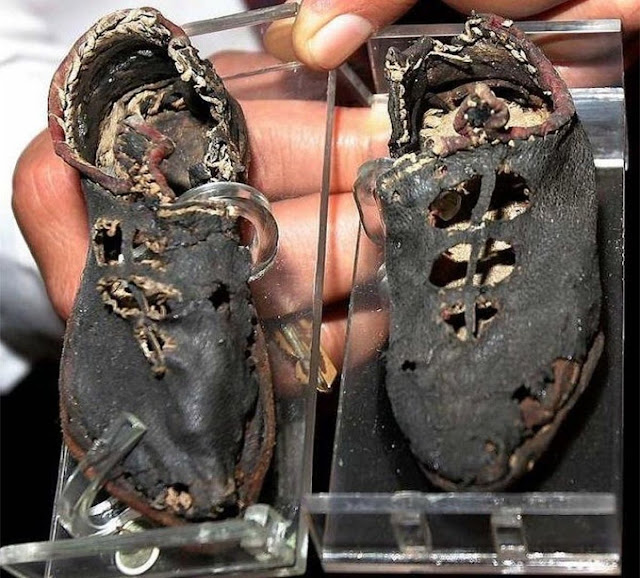

During the Roman period, which spanned from the 1st century BCE to the 3rd century CE, Palmyra enjoyed significant prosperity and emerged as an important regional power. The city thrived under Roman rule, benefiting from its strategic location and favorable economic conditions. Palmyrene merchants engaged in extensive commerce, connecting the Mediterranean world with the East, resulting in the city’s cosmopolitan character and wealth.

The discovery of the children’s shoes offers a glimpse into the daily lives and material culture of the inhabitants of Palmyra during this period. Shoes were essential items for both children and adults, providing protection and comfort while traversing the ancient streets and engaging in various activities. By examining the shoes, archaeologists can gain insights into ancient Roman footwear design, materials, and craftsmanship.

Furthermore, the finding of these shoes is a testament to the enduring archaeological significance of Palmyra. The city’s ruins, including the iconic Temple of Bel, the Arch of Triumph, and the Valley of the Tombs, have attracted explorers, scholars, and historians for centuries. Unfortunately, Palmyra has also faced significant threats in recent years due to the ongoing conflict in Syria. The presence of well-preserved artifacts like the Roman children's shoes highlights the importance of preserving and protecting cultural heritage sites in times of turmoil.

Studying these shoes within the broader historical context of the Roman Empire allows historians to reconstruct aspects of daily life, fashion, and societal norms of the time. It provides valuable evidence of the interconnectedness of ancient civilizations, as well as the lasting influence of Roman culture in regions far beyond the borders of Italy.

In summary, the discovery of 2,000-year-old Roman children’s shoes in the ruins of Palmyra contributes to our understanding of the city’s role in the Roman Empire and offers insights into the material culture and daily lives of its inhabitants. These artifacts provide a tangible connection to the past and underscore the importance of preserving and studying cultural heritage in an ever-changing world.

June 9, 2018

Amazing Color Photographs of Syria in the Early 1950s

Syria, country located on the east coast of the Mediterranean Sea in southwestern Asia. Its area includes territory in the Golan Heights that has been occupied by Israel since 1967. The present area does not coincide with ancient Syria, which was the strip of fertile land lying between the eastern Mediterranean coast and the desert of northern Arabia. The capital is Damascus (Dimashq), on the Baradā River, situated in an oasis at the foot of Mount Qāsiyūn.

Syria has been at war for seven years. The most recognizable images of the country today depict bombed-out buildings, piles of rubble, and displaced citizens.

Below is a collection of some of amazing color photographs of Syria which were taken in 1952.


November 1, 2015

Damascus 50 Years Ago: 20 Beautiful Color Photos Show What Syria’s Capital City Looked Like in the Mid-1960s

Syria has been the site of one of the worst conflicts on Earth for the past four and a half years. The most recognizable images of the country today depict bombed-out buildings, piles of rubble, and displaced citizens.

A collection of beautiful images taken fifty years ago by Charles W. Cushman are a stark contrast.


May 23, 2015

Pictures of Syria in 1940: Crossroads of the Middle East During World War II

In 1940, seven months before the United States entered World War II and nine months after Germany invade Poland, LIFE sent photographer Margaret Bourke-White to the young republic in order to document Syria's pivotal role—cultural, geographical, military—in the region.

Here's a collection of rare photographs which many of them did not run in LIFE before, featuring Damascus, Homs, Aleppo and other Syrian cities and towns as they appeared in the middle part of the last century.

A view of Damascus, Syria, 1940.

Raising the French flag at Aleppo, Syria, 1940.

Women carry water containers on their heads as they lead mules along a road in a desert village near Damascus, Syria, 1940.

Members of the Bedouin "camel cavalry" near Damascus, Syria, 1940.

Street scene, Damascus, Syria, 1940.

February 19, 2014

The Oldest Panoramas of Constantinople and Damascus, ca. 1843

Until recently, pioneering daguerreotypist Joseph-Philibert Girault de Prangey was unknown in the world of fine-art photography. His extraordinary images were discovered in a storeroom of his estate in the 1920s and only made known some eighty years later.

Girault de Prangey studied painting at the École des Beaux-Arts in Paris and learned daguerreotypy in 1841, the same year inventor Louis-Jacques-Mandé Daguerre publicly demonstrated the process. Girault de Prangey may have learned photography from Daguerre himself, or from Hippolyte Bayard, with whom he shared a mutual artist friend.

Aside from his creative interests, Girault de Prangey was an avid student of Ancient Near East architecture and in 1842 embarked on a three-year tour of Italy, Greece, Egypt, Turkey, Syria, and Palestine. He carried hundreds of pounds of photography equipment and made more than 800 daguerreotypes. His pictures of the Acropolis are the earliest surviving photographs of the famous site.

After returning to his home in Langres, France, Girault de Prangey made watercolor and pen-and-ink studies after his photographs and created a small-edition publication of lithographs from them. He also made stereographs of his estate and the exotic plants he collected. Girault de Prangey was apparently quite proud of his Near East photographs but did not exhibit or otherwise make them known before his death in 1892.

Constantinople, 1843

Damascus, 1843

(Photos by Joseph-Philibert Girault de Prangey)

February 9, 2014

Black and White Photographs of Syria in 1940

In 1940, seven months before the United States entered World War II and nine months after Germany invade Poland, LIFE sent photographer Margaret Bourke-White to the young (and, as it turned out, short-lived) republic in order to document Syria’s pivotal role — cultural, geographical, military — in the region. Eight decades later, in photographs that ran in LIFE and many more that did not, LIFE.com recalls Damascus, Homs, Aleppo and other Syrian cities and towns as they appeared in the middle part of the last century.


A view of Damascus, Syria, 1940.

Women carry water containers on their heads as they lead mules along a road in a desert village near Damascus, Syria, 1940.

Members of the Bedouin "camel cavalry" near Damascus, Syria, 1940.

Street scene, Damascus, Syria, 1940.

View of the downtown area of Aleppo from atop the ramparts of the great citadel built in the 4th century B.C.


FOLLOW US:
FacebookTumblrPinterestInstagram

CONTACT US


Browse by Decades

Popular Posts

Advertisement

09 10