Bring back some good or bad memories


ADVERTISEMENT
Showing posts with label St. Louis. Show all posts

February 4, 2023

Mississippi River Frozen Solid, February 1905

A woman standing on the Mississippi River beneath the Eads Bridge at St. Louis, Missouri in 1905. Dozens of people can be seen standing behind her, walking across the frozen river.


When the Mississippi River freezes over, it’s called an “ice gorge.” The river froze completely in St. Louis at least 10 times between 1831 and 1938, before the completion of the Alton Lock and Dam.

January 3, 2023

In 1936, the Mississippi River Was Frozen Allowing Individuals to Walk Across the River to Illinois

In February 1936, the Midwest suffered from extreme cold with temperatures falling below -10 degrees. The bitter cold was felt throughout the State but St. Louis was hit the hardest. A few consecutive days of biting temperature led to an ice floe in Mississippi River. It marked one of the hardest days for residents as coal supplies lessened and transportation was greatly affected. Trains inched their way to the Union Station enveloped with chilling snow. Homeless vagrants were also seen in doorways throughout the downtown area frozen in ice.

Though this was not the first recorded instance the Mississippi River froze, it was one that was worth remembering. City Engineers warned the general population never to cross the rivers on foot, but some daring people did not heed the warning. People boldly defied the warning by scrambling to cross the river on Feb. 7. They crossed from Gasconade St., south of St. Louis, all the way to the other end. Several days later, a group of people also crossed from the Municipal Bridge located downtown. Although ice sheets held strong, temporary breaks would happen because of water level changes. The river was able to hold the pressure for almost three weeks until it started to give away. The first victim to fall into the cold river was a dog who was lassoed out of the freezing water.

This has not been the first recorded instance the Mississippi River froze. Several accounts have been recorded and 1936 froze over is the third coldest recorded. The St. Louis area has been hit for at least 10 times during the years 1891 up until 1938. Only after the Alton Lock and Dam were built did ice formation from upper Mississippi to the Illinois River flow stopping the Mississippi River from experiencing another froze over.

Three men prepare to walk across the river from the foot of Gasconade Street in south St. Louis on Feb. 7, 1936, after a massive ice jam covered the river. They managed to get across.

People walking across the frozen Mississippi River from East St. Louis to St. Louis on Feb. 12, 1936. The Municipal (later MacArthur) Bridge piers are in the background.

Three women standing on the frozen Mississippi River on Feb. 15, 1936.

R. D. Schmickle of the U.S. Geological Survey prepares to operate a device that measures the speed of the Mississippi’s current on Feb. 22, 1936. He is lowering the torpedo-shaped instrument into a hole cut into the river ice atop the middle of the channel.

U.S. Geological Survey engineers measure current over the channel on Feb. 22, 1936, near the foot of Davis Street, in Carondelet.

A man examines some of the chunks of ice along the St. Louis riverfront on Feb. 26, 1936, after the ice jam across the Mississippi river began breaking up.

The breakup of the ice jam on Feb. 26, 1936, mangled the Missouri Pacific Railroad approach to a ferry landing at the foot of Davis Street, in Carondelet. The ferry ran to East Carondelet, Ill.

July 18, 2021

Picturing 1930s St. Louis: An Introduction

St. Louis is the second-largest city in Missouri, United States. It sits near the confluence of the Mississippi and the Missouri Rivers, on the western bank of the latter. It is the largest metropolitan area in Missouri, the second-largest in Illinois, the seventh-largest in the Great Lakes Megalopolis, and the 22nd-largest in the United States.

A “Gamma” global city, St. Louis has a diverse economy with strengths in the service, manufacturing, trade, transportation, and tourism industries. It is home to nine of the ten Fortune 500 companies based in Missouri.

Major research universities include Saint Louis University and Washington University in St. Louis. The Washington University Medical Center in the Central West End neighborhood hosts an agglomeration of medical and pharmaceutical institutions, including Barnes-Jewish Hospital.

Among the city’s notable sights is the 630-foot (192 m) Gateway Arch in the downtown area. St. Louis is also home to the St. Louis Zoo and the Missouri Botanical Garden, which has the second-largest herbarium in North America.

These amazing photos from Missouri Historical Society will give you a glimpse into St. Louis in 1931.

"Then and now” photo of two Oldsmobile cars. The vintage 1897 model Oldsmobile is parked next to a new 1931 Oldsmobile. Photo by Ed Meyer, June 1931

A speaker addresses the crowd at the dedication of the new Castle Point subdivision at the corner of Halls Ferry and Chambers roads in north St. Louis County. Photo by Isaac Sievers, June 1931

Banquet held at the Forest Park Hotel for the nurses of St. John’s Hospital. Photo by Isaac Sievers, May 1931

Boat-shaped car used by Anheuser-Busch to promote the brand. Photo by Sievers Studio, May 1931

Dodge half-ton truck decorated with signs complaining about its poor quality. Photo by Isaac Sievers, May 1931

May 23, 2021

St. Louis World’s Fair in 1904 Through Amazing Photos

The Louisiana Purchase Exposition, informally known as the St. Louis World’s Fair, was an international exposition held in St. Louis, Missouri, United States, from April 30 to December 1, 1904. Local, state, and federal funds totaling $15 million were used to finance the event.

St. Louis World’s Fair in 1904

More than 60 countries and 43 of the then-45 American states maintained exhibition spaces at the fair, which was attended by nearly 19.7 million people.

Historians generally emphasize the prominence of themes of race and empire, and the fair’s long-lasting impact on intellectuals in the fields of history, art history, architecture and anthropology. From the point of view of the memory of the average person who attended the fair, it primarily promoted entertainment, consumer goods and popular culture.

Here below is a set of amazing photos that show the St. Louis World’s Fair in 1904.

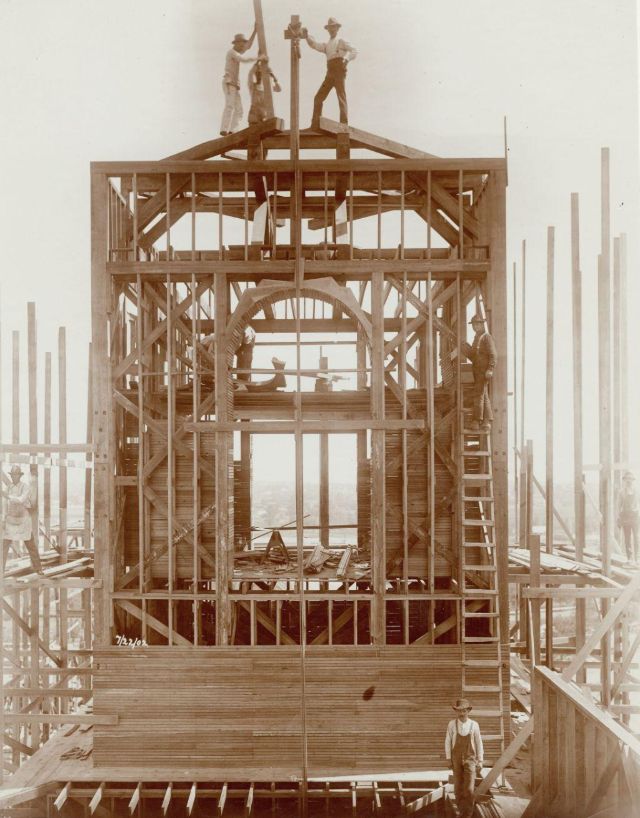
Carpenters at work on the Palace of Varied Industries during construction for the 1904 World's Fair, 1902

Dome and section of the roof truss for the Palace of Varied Industries building during construction for the 1904 World's Fair, 1902

Workers building the Palace of Education for the 1904 World's Fair, 1902

Workers hoisting the first piece of staff onto the Palace of Varied Industries for the 1904 World's Fair, 1902

Workers making window sashes for the Palace of Varied Industries during the construction phase for the 1904 World's Fair, 1902-03

January 14, 2021

25 Amazing Color Photos of St. Louis, Missouri in the Late 1940s and Early ’50s

St. Louis is the second-largest city in Missouri, and sits on the western bank of the Mississippi River, which forms the state line between Illinois and Missouri. The Missouri River merges with the Mississippi River 15 river miles north of Downtown St. Louis, forming the fourth-longest river system in the world.

Street scenes of St. Louis, Missouri from 1949 to 1951


Greater St. Louis is the largest metropolitan area in Missouri, second-largest in Illinois, seventh-largest in the Great Lakes Megalopolis, and the 22nd-largest in the United States.

Major research universities include Saint Louis University and Washington University in St. Louis. The Washington University Medical Center in the Central West End neighborhood hosts an agglomeration of medical and pharmaceutical institutions, including Barnes-Jewish Hospital.

Among the city's notable sights is the 630-foot (192 m) Gateway Arch in the downtown area. St. Louis is also home to the St. Louis Zoo, and the Missouri Botanical Garden, with the second-largest herbarium in North America.

These amazing color photos were taken by photographer Erwin Louis Ocker that show street scenes of St. Louis from 1949 to 1951.

Forest Park, Jewell Box, 1949

Forest Park, Lindell & Kingshighway Blvd., 1949

Forest Park, Shelter House & Gardens, 1949

Forest Park, Shelter House & Gardens, 1949

Fox Theatre and the Continental Life Building, Grand & Washington Avenue looking West. “Look for the Silver Lining” is playing at the Fox, 1949

October 26, 2020

The Photoscope, a Photobooth Sans Booth From 1904

Self proclaimed to be one of the most interesting and novel inventions at the St. Louis World’s Fair of 1904. And it was...


This photoscope (a photobooth sans booth) would take a photograph, develop it, and produce a picture in a minute. All for a nickel. It was a big hit at the fair. 200 in operation at the St. Louis Exposition.

Here are more ads of this device from 1904.


July 23, 2020

July 23, 1904: The First Ice Cream Cone Created During the St. Louis World’s Fair, Reputedly by Charles E. Menches

On July 23, 1904, according to some accounts, Charles E. Menches conceived the idea of filling a pastry cone with two scoops of ice cream and thereby invented the ice cream cone. He is one of several claimants to that honor: Ernest Hamwi, Abe Doumar, Albert and Nick Kabbaz, Arnold Fornachou, and David Avayou all have been touted as the inventor(s) of the first edible cone. Interestingly, these individuals have in common the fact that they all made or sold confections at the St. Louis World’s Fair.

Children and their mother enjoy ice cream cones at the St. Louis World’s Fair. The fair certainly helped make ice cream cones popular, but they probably were invented by a New Yorker who obtained a patent in 1903. (Image courtesy Missouri History Museum)

It is believed that Italo Marchiony, who migrated from Italy in the late 19th century, produced the first ice cream cone in 1896 in New York City. They give credit to Menches for introducing and popularizing ice cream cones rather than for creating it. The patent for cone-making was awarded to Italo Marchiony in 1903. Marchiony was a street vendor on Wall Street where he sold lemon ices from a pushcart to Wall Street brokers and runners. He had been working on a cone-making device since 1896 and filed for a patent in 1902.

Opening-day crowds at the St. Louis World’s Fair gather outside the Palace of Varied Industries, one of a dozen massive exhibition halls featuring the industrial, agricultural and cultural output of America. The palace was just north of the Grand Basin, on land now part of the Forest Park golf course. (Image courtesy Missouri History Museum)

Some of the people who attended the more than two hours of speeches on April 30, 1904, opening day of the St. Louis World’s Fair. In the left background is Festival Hall, built upon what now is called Art Hill. (Image courtesy Missouri History Museum)

The 264-foot-tall Ferris Wheel, a major attraction at the fair, which was installed in Forest Park near Skinker and Forsyth boulevards. It first was used at the Columbian Exposition in Chicago in 1893, then brought down to St. Louis for the Louisiana Purchase Exposition. Each of its 36 cars could hold 40 people. After the fair, the wheel was scrapped. Its axle supposedly was buried in the park. Just where it might be is one of the enduring mysteries of the fair. (Image courtesy Missouri History Museum)

Visitors enjoy a water-chute ride at the St. Louis World’s Fair. (Image courtesy Missouri History Museum)

A view down the Ten Million Dollar Pike, a midway of amusements and concessions. It ran along the north side of Lindell Boulevard west of DeBaliviere Avenue. It was one of the fair’s most popular features. (Image courtesy Missouri History Museum)

May 22, 2019

Amazing Color Photos Document Memories From Parks College, St. Louis in 1969

Parks College of Engineering, Aviation and Technology is a college within Saint Louis University.

Founded by Oliver Parks in 1927. Parks Air College was America's first federally certified school of aviation, holding the FAA Air Agency Certificate no. 1. Oliver Parks bought 100 acres in East St. Louis in 1928, and built five buildings the same year. By 1929 Parks operated 35 TravelAir trainers with an enrollment of 600 students.

Now known as Parks College of Engineering, Aviation, and Technology, it is a modern, growing, active part of the university.

These amazing photos from Saint Louis University Libraries Digitization Center that documented various activities of faculty, staff, and students engaged in study, classroom activities and recreation in 1969.

Walking to class

Welcome National Intercollegiate Flying Association (NIFA)

Academy bugler

Aerolab 4-inch supersonic tunnel

Aerospace Engineering Directory

November 4, 2017

America’s Oldest Mugshots: See Incredible Photos of Criminals Made by St. Louis Police Department Between 1857 and 1867

A hundred and fifty years ago, shortly after the invention of photography, some police departments began making images of convicted criminals. Shayne Davidson, a visual artist based in Ann Arbor, Michigan, has delved into a collection of photographs made by the St. Louis Police Department between 1857 and 1867. The archive, held at the Missouri History Museum, comprises the oldest extant examples of mugshots in the U.S.


Rogues’ galleries, as mugshot collections were called, became widespread in the late 19th century as one of the earliest and simplest uses of images used by police to “know” and control populations. They were later replaced, in 1888, with the standardized frontal and profile mugshots developed by French police officer and biometrics researcher Alphonse Bertillon.

Though never produced as art objects, mugshots and police photos have become hot items for collectors in recent decades. The passage of time provides a romantic veneer to the harsh realities of the pictures.

This gem ambrotype of John Lockhart was called the first photo in the "illustrious collection."

After he was arrested for embezzlement, Joseph Johnson was unable to post bail and sent to jail to await his trial.

Elizabeth Wohlman was accused of stealing jewelry from Eugene Jaccard and Co. and sentenced to the Missouri State Penitentiary. She was eventually pardoned by Governor Thomas Fletcher.

John Fight, a native of Ireland, was convicted of grand larceny in St. Louis and went on to serve two years in the Missouri State Penitentiary.

Dave Marshal was a suspected "moll buzzer," that is, a thief who pickpockets or steals women's purses.

June 26, 2016

Missouri in the Earliest Photography: 24 Rare Vintage Photos That Capture Everyday Life in St. Louis From 1848-70

Thomas Easterly (1809–1882), a native of Vermont, was an itinerant photographer in Iowa and the upper Midwest until 1848 when he settled in St. Louis. He operated a daguerreotype studio in the city until the 1870s.

Thomas photographed mostly portrait, but street and urban photography were parts in his work. Here are some rare photographs capturing everyday life in St. Louis from 1848 to 1870 by Thomas Easterly.

Canton Tea Company and Union Fire Company, 1848

Chouteau's Pond, 1851

Chouteau's Pond, ca. 1854

Chouteau's Pond, view south from 8th and Clark Streets, 1850

Cracker Castle, ca. 1866


FOLLOW US:
FacebookTumblrPinterestInstagram

CONTACT US


Browse by Decades

Popular Posts

Advertisement

09 10