Bring back some good or bad memories


ADVERTISEMENT
Showing posts with label Saigon. Show all posts

January 19, 2026

When Brad Pitt and Angelina Jolie Riding Around Vietnam’s Southern Ho Chi Minh City on a Motorcycle in 2006

In November 2006, one of the most famous couples in Hollywood history, Brad Pitt and Angelina Jolie, surprised the world, and the people of Ho Chi Minh City, by appearing as ordinary tourists. Their visit has since become a legendary piece of “Brangelina” lore in Vietnam.

The couple arrived unannounced on Wednesday, November 22, 2006, flying in from Cambodia. They stayed at the Park Hyatt Hotel in District 1, but rather than using a fleet of black SUVs or heavy security, they chose to blend in.

On Thanksgiving Day, November 23, they decided to explore the city like locals. Pitt rented a Yamaha Nouvo, a common automatic scooter in Vietnam at the time. Passersby were stunned to see “Mr. & Mrs. Smith” weaving through Saigon’s chaotic, buzzing traffic. Pitt drove while Jolie sat behind him, both dressed in casual clothes and sunglasses.

They were spotted driving past the Ho Chi Minh City People’s Committee Building (City Hall), through the city center, and eventually heading toward Ben Thanh Market for some shopping. When a reporter from the Tuoi Tre newspaper asked if he was worried about the “chaotic” traffic, Pitt simply smiled and replied, “There will be no problem.”

The couple spent their evening at Temple Club, a popular restaurant on Ton That Thiep Street converted from an old temple. They reportedly enjoyed a quiet dinner, with Brad describing Vietnam as “wonderful.”

Beyond sightseeing, this trip laid the groundwork for their deep connection to the country. During this visit, they stopped at the Tam Binh Orphanage in Thu Duc. It was here that they first met a three-year-old boy named Pham Quang Sang, whom Angelina Jolie would officially adopt a few months later in early 2007, renaming him Pax Thien.


October 23, 2024

Saigon in 1970 by Dick Hughey

Saigon in 1970 was a city deeply affected by the Vietnam War, which was at a critical juncture during that time. The city, now known as Ho Chi Minh City, was the capital of South Vietnam and served as a hub for U.S. military operations, foreign diplomats, and journalists.

The atmosphere was a mix of tension and vibrant life. While there were significant military activities and ongoing conflicts, Saigon also had a bustling urban culture with cafes, markets, and nightlife. American presence was strong, leading to cultural exchanges but also significant social divisions.

In 1970, the South Vietnamese government was struggling to maintain control amid increasing pressure from North Vietnamese forces and the Viet Cong. The U.S. was also reassessing its military strategy, which would eventually lead to the withdrawal of American troops.

Overall, it was a complex time marked by both the struggles of war and the resilience of the local populace. These fascinating photos from TommyJapan1 were taken by Dick Hughey that show street scenes of Saigon in 1970.


July 26, 2022

39 Gorgeous Vintage Photos Capture Beautiful Style Queens of Saigon in the 1960s

Before 1975, there were great differences in fashion styles between the North and the South, especially in Saigon. In addition to the newly-changed ao dai, the women of Saigon also adopted Western attire and donned jeans, miniskirts and short dresses with such variety of materials, designs, sizes, shades and colors. Other common statements during this era were headbands, sunglasses as well as big hair and thick eyeliner.

Take a look back at the fashion queens of Saigon in the 1960s through these 39 fascinating vintage photographs:


July 23, 2022

33 Vibrant Vintage Photos of Life in Saigon in the 1960s

As the financial, industrial and transport center of the Republic of Vietnam, Saigon however, beginning in the 1960s, experienced an economic downturn and high inflation, as it was completely dependent on U.S. aid and imports from other countries. 

Widespread urbanization led to the city being turned into “a huge slum” and suffering from “prostitutes, drug addicts, corrupt officials, beggars, orphans, and Americans with money”. It was “a black-market city in the largest sense of the word”, according to Stanley Karnow. 

Take a look back at Saigon in the 1960s through these 33 vibrant vintage photographs:

Shops on a street, 1960

A man and a traditionally dressed woman speed by on a motorbike, 1961

On a street in Cholon Chinatown, 1961

Tired cyclo drivers stretch out for siestas in their cabs, 1961

A man drives his wife and son on a scooter past passengers on a cyclo, 1961

April 1, 2020

40 Fascinating Color Photos Capture Everyday Life of Saigon in the 1960s

Saigon in the 1960s was the capital of America’s global proxy war to counter the ‘domino effect’ of spreading communism, the focal point of the battle between ideologies. Most of the fighting, however, took place in rural villages throughout central Vietnam.

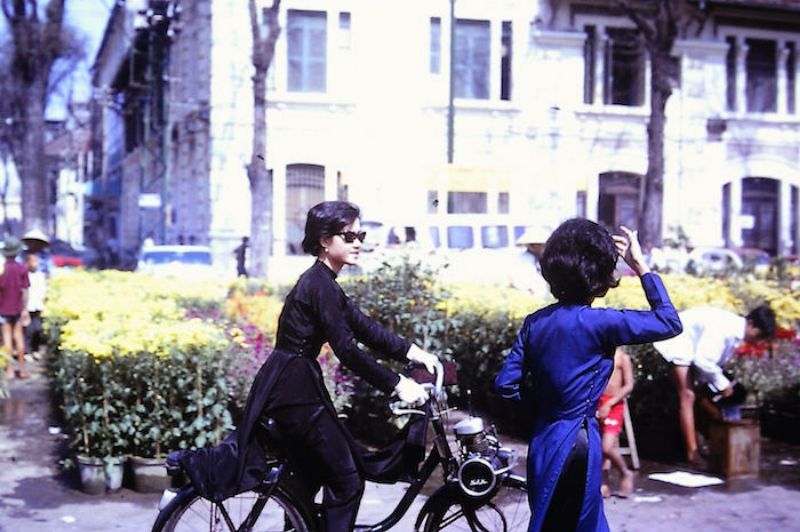
In Saigon, life went on much the same as it had for years — except with more American soldiers around. The motorbikes are older, and nobody’s wearing helmets, but much of the street life in Saigon looked the same back in the 1960s as it does today: Tall trees, ‘Ao Dai’ dresses, conical hats, and cyclos.

These fascinating color photos were taken by photographer Wilbur E. Garrett that show everyday life of Saigon in 1961 and 1965.

Saigon. Male patrons of a sidewalk cafe check out women pedestrians, 1961

Saigon. Rows of bicycles clutter a downtown parking area, 1965

Saigon. An umbrellalike poetry inscribed ‘non la’, or hat, shades a girl's face, 1961

Saigon. A woman ties down her ‘Ao dai’ while riding her bicycle, 1965

Saigon. A band entertains in a makeshift nightclub, 1965

April 30, 2019

Last Days in Vietnam: The Story Behind the Iconic Image of the Fall of Saigon in April 1975

Dutch photographer Hugh van Es, who died in 2009 at the age of 67, became famous for his iconic picture of Americans leaving Saigon, on one of the last helicopters out, on 29 April 1975, the day before the city was captured by the North Vietnamese army at the end of the Vietnam war. At the time he was working as a staff photographer for United Press International (UPI).

A member of the CIA helps evacuees up a ladder onto an Air America helicopter on the roof of 22 Gia Long Street on April 29, 1975, shortly before Saigon fell to advancing North Vietnamese troops.

The photograph has usually been assumed to be of the US embassy, but in a newspaper article Van Es wrote: “If you looked north from the office balcony, towards the cathedral, about four blocks from us, on the corner of Tu Do and Gia Long, you could see a building called the Pittman Apartments, where we knew the CIA station chief and many of his officers lived. Several weeks earlier, the roof of the elevator shaft had been reinforced with steel plate so that it would be able to take the weight of a helicopter. A makeshift wooden ladder now ran from the lower roof to the top of the shaft. Around 2.30 in the afternoon, while I was working in the darkroom, I suddenly heard Bert Okuley [a UPI staffer who escaped that evening] shout ‘Van Es, get out here, there's a chopper on that roof!’”

Van Es grabbed his camera and dashed to the balcony. “Looking at the Pittman Apartments,” he said, “I could see 20 or 30 people on the roof, climbing the ladder to an American Huey helicopter. At the top of the ladder stood an American in civilian clothes, pulling people up and shoving them inside. Of course there was no possibility that all the people on the roof could get into the helicopter, and it took off with 12 or 14 on board ... Those left on the roof waited for hours, hoping for more helicopters to arrive. To no avail.”

Illustrating the Fall of Saigon, this is the most iconic picture of the evacuation of Saigon and there's no free replacement which captures the event in the same way. (Photograph: Hugh van Es)

After shooting about 10 frames, Van Es went back to the darkroom and prepared a print for his regular 5pm transmission to Tokyo. It took about 12 minutes to send a single print with a caption but, as he laconically put it: “Editors didn’t read captions carefully in those days.” The picture was erroneously described as showing the embassy roof and, after years of trying to put the record straight, the photographer gave up. “Thus,” he said later, “one of the best known images of the Vietnam war shows something other than what almost everyone thinks it does.”

He was born Hubert van Es in Hilversum in the Netherlands and learned his profane and always apparently rudimentary English while hanging out with allied troops at the end of the second world war. He had decided he wanted to become a photographer at the age of 13, after going to a photo exhibition at the local museum which featured the work of the war photographer Robert Capa, who became his lifelong hero.

Van Es began work as a photographer with the Nederlands Fotopersbureau in Amsterdam in 1959. After arriving in Hong Kong as a freelance in 1967, he joined the South China Morning Post as chief photographer, and the following year had a chance to go to Vietnam as a soundman with NBC News. After a brief stint there, he joined the Associated Press staff and was with them in Saigon until 1972, when he transferred to UPI, with whom he spent three years.

The only money he ever made from the famous photograph was a one-off bonus of $150. Proud though he was of the picture, he was even more pleased with the shots he had taken during the battle for Hamburger Hill. Van Es stayed on in Saigon and took pictures of the North Vietnamese, made safer by the Vietnamese words Báo Chí Hà Lan, meaning Dutch Press, which he stuck in his camouflage hat along with a miniature plastic Dutch flag. After Vietnam, he made Hong Kong his base and also covered the Moro rebellion in the Philippines and the Soviet invasion of Afghanistan.

February 4, 2019

Before Buses and Taxis Took Over the Streets, Saigon of the 1960s Was Dominated by Italian Three-Wheeled Lambro Cabs

The Italian three-wheeler was not just a means of public transportation in Saigon in the old days. Before buses and taxis took over the streets, Saigon of the 1960s was dominated by three-wheeled Lambro cabs, locally known as ‘xe lam’.

Lambro was a line of scooters from the renowned Italian Lambretta. In comparison to small horse-drawn wagons that had been extensively used in the Mekong Delta in previous decades, it proved to be more convenient and comfortable for commuters.

It was the main means of public transport that could carry up to 10 passengers sitting on 2 benches at the back. The driver’s cabin had a canvas top to protect them from the sun and the rain. The front seats by the driver’s side could be occupied by at least two passengers.

In its heyday, the special noise ‘xe lam’ made could be heard in every corner of the southern metropolis. There was no station in the Lambro network, locals could hail it anywhere on the street. Passengers’ belongings could be piled on the top of ‘xe lam’.

With passengers sitting face to face on two benches, ‘xe lam’ might have not been ideal for tall people, but it was believed that many had found love in the narrow space of the vehicle.

‘Xe lam’ started vanishing from the southern streets in the 1990s to be replaced later by public buses. At the time it was used mostly as a school bus. Since 2004, Lambro has been banned in big cities for traffic safety reasons.


January 9, 2019

Portraits of U.S. Army Nurse Joan McDermott During Her Time in Vietnam War in the Late 1960s

Joan McDermott attended Walther Memorial Hospital School of Nursing in Chicago to become a registered nurse when she was only 17 years old. She then worked in a suburban hospital in surgery for 2 years before joining the U.S. Army Nurse Corps during the Vietnam War. In late 1967, Joan was sent to Saigon arriving a month before the TET Offensive. While serving at an Army hospital, enemy snipers attacked the area and forced Joan to sleep under a table in the hospital for 3 nights to avoid the gunfire. Sadly, a casualty of this attack included one of her childhood neighbors from growing up in Wisconsin. It was a difficult beginning to her service in the Army to say the least.


Despite this harrowing experience, Joan said one of the best parts of the military was, “the comradery, no question about it. You never experienced anything like that especially in a war zone. It makes you feel like you’re closer to your comrades and family. When people close to you end up as casualties to the battlefield it really hits hard.”

Joan remembers one of the better memories of her service being “… the opportunity in Saigon to get to know the Vietnamese people. A few of us would go and pack up our jeep and do what we called MedCAPs. We would go to orphanages and give the kids there shots or patch up their injuries. We would also go to hospitals to help people and when local surgeons couldn’t perform procedures we would bring the patients back to our hospital and do the procedures there. Having Vietnamese friends gave me a unique perspective.” Living on the other side of the world in Southeast Asia gave her the opportunity to see the world through other people’s eyes. “When you’re looking at the world from the perspective of other people and other countries, the U.S. looks quite different. It broadened my perspective on inter-dependency of all citizens of the earth."


In recent years, Joan has played an important role in the Lake Havasu veterans community. She credits this participation to a convention in Phoenix that inspired her to get involved. “As a female veteran, I didn’t really think of myself as a vet, I was a mom, a nurse and married to an army officer. It wasn’t until I came to Lake Havasu and went to a convention of women in the military in Phoenix. I was asked why I wasn’t a member of Veterans of Foreign Wars (VFW) and I responded because I didn’t realize I qualified. That brought it full circle that I was a veteran and I wanted to help serve other veterans.”

After this revelation Joan joined the VFW and became the Commander of post 9401 where she is currently serving in her second year. After she finishes her service at the VFW she hopes to return to nursing part-time. The VFW works with numerous other veterans organizations as well as the Veterans Treatment Court, a program that helps veterans get the proper assistance with substance abuse or combat mental health issues to help keep them from becoming involved in the criminal justice system. There is a Veterans Court in Lake Havasu that is now expanding into Bullhead city representing rural veterans. Joan works very closely with vets in the area and is very proud of it. “I enjoy every moment of it, it’s really wonderful to continue to be able to give back to my country.”

Portrait of Joan McDermott in 2016.

(via #MilitaryMonday)

December 25, 2018

20 Color Vintage Photographs That Show How Saigoneses Enjoyed Christmas in the 1960s and 1970s

If there’s anything the city’s residents do well, it’s celebrate a festive occasion. From the familial warmth of Tet to outdoor Christmas activities, Saigoneses are always down to have fun and maybe. In the 1960s and 1970s, Saigon as shown in the photos below, this was no different.


December 21, 2018

December 1, 2018

Fascinating Color Pictures That Capture Street Scenes of Saigon, Vietnam in the 1960s

These fascinating photos were taken by John L. Beck around 1968 when he was serving with the US Army in Vietnam. “I bought a Minox subminiature camera to play with. While I didn't keep it very long, I do have original prints I took with the camera along with the original negatives.

I decided to scan the faded original prints, edit them a little and post them. The resulting scans are in random order because the negatives have no numbers.”


FOLLOW US:
FacebookTumblrPinterestInstagram

CONTACT US


Browse by Decades

Popular Posts

Advertisement

09 10