Bring back some good or bad memories


ADVERTISEMENT
Showing posts with label bicycle & motorcycle. Show all posts

March 21, 2026

Sharing a Cigarette During the Tour de France, ca. 1927

During the Tour de France in 1927, a captivating moment was captured as two cyclists shared a cigarette amidst the grueling race. At a time when the race was known for its extreme physical endurance and challenging terrain, the image of these athletes casually taking a break to smoke highlighted a stark contrast to the modern image of sports professionalism. Back then, cyclists were not the well-conditioned, highly trained athletes we think of today, but often worked with fewer resources and a less scientific approach to training.


The cigarette break served as a small, humanizing moment in the midst of the grueling competition. The riders, caught between moments of exhaustion and the fleeting respite, were sharing a brief pause from the intense race. The casualness with which they lit up during such an intense event shows how much the culture of competitive sports has changed over the years, with the focus now on optimal health and performance.

This iconic photograph from the 1927 Tour de France is a reminder of the past and how far the sport has evolved. It symbolizes a different era in cycling, one where athletes could share a smoke as easily as they shared the road. Today, the Tour de France is synonymous with elite athleticism, but this picture offers a rare glimpse into a time when the race was less about perfection and more about sheer will and grit, with moments of levity in between the fierce competition.

February 23, 2026

Romantic Photos of Paul Newman and Katharine Ross Riding Bike on the Set of “Butch Cassidy and the Sundance Kid”

The bicycle scene in Butch Cassidy and the Sundance Kid (1969) is one of the most famous examples of an actor doing their own stunts, but the behind-the-scenes story is as playful and chaotic as the sequence itself.

Filmed in late 1968, primarily in the ghost town of Grafton, Utah, the scene was a late addition by director George Roy Hill. He felt the film needed a romantic break and a way to emphasize the “bohemian” bond between the trio.

Though a stunt double was hired, the double couldn’t manage the tricks on the rickety, antique bicycle. Newman, an avid athlete, eventually took over. He performed nearly all the stunts, including riding with his feet on the handlebars, except for the final crash through the fence.

Interestingly, the one stunt Newman didn’t do was the backward tumble into the corral. That was performed by the film’s cinematographer, Conrad L. Hall, who stepped in to get the shot. To get the bull (named Bill) to chase Newman for the finale, the crew reportedly had to apply a mild irritant to the animal to make it move, as it was naturally quite placid.

The chemistry you see on screen between Paul Newman and Katharine Ross was mirrored by a bit of set drama. Ross, who was dating cinematographer Conrad Hall at the time, was an aspiring photographer. Hall allowed her to operate a camera for a small “extra” shot, which infuriated director George Roy Hill. He famously banned her from the set unless she was actively filming a scene.

The use of the pop song “Raindrops Keep Fallin’ on My Head” was highly controversial at the time. Studio executives hated it, thinking a contemporary song had no place in a Western, but it went on to win an Oscar.


January 25, 2026

1933 Harley-Davidson Motorcycles on the Beach in Milwaukee for a Photo Shoot

In 1933, Harley-Davidson designers created a one year only paint job which is arguably the best that has ever come out of Milwaukee. Even back in the 1930s, Harley knew that nothing looks better on a motorcycle than beautiful women and if you throw in some sand and sun, you’ve got a recipe for success. So, Harley trucked a couple of their new ’33 models down to Bradford Beach in Milwaukee for a photo shoot.

Both motorcycles pictured are powered by 74” sidevalve engines mated to hand-shifted three-speed transmissions. The 1933 model year was one of the lowest production years in Harley history, with only 2671 big twins produced and a total production of 3703 units (this number includes singles and small twins). Of the two motorcycles used in the photo shoot, the sidecar model, is the rarest with only 164 being manufactured. These low productions numbers were a result of the Great Depression, which drastically cut sales for Harley-Davidson. It is likely that Harley hoped that their new “flashy” paint job would help attract more customers. Unfortunately, most of these photos were deemed too risque for an ad campaign, but one did make it on the cover of the Enthusiast.


January 19, 2026

When Brad Pitt and Angelina Jolie Riding Around Vietnam’s Southern Ho Chi Minh City on a Motorcycle in 2006

In November 2006, one of the most famous couples in Hollywood history, Brad Pitt and Angelina Jolie, surprised the world, and the people of Ho Chi Minh City, by appearing as ordinary tourists. Their visit has since become a legendary piece of “Brangelina” lore in Vietnam.

The couple arrived unannounced on Wednesday, November 22, 2006, flying in from Cambodia. They stayed at the Park Hyatt Hotel in District 1, but rather than using a fleet of black SUVs or heavy security, they chose to blend in.

On Thanksgiving Day, November 23, they decided to explore the city like locals. Pitt rented a Yamaha Nouvo, a common automatic scooter in Vietnam at the time. Passersby were stunned to see “Mr. & Mrs. Smith” weaving through Saigon’s chaotic, buzzing traffic. Pitt drove while Jolie sat behind him, both dressed in casual clothes and sunglasses.

They were spotted driving past the Ho Chi Minh City People’s Committee Building (City Hall), through the city center, and eventually heading toward Ben Thanh Market for some shopping. When a reporter from the Tuoi Tre newspaper asked if he was worried about the “chaotic” traffic, Pitt simply smiled and replied, “There will be no problem.”

The couple spent their evening at Temple Club, a popular restaurant on Ton That Thiep Street converted from an old temple. They reportedly enjoyed a quiet dinner, with Brad describing Vietnam as “wonderful.”

Beyond sightseeing, this trip laid the groundwork for their deep connection to the country. During this visit, they stopped at the Tam Binh Orphanage in Thu Duc. It was here that they first met a three-year-old boy named Pham Quang Sang, whom Angelina Jolie would officially adopt a few months later in early 2007, renaming him Pax Thien.


September 18, 2025

Vintage Photos of People With Their Motorcycles in the 1920s and ’30s

In the 1920s and ’30s, motorcycles were more than just machines—they were symbols of freedom, modernity, and adventure. In an era defined by rapid industrial growth and cultural change, people who rode motorcycles embodied a spirit of independence that set them apart from the rest of society.

After the First World War, motorcycles became increasingly accessible, serving both as affordable transportation and as thrilling vehicles for sport. Young men, and occasionally women, embraced them as a way to break free from traditional norms, speeding along country roads or gathering at racetracks. Riders often wore leather jackets, goggles, and helmets, creating an image of toughness and daring that would influence motorcycle culture for decades to come.

In cities, motorcycles were practical tools—used by police, couriers, and workers who needed to move quickly through growing urban landscapes. In the countryside, they became associated with leisure rides, road trips, and a sense of romance tied to open roads and untamed landscapes. Clubs and informal groups began to form, giving rise to early motorcycle communities and competitions that celebrated both skill and camaraderie.

These vintage photos from Vintage Cars & People capture not only the riders and their motorcycles, but also the spirit of freedom, style, and adventure that defined a generation on the move.

A family of three posing with a Harley-Davidson 1000 JE Combination in front of a brick-built house. The sidecar is attached to the left side of the bike, which suggests that the photo was taken in a country with left-hand traffic, circa 1928

A dapper fellow and a lady posing with a D-Rad R 0/5 Combination sidecar motorcycle in front of a monumental equestrian statue. The location is Deutsches Eck. The motorbike is registered in the Saxon district of Leipzig, 1927

A fellow in a leather jacket posing in the saddle of a single-cylinder motorcycle in front of Lorelei Rock in the Middle Rhine Valley. The motorbike is registered in the district of Rhine-Hesse, circa 1928

Three dapper fellows in suits and a stylish lady dressed in white posing with a HRD "Howard Davies 90" motorcycle. The bike is registered in the state of Upper Austria, circa 1928

A stylish couple posing in the saddle of a Norton 16H motorcycle in the countryside. The print is dated "1929" on reverse

August 15, 2025

Amazing Photos of Rollie Free During His Record-Breaking Speed for a Motorcycle at the Bonneville Salt Flats in Utah, 1948

In 1948, Rollie Free (1900–1984) set one of the most iconic motorcycle speed records in history — and did it in a way that made for one of the most famous photographs in motorsport.


On the morning of September 13, 1948, Free raised the American motorcycle speed record by riding the very first Vincent HRD, owned by the California sportsman John Edgar and sponsored by Mobil Oil, to a speed of 150.313 mph (241.905 km/h). Special features included the first-ever Vincent use of a rear shock absorber, the first Mk II racing cams, and horizontally mounted racing carburetors. Free adopted a style used by other racers, such as Norman Teleford, of lying flat on the machine's seat, thereby minimizing wind resistance and moving its center of gravity rearward.

To protect himself and allow comfort when in such a position, Free had developed special protective clothing. However, when his leathers tore from early runs at 147 mph (237 km/h), he discarded them and made a final attempt without a jacket, pants, gloves, boots, or helmet. Free lay flat on the motorcycle wearing only a bathing suit, a shower cap, and a pair of borrowed sneakers – inspired by his friend Ed Kretz. This resulted not only in the record, but also produced one of the most famous photographs in motorcycling history, the “bathing suit bike.” The photo was taken from a car driven parallel to his run on the Bonneville Salt Flats.

It is debated whether the exact model of motorcycle was a Black Lightning or Black Shadow. Most believe that it was a custom ordered Black Lightning, as it was some 100 pounds lighter and 25 hp (19 kW) more powerful than a stock Black Shadow. In one of his books, Phil Irving (one of the designers) said that there were only about 16 of the model produced.

The Vincent used is sometimes mistaken for a Series B machine, having the stamp BB on its engine casing, but is actually a works-modified machine, and has been recognized as the first, or prototype of 30 Lightnings. The bike remained racing in the United States until the mid-1960s, and then resided virtually intact in the private collection of Herb Harris of Austin, Texas. The bike was sold from the Harris collection in November 2010 for a rumored $1.1 million, which would be one of the highest prices ever paid privately for a motorcycle.

Free later moved to California and, after his racing career faded, worked in the auto servicing industry. He died in 1984 and was posthumously inducted into the Motorcycle Hall of Fame in 1998.


August 9, 2025

Vintage Suzuki Motorcycle Ads From the 1970s

The 1970s was a period of significant change for Suzuki motorcycles, marked by a shift from two-stroke to four-stroke dominance. The decade began with the highly successful GT series, known for its powerful two-stroke engines, with the GT750 “Water Buffalo” being a standout liquid-cooled model.

In a bold move, Suzuki also experimented with the Wankel rotary engine in the unique RE5. The most pivotal moment came in the latter half of the decade with the introduction of the GS series. The GS750 became Suzuki’s first four-cylinder, four-stroke superbike, establishing the company as a major contender in the global motorcycle market and setting the stage for future performance machines.

Here is a collection of vintage photos showcasing Suzuki motorcycle ads from the 1970s.

Suzuki GT-185 Adventurer

Suzuki GT-185K Adventurer

Suzuki GT-250 Hustler

Suzuki GT-250K Hustler

Suzuki GT-250L Hustler

July 3, 2025

Fourth of July Parade Winner, 1900

Leela McAdam (nee McCabe), winner of the best decorated bicycle for the 1900 Fourth of July parade in Lompoc, California, stands outside her home at 137 South J Street. Her bicycle, her belt, and her hat were decorated with sweet peas.

June 23, 2025

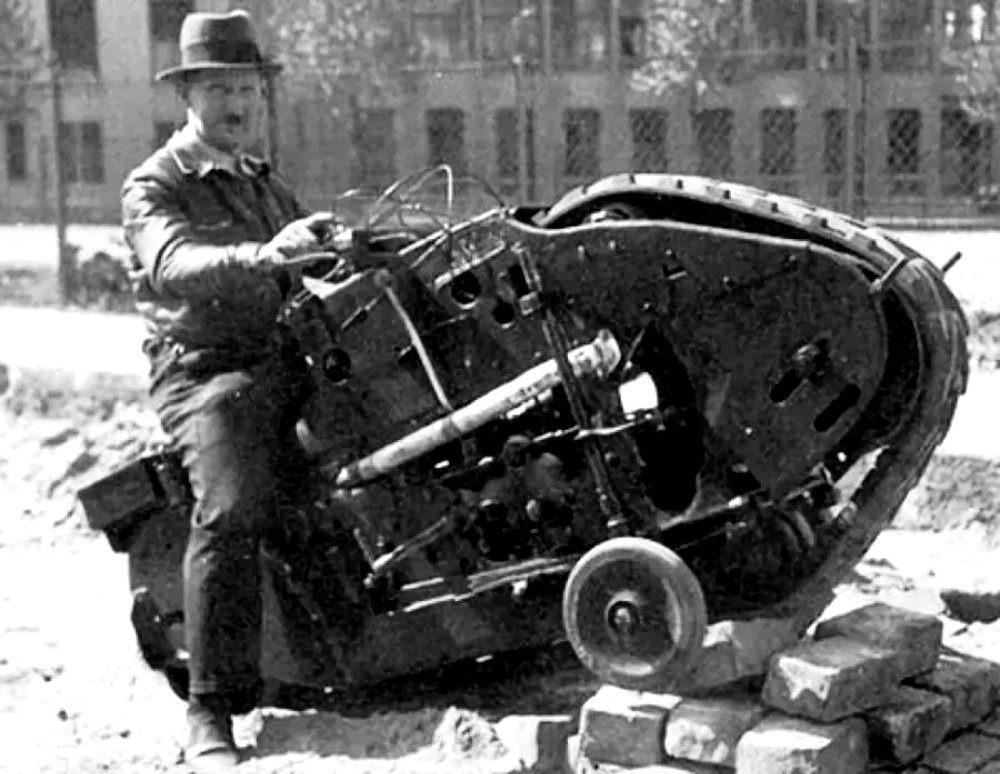
Tractor-Cycle, Treaded Motorcycle Designed by French Inventor J. Lehaitre, ca. 1938

In 1938, inventor J. Lehaitre introduced a fascinating innovation known as the Tractor-Cycle—a motorcycle equipped with a tractor-style transmission belt instead of conventional wheels. Designed to handle a wide range of terrain, this unique vehicle could travel at speeds of up to 25 mph.

Its rugged, tank-like track system gave it impressive off-road capabilities, making it suitable for military or rugged exploration purposes. In fact, it was even designed to accommodate a machine gun, suggesting potential military applications at the time.

Though it never became mainstream, the Tractor-Cycle remains an intriguing example of early 20th-century experimentation in all-terrain vehicle design.


May 28, 2025

Photos of Biker Ladies With Their Custom Made Leather Belts at a Motorcycle Rally in Laconia, New Hampshire, 1947.

It calls itself as “the world’s oldest motorcycle rally.” In 1947 LIFE sent photographer Sam Shere to chronicle an early but already bustling version of the gathering, and the magazine’s story in its Aug. 11, 1947 issue was inspired in part by the growth of cycling as a social activity in the years following World War II.

“Today’s 200,000 “bike” riders are organized like so many Panzer units into well-disciplined clubs with costumes,” LIFE wrote. “…To these stalwarts the motorcycle is a white charger, an emblem of knighthood. The gas fumes, the roaring wind, and the staccato snorting of the exhaust enchant them.”

Shere’s photos capture the joyful juxtaposition of leather-clad bikers converging on a quaint New England setting. But the images that stand out most feature cyclists from the Motor Maids of America. The group, dedicated to bringing female motorcyclists together, began in 1940 with a few dozen riders and today boasts a membership of about 1,300. The photos from the Laconia rally include shots of the group’s founder, Dot Robinson, with her 15-year-old-daughter Betty. Their Motor Maids uniforms are both jaunty and a tad formal. They make the Motor Maids look like meter maids gone rogue.


May 7, 2025

A World War II US Soldier Posing With Captured Killinger and Freund Motorcycle, 1945

This odd looking motorcycle was captured by the US Army at a German military base in the spring of 1945. At first glance, it might remind you of an Indian Chief with it’s full skirted fenders, but take a closer look and you’ll see that it is very different kind of machine.


The Killinger and Freund Motorcycle was an attempt in 1935 by a group of five German engineers from Munich to design a more streamlined and modified version of the German Megola front-wheel drive motorcycle. The work took three years to complete but the result was impressive. The engine displacement stayed the same as the Megola at 600 cc but was much lighter and more simplified than a standard 100 cc motorcycle of the time.

The motorcycle featured a three-cylinder two-stroke engine built right into the front wheel, transmission and clutch, with more comfortable front and rear suspension. Streamlining was important as aerodynamics was the first priority of the team who wanted all the moving parts covered, dirt and mud protection, and an elegant style. Other priorities were that the motorcycle be multi-cylinder and possess front- wheel-drive. Their design met with success.

The first impressions of the new motorcycle was of a streamlined racing machine with rounded covers for the front and rear wheels, aerodynamically improved fork, frame, and fuel tank all built on a tubular framework covered in sheet metal.

The rear suspension was linked to the lower end of the tubular frame and featured flexible rubber and metal elements that did not require servicing. Steering was much like an ordinary motorcycle but with more vertical telescopic elements than usual, which translated into a wheelbase that wouldn’t change much whenever the front fork dived.


The new front-wheel-drive was a vast improvement over the old Megola design. The weight of the engine was lower. The front wheel with integrated engine had a combined weight of 50 kg (110 lb). Additionally, a custom carburetor without a float needle didn’t have the problems caused by vibration. And finally, the light-weight battery ignition allowed trouble-free engine starts and helped to keep the engine weight low. The distributor and the points were located in the hub. The technicians originally intended to build a dynastarter. These improvements would have been impossible to add to the old Megola design.

The three cylinder two-stroke engine used a Drehschieber (“rotary valve,” a turning disk, with intake holes for exact timing of the fuel-air mixture intake). The fuel-air mixture was sucked in by the vacuum in the three crankshaft housings as usual. The Drehschieber does the intake timing for all three cylinders. The engine was not a radial engine associated with aircraft and there was no need for a flywheel. All three cranks worked on one common gear. This arrangement and the recoil of the pistons in the turning direction secured a perfect balance of the moving parts. The cylinders were made of KS (Kolbenschmidt) iron cylinder walls and were embedded in the Silumin alloy engine housing. The only things that could be visibly identified as engine parts were the alloy cylinder heads with multiple cooling fins and the exhaust pipes located between the spokes of the cast alloy front wheel. These flat spokes were designed to serve as a functional cooling fan.

The two-speed transmission was built as a differential transmission and used slope-meshed gears. The clutch was made of conventional clutch disks. The clutch (with the springs at the outer circle) was located in front of the transmission. The transmission was actuated by foot-operated steel cables. All parts of the engine allowed easy access for service work. After the removal of the engine – only two bolts and some wiring had to be removed – all important parts were within reach.

The tire could also be removed easily. You had to unlock a safety mechanism and then remove the tire completely with the split rim (very similar to the split rim developed by BMW). The front brake was installed in the hub. The rear suspension also had telescopic oil-filled shock absorbers. The gasoline flowed down through flexible hoses. A panel in the frame allowed easy access to the seat springs to adjust the hardness of the seat's suspension.


The Killinger and Freund Motorrad (motorcycle) was test-driven after the engine was tested on a test stand. Its total weight was 135 kg (297 lb). This design was intended for civilian production but the start of World War II cancelled those plans.

May 5, 2025

The Suzuki Ad Campaigns Photographs by Franco Turcati That Scandalized the Whole Italy in the 1960s

Franco Turcati was used to shoot Alfa Romeo automobiles for the Turin-based car dealership Monzeglio, that in the early 1970s became the first Italian importer of Suzuki motorbikes.

“This gentleman called Hideyuki Miyakawa, who had come to Italy all the way from Japan on a motorbike,” Turcati told Synaesthetic Magazine. “He married Maria Luisa Bassano, a woman from Turin, and started working as a middle man between Monzeglio and Suzuki. He was an extremely talented guy who soon turned into a close collaborator of [esteemed Italian car designer] Giugiaro, becoming his right-arm in the world.”

In 1965, quipped with a Nikon F with a 300mm telephoto lens lent to him by Quattroruote, Turcati dived into advertising by shooting the first iconic Suzuki Italian campaigns. The sensual ‘Io Suzuki e Tu?’ campaign paired motorbikes and girls with the typical male gaze of those days, but it was also a fantastic insight into the transitioning phase of late 1960s and early 1970s female fashion.

Modelled by Turcati’s teenage friend and model Lia Dezman, the adverts featured curly wigs, knee-high vinyl boots, and see-through crochet garments. However, to shock the public opinion was the following campaign. With a slogan conceived by ad woman Vilma Cino and inspired by a quote from George Orwell’s Animal Farm, the campaign titled ‘Donne e moto sono tutte uguali, ma qualcuna è più uguale’ (‘All women and bikes are equal, but some are more equal than others.’) 

“It was the first ad campaign to be condemned in Italy by the Istituto di Autodisciplina Pubblictaria, a newly formed body that sanctioned offensive adverts,” explained Turcati. “Despite Vilma was a woman herself and was inspired by Orwell, the advert was accused of sexism. Back then, the fire of feminism was just starting in Italy and, at the same time, [photographer] Oliviero Toscani’s bum for the Jesus Jeans advertising campaign had just come out too. Both adverts were targeted by Angelo Pezzana, the founder of FUORI the first Italian gay movement, who at night time would cover the billboards with massive stickers saying ‘this advert offends women.’ The fun fact is that some years later I met Pezzana, whilst on holiday in Sicily, and he proudly told me the anecdote. Those were very peculiar and amusing times.”

As a consequence, Suzuki had to change its advertising strategy and came up with the ‘Suzuki Isola D’Acciaio’ (Suzuki Steel Island) slogan. The campaign, shot on the Forte dei Marmi beach, despite its futuristic appeal didn’t reach the same level of popularity of the previous incriminated one.  In the company’s Japanese headquarters, a decision was taken to opt for more sober campaigns. 

“The Japanese didn’t like the campaign condemnation despite it brought lots of attention to the brand against much stronger competitors like Honda, Kawasaki, Laverda, and Guzzi,” said Turcati. “They signed a deal with a new advertising firm, OPIT from Milan and booked the Monza circuit to shoot a campaign there. I regretfully have to say that it was insignificant. When the agency accepts a compromise with the client, creativity is lost.”

“After we were the first to try different and challenging campaigns out, most motorbike adverts turned extremely vulgar and tasteless. The copy and paste generation of the Macintosh era overall ruined the style,” observed Turcati, “With the advent of computers we were enthusiastic at first, but then I realized that the market suddenly changed, opening to a multitude of young people who haven’t got any true grasp of typography and design. There has been a fall in our interlocutors. We were used to grow professionally by confronting ourselves with great entrepreneurs and art directors.”


FOLLOW US:
Facebook • Tumblr • Pinterest • Instagram

CONTACT US


Browse by Decades

Popular Posts

Advertisement

09 10