Bring back some good or bad memories


ADVERTISEMENT
Showing posts with label Prague. Show all posts

July 2, 2026

28 Amazing Photographs of the Prague Astronomical Clock From Between the Late 19th and Early 20th Centuries

The Prague astronomical clock, or Prague Orloj, is a medieval astronomical clock attached to the Old Town Hall in Prague, the capital of the Czech Republic. The Orloj is mounted on the southern wall of the city’s Old Town Hall in the Old Town Square.

The clock mechanism has three main components – the astronomical dial, representing the position of the Sun and Moon in the sky and displaying various astronomical details; statues of various Catholic saints stand on either side of the clock; “The Walk of the Apostles,” an hourly show of moving Apostle figures and other sculptures, notably a figure of a skeleton that represents Death, striking the time; and a calendar dial with medallions representing the months. According to local legend, the city will suffer if the clock is neglected and its good operation is placed in jeopardy; a ghost, mounted on the clock, was supposed to nod its head in confirmation. According to the legend, the only hope was represented by a boy born on New Year’s night.

The late 19th and early 20th centuries were a transformative era for the Orloj. During this time, the clock evolved from a neglected, semi-functional relic into a celebrated national symbol of Czech cultural revival, right before facing near-destruction at the end of World War II.

By the mid-19th century, the clock was in poor condition and frequently stopped working. A massive, milestone restoration completed in 1866 completely modernized the clock’s appearance and mechanical reliability. The distinct wooden figures of the 12 Apostles that parade every hour were newly installed in the upper windows during this restoration. Celebrated Czech painter Josef Mánes was commissioned to create a brand-new, intricately painted lower calendar dial. His design featured 12 medallions depicting rural bohemian life matched to the signs of the zodiac. In 1865, a golden crowing rooster was added above the Apostle windows to signal the conclusion of the hourly mechanical show.

Following the 1866 restoration, Prague authorities realized that exposing Josef Mánes’ masterpiece painting to the elements would ruin it. The original Mánes calendar dial was carefully removed and moved to the Prague City Museum for safekeeping. It was replaced on the tower by an exact structural copy. After another round of reconstructions on the Old Town Hall facade, the golden rooster mechanism was fully finalized and played for the public for the first time on New Year’s Eve on December 31, 1882. The local Prague clockmaking company L. Hainz officially took over the maintenance and regular repair of the clock in the 1860s, a stewardship role they proudly maintained well into the 20th century.

The early 1900s brought massive technological adjustments and political upheaval to Prague, directly impacting how the clock told time. In 1912, the astronomical dial was modified to formally integrate Central European Time (German Civil Time). This update divided the standard day into 12 equal hours mapped to standard European timekeeping, though the complex internal gear adjustments meant it didn’t run perfectly until decades later. Following the collapse of the Austro-Hungarian Empire in 1918, Czechoslovakia declared its independence right in front of the clock tower. The clock was heavily embraced as a triumph of historic Czech engineering during this patriotic surge.

The darkest moment in the clock’s modern history occurred at the very end of WWII. On May 7–8, 1945, Nazi forces used anti-aircraft guns and incendiary shelling on the Old Town Square to suppress the Czech resistance broadcasting from the town hall. The building caught fire, the wooden Apostles and the calendar face burned to ashes, and the heavy medieval iron mechanism was severely warped by the extreme heat. The clock remained completely motionless and silent until a massive community-led restoration brought it back to life in 1948.


June 25, 2025

Prague in 1995 Through Fascinating Photos

Prague in the 1990s was a city in transition, reborn from decades of communist rule into a vibrant center of culture, tourism, and democracy. After the Velvet Revolution in 1989 and the peaceful split of Czechoslovakia in 1993, Prague emerged as the capital of the newly independent Czech Republic.

The city’s rich architectural heritage—Gothic spires, Baroque churches, and Art Nouveau facades—drew growing numbers of international visitors. At the same time, a youthful energy transformed its streets: cafés, clubs, and galleries flourished, while local artists and entrepreneurs began shaping a new cultural identity.

The decade marked a blending of old-world charm and post-communist renewal, making Prague one of Europe’s most captivating capitals of the era. These fascinating photos, uncovered by David Pirmann, offer a glimpse into the streets of Prague in 1995.


November 6, 2023

40 Incredible Photos of Prague After the Liberation in 1945

The Prague offensive was the last major military operation of World War II in Europe. The offensive was fought on the Eastern Front from 6 May to 11 May 1945. Fought concurrently with the Prague uprising, the offensive significantly helped the liberation of Czechoslovakia in 1945. The offensive was one of the last engagements of World War II in Europe and continued after Nazi Germany’s unconditional capitulation on 8/9 May.

The city of Prague was ultimately liberated by the USSR during the Prague offensive. All of the German troops of Army Group Centre (Heeresgruppe Mitte) and many of Army Group Ostmark (formerly known as Army Group South) were killed or captured, or fell into the hands of the Allies after the capitulation.

These photos were collected by Wayne Huebner that show street scenes of Prague after the liberation around 1945.

Prague. Charles Bridge and Hradčany, 1945

Prague. Charles Bridge, 1945

Prague. Charles Bridge, 1945

Prague. Charles Bridge, 1945

Prague. Charles Bridge, 1945

April 14, 2022

Fascinating Black and White Photos of Prague in 1990

Prague is the capital and largest city in the Czech Republic, the 13th largest city in the European Union and the historical capital of Bohemia. Situated on the Vltava river, Prague is home to about 1.3 million people, while its metropolitan area is estimated to have a population of 2.7 million. The city has a temperate oceanic climate, with relatively warm summers and chilly winters.

In 1989, after the riot police beat back a peaceful student demonstration, the Velvet Revolution crowded the streets of Prague, and the capital of Czechoslovakia benefited greatly from the new mood.

In 1993, after the Velvet Divorce, Prague became the capital city of the new Czech Republic. From 1995, high-rise buildings began to be built in Prague in large quantities.

In the late 1990s, Prague again became an important cultural center of Europe and was notably influenced by globalization. These fascinating black and white photos were taken by Greg Wass that show street scenes of Prague in 1990.


March 5, 2022

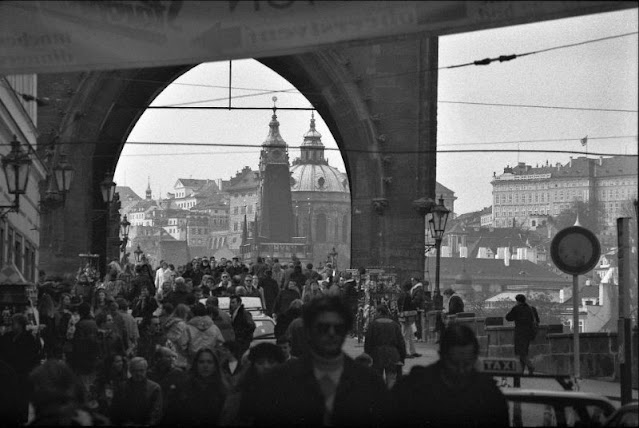
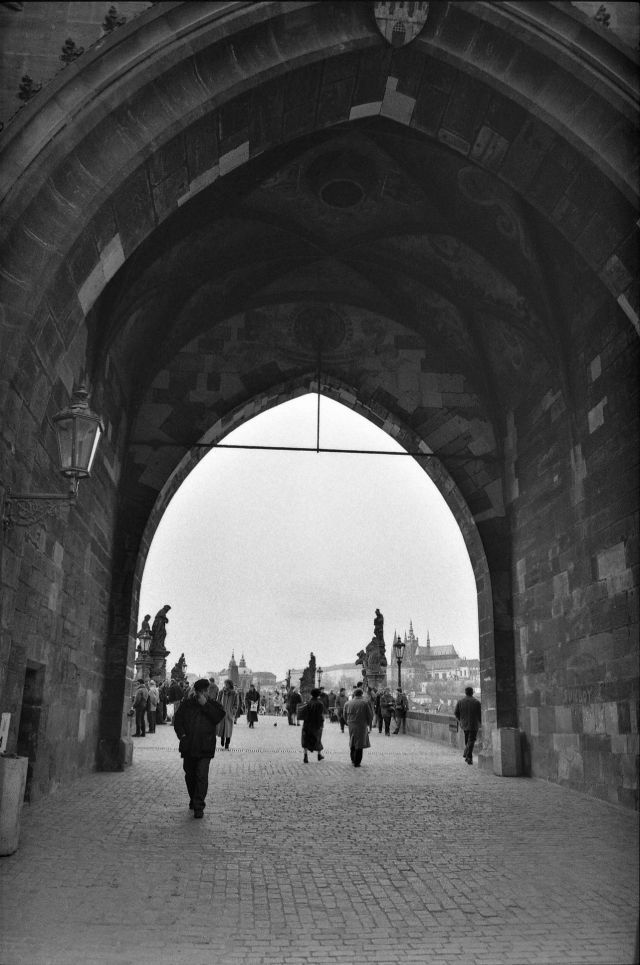
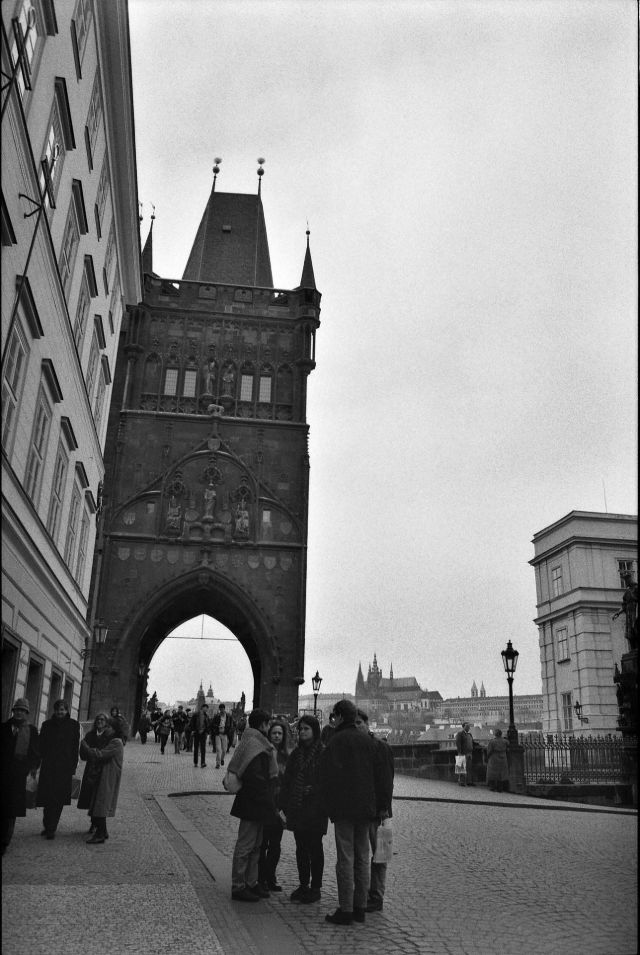
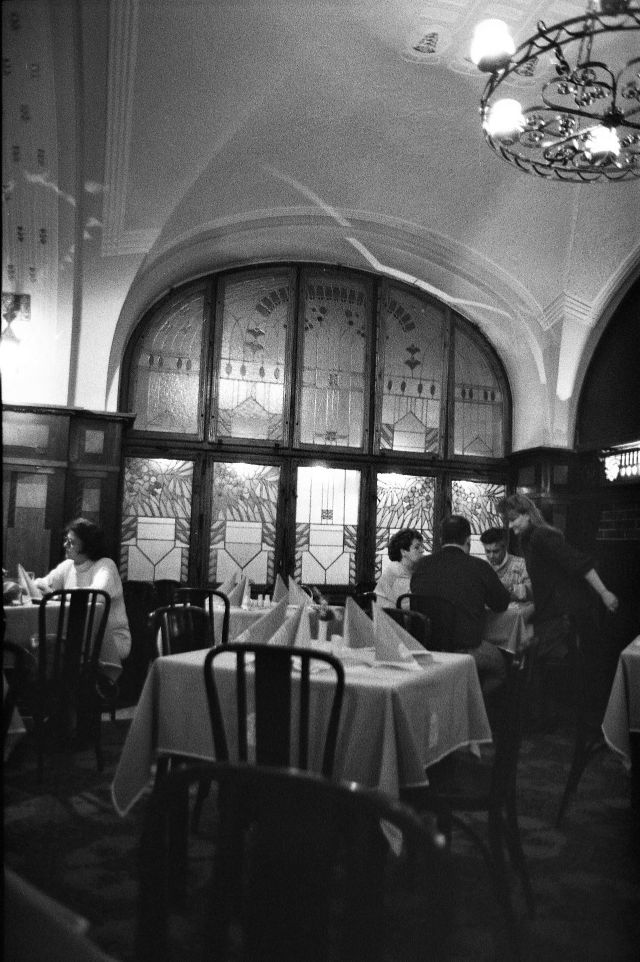
30 Black and White Photos Capture Street Scenes of Prague in the Mid-1990s

In 1989, after the riot police beat back a peaceful student demonstration, the Velvet Revolution crowded the streets of Prague, and the capital of Czechoslovakia benefited greatly from the new mood.

In 1993, after the Velvet Divorce, Prague became the capital city of the new Czech Republic. From 1995 high-rise buildings began to be built in Prague in large quantities. In the late 1990s, Prague again became an important cultural center of Europe and was notably influenced by globalization.

These beautiful black and white photos were taken by Fraser Pettigrew that show street scenes of Prague in February 1995.

Approaching Charles Bridge, Prague, 1995

Approaching Charles Bridge, Prague, 1995

Approaching Charles Bridge, Prague, 1995

Basement restaurant, Grand Hotel Europa, Wenceslas Square, Prague, 1995

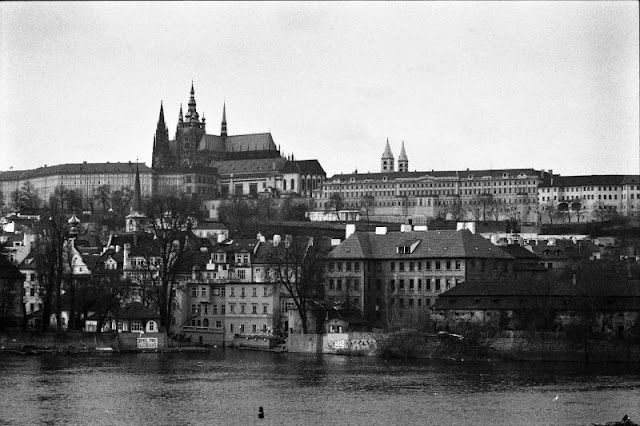
Castle from Charles Bridge, Prague, 1995

January 25, 2021

Rare Images of Louis Armstrong on His Visit to Prague in 1965

When Louis Armstrong visited Prague in March of 1965, at which time he was truly an international star. These rare images from TresBohemes captured moments of this Jazz great on his visit to Prague in 1965.


January 22, 2020

Interior Views of the Central Social Institution in Prague, Czechoslovakia, 1937

The Central Social Institution in Prague was home to the world’s largest vertical file cabinet. It consists of 3,000 drawers, 10 feet high, reaching from floor to ceiling and covering approximately 4,000 square feet. The drawers are all equipped with roller bearings.

Special desks were built for those working at the files. They are, in essence, electrically operated elevators, controlled by a touch of a button, which rise or descend, move to the right or left and stop before the desired drawer.

The drawers themselves are electrically opened and shut. With this installation it is now possible for 20 workers to do what formerly required the services of 400.

There are many jobs in which distribution of the work only results in confusion. In this case, eliminating help expedites progress.

These amazing photographs below show men working in mobile work stations used to access the card catalog drawers in the Central Social Institution, Prague, Czechoslovakia (now Czech Republic) in 1937.


June 7, 2019

50 Beautiful Color Pics That Capture Street Scenes of Prague in the 1980s

Prague is the capital and largest city in the Czech Republic, the 14th largest city in the European Union and the historical capital of Bohemia.

Situated in the north-west of the country on the Vltava river, the city  has a temperate climate, with warm summers and chilly winters.  Prague has been a political, cultural and economic centre of central Europe complete with a rich history.

Prague is home to a number of well-known cultural attractions, many of which survived the violence and destruction of 20th-century Europe. Main attractions include Prague Castle, Charles Bridge, Old Town Square with the Prague astronomical clock, the Jewish Quarter, Petřín hill and Vyšehrad.

The city has more than ten major museums, along with numerous theatres, galleries, cinemas and other historical exhibits. An extensive modern public transportation system connects the city. Also, it is home to a wide range of public and private schools, including Charles University in Prague, the oldest university in Central Europe.

Prague is one of the most liveable cities in the world, and the most liveable city in former Eastern Bloc (except Berlin), ranking ahead of St. Louis, Hong Kong and others.

These beautiful color pics were taken by Simon K that show street scenes of Prague in 1987.

A tram travels through the Nové Město

A back street in Josefov, the Jewish district

A busy day in the Nové Město

A coachload of students disgorges onto the plaza of Hradcány castle, with Prague city centre beyond

A flower stall in the Staré Město

December 20, 2017

24 Impressive Black and White Photos of Prague in the 1950s

Prague is the capital and largest city in the Czech Republic, the 14th largest city in the European Union and also the historical capital of Bohemia. Situated in the north-west of the country on the Vltava river, the city has a temperate climate, with warm summers and chilly winters.

Prague has been a political, cultural and economic centre of central Europe complete with a rich history. Founded during the Romanesque and flourishing by the Gothic, Renaissance and Baroque eras, Prague was the capital of the kingdom of Bohemia and the main residence of several Holy Roman Emperors. It was an important city to the Habsburg Monarchy and its Austro-Hungarian Empire.

The city played major roles in the Bohemian and Protestant Reformation, the Thirty Years' War and in 20th-century history as the capital of Czechoslovakia, during both World Wars and the post-war Communist era.

take a look at these impressive photos from Mark Susina to see everyday life of Prague from the 1950s.


July 29, 2017

45 Wonderful Pictures Capture Street Scenes of Prague in 1980

Prague is the capital and largest city of the Czech Republic, and the 14th largest city in the European Union. It is also the historical capital of Bohemia. Situated in the north-west of the country on the Vltava river, the city has a temperate climate, with warm summers and chilly winters.

Prague has been a political, cultural, and economic centre of central Europe with waxing and waning fortunes during its history.
It is also home to a number of famous cultural attractions, many of which survived the violence and destruction of 20th-century Europe. Main attractions include the Prague Castle, the Charles Bridge, Old Town Square with the Prague astronomical clock, the Jewish Quarter, Petřín hill and Vyšehrad.

The city has more than ten major museums, along with numerous theatres, galleries, cinemas, and other historical exhibits. An extensive modern public transportation system connects the city. Also, it is home to a wide range of public and private schools, including Charles University in Prague, the oldest university in Central Europe.

Take a look at these wonderful photos from Ed Sijmons to see street scenes of this beautiful city taken in June 1980.


FOLLOW US:
Facebook • Tumblr • Pinterest • Instagram

CONTACT US


Browse by Decades

Popular Posts

Advertisement

09 10