Bring back some good or bad memories


ADVERTISEMENT
Showing posts with label Omaha. Show all posts

February 22, 2022

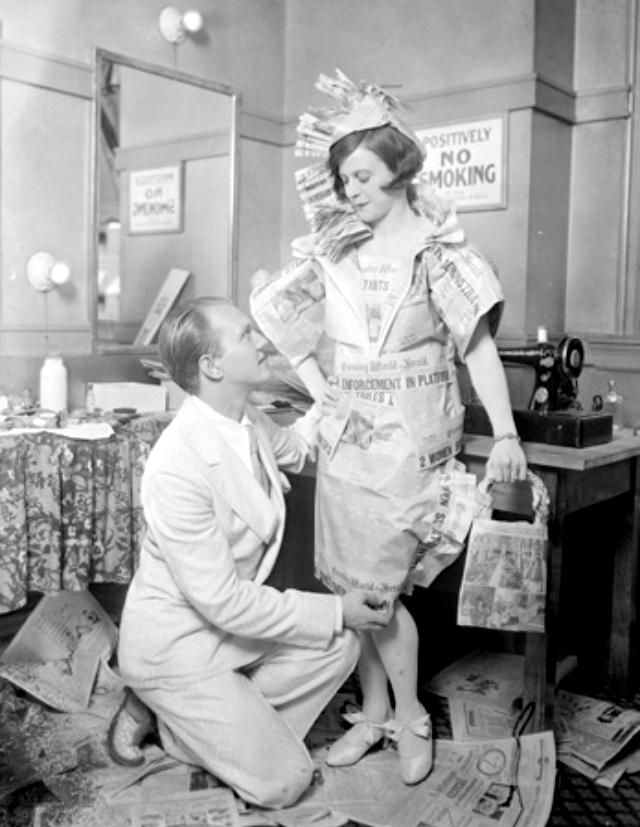
Newspaper Dress, 1928

This unidentified young woman gives new meaning to “being in the news.” She is wearing a dress made from Omaha’s Evening World-Herald newspaper. Most of the newspapers date from June 1928.

Woman wearing a dress made from Evening World-Herald, an Omaha newspaper, June 1928. (via History Nebraska)

June 8, 2021

Scalped in 1867 by Cheyenne in Nebraska, Here’s the Story Behind William Thompson’s Scalp

Scalping is often depicted in old-timey cowboy-and-Indian movies with lots of quavering music and dramatic pauses. But then you see the real scalp under a bell jar and it isn’t so melodramatic anymore.

William Thompson’s scalp, archived at the Main Library in Omaha, Nebraska, looks more like some sort of rodent than an impactful part of history. However, Thompson’s story—surviving a scalping, holding on to the coiffure in question—makes it all the more remarkable.


On a hot and muggy evening in August of 1867, as the railroad was being built. Union Pacific officials realized they were not getting any telegraph feed west of the Plum Creek Station. Four railroad telegraph workers and a foreman went to Plum Creek Station, which later evolved into the city of Lexington. They arrived on a handcar. They came around a curve and ran into a bunch of railroad ties. The handcar was derailed. At this time, there were 25 Cheyenne warriors that were waiting in ambush, and they came down and attacked the repair party. Working on the railroad was a dangerous job.

William Thompson was a victim in the attack. He suffered a wound to the upper arm, and one of the Cheyenne braves scalped him. He was awake, and alive at the time. There is much debate on how he managed to stay quiet, but apparently he did.


Earlier in the day, another train left Omaha. It arrived after the attack, and it ran into the same bunch of railroad ties as the handcar. That derailed the entire train, 17 cars, the engineer, the fireman, the conductor were killed, and it was the first successful derailment of an entire train by a Native American tribe in U.S. history.

Then UP realized they had a serious issue. They sent out a second rescue train the next day. They rescued Thompson who was quite a sight at that time. Infection had started to set in, but he was alive, and they took him back to Omaha where they tried to re-attach the scalp. Dr. Richard Moore tried to do that in August of 1867, but they were unsuccessful. But the doctor did believe Mr. Thompson was a strong individual, and he would survive the infection, which he did.

Thompson was from England and he hung on to the scalp. His fellow countrymen were not as enamored with the scalp as he was. Thompson donated his scalp to the doctor who had tried to help him. He did decide to donate it to Dr. Moore in 1900. Dr. Moore then decided to donate it to the Omaha Public Library since he assumed the local interest would be piqued.

The scalp is now kept in an acid-free box at the W. Dale Clark Library in Omaha. It’s always handled carefully with gloves. It’s been the subject of some several national TV shows, and people often request to see it.


(The original story was told by Lynn Sullivan, a library specialist at the W. Dale Clark Library in Omaha, via KOLN)
January 31, 2021

William Roentgen Demonstrates X-ray Machines at the Trans-Mississippi and International Exposition in Omaha, 1898

In the late 19th century, X-rays set America’s imagination ablaze. Only three years after its discovery by William Roentgen, the mysterious radiation went on display in this free-standing pavilion at the Trans-Mississippi and International Exposition of 1898 in Omaha, Nebraska.

Here, X-ray machines let attendees glimpse the interiors of everyday objects as well as their own bodies, blissfully unaware the devices were zapping them with 1,500 times as much radiation as contemporary X-ray machines. Even when their hair fell out, they embraced the rays as an early – and effective – depilatory.

The Collections of the Omaha Public Library

November 28, 2011

Amazing Vintage Photographs Capture Everyday Life in Omaha, Nebraska in November 1938

“I spent a cold November week in Omaha and walked a hundred miles. Was it Kearney Street where unemployed men sat all day on the steps of cheap hotels? A tattoo parlor, and the city mission with its soup kitchen. Men hanging around the stockyards. One morning I photographed a grain elevator: pure sun-brushed silo columns of cement rising from behind CB&Q freight car. The genius of Walker Evans and Charles Sheeler welded into one supreme photographic statement, I told myself. Then it occurred to me that it was I who was looking at the grain elevator. For the past year I had been sedulously aping the masters. And in Omaha I realized that I had developed my own style with the camera. I knew that I would photograph only what pleased me or astonished my eye, and only in the way I saw it.”
John F. Vachon (May 19, 1914 – April 20, 1975) was an American photographer. He worked as a filing clerk for the Farm Security Administration before Roy Stryker recruited him to join a small group of photographers, including Esther Bubley, Marjory Collins, Mary Post Wolcott, Jack Delano, Arthur Rothstein, Walker Evans, Russell Lee, Gordon Parks, Charlotte Brooks, Carl Mydans, Dorothea Lange and Ben Shahn, who were employed to publicize the conditions of the rural poor in America.

Cars and parking meters

Nebraska is the white spot of the nation

Danbaum armored car

On a streetcar

Unemployed men who ride the freight trains from Omaha to Kansas City and St. Louis and back


FOLLOW US:
FacebookTumblrPinterestInstagram

CONTACT US


Browse by Decades

Popular Posts

Advertisement

09 10