Bring back some good or bad memories


ADVERTISEMENT
Showing posts with label New Orleans. Show all posts

October 28, 2025

Street Scenes of 1963 New Orleans in Fascinating Photos

The streets of New Orleans in the 1960s were alive with rhythm, color, and contrast — a city where tradition and transformation met at every corner. From the lively French Quarter with its wrought-iron balconies and jazz drifting from open doors, to the quieter residential neighborhoods lined with shotgun houses and oak-shaded avenues, the city’s unique charm was unmistakable.

This was a decade of change in America, and New Orleans reflected it vividly. Streetcars rattled along St. Charles Avenue, brass bands played in impromptu parades, and a growing sense of cultural pride and civil rights activism infused the atmosphere. Markets bustled, children played on stoops, and artists, musicians, and travelers mingled in cafés and clubs, capturing the city’s enduring spirit of creativity and resilience.

Every photograph from this era feels like a window into a timeless New Orleans — vibrant yet weathered, soulful yet joyful, and forever moving to its own unmistakable beat. These fascinating photos, taken by Laird Scott during his honeymoon vacation, showcase street scenes of New Orleans in December 1963.

New Orleans. Hotsy Totsy Club, December 1963

New Orleans. 500 Club - A High Class Joint with a live band, December 1963

New Orleans. Alley, December 1963

New Orleans. Antique shop, December 1963

New Orleans. Bourbon Street at night, December 1963

October 22, 2024

An Organ Grinder Moving Through the Streets of New Orleans Photographed by Arnold Genthe in the 1920s

The organ grinder was a musical novelty street performer of the 19th century and the early part of the 20th century, and refers to the operator of a street or barrel organ.

While New Orleans was known for its live musical traditions, organ grinders were part of a broader tradition of itinerant street performers. However, by the 1920s, this form of entertainment was beginning to decline as radio, recorded music, and changing urban regulations became more common. In many cities, including New Orleans, street performers like organ grinders were subject to municipal regulations and could be viewed as nuisances or even beggars by some members of society.

Despite this, they contributed to the city’s diverse cultural landscape, offering a nostalgic link to older forms of entertainment and a unique charm that is still remembered today.


July 24, 2024

35 Found Snaps Capture Street Scenes of New Orleans in the Late 1950s

In the 1950s, New Orleans was a vibrant, culturally rich city known for its unique blend of French, Spanish, African, and American influences. The city was famous for its jazz music scene, with icons like Louis Armstrong and Fats Domino gaining national fame. The French Quarter remained a hub of nightlife and entertainment, while the city’s cuisine, featuring dishes like gumbo and jambalaya, was celebrated.

In addition to its vibrant cultural scene, New Orleans in the 1950s experienced significant economic growth, partly due to the expansion of the oil industry. The port of New Orleans remained one of the busiest in the United States, facilitating international trade.

However, the era was also marked by racial segregation and civil rights struggles, as African Americans fought for equality in a society that was deeply divided by race. The city also faced challenges such as urban decay in some neighborhoods and political corruption scandals.

Despite these challenges, New Orleans maintained its reputation as a city with a lively, resilient spirit. These vintage snaps were found by Mark Susina that captured street scenes of New Orleans in 1959.


May 4, 2024

New Orleans in 1973 Through Fascinating Photos

New Orleans in the 1970s was a vibrant and culturally rich city, known for its music, food, and unique blend of French, Spanish, African, and Creole influences.

The city was experiencing a revival of its jazz and blues scene, with iconic venues like Preservation Hall attracting both locals and tourists. However, the city also faced challenges such as crime and urban decay, especially in certain neighborhoods.

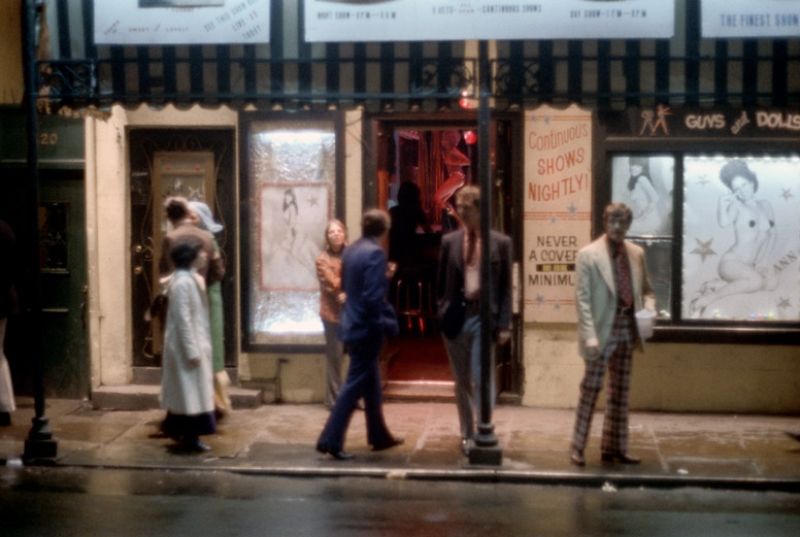
Despite this, the 1970s were a period of cultural renaissance for New Orleans, laying the groundwork for the city’s enduring reputation as a melting pot of music, cuisine, and history. These fascinating photos were taken by American photographer Nick DeWolf that show street scenes in New Orleans in 1973.

Bourbon Street, French Quarter, New Orleans, Louisiana, 1973

Cafe Creole, French Quarter, New Orleans, Louisiana, 1973

"Continuous Shows Nightly!", French Quarter, New Orleans, Louisiana, 1973

Arcade, French Quarter, New Orleans, Louisiana, 1973

Chris Owens, French Quarter, New Orleans, Louisiana, 1973

June 24, 2022

18 Amazing Vintage Photographs of Bourbon Street, New Orleans in 1957

Whether or not you’ve been to New Orleans, the party and food capital of Louisiana and perhaps the U.S., you’ve probably heard of Bourbon Street. Bourbon Street is a historic street in the heart of the French Quarter of New Orleans. Extending thirteen blocks from Canal Street to Esplanade Avenue, Bourbon Street is famous for its many bars and strip clubs.

The French claimed Louisiana in the 1690s, and Jean Baptiste Le Moyne de Bienville was appointed Director General in charge of developing a colony in the territory. He founded New Orleans in 1718. In 1721, the royal engineer Adrien de Pauger designed the city’s street layout. He named the streets after French royal houses and Catholic saints. He paid homage to France’s ruling family, the House of Bourbon, with the naming of Bourbon Street.

The French Quarter was central to this image of cultural legacy and became the best-known part of the city. Recent arrivals in New Orleans criticized the perceived loose morals of the Creoles, a perception that drew many travelers to New Orleans to drink, gamble and visit the city’s brothels, beginning in the 1880s.

Bourbon Street was a premier residential area prior to 1900. This changed in the late 1800s and early 1900s, when the Storyville red-light district was constructed on Basin Street adjacent to the French Quarter. The area became known for prostitution, gambling and vaudeville acts. Jazz is said to have developed here, with artists such as King Oliver and Jelly Roll Morton providing musical entertainment at the brothels.

Before World War II, the French Quarter was emerging as a major asset to the city’s economy. While there was an interest in historic districts at the time, developers pressured to modernize the city. Simultaneously, with the wartime influx of people, property owners opened adult-centered nightclubs to capitalize on the city’s risqué image. Wartime Bourbon Street was memorably depicted in Erle Stanley Gardner’s detective novel “Owls Don’t Blink”. After the war, Bourbon Street became the new Storyville in terms of reputation. By the 1940s and 1950s, nightclubs lined Bourbon Street. Over 50 different burlesque shows, striptease acts and exotic dancers could be found.


March 4, 2022

20 Vintage Snaps of People Wearing Spooky for New Orleans’ Mardi Gras in 1903

These photos of costumed revelers are from the Telling-Grandon scrapbook/diary, found at the Louisiana Digital Library. It contains photographs and ephemera collected by an Evanston, Illinois group during a visit by train to the New Orleans Carnival of 1903.


While the scrapbook has no single author, several of the entries are signed by individuals within the group. Two of the more prominent among these were an Irving Telling and Willie Grandon; thus the title of the collection, Telling-Grandon.

The holiday of Mardi Gras is celebrated in all of Louisiana, including the city of New Orleans. Celebrations are concentrated for about two weeks before and through Shrove Tuesday, the day before Ash Wednesday. Usually there is one major parade each day (weather permitting); many days have several large parades. The largest and most elaborate parades take place the last five days of the Mardi Gras season. In the final week, many events occur throughout New Orleans and surrounding communities, including parades and balls (some of them masquerade balls).


February 8, 2022

John G. Zimmerman: American in Black and White

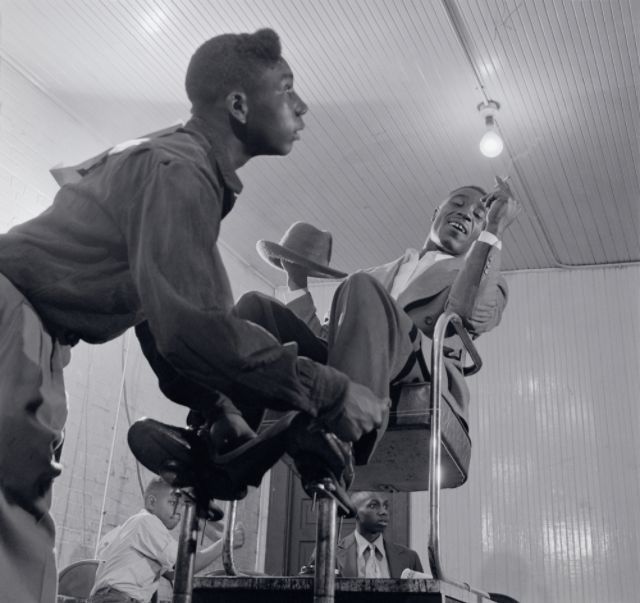
In 1952, renowned American photographer John G. Zimmerman moved to Atlanta. During his time there he shot a series of noteworthy assignments for Ebony depicting the lives of African Americans in the Midwest and the Jim Crow south. These photographs are a lesser-known yet notable part of Zimmerman’s early work. The subject matter ranges from the first all black supermarket in Detroit, boxing legend Joe Louis, to sharecropper Matt Ingram’s quest for justice.

The Center for Photographic Art states: “the work of John G. Zimmerman, one of the 20th century’s most wide-ranging and innovative photojournalists, helped generate a golden age in magazine photography. Zimmerman grew up in Torrance, California, developing and printing film in the family kitchen and darkroom. A three-year high school photography program with Hollywood cinematographer Clarence A. Bach prepared him for his first job as a staffer at Time magazine. Following that assignment he spent several years freelancing for Life and Ebony magazines, creating groundbreaking images of the lives of African Americans in the Midwest, and in the deeply segregated, pre-Civil Rights south.”

Take a look at Zimmerman’s work in the 1950s through 18 black and white photographs below:

Curtis Phillips, winner of the Shoe Shine Contest, Wilson, North Carolina, 1952.

Department store, 1953.

Jumping rope, Tennesse, 1953.

Swimming hole, Tennessee, 1953.

Matt Ingram, wife Linward and their children pray before dinner, Yanceyville, North Carolina, 1953.

November 4, 2021

Kodachrome Slides of New Orleans in the 1970s

New Orleans is a consolidated city-parish located along the Mississippi River in the southeastern region of the U.S. state of Louisiana. It is the most populous city in Louisiana. Serving as a major port, New Orleans is considered an economic and commercial hub for the broader Gulf Coast region of the United States.

New Orleans is world-renowned for its distinctive music, Creole cuisine, unique dialects, and its annual celebrations and festivals, most notably Mardi Gras. The historic heart of the city is the French Quarter, known for its French and Spanish Creole architecture and vibrant nightlife along Bourbon Street.

The city has been described as the “most unique” in the United States, owing in large part to its cross-cultural and multilingual heritage Additionally, New Orleans has increasingly been known as “Hollywood South” due to its prominent role in the film industry and in pop culture.

These Kodachrome slides from Rob Ketcherside were taken by his grandfather David C. Cook that show street scenes of New Orleans in 1976.

New Orleans street scene, 1976

New Orleans street scene, 1976

New Orleans street scene, 1976

Fishing boat Tabby V, New Orleans, 1976

Into the drink, New Orleans, 1976

May 7, 2021

Portraits of Young ‘White’ Slaves From New Orleans From the 1860s

Photographs of emancipated children were sold to raise money for the education of freed slaves in New Orleans. The children featured in the photographs drew attention to the fact that slavery was not solely a matter of color. If a child’s mother was an enlsaved person, then he or she was enslaved as well.


The group of emancipated slaves whose portraits were brought by Colonel Hanks and Mr. Phillip Bacon from New Orleans, where they were set free by General Butler. Mr. Bacon went to New Orleans with army, and was for eighteen months employed as Assistant-Superintendent of Freedmen, under the care of Colonel Hanks. He established the first school in Louisiana for emancipated slaves, and these children were among his pupils. He will soon return to Louisiana to resume his labor.

The following article appeared in Harper’s Weekly on January 30, 1864. The short biographies contained in the article offer us a rare (and possibly unique) record of enslaved children.

Rebecca Huger is eleven years old, and was a slave in her father’s house, the special attendant of a girl a little older than herself. To all appearance she is perfectly white. Her complexion, hair, and features show not the slightest trace of negro blood. In the few months during which she has been at school she has learned to read well, and writes as neatly as most children of her age. Her mother and grandmother live in New Orleans, where they support themselves comfortably by their own labor. The grandmother, an intelligent mulatto, told Mr. Bacon that she had "raised" a large family of children, but these are all that are left to her.

Rosina Downs is not quite seven years old. She is a fair child, with blonde complexion and silky hair. Her father is in the rebel army. She has one sister as white as herself, and three brothers who are darker. Her mother, a bright mulatto, lives in New Orleans in a poor hut, and has hard work to support her family.

Charles Taylor is eight years old. His complexion is very fair, his hair light and silky. Three out of five boys in any school in New York are darker than he. Yet this white boy, with his mother, as he declares, has been twice sold as a slave. First by his father and "owner," Alexander Wethers, of Lewis County, Virginia, to a slave-trader named Harrison, who sold them to Mr. Thornhill of New Orleans. This man fled at the approach of our army, and his slaves were liberated by General Butler. The boy is decidedly intelligent, and though he has been at school less than a year he reads and writes very well. His mother is a mulatto; she had one daughter sold into Texas before she herself left Virginia, and one son who, she supposes, is with his father in Virginia. These three children, to all appearance of unmixed white race, came to Philadelphia last December, and were taken by their protector, Mr. Bacon, to the St. Lawrence Hotel on Chestnut Street. Within a few hours, Mr. Bacon informed me, he was notified by the landlord that they must therefore be colored persons, and he kept a hotel for white people. From this hospitable establishment the children were taken to the "Continental," where they were received without hesitation.

Wilson Chinn is about 60 years old, he was “raised” by Isaac Howard of Woodford County, Kentucky. When 21 years old he was taken down the river and sold to Volsey B. Marmillion, a sugar planter about 45 miles above New Orleans. This man was accustomed to brand his negroes, and Wilson has on his forehead the letters “V. B. M.” Of the 210 slaves on this plantation 105 left at one time and came into the Union camp. Thirty of them had been branded like cattle with a hot iron, four of them on the forehead, and the others on the breast or arm.

Augusta Boujey is nine years old. Her mother, who is almost white, was owned by her half-brother, named Solamon, who still retains two of her children.

Mary Johnson was cook in her master’s family in New Orleans. On her left arm are scars of three cuts given to her by her mistress with a rawhide. On her back are scars of more than fifty cuts given by her master. The occasion was that one morning she was half an hour behind time in bringing up his five o’clock cup of coffee. As the Union army approached she ran away from her master, and has since been employed by Colonel Hanks as cook.

Isaac White is a black boy of eight years; but none the less intelligent than his whiter companions. He has been in school about seven months, and I venture to say that not one boy in fifty would have made as much improvement in that space of time.

Robert Whitehead—the Reverend Mr. Whitehead perhaps we ought to style him, since he is a regularly-ordained preacher—was born in Baltimore. He was taken to Norfolk, Virginia, by a Dr. A. F. N. Cook, and sold for $1525; from Norfolk he was taken to New Orleans where he was bought for $1775 by a Dr. Leslie, who hired him out as house and ship painter. When he had earned and paid over that sum to his master, he suggested that a small present for himself would be quite appropriate. Dr. Leslie thought the request reasonable, and made him a donation of a whole quarter of a dollar. The reverend gentleman can read and write well, and is a very stirring speaker. Just now he belongs to the church militant, having enlisted in the United States army.


March 2, 2021

Portraits of Rebecca Huger, a Young White Slave Girl of New Orleans From the 1860s

In 1863, the Union military (specifically the Department of the Gulf under Maj. Gen. N.P. Banks), the American Missionary Association, and the National Freedmen’s Relief Association cooperated in a joint effort to provide funds for schools for freed slave children in Louisiana. To this end, they arranged for a series of photographs of slave children from New Orleans with ‘white’ features and tours with these children. A new photographic medium, cartes de visites, allowed images of the children to be sold both as a fundraising device and to buoy up support for the ongoing war.

To appeal to the white middle class in the North, the children were photographed as in typical middle class family portraits. Although several of the children were age 6 or 7, the one of whom most cdvs have survived is Rebecca Huger, a young New Orleanian of about age 11. Rebecca was photographed in numerous poses and clothes and most of the photographs with several children include Rebecca.


Rebecca Huger was the daughter of John M. Huger, a Commercial Merchant in New Orleans before the Civil War. She was one of 17 house slaves owned by Mr. Huger. Harper’s Weekly wrote about Rebecca, “To all appearance, she is perfectly white. Her complexion, hair, and features show not the slightest trace of negro blood.” Harper’s Weekly editors explained that as “the offspring of white fathers through two or three generations, they are as white, as intelligent, as docile, as most of our own children.” In the few months during which she has been at school she has learned to read well, and writes as neatly as most children of her age.

The back of some of these photos reads, “Nett proceeds from the sale of these photographs will be devoted to the education of colored people in the Department of the Gulf.” This refers to the National Freedmen’s Relief Association who sold these photos for 25 cents to pay for teachers and supplies in Louisiana.

Some authors have suggested that the organizers of the fundraising campaign thought that Northerners would give more generously at the sight of young ‘white’ slaves. Others, however, feel that Rebecca’s age and demeanor evoked for Northern viewers the “fancy girls” that would be sold in the New Orleans slave market and become concubines. The photographs seemed to say that slavery could threaten even the white population.


FOLLOW US:
FacebookTumblrPinterestInstagram

CONTACT US


Browse by Decades

Popular Posts

Advertisement

09 10