Bring back some good or bad memories


ADVERTISEMENT
Showing posts with label Tennessee. Show all posts

July 22, 2026

30 Fascinating Photos of Everyday Life in Chattanooga From the 1890s

These fascinating photos, from Charles Gustavus Walline (March 30, 1874—July 14, 1943), offer a rare and captivating window into everyday life in Chattanooga, Tennessee, during the 1890s.

Captured in striking detail, the images showcase bustling street scenes, local residents in period clothing, horse-drawn carriages, early industrial landscapes, and the daily routines of a growing Southern city.

From lively markets and Victorian homes to workers and families going about their day, these vintage photos beautifully preserve the atmosphere, architecture, and spirit of Chattanooga at the end of the 19th century, a pivotal time of change and progress in American history.

A group with their bicycles

Charles Walline and a young woman lounge on the lawn near White Oak Cemetery

Charles Walline on a bicycle, riding on a dirt road

Chattanooga street scenes

Chattanooga street scenes

March 16, 2026

Tennessee During the American Civil War in Rare and Amazing Photos

During the American Civil War, Tennessee served as a vital and bloody crossroads, becoming the second most fought-over state after Virginia.

Known as the “Gateway to the Deep South,” its strategic rivers and railroads made it a primary objective for both Union and Confederate forces. From the devastating carnage at Shiloh to the dramatic “Battle Above the Clouds” in Chattanooga and the decisive clashes in Nashville, the state was a landscape of constant upheaval.

Tennessee was also a land deeply divided in loyalty, particularly between the pro-Union East and the Confederate-leaning West. The war left an indelible mark on the state, as its rugged mountains and fertile plains bore witness to some of the most turning-point moments that ultimately shaped the future of a divided nation.

These rare and amazing photos document the Union Army buildup of troops and supplies in and around the vital railroad center of Chattanooga, Tennessee, with additional scenes of Lookout Mountain and other sites in Tennessee during the American Civil War.

View of park of artillery captured at the Battle of Chattanooga, November 24, 25, and 26, 1863

Battlefield of Lookout Mountain, Tennessee, circa 1865

Capitol, Nashville, Tennessee, circa 1865

Chattanooga depot, Nashville, Tennessee, circa 1865

Grave yard and Monument of Hazen's Brigade on Stones River Battleground, Tennessee, circa 1865

January 29, 2026

In 1971, Young Oprah Winfrey Won the Miss Fire Prevention Contest in Her Hometown of Nashville

In 1971, at 17 years old, Oprah Winfrey won the Miss Fire Prevention contest in Nashville, Tennessee, by differentiating herself through her ambition and public speaking skills. While she was the only Black competitor in the pageant, her win was largely credited to a specific moment during the judging session.


When judges asked the finalists what they wanted to be when they grew up, other contestants gave traditional answers like “teacher” or “nurse.” Having already heard those responses, Oprah thought on her feet and declared she wanted to be a television journalist like Barbara Walters.

The pageant was sponsored by local radio station WVOL and the Nashville Gas Co.. It focused on intelligence and public presence rather than just beauty. For her victory, she received a Longines watch and a digital clock radio.

The win directly launched her media career. When she went to the WVOL radio station to claim her prizes, a DJ invited her to read news copy on tape. Impressed by her voice, the station hired her on the spot to read afternoon newscasts, making her their first female news reader while she was still in high school.

This victory set the stage for her to be crowned Miss Black Tennessee later that year and eventually become Nashville’s first Black female news co-anchor at age 19.


September 3, 2025

The Marriage of 22-Year-Old Charlie Johns and 9-Year-Old Eunice Winstead in 1937

On January 19, 1937, 22-year-old tobacco farmer Charlie Johns married his 9-year-old neighbor, Eunice Winstead. The couple was joined by Baptist preacher Walter Lamb in Sneedville, Hancock County. Johns offered Lamb a dollar (equivalent to $22 in today) to perform the marriage. To get to the wedding without her parents’ knowledge, Winstead told them she was going out to get a doll.

Johns falsified Winstead’s age in order to obtain their marriage license. At the time of their marriage, the state of Tennessee had no minimum age for marriage. Winstead’s mother had married at the age of sixteen, and her sister Ina married at thirteen. Though the mothers of Johns and Winstead initially believed that Eunice was too young to marry, they ultimately decided to approve of the marriage.


Johns and Winstead’s marriage was discovered by the press approximately ten days after the wedding. It was then widely covered by American newspapers and magazines. The union was reported by The Times and Life magazines, along with The New York Times. It also inspired the 1938 film Child Bride. Johns avoided media attention, accusing reporters of making things up, and he did not allow any photographs to be taken of his wife and children.

A 1937 piece published by Life about the case displayed a picture of Winstead and Johns at their home in Sneedville. In a news article published that year, The Knoxville Journal reported that “The Winstead family seems complacent over the future of the 9-year-old bride because Charlie, the bridegroom, owns 50 acres of mountain land, several mules and he’s a good farmer.” Another article in Newsweek portrayed Winstead sitting on Johns’ knees.

Reactions to the marriage triggered a change to the law in Tennessee, forbidding marriage of individuals under the age of 16, even if they have parental consent. It provided for exceptions in cases such as pregnancy.


February 27, 2025

Feeding the Workhands, Claiborne County, Tennessee, ca. 1940s

In the 1940s, in the heart of Claiborne County, Tennessee, a vivid photograph captures a moment of respite and community amidst the labor of wheat harvesting. The image shows a group of weary men, their clothes dusty and worn from a hard day’s work, gathered around a table brimming with food.

(Photo: Joe Clark HBSS - Clark Family Photo Collection - Special Collections Library - University of North Texas)

The scene unfolds as the men take a well-deserved break, their fatigue evident but momentarily eased by the hearty meal before them. Two women, their faces marked with the strains of both work and care, are busy serving the men, ensuring that everyone is fed and refreshed. Meanwhile, a third woman cradles a baby, adding a tender touch to the bustling scene.

At the head of the table, a man lovingly holds a young boy on his lap, creating a poignant image of family and connection even in the midst of demanding labor. This simple yet powerful snapshot, as narrated by Junebug Clark, not only highlights the physical demands of harvesting but also underscores the communal spirit and familial bonds that sustain the workers.

In this moment, the photograph offers more than just a glimpse into the daily lives of those in Claiborne County; it reveals the heart of rural life where hard work and family support intertwine, making the challenges of the harvest season a shared experience of perseverance and care.

February 20, 2025

Photographs Children Playing “Drop the Handkerchief” at Locust Grove School, Claiborne County, Tennessee, 1940

In the heart of Claiborne County, Tennessee, in the year 1940, the Locust Grove School was a lively hub of childhood laughter and simple joys. On a crisp, sunny day, the schoolyard was transformed into a playground of innocent fun as the students enjoyed their recess.

These photographs, captured by Joe Clark and now part of the Clark Family Photo Collection at the University of North Texas, beautifully freezes a moment of pure childhood delight. In the images, a group of children stands in a wide, cheerful circle, their hands linked together in a display of camaraderie. Their faces, glowing with excitement, are turned toward the center where the action unfolds.

At the heart of the circle, a child darts energetically around the group, clutching a handkerchief in one hand. This game, known as “Drop the Handkerchief,” was a popular pastime, a delightful blend of anticipation and strategy. The child running circles around the group is tasked with dropping the handkerchief behind one of the standing classmates without being noticed. When the handkerchief falls, the chosen child must chase the runner and try to tag them before they can take their place in the circle.


November 8, 2024

When Young Elvis Presley Met the Legendary B.B. King in Memphis, Tennessee in 1957

When we think of musical legends, a few names come to mind instantly: B.B. King, the King of Blues, and Elvis Presley, the King of Rock ‘n’ Roll. Their legacies are cemented in the annals of music history, but perhaps lesser known is the genuine bond these two giants shared, a bond that crossed racial and musical boundaries. B.B. King, always humble, had a remarkable story to tell about Elvis—a story that set the record straight about the man he knew behind the icon.

“When Elvis appeared he was already a big, big star. Remember this was the fifties, so for a young white boy to show up in an all-black function took guts,” King once recalled. This candid statement highlights a pivotal moment in both their careers and the cultural environment of the time. Elvis’s decision to attend and perform at predominantly African-American events wasn’t just about music; it was about paying respect to the roots from which he drew inspiration.

“I believe he was showing his roots and he seemed proud of those roots,” King continued. “After the show, he made a point of posing for pictures with me, treating me like royalty.” Elvis’s gesture was more than just a photo op; it was a public acknowledgment of the deep influence of blues and rhythm and blues artists like B.B. King on his own musical style. “He’d tell people I was one of his influences. I doubt whether that’s true, but I like hearing Elvis give Memphis credit for his musical upbringing,” King mused.


Their friendship didn’t end there. Fast forward to 1972, when B.B. King found himself in need of a career boost. Elvis, then a major draw at the Hilton Hotel in Las Vegas, stepped in to help his friend. “Elvis helped me get a good gig at the Hilton Hotel while he was playing in the big theater. He put in a call for me and I worked in the lounge to a standing room only crowd,” King remembered fondly. This favor spoke volumes about Elvis’s character. While his fame could have made him insular, he chose instead to lift others, especially those he admired.

“Elvis fans came in different colors, but their love for good music was all the same,” King reflected. This sense of unity through music was something Elvis cherished and it made the lounge, where King played, a gathering place for true music lovers. “They were always a good audience,” King added, highlighting the impact of Elvis’s support on his performances.

After the lights dimmed and the audience left, King and Presley would often find themselves together in Elvis’s suite. “Many nights I’d go upstairs after we finished our sets and go up to his suite. I’d play Lucille [King’s guitar] and sing with Elvis, or we’d take turns. It was his way of relaxing.” These images of two musical icons, stripped of the glitz and glamour, simply enjoying each other’s company and sharing the music they loved, is both poignant and powerful.

“I’ll tell you a secret. We were the original Blues Brothers because that man knew more blues songs than most in the business—and after some nights it felt like we sang every one of them,” King joked. His humor, however, underscores a truth about Elvis’s devotion to the blues. He wasn’t just a performer who dabbled in different genres; he was a student of music who respected its roots and its masters.
But what King valued most in Elvis was his unwavering respect. “When we were hanging out in the Hilton in the 70s, Elvis had not lost his respect, his ‘yes sir,’ his love for all fields of music. And I liked that.” King’s words are a testament to a side of Elvis that often gets overlooked—a side that admired and acknowledged the contributions of African-American artists to the fabric of American music.

The friendship between B.B. King and Elvis Presley serves as a reminder that music transcends boundaries. It brings people together, irrespective of race or genre, and has the power to forge bonds that last a lifetime. While B.B. King may have doubted his influence on Elvis, the respect and admiration the two shared was mutual, sincere, and deeply rooted in their shared love for the blues.

April 27, 2024

12-Year-Old Elvis Presley Posing on His Bike in Front of the S&S Drug Store, Memphis, 1948

In the summer of 1947, a woman walked into a drug store in Memphis, Tennessee, to drop off film to be developed when she realized she had one exposure left. She noticed a young boy outside the drugstore and asked him to pose with his bicycle so she could finish the roll and turn it in. Only years later did she realize that it was a 12-year-old Elvis Presley and gave the photo to a family friend of his.


In 2014 this photo was finally published of the young Elvis Presley in Vanity Fair magazine.

January 7, 2023

Segregation and Music Scenes in Memphis, Tennesse Through Ernest C. Withers’ Pictures From the 1940s to 1960s

Ernest C. Withers (August 7, 1922 – October 15, 2007) was an African-American photojournalist. He is best known for capturing over 60 years of African American history in the segregated South, with iconic images of the Montgomery Bus Boycott, Emmett Till, Memphis sanitation strike, Negro league baseball, and musicians including those related to Memphis blues and Memphis soul.

Sanitation workers assemble in front of Clayborn Temple for a solidarity march, Memphis, Tennessee, 1968.

Withers’ interest in photography began in his eighth-grade year at a Memphis school. More than seventy years later, he continued to maintain a studio on Beale Street – once the Memphis epicentre of the musical life of the nation. 

Throughout the 1950s, Withers was, in his own words, “a news photographer,” “recording events that were taking place.” Momentous events were occurring, and he recorded them for African American newspapers across the country.

Portrait in a Cotton Field, no date.

During the 1950’s and 1960’s, Withers travelled throughout the South with Dr. Martin Luther King Jr., James Meredith, Medgar Evers and other leaders of the Civil Rights movement. He provided images that made the dramatic stories of the era – a vivid Dr. King riding the first desegregated bus in Montgomery, murders of Civil Rights workers, voter registration drives, lynchings and the powerful Memphis Sanitation Workers Strike. The result is an encompassing and moving chronicle of the great American crusade of the second half of the Twentieth Century.

As he travelled across the South, Withers’ base was always his hometown. Take a look back at life in mid-century Memphis through these 22 pictures taken by Withers:

The WDIA Twins, 1948.

William Edwin Jones pushes daughter Renee Andrewnetta Jones (8 months old) during protest, Main Street, Memphis, Tennessee, 1950s.

Memphis zoo segregation.

April 4, 2022

Found Photos From Daisy Studio in Memphis, Tennessee From the Early 1940s

Memphis is a city along the Mississippi River in southwestern Shelby County, Tennessee, United States. It is Tennessee’s second-most populous city behind Nashville; fifth-most populous city in the Southeast, the nation’s 28th-largest; and the largest city proper of those situated along the Mississippi River. The city is the anchor of West Tennessee and the greater Mid-South region, which includes portions of neighboring Arkansas, Mississippi, and the Missouri Bootheel.

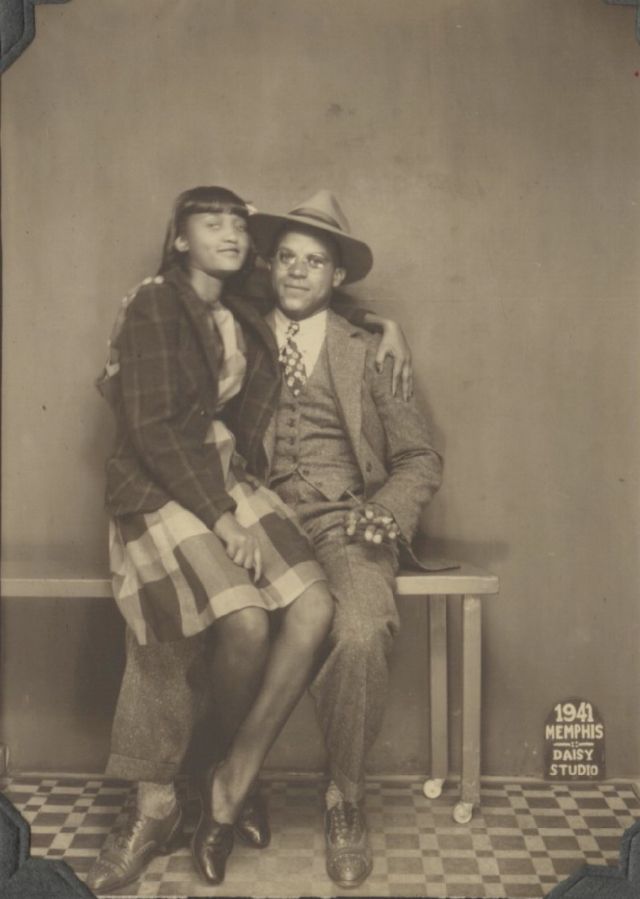
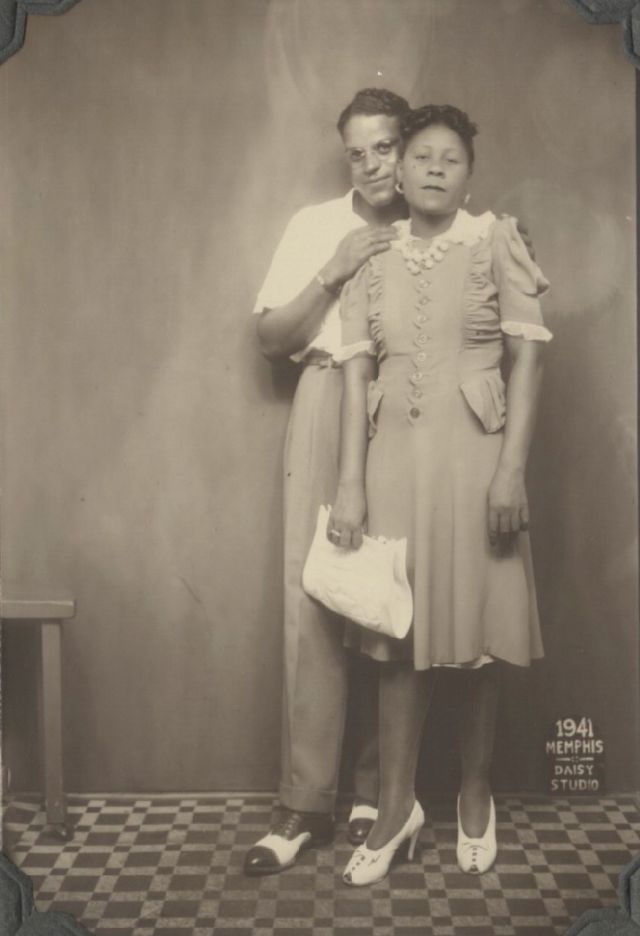
1940s portrait photos from Daisy Studio at 315 Beale Street, Memphis, Tennessee

Memphis is the seat of Shelby County, Tennessee's most populous county. One of the more historic and culturally significant cities of the southern United States, Memphis has a wide variety of landscapes and distinct neighborhoods.

Home to Tennessee’s largest African-American population, Memphis grew into one of the largest cities of the Antebellum South as a market for agricultural goods, natural resources like lumber, and the American slave trade. After the American Civil War and the end of slavery, the city experienced even faster growth into the 20th century as it became among the largest world markets for cotton and lumber.

Daisy Studio was at 315 Beale Street, Memphis, Tennessee, a few buildings west of the “Old” Daisy Theatre on the same block. These found photos from ⓑⓘⓡⓒⓗ from memphis were taken by the studio from the early 1940s.

1941 photo of girl at Daisy Studio on Beale Street, Memphis, Tennessee

1941 photo of man and women, Daisy Studio, Beale Street, Memphis, Tennessee

1941 photo of man and women, Daisy Studio, Beale Street, Memphis, Tennessee

1942 photo of a sharp-dressed man, Daisy Studio, Beale Street, Memphis, Tennessee

1942 photo of friends at Daisy Studio, Beale Street, Memphis, Tennessee

February 8, 2022

John G. Zimmerman: American in Black and White

In 1952, renowned American photographer John G. Zimmerman moved to Atlanta. During his time there he shot a series of noteworthy assignments for Ebony depicting the lives of African Americans in the Midwest and the Jim Crow south. These photographs are a lesser-known yet notable part of Zimmerman’s early work. The subject matter ranges from the first all black supermarket in Detroit, boxing legend Joe Louis, to sharecropper Matt Ingram’s quest for justice.

The Center for Photographic Art states: “the work of John G. Zimmerman, one of the 20th century’s most wide-ranging and innovative photojournalists, helped generate a golden age in magazine photography. Zimmerman grew up in Torrance, California, developing and printing film in the family kitchen and darkroom. A three-year high school photography program with Hollywood cinematographer Clarence A. Bach prepared him for his first job as a staffer at Time magazine. Following that assignment he spent several years freelancing for Life and Ebony magazines, creating groundbreaking images of the lives of African Americans in the Midwest, and in the deeply segregated, pre-Civil Rights south.”

Take a look at Zimmerman’s work in the 1950s through 18 black and white photographs below:

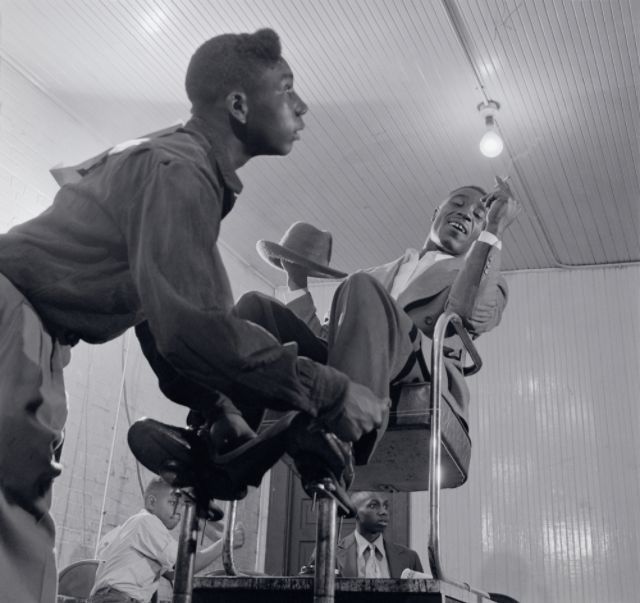
Curtis Phillips, winner of the Shoe Shine Contest, Wilson, North Carolina, 1952.

Department store, 1953.

Jumping rope, Tennesse, 1953.

Swimming hole, Tennessee, 1953.

Matt Ingram, wife Linward and their children pray before dinner, Yanceyville, North Carolina, 1953.

May 1, 2021

Photographs of a Family of Nine Living in Field on U.S. Route 70 Near the Tennessee River During the Depression, 1936

A native of Boston, Carl Mydans (1907–2004) was born into a family of second-generation Russian immigrants. He studied journalism at Boston University, where he first learned how to take and develop photographs. After he graduated in 1930, he found work as a reporter for American Banker, but eventually bought a 35-millimeter Contax camera. The Contax was small, and enabled its carrier to easily roam about and take photos with a minimum of advance preparation. He quickly mastered the camera, and began to sell his work to Time and other magazines.

In 1935, Mydans was hired as a photographer with a U.S. federal agency called the Resettlement Administration, which later became the Farm Security Administration. He traveled throughout New England and the South, documenting the failed end of a rural-based economy, and gained a reputation for his images of bedraggled Arkansas farmers and their families. It was the Great Depression, and the poorest of America’s poor were devastated by the economic downturn.

These pictures, of a Tennessee family of nine living in a hut built on an abandoned truck chassis, portray the misery of the times as starkly as any photographs by his more celebrated contemporaries in the FSA.

Resettlement Administration official investigating the case of nine living in field on U.S. Route 70 between Camden and Bruceton, Tennessee, near the Tennessee River. March 1936.

Family of nine living in open field in rough board covering built on old Ford truck chassis on U.S. Route 70, between Bruceton and Camden, Tennessee. Their water supply was an open creek running near highway.

Mother and father of a family of nine living in open field in rough board covering built on old Ford chassis on U.S. Route 70, between Bruceton and Camden, Tennessee.

Mother and baby of family of nine living in field on U.S. Route 70 in Tennessee, near Tennessee River.

Mother and baby of family of nine living in field on U.S. Route 70 in Tennessee, near Tennessee River.

Twelve-year old girl of family of nine living in one-room hut built over the chassis of abandoned Ford truck in open field on U.S. Route 70 between Camden and Bruceton, Tennessee. View also shows one of the small boys in family; the girl is dressed in a meal sack.

Oldest boy of family of nine, seventeen years old, claims two years schooling; living with his family in open field, on U.S. Route 70 between Camden and Bruceton, Tennessee.

Three of the family of nine living in field in rough board covering built on old Ford truck chassis on U.S. Route 70, between Camden and Bruceton, Tennessee.

Twelve-year old girl of family of nine, cooking meal in rude, open lean-to near hut, Tennessee.

Interior of wood shack built upon Ford truck chassis housing father, mother and seven children. This view shows the mother and two of her children.

One-room hut housing family of nine built over chassis of abandoned Ford in open field between Camden and Bruceton, Tennessee, near Tennessee River.

This one-room hut built of rough lumber over the chassis of an abandoned Ford truck was the housing provided by a landlord for an illiterate wood-cutter, with a wife and seven children. Found on U.S. Route 70 between Camden and Bruceton, Tennessee, near Tennessee River. Family of nine lived and slept in this shack.

(Photos by Carl Mydans)


FOLLOW US:
FacebookTumblrPinterestInstagram

CONTACT US


Browse by Decades

Popular Posts

Advertisement

09 10