Bring back some good or bad memories


ADVERTISEMENT
Showing posts with label Louisiana. Show all posts

October 28, 2025

Street Scenes of 1963 New Orleans in Fascinating Photos

The streets of New Orleans in the 1960s were alive with rhythm, color, and contrast — a city where tradition and transformation met at every corner. From the lively French Quarter with its wrought-iron balconies and jazz drifting from open doors, to the quieter residential neighborhoods lined with shotgun houses and oak-shaded avenues, the city’s unique charm was unmistakable.

This was a decade of change in America, and New Orleans reflected it vividly. Streetcars rattled along St. Charles Avenue, brass bands played in impromptu parades, and a growing sense of cultural pride and civil rights activism infused the atmosphere. Markets bustled, children played on stoops, and artists, musicians, and travelers mingled in cafés and clubs, capturing the city’s enduring spirit of creativity and resilience.

Every photograph from this era feels like a window into a timeless New Orleans — vibrant yet weathered, soulful yet joyful, and forever moving to its own unmistakable beat. These fascinating photos, taken by Laird Scott during his honeymoon vacation, showcase street scenes of New Orleans in December 1963.

New Orleans. Hotsy Totsy Club, December 1963

New Orleans. 500 Club - A High Class Joint with a live band, December 1963

New Orleans. Alley, December 1963

New Orleans. Antique shop, December 1963

New Orleans. Bourbon Street at night, December 1963

October 22, 2024

An Organ Grinder Moving Through the Streets of New Orleans Photographed by Arnold Genthe in the 1920s

The organ grinder was a musical novelty street performer of the 19th century and the early part of the 20th century, and refers to the operator of a street or barrel organ.

While New Orleans was known for its live musical traditions, organ grinders were part of a broader tradition of itinerant street performers. However, by the 1920s, this form of entertainment was beginning to decline as radio, recorded music, and changing urban regulations became more common. In many cities, including New Orleans, street performers like organ grinders were subject to municipal regulations and could be viewed as nuisances or even beggars by some members of society.

Despite this, they contributed to the city’s diverse cultural landscape, offering a nostalgic link to older forms of entertainment and a unique charm that is still remembered today.


July 24, 2024

35 Found Snaps Capture Street Scenes of New Orleans in the Late 1950s

In the 1950s, New Orleans was a vibrant, culturally rich city known for its unique blend of French, Spanish, African, and American influences. The city was famous for its jazz music scene, with icons like Louis Armstrong and Fats Domino gaining national fame. The French Quarter remained a hub of nightlife and entertainment, while the city’s cuisine, featuring dishes like gumbo and jambalaya, was celebrated.

In addition to its vibrant cultural scene, New Orleans in the 1950s experienced significant economic growth, partly due to the expansion of the oil industry. The port of New Orleans remained one of the busiest in the United States, facilitating international trade.

However, the era was also marked by racial segregation and civil rights struggles, as African Americans fought for equality in a society that was deeply divided by race. The city also faced challenges such as urban decay in some neighborhoods and political corruption scandals.

Despite these challenges, New Orleans maintained its reputation as a city with a lively, resilient spirit. These vintage snaps were found by Mark Susina that captured street scenes of New Orleans in 1959.


May 4, 2024

New Orleans in 1973 Through Fascinating Photos

New Orleans in the 1970s was a vibrant and culturally rich city, known for its music, food, and unique blend of French, Spanish, African, and Creole influences.

The city was experiencing a revival of its jazz and blues scene, with iconic venues like Preservation Hall attracting both locals and tourists. However, the city also faced challenges such as crime and urban decay, especially in certain neighborhoods.

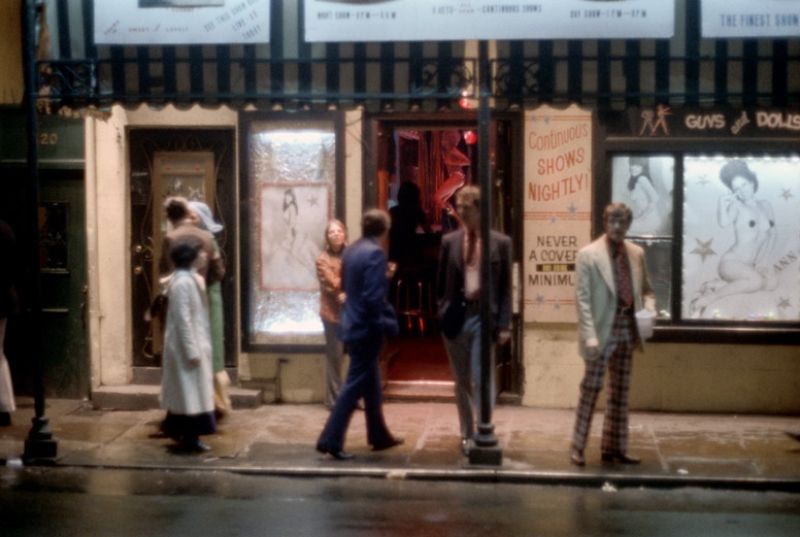
Despite this, the 1970s were a period of cultural renaissance for New Orleans, laying the groundwork for the city’s enduring reputation as a melting pot of music, cuisine, and history. These fascinating photos were taken by American photographer Nick DeWolf that show street scenes in New Orleans in 1973.

Bourbon Street, French Quarter, New Orleans, Louisiana, 1973

Cafe Creole, French Quarter, New Orleans, Louisiana, 1973

"Continuous Shows Nightly!", French Quarter, New Orleans, Louisiana, 1973

Arcade, French Quarter, New Orleans, Louisiana, 1973

Chris Owens, French Quarter, New Orleans, Louisiana, 1973

March 4, 2022

20 Vintage Snaps of People Wearing Spooky for New Orleans’ Mardi Gras in 1903

These photos of costumed revelers are from the Telling-Grandon scrapbook/diary, found at the Louisiana Digital Library. It contains photographs and ephemera collected by an Evanston, Illinois group during a visit by train to the New Orleans Carnival of 1903.


While the scrapbook has no single author, several of the entries are signed by individuals within the group. Two of the more prominent among these were an Irving Telling and Willie Grandon; thus the title of the collection, Telling-Grandon.

The holiday of Mardi Gras is celebrated in all of Louisiana, including the city of New Orleans. Celebrations are concentrated for about two weeks before and through Shrove Tuesday, the day before Ash Wednesday. Usually there is one major parade each day (weather permitting); many days have several large parades. The largest and most elaborate parades take place the last five days of the Mardi Gras season. In the final week, many events occur throughout New Orleans and surrounding communities, including parades and balls (some of them masquerade balls).


February 10, 2022

DOCUMERICA: Snapshots of America in Crisis in the 1970s

By the late 1960s, the American landscape was ravaged by decades of unchecked land development, blighted by urban decay in the big cities, and plagued by seemingly unstoppable air, noise, and water pollution. 

In November 1971, the newly created Environmental Protection Agency (EPA) announced a monumental photodocumentary project to “photographically document subjects of environmental concern” in the United States. The collection, now at the National Archives, resulted in a collection of more than 20,000 photographs by its conclusion in 1978.

With support from the first EPA administrator, William Ruckelshaus, project director Gifford D. Hampshire contracted well-known photographers to work for the EPA on the project. Estimates of the number involved range between 70 and 120, and they were organized geographically, with each photographer working in a particular area in which they were already active.

Subjects photographed include urban cityscapes, small towns, rural areas, beaches and mountains. They show people going about their everyday lives as well as working in farms; waterfronts; mining and logging, industry and heavy industry. Images document junk yards, highways, Amtrak trains, air and water pollution; and environmental protection and pollution control measures. 

The earliest assignments were closely aligned to the EPA's proposed areas of concern: air and water pollution, management of solid waste, radiation and pesticides, and noise abatement.  However, photographers had considerable creative freedom about what they shot.  Among the areas depicted are national parks and forests, including environmentally sensitive areas that were under development or considered for government protection.

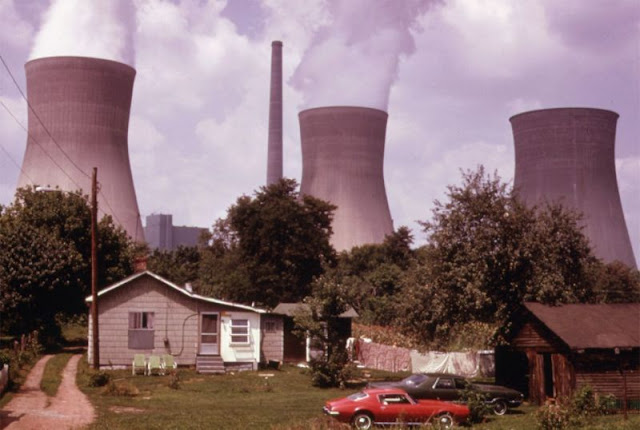
Water cooling towers of the John Amos Power Plant loom over a home located across the Kanawha River, near Poca, West Virginia, August 1973. (Harry Schaefer)

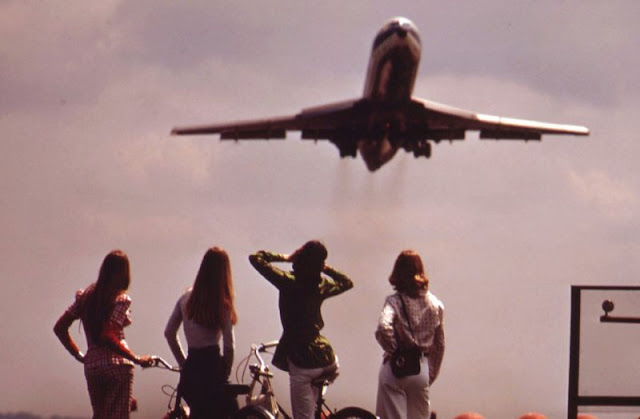
One of four bicyclists holds her ears against the roar of the jet taking off from National Airport in Washington, District of Columbia, May 1973. (John Neubauer)

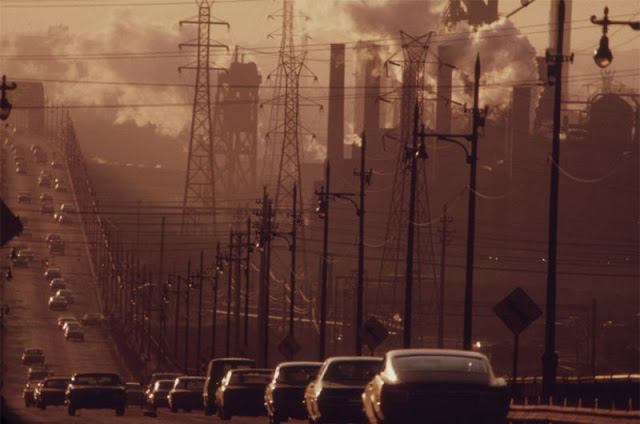
Clark Avenue and Clark Avenue bridge, looking east from West 13th Street, obscured by industrial smoke, in Cleveland, Ohio, July 1973. (Frank J. Aleksandrowicz)

Balloon logging in the Culp Creek drainage area of Oregon, near Eugene.

A mountain of damaged oil drums lies in a heap in an Exxon refinery near Baton Rouge, Louisiana, December 1972. (John Messina)

November 4, 2021

Kodachrome Slides of New Orleans in the 1970s

New Orleans is a consolidated city-parish located along the Mississippi River in the southeastern region of the U.S. state of Louisiana. It is the most populous city in Louisiana. Serving as a major port, New Orleans is considered an economic and commercial hub for the broader Gulf Coast region of the United States.

New Orleans is world-renowned for its distinctive music, Creole cuisine, unique dialects, and its annual celebrations and festivals, most notably Mardi Gras. The historic heart of the city is the French Quarter, known for its French and Spanish Creole architecture and vibrant nightlife along Bourbon Street.

The city has been described as the “most unique” in the United States, owing in large part to its cross-cultural and multilingual heritage Additionally, New Orleans has increasingly been known as “Hollywood South” due to its prominent role in the film industry and in pop culture.

These Kodachrome slides from Rob Ketcherside were taken by his grandfather David C. Cook that show street scenes of New Orleans in 1976.

New Orleans street scene, 1976

New Orleans street scene, 1976

New Orleans street scene, 1976

Fishing boat Tabby V, New Orleans, 1976

Into the drink, New Orleans, 1976

September 13, 2021

In 1948, Burlesque Dancer Stacy “Stormy” Lawrence Did a Surprise Striptease for the Students at Louisiana State University

The event was actually a school run event in front of a field house on campus of Louisiana State University in Baton Rouge. One of the students came up with this stunt because he wanted to generate a campus prank story since he was running for student body president. This same student also was at the campus house to help promote a school humor magazine he was an editor at. The famous stunt had Stormy and a Dixieland band crashed the event in the back of a large truck.

The famous Bourbon Street burlesque dancer ventured out after the truck moved in to place and began to tease the crowd with her routine while the band started playing. She began to strip, which caught most of the crowd completely off guard, and showcased her famous talents. The school officials there panicked, and the crowd actually had mixed emotions. Some, like the ones up close in the pictures, cheered and enjoyed the show.

However, others found this stunt demeaning to the school, and sought to put an end to the stunt before it went too far. Led by some LSU football players, a group of young men stormed the truck. They destroyed some of the instruments, including the drums and a piano, and chased off the band. They then had to figure out what to do with Stormy.

Apparently, even as the crowd besieged the truck, Stormy never lost her composure and even continued to engage the crowd. Once the group of students started smashing the instruments, she stopped and tried to leave. Instead, the students actually grabbed her and threw her into a lake nearby. Of that experience, she famously said “'boys will be boys.”

Since this was a planned event for the school, local papers and photographers were there. One of them snapped these pictures and sold them to LIFE Magazine. The event made headlines around the state at the time, but LIFE Magazine decided not to publish the pictures even after purchasing them. The papers around the area did publish some of the pictures and of course ran the story.

At the school, it became legend, and was even reprinted in the school yearbook in 1975. The results for the students involved in this event is unknown, but apparently no charges were made on anyone.

“Well, it was all a lot of fun then,” Stormy recalled years later. “I still hear from the guys who were there when it happened. I don’t harbor any ill will about it at all.”

Stormy continued to be a famous dancer in New Orleans throughout the late 1940s and 1950s. She was most famous for being the main headliner at her own club she opened, Stormy’s Casino Royale, and was also known as the “belle of Bourbon Street,” as one magazine described her. She made more headlines in another stunt in 1952, when she endorsed Alabama Gov. James “Kissin’ Jim” Folsom, who made an unsuccessful bid for the presidency on the Democratic ticket. When asked why she supported the presidential hopeful, she actually said Folsom was like “a honey pot.” Stormy died in 1982 at the age of 54, but her campus legend lives on.


March 2, 2021

Portraits of Rebecca Huger, a Young White Slave Girl of New Orleans From the 1860s

In 1863, the Union military (specifically the Department of the Gulf under Maj. Gen. N.P. Banks), the American Missionary Association, and the National Freedmen’s Relief Association cooperated in a joint effort to provide funds for schools for freed slave children in Louisiana. To this end, they arranged for a series of photographs of slave children from New Orleans with ‘white’ features and tours with these children. A new photographic medium, cartes de visites, allowed images of the children to be sold both as a fundraising device and to buoy up support for the ongoing war.

To appeal to the white middle class in the North, the children were photographed as in typical middle class family portraits. Although several of the children were age 6 or 7, the one of whom most cdvs have survived is Rebecca Huger, a young New Orleanian of about age 11. Rebecca was photographed in numerous poses and clothes and most of the photographs with several children include Rebecca.


Rebecca Huger was the daughter of John M. Huger, a Commercial Merchant in New Orleans before the Civil War. She was one of 17 house slaves owned by Mr. Huger. Harper’s Weekly wrote about Rebecca, “To all appearance, she is perfectly white. Her complexion, hair, and features show not the slightest trace of negro blood.” Harper’s Weekly editors explained that as “the offspring of white fathers through two or three generations, they are as white, as intelligent, as docile, as most of our own children.” In the few months during which she has been at school she has learned to read well, and writes as neatly as most children of her age.

The back of some of these photos reads, “Nett proceeds from the sale of these photographs will be devoted to the education of colored people in the Department of the Gulf.” This refers to the National Freedmen’s Relief Association who sold these photos for 25 cents to pay for teachers and supplies in Louisiana.

Some authors have suggested that the organizers of the fundraising campaign thought that Northerners would give more generously at the sight of young ‘white’ slaves. Others, however, feel that Rebecca’s age and demeanor evoked for Northern viewers the “fancy girls” that would be sold in the New Orleans slave market and become concubines. The photographs seemed to say that slavery could threaten even the white population.


February 3, 2021

Indians at World’s Fair Trying to Prevent Picture Being Made by Reflecting Sunlight From Small Mirrors Into Camera, 1904

With 750 accredited photographers, and thousands of attendees armed with Kodak film that allowed 100 snapshots per roll, the 1904 Louisiana Purchase Exposition in St. Louis witnessed camera-related clashes between attendees and exhibitors that were perhaps inevitable.

In this picture, Native Americans tried to sabotage an unauthorized photo by flashing mirrors whose reflections obstructed the shot. Not, as some believed, because they feared cameras would snatch their souls away, but because they were dependent on sales from their likenesses as much as their handicrafts.

(Photo by Richard Ross Whiting/ Library of Congress)

March 30, 2020

42 Fascinating Color Photo Capture Street Scenes of New Orleans in the Late 1950s

New Orleans is a consolidated city-parish located along the Mississippi River in the southeastern region of the U.S. state of Louisiana. It is the most populous city in Louisiana. Serving as a major port, New Orleans is considered an economic and commercial hub for the broader Gulf Coast region of the United States.

New Orleans is world-renowned for its distinct music, Creole cuisine, unique dialect, and its annual celebrations and festivals, most notably Mardi Gras. The historic heart of the city is the French Quarter, known for its French and Spanish Creole architecture and vibrant nightlife along Bourbon Street.

The city has been described as the "most unique" in the United States, owing in large part to its cross-cultural and multilingual heritage.

This set of pictures from Monceau was taken by William M. Green Sr. in May of 1958. Anyone who if familiar with New Orleans, particularly Canal Street and the French Quarter, will recognize many of the places captured in these pictures, though many look different than we would see today.

Canal Street King Cotton

Adam Comeaux French Quarter

Bohland Pirate's Alley artist sketching girl

Bourbon Street houses

Bourbon Street one way


FOLLOW US:
Facebook • Tumblr • Pinterest • Instagram

CONTACT US


Browse by Decades

Popular Posts

Advertisement

09 10