Bring back some good or bad memories


ADVERTISEMENT
Showing posts with label Memphis. Show all posts

November 8, 2024

When Young Elvis Presley Met the Legendary B.B. King in Memphis, Tennessee in 1957

When we think of musical legends, a few names come to mind instantly: B.B. King, the King of Blues, and Elvis Presley, the King of Rock ‘n’ Roll. Their legacies are cemented in the annals of music history, but perhaps lesser known is the genuine bond these two giants shared, a bond that crossed racial and musical boundaries. B.B. King, always humble, had a remarkable story to tell about Elvis—a story that set the record straight about the man he knew behind the icon.

“When Elvis appeared he was already a big, big star. Remember this was the fifties, so for a young white boy to show up in an all-black function took guts,” King once recalled. This candid statement highlights a pivotal moment in both their careers and the cultural environment of the time. Elvis’s decision to attend and perform at predominantly African-American events wasn’t just about music; it was about paying respect to the roots from which he drew inspiration.

“I believe he was showing his roots and he seemed proud of those roots,” King continued. “After the show, he made a point of posing for pictures with me, treating me like royalty.” Elvis’s gesture was more than just a photo op; it was a public acknowledgment of the deep influence of blues and rhythm and blues artists like B.B. King on his own musical style. “He’d tell people I was one of his influences. I doubt whether that’s true, but I like hearing Elvis give Memphis credit for his musical upbringing,” King mused.


Their friendship didn’t end there. Fast forward to 1972, when B.B. King found himself in need of a career boost. Elvis, then a major draw at the Hilton Hotel in Las Vegas, stepped in to help his friend. “Elvis helped me get a good gig at the Hilton Hotel while he was playing in the big theater. He put in a call for me and I worked in the lounge to a standing room only crowd,” King remembered fondly. This favor spoke volumes about Elvis’s character. While his fame could have made him insular, he chose instead to lift others, especially those he admired.

“Elvis fans came in different colors, but their love for good music was all the same,” King reflected. This sense of unity through music was something Elvis cherished and it made the lounge, where King played, a gathering place for true music lovers. “They were always a good audience,” King added, highlighting the impact of Elvis’s support on his performances.

After the lights dimmed and the audience left, King and Presley would often find themselves together in Elvis’s suite. “Many nights I’d go upstairs after we finished our sets and go up to his suite. I’d play Lucille [King’s guitar] and sing with Elvis, or we’d take turns. It was his way of relaxing.” These images of two musical icons, stripped of the glitz and glamour, simply enjoying each other’s company and sharing the music they loved, is both poignant and powerful.

“I’ll tell you a secret. We were the original Blues Brothers because that man knew more blues songs than most in the business—and after some nights it felt like we sang every one of them,” King joked. His humor, however, underscores a truth about Elvis’s devotion to the blues. He wasn’t just a performer who dabbled in different genres; he was a student of music who respected its roots and its masters.
But what King valued most in Elvis was his unwavering respect. “When we were hanging out in the Hilton in the 70s, Elvis had not lost his respect, his ‘yes sir,’ his love for all fields of music. And I liked that.” King’s words are a testament to a side of Elvis that often gets overlooked—a side that admired and acknowledged the contributions of African-American artists to the fabric of American music.

The friendship between B.B. King and Elvis Presley serves as a reminder that music transcends boundaries. It brings people together, irrespective of race or genre, and has the power to forge bonds that last a lifetime. While B.B. King may have doubted his influence on Elvis, the respect and admiration the two shared was mutual, sincere, and deeply rooted in their shared love for the blues.

April 27, 2024

12-Year-Old Elvis Presley Posing on His Bike in Front of the S&S Drug Store, Memphis, 1948

In the summer of 1947, a woman walked into a drug store in Memphis, Tennessee, to drop off film to be developed when she realized she had one exposure left. She noticed a young boy outside the drugstore and asked him to pose with his bicycle so she could finish the roll and turn it in. Only years later did she realize that it was a 12-year-old Elvis Presley and gave the photo to a family friend of his.


In 2014 this photo was finally published of the young Elvis Presley in Vanity Fair magazine.

January 7, 2023

Segregation and Music Scenes in Memphis, Tennesse Through Ernest C. Withers’ Pictures From the 1940s to 1960s

Ernest C. Withers (August 7, 1922 – October 15, 2007) was an African-American photojournalist. He is best known for capturing over 60 years of African American history in the segregated South, with iconic images of the Montgomery Bus Boycott, Emmett Till, Memphis sanitation strike, Negro league baseball, and musicians including those related to Memphis blues and Memphis soul.

Sanitation workers assemble in front of Clayborn Temple for a solidarity march, Memphis, Tennessee, 1968.

Withers’ interest in photography began in his eighth-grade year at a Memphis school. More than seventy years later, he continued to maintain a studio on Beale Street – once the Memphis epicentre of the musical life of the nation. 

Throughout the 1950s, Withers was, in his own words, “a news photographer,” “recording events that were taking place.” Momentous events were occurring, and he recorded them for African American newspapers across the country.

Portrait in a Cotton Field, no date.

During the 1950’s and 1960’s, Withers travelled throughout the South with Dr. Martin Luther King Jr., James Meredith, Medgar Evers and other leaders of the Civil Rights movement. He provided images that made the dramatic stories of the era – a vivid Dr. King riding the first desegregated bus in Montgomery, murders of Civil Rights workers, voter registration drives, lynchings and the powerful Memphis Sanitation Workers Strike. The result is an encompassing and moving chronicle of the great American crusade of the second half of the Twentieth Century.

As he travelled across the South, Withers’ base was always his hometown. Take a look back at life in mid-century Memphis through these 22 pictures taken by Withers:

The WDIA Twins, 1948.

William Edwin Jones pushes daughter Renee Andrewnetta Jones (8 months old) during protest, Main Street, Memphis, Tennessee, 1950s.

Memphis zoo segregation.

April 4, 2022

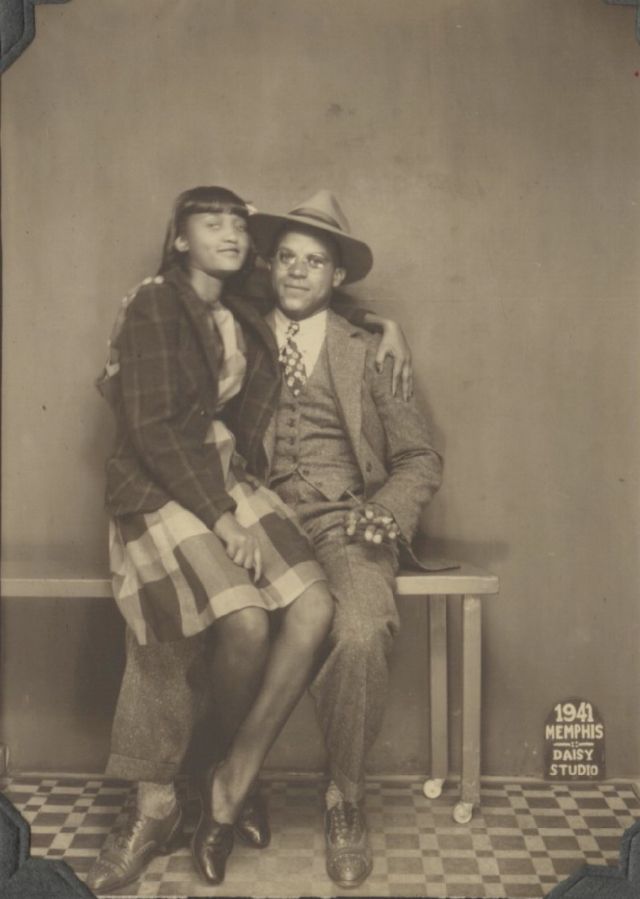
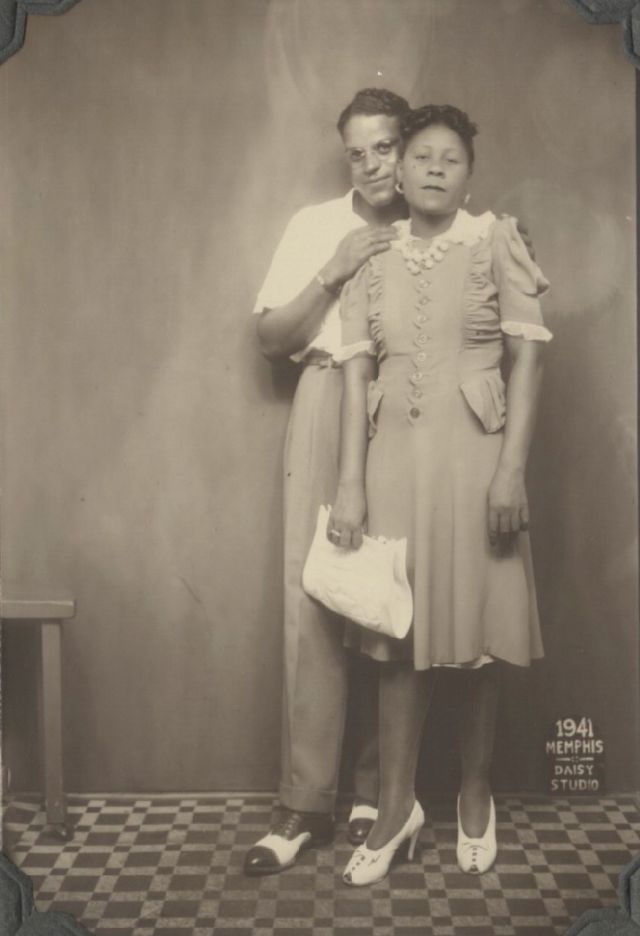
Found Photos From Daisy Studio in Memphis, Tennessee From the Early 1940s

Memphis is a city along the Mississippi River in southwestern Shelby County, Tennessee, United States. It is Tennessee’s second-most populous city behind Nashville; fifth-most populous city in the Southeast, the nation’s 28th-largest; and the largest city proper of those situated along the Mississippi River. The city is the anchor of West Tennessee and the greater Mid-South region, which includes portions of neighboring Arkansas, Mississippi, and the Missouri Bootheel.

1940s portrait photos from Daisy Studio at 315 Beale Street, Memphis, Tennessee

Memphis is the seat of Shelby County, Tennessee's most populous county. One of the more historic and culturally significant cities of the southern United States, Memphis has a wide variety of landscapes and distinct neighborhoods.

Home to Tennessee’s largest African-American population, Memphis grew into one of the largest cities of the Antebellum South as a market for agricultural goods, natural resources like lumber, and the American slave trade. After the American Civil War and the end of slavery, the city experienced even faster growth into the 20th century as it became among the largest world markets for cotton and lumber.

Daisy Studio was at 315 Beale Street, Memphis, Tennessee, a few buildings west of the “Old” Daisy Theatre on the same block. These found photos from ⓑⓘⓡⓒⓗ from memphis were taken by the studio from the early 1940s.

1941 photo of girl at Daisy Studio on Beale Street, Memphis, Tennessee

1941 photo of man and women, Daisy Studio, Beale Street, Memphis, Tennessee

1941 photo of man and women, Daisy Studio, Beale Street, Memphis, Tennessee

1942 photo of a sharp-dressed man, Daisy Studio, Beale Street, Memphis, Tennessee

1942 photo of friends at Daisy Studio, Beale Street, Memphis, Tennessee

April 15, 2021

Special License Plates Tag Careless Drivers With Skulls in Memphis, 1939

In 1939, special license plates for traffic violators are being considered as a safety measure by Cliff Davis, commissioner of public safety in Memphis, Tennessee.


If the measure is adopted motorists who persistently break traffic laws will be required to run in their regular license plates for special tags, similar to that shown in the photograph above, bearing a skull and the words “traffic-law violator.”

August 14, 2020

45 Vintage Souvenir Photos at Studios of Memphis in the 1950s

Memphis is a city along the Mississippi River in southwestern Shelby County, Tennessee, United States. The city is the anchor of West Tennessee and the greater Mid-South region, which includes portions of neighboring Arkansas, Mississippi, and the Missouri Bootheel.

Souvenir photos at studios of Memphis in the 1950s

Memphis is the seat of Shelby County, Tennessee’s most populous county. One of the more historic and culturally significant cities of the southern United States, Memphis has a wide variety of landscapes and distinct neighborhoods.

Home to Tennessee’s largest African-American population, Memphis played a prominent role in the American civil rights movement and was the site of Martin Luther King Jr.’s 1968 assassination.

Memphis is a regional center for commerce, education, media, art, and entertainment. It has long had a prominent music scene, with historic blues clubs on Beale Street originating the unique Memphis blues sound in the early 20th century. The city's music has continued to be shaped by a multicultural mix of influences: the blues, country, rock and roll, soul, and hip-hop.

A set of vintage souvenir photos from uofmtiger52 that show portraits of people at studios of Memphis in the 1950s.

Souvenir photo of couples double-dating at the Mid-South Fair, Fair Grounds Amusement Park, Memphis, 1950

Two young boys dressed as cowboys for souveneir photo at the Mid-South Fair, Fairgrounds Amusement Park, Memphis, 1951

Souvenir photo of a young boy in his winter coat visiting the Memphis Zoo, Overton Park, Memphis, 1953

Couple poses for a souvenir photo, Mid-South Fair, Fairgrounds, Memphis, 1954

Memphis City Parks Olympics Softball Champions Glenview Park team picture at Memphis Zoo, Overton Park, Memphis, 1954

June 3, 2020

“NO WHITE PEOPLE ALLOWED IN ZOO TODAY”

These black and white photographs, taken by Ernest Withers, depict the entrance to a Memphis zoo. At front and center is a sign reading “NO WHITE PEOPLE ALLOWED IN ZOO TODAY.” Behind it, several African Americans can be seen in the zoo.

(Photo by Ernest Withers)

The nascent civil rights movement that photographer Ernest Withers witnessed in Montgomery and Little Rock was developing in Memphis. African Americans were only allowed to visit the Memphis public zoo one day a week. Actually, black domestics were allowed in the Overton Park zoo six days a week as long as they were chaperoning white children. Thursdays, called “maid’s day off,” was just for blacks.

(Photo by Ernest Withers)

In 1959, O.Z. Evers and the black Binghampton Civic League filed a lawsuit in federal court to open the zoo, the city’s Brooks Memorial Art Gallery and the Memphis Museum every day of the week. The city claimed, “the incidence of violence, vandalism and disorders among visitors to the parks of the city of Memphis is greatly increased in those parks frequented by Negro citizens.” More police would needed, and the costs would be prohibitive.

Despite the tepid answer, the federal lawsuit moved slowly. But in late 1960, the park commission decided to desegregate the zoo, the art museum and Memphis Museum.

(Photos by Ernest C. Withers)

February 8, 2020

70's Style and Soul: Amazing Candid Photographs Taken in Soul Clubs in Memphis and New York, c.1973

These candid photographs, taken in Soul clubs in Memphis and New York, are the work of photographer David Reed. Still working today, Reed was first commissioned by the UK’s Sunday Times Magazine in 1969, and worked for them continuously until 1990.

Reed was also a regular contributor both to Nova Magazine, until its demise in 1975 and The Radio Times. His work were published in The Observer Magazine and The Telegraph Magazine.

Even though he is in essence a photojournalist, Reed’s skills are such that a number of his portrait photographs are now part of the permanent collection of The National Portrait Gallery in London.

The images seen here were taken for an eight-page feature entitled “Soul on Fire” for The Sunday Times. By the early 1970s, Soul music had become increasingly diverse, evolving into multiple micro-genres from its roots in Gospel and R&B.

In 1971, Don Cornelius’ Soul Train pulled into the televisual station and would remain there until 2006. By which time, many of the clothes you see here had returned to the status of high-fashion.


FOLLOW US:
FacebookTumblrPinterestInstagram

CONTACT US


Browse by Decades

Popular Posts

Advertisement

09 10