Bring back some good or bad memories


ADVERTISEMENT
Showing posts with label Kentucky. Show all posts

September 23, 2026

Fascinating Photos of Downtown Somerset, Kentucky in 1980

These fascinating photos capture downtown Somerset, Kentucky, as it appeared in September 1980. The images show the streets, storefronts, local businesses, and everyday activity that defined the heart of the town at the start of the decade.

From parked cars and shop signs to pedestrians and familiar architecture, the photos preserve a clear snapshot of small-city life in south-central Kentucky more than forty years ago. They offer a valuable visual record of how Somerset’s downtown looked and felt in that moment in time.

Central Avenue looking north from E. Mt. Vernon Street, Somerset, Kentucky, September 1980

Downtown Somerset, Kentucky, September 1980

E. Mt. Vernon Street looking east from Central Avenue, Somerset, Kentucky, September 1980

E. Mt. Vernon Street looking west from Central Avenue, Somerset, Kentucky, September 1980

E. Mt. Vernon Street, looking east from Fountain Square, Somerset, Kentucky, September 1980

April 19, 2025

Under the Big Top: Jim Slaughter Captures the Circus in the 1960s and ’70s

Hoxie Brothers Circus played Somerset, Kentucky often in the 1960s and ’70. Despite the name implication, there were no “brothers” involved.

“Hoxie” Tucker – the circus owner – grew up in Somerset and enjoyed playing the smaller towns. His family had been in the grocery business here in the early 20th Century and his brother, Ed, was a popular teacher, coach and administrator in the Somerset schools.

Taken by Jim Slaughter, these vintage photos from PCPL_Photos showcase Hoxie Brothers Circus from the 1960s and ’70s.


December 20, 2023

The Amazing Story of Chinn’s Cave House at Brooklyn Bridge, Kentucky

Chinn’s Cave House was literally built out of the side of a cliff in rural Kentucky just west of Lexington. It was a small restaurant and gas station but they also secretively sold liquor and had gambling machines hidden in the back until the law found out what was going on in the cave and then...


In a state known for it’s characters, it truly takes someone special to build a reputation like the one of Colonel George M. Chinn (1902–1987) . Growing up in Mundy’s Landing in Mercer County, Kentucky, Chinn earned the nickname “Double Chinn,” thanks to his robust physical frame and family’s surname. Robust not only in stature but in personality, Chinn had highly diverse interests and accomplishments, and he was influential not only in Kentucky, but across the world. He played on the 1921 Centre College national championship football team, was personal bodyguard to Governor A. B. “Happy” Chandler, and served in the armed forces during both World Wars, Korea, and Vietnam, becoming an accomplished ordinance engineer and designer of the M-19 automatic grenade launcher.

March 19, 2022

At the Time of the Louisville Flood, 1937

A good photojournalist might count himself lucky if he gets only one of his images published in a leading newspaper. A good photo should be able to convey an entire story on its own, but sometimes the image itself might be misleading because of the time and place it was made. In this famous example, Margaret Bourke-White’s picture of a depression era food line has actually more to tell than its face value.

During the Great Ohio River Flood of 1937, men and women in Louisville, Kentucky, line up seeking food and clothing from a relief station, in front of a billboard proclaiming, “World’s Highest Standard of Living.” (Margaret Bourke-White—Time & Life Pictures/Getty Images)

Margaret Bourke-White’s 1937 picture of African American men, women and children huddled in line before a billboard—on which a car bearing a beaming white family (and their dog!) appears to drive confidently into the future beneath the ultimately ironic slogan, “World’s Highest Standard of Living.” The overhead picture also shows a  middle-class white family, smiling in their car with the tagline, “There’s no way like the American Way.”

The juxtaposition of the poor black people and the happy white family is quite striking, which makes this photograph one of the most recognizable images of the Great Depression. However, this is misleading as the image was taken right after the Ohio River Flood of 1937. Over one million residents were left homeless after the flood, which only exacerbated the conditions of the 1930s depression. A lot of residents had to resort to charitable donations after the catastrophe, and Bourke-White entitled the photograph, “Kentucky Flood.”

African Americans in Louisville, Kentucky, seek food and clothing from a relief station in the aftermath of flooding that devastated the city in 1937. The billboard in Margaret Bourke-White’s famous “American Way” photograph is visible in the background. (Margaret Bourke-White—Time & Life Pictures/Getty Images)

While the lack of an appropriate description might mislead some into thinking that everywhere people were always in food lines around 1930s America, the photograph is still quite symbolic of the great depression.

February 16, 2022

20 Historic Photographs Captured the Aftermath of the Great Ohio River Flood of 1937

In 1937, the worst Ohio River flood in history covered 60 percent of the City of Louisville and 65 square miles of Jefferson County outside the old city. About 23,000 people were evacuated. Damages totaled more than $1 billion in today’s dollars. 

In January of 1937, rains began to fall throughout the Ohio River Valley; eventually triggering what is known today as the “Great Flood of 1937”. Overall, total precipitation for January was four times its normal amount in the areas surrounding the river. In fact, there were only eight days in January when the Louisville station recorded no rain. These heavy rains, coupled with an already swollen river, caused a rapid rise in the river’s level. 

The morning of January 24 the entire Ohio River was above flood stage. In Louisville, the river rose 6.3 feet from January 21-22. As a result, the river reached nearly 30 feet above flood stage. Louisville, where light and water services had failed, was the hardest hit city along the Ohio River. On January 27, the river reached its crest at 460 feet above sea level or 40 feet above its normal level, which is well over a 100-year event. Almost 70 percent of the city was under water, and 175,000 people were forced to leave their homes. The U.S. Weather Bureau reported that total flood damage for the entire state of Kentucky was $250 million, an incredible sum in 1937. The number of flood-related deaths rose to 190. The flood completely disrupted the life of Louisville, inundating 60% of the city and 65 square miles. 

The 1937 flood prompted the construction of the Ohio River Flood Protection System. Started in 1948, it took nearly 40 years to complete. The floodwall stretches for 29 miles from northeastern Louisville Metro to the southwest, protecting about 110 square miles from Ohio River flooding. Sixteen pumping stations move stormwater from the protected area into the river.

These vintage photographs by Margaret Bourke-White captured just how dramatic the flood was, and how much was changed by the rising river.

The Great Ohio River Flood, Louisville, Kentucky, 1937.

The Great Ohio River Flood, Louisville, Kentucky, 1937.

The Great Ohio River Flood, Louisville, Kentucky, 1937.

The Great Ohio River Flood, Louisville, Kentucky, 1937.

Flood waters cover the track and infield at Louisville’s famous Churchill Downs racetrack, 1937.

February 8, 2022

John G. Zimmerman: American in Black and White

In 1952, renowned American photographer John G. Zimmerman moved to Atlanta. During his time there he shot a series of noteworthy assignments for Ebony depicting the lives of African Americans in the Midwest and the Jim Crow south. These photographs are a lesser-known yet notable part of Zimmerman’s early work. The subject matter ranges from the first all black supermarket in Detroit, boxing legend Joe Louis, to sharecropper Matt Ingram’s quest for justice.

The Center for Photographic Art states: “the work of John G. Zimmerman, one of the 20th century’s most wide-ranging and innovative photojournalists, helped generate a golden age in magazine photography. Zimmerman grew up in Torrance, California, developing and printing film in the family kitchen and darkroom. A three-year high school photography program with Hollywood cinematographer Clarence A. Bach prepared him for his first job as a staffer at Time magazine. Following that assignment he spent several years freelancing for Life and Ebony magazines, creating groundbreaking images of the lives of African Americans in the Midwest, and in the deeply segregated, pre-Civil Rights south.”

Take a look at Zimmerman’s work in the 1950s through 18 black and white photographs below:

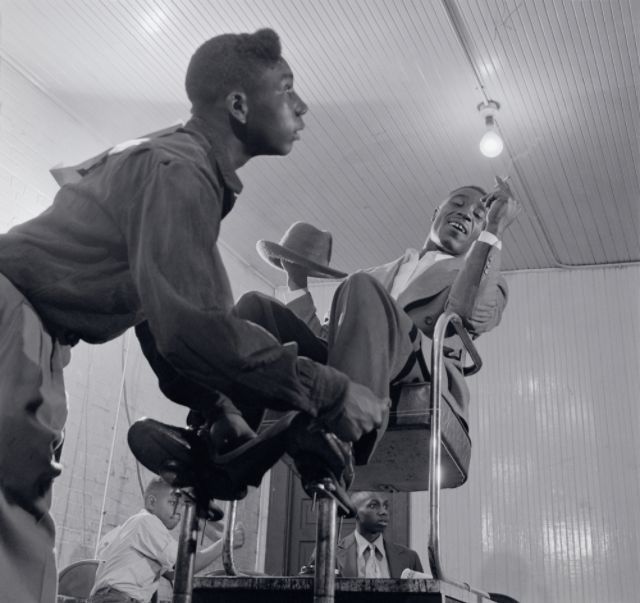
Curtis Phillips, winner of the Shoe Shine Contest, Wilson, North Carolina, 1952.

Department store, 1953.

Jumping rope, Tennesse, 1953.

Swimming hole, Tennessee, 1953.

Matt Ingram, wife Linward and their children pray before dinner, Yanceyville, North Carolina, 1953.

June 4, 2021

Horse Found in a Tree After Storm in Louisville, Kentucky in 1937

When you hear about Louisville’s Great Flood, people are talking about the devastating flood of 1937. It rained almost every day that January — nearly 20 inches — putting 70 percent of the city under water. It was the widest and most destructive flood in U.S history at the time.

The photo here shows the aftermath of the flooding – a dead horse lodged high in trees due to flood waters:


More than 150 cities along the Ohio River — then unprotected by levees or floodwalls —were inundated, driving hundreds of thousands from their homes. Hundreds of people died. From Pittsburgh to Cairo, Illinois, the damage amounted to $8.7 billion in today’s money.

Louisville was the hardest hit, with more than half the population of 308,245 evacuated. Nearly 50,000 homes were flooded, as were 250 of the city’s 350 churches. In today’s money, the damage total was $1.7 billion.

The Great Flood of 1937 sets the record for the highest the Ohio River has ever hit. On January 27, 1937, the water levels reached 52.15 feet at the upper gauge, where flood stage starts at 23 feet. At the lower gauge, it was 85.44 feet, where the flood stage begins at 55 feet.

February 26, 2020

Rainey Bethea, the Last Person to Be Publicly Executed in the United States on August 14, 1936

Less than a century ago, 20,000 people traveled to Kentucky to see a white woman hang a black man.

The United States has a long history of so-called “legal” public executions. The last one was carried out in Owensboro, Kentucky, in 1936 when Rainey Bethea was hanged after his conviction for the rape and murder of a 70-year-old woman. Florence Thompson was the sheriff. She had taken over the job from her husband, Everett, some three months earlier, after he had died of pneumonia. In law it was her duty to spring the trap herself, although she was allowed to hire someone to do it for her. The idea of a female sheriff carrying out an execution greatly added to the excitement and attention the case received from the press.

Rainey Bethea photographed two weeks before his hanging. (AP Photo)

Local sheriff Florence Thompson was charged with seeing the public execution through. (AP Photo)


Crime and arrest

During the early morning of June 7, 1936, Bethea entered the home of Lischia Edwards at 322 East Fifth Street by climbing onto the roof of an outbuilding next door. From there, he jumped onto the roof of the servant’s quarters of Emmett Wells’ house, and then walked down a wooden walkway. He climbed over the kitchen roof to Edwards’ bedroom window.

After removing a screen from her window, he entered the room, waking her. Bethea then choked Edwards and violently raped her. After she was unconscious, he searched for valuables and stole several of her rings. In the process, he removed his own black celluloid prison ring, and failed to later retrieve it. He left the bedroom and hid the stolen jewels in a barn not far from the house.

The crime was discovered late that morning after the Smith family, who lived downstairs, noticed they had not heard Edwards stirring in her room. They feared she might have been ill and knocked on the door of her room, attempting to rouse her. They found the door locked with a skeleton key still inside the lock from the inside, which prevented another key from being placed in the lock from the outside. They contacted a neighbor, Robert Richardson, hoping he could help, and he managed to knock the key free, but another skeleton key would not unlock the door. Smith then got a ladder. He climbed into the room through the transom over the door and discovered that Edwards was dead.

The Smiths alerted Dr. George Barr while he was attending a service at the local Methodist Church. Dr. Barr realized there was little he could do and summoned the local coroner, Delbert Glenn, who attended the same church. The Smiths also called the Owensboro police. Officers found the room was otherwise tidy, but there were muddy footprints everywhere. Coroner Glenn also found a celluloid prison ring, which Bethea, in his drunken state, had inadvertently left behind in the room.

By late Sunday afternoon, the police already suspected Rainey Bethea after several residents of Owensboro stated that they had previously seen Bethea wearing the ring. Since Bethea had a criminal record, the police could use the then-new identification technique of fingerprints to establish that Bethea had recently touched items inside the bedroom. Police searched for Bethea over the next four days.

On the Wednesday following the discovery of the murder, Burt “Red” Figgins was working on the bank of the Ohio River, when he observed Bethea lying under some bushes. Figgins asked Bethea what he was doing, and Bethea responded he was “cooling off.” Figgins then reported this sighting to his supervisor, Will Faith, and asked him to call the police. By the time Faith had returned to the spot on the river bank, Bethea had moved to the nearby Koll’s Grocery. Faith followed him and then found a policeman in the drugstore, but when they searched for Bethea, he again eluded capture.

Later that afternoon, Bethea was again spotted. This time, he was cornered on the river bank after he tried to board a barge. When police officers questioned him, he denied that he was Bethea, claiming his name was James Smith. The police played along with the fabricated name, fearing a mob would develop if residents were to learn that they had captured Bethea. After his arrest, Bethea was identified by a scar on the left side of his head.

On Friday, August 14, 1936, Rainey Bethea is photographed with Sheriff’s Deputies Albert Riesz and Lawrence Dishman as they leave the Jefferson County jail in Louisville, Kentucky for his execution in Owensboro, Kentucky. (AP Photo/Owensboro Messenger-Inquirer)


Execution

On August 6, the Governor of Kentucky, Albert Chandler, signed Bethea’s execution warrant and set the execution for sunrise on August 14. However, Sheriff Thompson requested the governor to issue a revised death warrant because the original warrant specified that the hanging would take place in the courthouse yard where the county, at significant expense, had recently planted new shrubs and flowers. Chandler was out-of-state, so Lieutenant Governor of Kentucky Keen Johnson, as acting governor, signed a second death warrant moving the location of the hanging from the courthouse yard to an empty lot near the county garage.

Rainey Bethea’s last meal consisted of fried chicken, pork chops, mashed potatoes, pickled cucumbers, cornbread, lemon pie, and ice cream, which he ate at 4:00 p.m. on August 13 in Louisville. At about 1:00 a.m., Daviess County deputy sheriffs transported Bethea from Louisville to Owensboro. At the jail, G. Phil Hanna, a farmer from Epworth, Illinois who had assisted with hangings across the country, visited Bethea and instructed him to stand on the X that would be marked on the trapdoor.

On August 13, 1936, Rainey Bethea has his last meal in Louisville, Kentucky before being publicly hanged in Owensboro, Kentucky. (AP Photo/The Courier-Journal)

It was estimated that a crowd of about 20,000 people gathered to watch the execution with thousands coming from out of town. Hash arrived at the site intoxicated wearing a white suit and a white Panama hat. At this time, no one but he and Thompson knew that he would pull the trigger.

Bethea left the Daviess County Jail at 5:21 a.m. and walked with two deputies to the scaffold. Within two minutes, he was at the base of the scaffold. Removing his shoes, he put on a new pair of socks. He ascended the steps and stood on the large X as instructed. He made no final statement to the waiting crowd. After Bethea made his final confession to Father Lammers, of the Cathedral of the Assumption in Louisville, officers placed a black hood over his head and fastened three large straps around his ankles, thighs, arms, and chest.

Twenty-six year old Rainey Bethea is led up the gallows steps. (Universal History Archive/UIG via Getty Images)

Bethea’s was the last sanctioned public hanging in the U.S. (Bettmann Archive via Getty Images)

A reported 20,000 people were in Owensboro to watch the hanging. Executions have changed dramatically over the years since, morphing from public spectacles to somber and tightly controlled affairs held deep inside prisons. (Bettmann Archive via Getty Images)

On Friday, Aug. 14, 1936, a large crowd watches as attendants adjust a black hood over Rainey Bethea’s head just before his public hanging in Owensboro, Kentucky. Bethea, a 26-year-old black man convicted of murdering and robbing a 70-year-old white woman, was the last person killed in a public execution in the United States. (AP Photo)

Onlookers strain to view the hanging of Rainey Bethea in Owensboro, Kentucky, on August 14, 1936. (Joseph Costa/NY Daily News Archive via Getty Images)

Vendors do a brisk business as a crowd gathers before dawn—the hour of execution for convicted rapist Rainey Bethea. (Bettmann Archive via Getty Images)

Hanna placed the noose around Bethea’s neck, adjusted it, and then signaled to Hash to pull the trigger. Instead, Hash, who was drunk, did nothing. Hanna shouted at Hash, “Do it!” and a deputy leaned onto the trigger, which sprang the trap door. Throughout all of this, the crowd was hushed. Bethea fell eight feet and his neck instantly broke. About 14 minutes later, two doctors confirmed Bethea was dead. After the noose was removed, his body was taken to Andrew & Wheatley Funeral Home. He had wanted his body sent to his sister in South Carolina. Instead, he was buried in a pauper’s grave at the Rosehill Elmwood Cemetery in Owensboro.

Many newspapers, having spent considerable sums of money to cover the first execution publicly performed by a woman, were disappointed, and several journalists took liberties in reporting the event, describing it as a “Roman Holiday,” some falsely reporting that the crowd rushed the gallows to claim souvenirs, and at least one newspaper falsely reported that Sheriff Thompson fainted at the base of the scaffold.

Afterwards, Hanna complained that Hash should not have been allowed to perform the execution in his drunken condition. Hanna further said it was the worst display he experienced in the 70 hangings he had supervised.

April 3, 2018

The Valley of Poverty: 35 Amazing Photographs Capture Daily Life of Appalachians in Eastern Kentucky in the Early 1960s

These bleak pictures appear to show America in the grip of the 1920s Great Depression. The reality is that they were taken in the 1960s, in a lonely valley in Eastern Kentucky long forgotten by affluent America. The pictures of Appalachia were taken by photographer John Dominis, and appeared in 1964 issue of LIFE, titled ‘The Valley of Poverty’ — one of the very first substantive reports in any American publication on President Lyndon Johnson's nascent War on Poverty.

At the time, LIFE was arguably the most influential weekly magazine in the country, and without doubt the most widely read magazine anywhere to regularly publish major photo essays by the world's premier photojournalists. In that light, LIFE was in a unique position in the early days of Johnson's administration to not merely tell but to show its readers what was at stake, and what the challenges were, as the new president's "Great Society" got under way.

As LIFE put it to the magazine's readers in January 1964:
“In a lonely valley in eastern Kentucky, in the heart of the mountainous region called Appalachia, live an impoverished people whose plight has long been ignored by affluent America. Their homes are shacks without plumbing or sanitation. Their landscape is a man-made desolation of corrugated hills and hollows laced with polluted streams. The people, themselves — often disease-ridden and unschooled — are without jobs and even without hope. Government relief and handouts of surplus food have sustained them on a bare subsistence level for so many years that idleness and relief are now their accepted way of life.”


December 22, 2017

June 12, 2017

14 Stunning Color Photographs That Show American Soldiers Preparing Their New Tanks for Battle in World War II

This rare collection was taken by Office of War Information photographer Alfred T. Palmer in 1942, as he visited Fort Knox and were likely used for propaganda.

The photographs show American soldiers preparing for battle in their new tanks at Fort Knox, Kentucky involving the M3 and M4 tanks. The soldiers pictured were originally members of the 7th Cavalry Brigade which was reorganized and activated as the 1st Armoured Division in 1940.

America quickly realized the need for a strong armored force after witnessing the Nazis dominate the early years of the war in Europe thanks in part to the Panzerwaffe and their Panzer tank. Fort Knox is perhaps best known as the site of the United States Bullion Depository where a large portion of the country’s gold reserves is stored.


FOLLOW US:
Facebook • Tumblr • Pinterest • Instagram

CONTACT US


Browse by Decades

Popular Posts

Advertisement

09 10