Bring back some good or bad memories


ADVERTISEMENT
Showing posts with label Jamaica. Show all posts

November 13, 2025

Ali MacGraw and Steve McQueen Photographed on Location at the Set of the Film “Papillon” in Jamaica, 1972

In 1972, Ali MacGraw and Steve McQueen were photographed together in Jamaica during the filming of Papillon, one of McQueen’s most ambitious projects. Though MacGraw wasn’t in the film, she joined him on location shortly after they met, marking the beginning of one of Hollywood’s most talked-about romances of the decade. At the time, she was fresh off the massive success of Love Story (1970), which had made her one of the most recognizable actresses in the world. McQueen, already known as the “King of Cool,” was at the peak of his career, balancing his tough, rebellious image with a rare kind of quiet charisma that few stars ever achieved.

Their connection sparked during the filming of The Getaway (1972), where they played on-screen lovers. The chemistry quickly bled into real life, leading MacGraw to leave her husband, Paramount executive Robert Evans, for McQueen. They married in 1973, at the height of their fame, and became the embodiment of the rugged-meets-refined aesthetic that defined 1970s Hollywood glamour, a mix of denim, leather, and understated luxury that still inspires fashion and pop culture today.

Behind the image, their relationship was turbulent. McQueen’s controlling nature and MacGraw’s struggle to balance her career with his demands eventually led to their separation in 1978. Still, their time together remains frozen in cultural memory, two icons caught between rebellion and romance, adventure and fame. Decades later, the photos of them on that Jamaican set still carry the same sense of effortless allure, a reminder of when love stories unfolded without filters and style was simply a reflection of who you were.


December 15, 2024

Some Polaroid Photographs of Eric Clapton and Pattie Boyd in Jamaica, ca. 1980

Some color Polaroid photographs of Eric Clapton and Pattie Boyd on holiday at Ian Fleming’s Jamaican estate Goldeneye, circa 1980. The shots include Eric and Pattie posing against the louvred shutters, Eric hiding in a tree, and Eric joking with the locals...

In her autobiography, Wonderful Tonight: George Harrison, Eric Clapton and Me, Pattie Boyd recalls a trip to Goldeneye in the mid-1970s: “Eric needed a holiday so we went to Montego Bay in Jamaica to stay in a house called Goldeneye, which had belonged to Ian Fleming, who wrote the James Bond novels. It had just been bought by Chris Blackwell, who founded Island Records. Subsequently he turned it into a luxury resort, but when we were there the house was full of original 1940s furniture in mint condition, and had its own beach. We had the most glorious time except... every morning the gardener would arrive with the biggest, fattest joint for Eric, then take him to the ‘tea shop.’ In fact, it sold rum, and they would spend the day smoking dope and drinking. Eric would come back in the evening and pass out.”


July 23, 2024

Photos of People at Playboy Club Hotel, Jamaica in 1971

The Playboy Club was initially a chain of nightclubs and resorts owned and operated by Playboy Enterprises. The first Playboy Club opened in Chicago in 1960. Each club generally featured a Living Room, a Playmate Bar, a Dining Room, and a Club Room.

Members and their guests were served food and drinks by Playboy Bunnies, some of whom were featured in Playboy magazine. The clubs offered name entertainers and comedians in the Club Rooms, and local musicians and the occasional close-up magician in the Living Rooms.
Starting with the London and Jamaica club locations, the Playboy Club became international in scope. These vintage photos from Shane Egan were taken by Estonian-American engineer Raivo Luik that show people at Playboy Club Hotel in Jamaica on February 12, 1971.


May 9, 2024

Behind the Scenes Photographs Taken by Bunny Yeager During the Filming of “Dr. No” in Jamaica

Rarely seen photographs taken during the filming of Dr No in Jamaica. They were most likely taken by the production stills photographer Bunny Yeager but that is not fully confirmed. Terence Young directed.


Bunny was definitely on set during the shooting of the scenes on the beach. She describes how she came to take the photos in her book Camera in Jamaica:

“The photos of Ursula wearing a bikini and shirt, posing besides some roots were made a few feet away from the scene of the film. The cinematographer and crew took a break because cloud was overhead so I was able to sneak in a few shots. Exposure was 1/50 sec at f8 as the area was in shade in addition to the sun being hidden. The photo near the centre by the boats and fish nets show Ursula wrapped in a towel. Here I used a strobe light to balance the lighting in the background. The other shots were taken after work about 6pm on the beach near the hotel. The light was terribly dim, making it hard to see focus. I used a tripod shooting at 1/10 sec at f8, then I used strobe to help lighten face and figure.”

She described Ursula Andress “as about five feet five, with brown skin and brown hair sun streaked blond. Her figure is firm, trimmed and tanned all over. Her hips are especially slim which is unusual for sensual looking women. She admits to being moody. Her husband claims she is unpredictable and is really ten different women rolled into one.”


November 12, 2023

Amazing Photographs of Grace Kelly on Vacation in Jamaica, 1955

If you ask movie lovers (or just about anybody with a pulse) to name the most beautiful person to have ever graced the silver screen, most will have a single, definitive answer: Grace Kelly. Her looks always appear effortless and her visage remains timeless.

Kelly seemingly lived two lives: one as an actress, starring in such films as Alfred Hitchcock’s 1954 classics Rear Window and Dial M for Murder; then there’s her second life, in which she became the Princess of Monaco after retiring from acting at the age of 26 to marry Prince Rainier III in 1956.

While her formative years certainly seemed like they were ripped straight from a Hollywood script, sadly Princess Grace’s later years weren’t happily ever after. She died tragically at the age of 52 on September 14, 1982, succumbing to injuries sustained in a traffic collision the day prior. According to a CAT scan, she suffered a brain hemorrhage that likely led to the crash, and another hemorrhage while in the hospital.

Though Kelley’s life was cut far too short, her legacy is forever preserved in some of the most celebrated films of all time, along with countless candid photos such as these ones, captured by her longtime photographer Howell Conant. The photographs were taken by Conant during Grace Kelly’s holiday in Jamaica, in 1955. She was the one who insisted for him to come along and the photo shoot ended up in the pages of Colliers magazine.


May 4, 2022

Amazing Photos of Sugar Production in Jamaica From the Late 19th and Early 20th Centuries

In the seventeenth-century, Jamaica’s tropical climate, along with the transe-Atlantic slave trade, made Jamaica into the world’s largest sugar producer. Throughout the eighteenth and early nineteenth centuries, Jamaica remained the world’s largest sugar exporter.

Both the United States and Continental Europe depended heavily on the British Colonial, and therefore the Jamaican, export of sugar. Furthermore the Jamaican sugar trade expanded as a result of the Napoleonic Wars. Only during the American revolution did the Jamaican’s experience a drop in capital, due to the war time ban on trade with America.

Prosperity for the British colony was not to last though, and by March 1815, Jamaica saw the peak of its sugar industry. British domination over the world sugar market lasted until the 1830s, when slavery was abolished, and Cuba over took its neighbor in sugar production.

These amazing photos from The Caribbean Photo Archive captured sugar production in Jamaica from the late 19th and early 20th centuries.

Llandovery Sugar Estate, St. Ann, Jamaica, circa 1890

Ploughing The Cane Field at Orange Valley Estate, St Ann, Jamaica, circa 1890

Anchovy Sugar Estate, St James, Jamaica, circa 1890

Sugar Cane Cutters, Jamaica, circa 1890

Taking the Cane Crop at Orange Valley Estate, St Ann, Jamaica, circa 1890

April 25, 2022

45 Amazing Photos Capture Everyday Life of Kingston, Jamaica in the 1890s

Kingston is the capital and largest city of Jamaica, located on the southeastern coast of the island. It faces a natural harbor protected by the Palisadoes, a long sand spit which connects the town of Port Royal and the Norman Manley International Airport to the rest of the island. In the Americas, Kingston is the largest predominantly English-speaking city south of the United States.

The city proper is bounded by Six Miles to the west, Stony Hill to the north, Papine to the northeast and Harbour View to the east, which are communities in urban and suburban Saint Andrew. Communities in rural St. Andrew such as Gordon Town, Mavis Bank, Lawrence Tavern, Mt. Airy and Bull Bay would not be described as being in Kingston city.

Two districts make up the central area of Kingston: the historic Downtown, and New Kingston. Both are served by Norman Manley International Airport and also by the smaller and primarily domestic Tinson Pen Aerodrome.

Here below is a set of amazing photos that documented everyday life of Kingston, Jamaica in the 1890s.

The market, Kingston, Jamaica, circa 1890

Country Negroes starting out for Kingston, Jamaica, circa 1890

Fountain, Kingston, Jamaica, circa 1890

Going to market, Rockfort Road, Kingston, Jamaica, 1890

Harbour Street looking west, Kingston, Jamaica, circa 1890

December 9, 2021

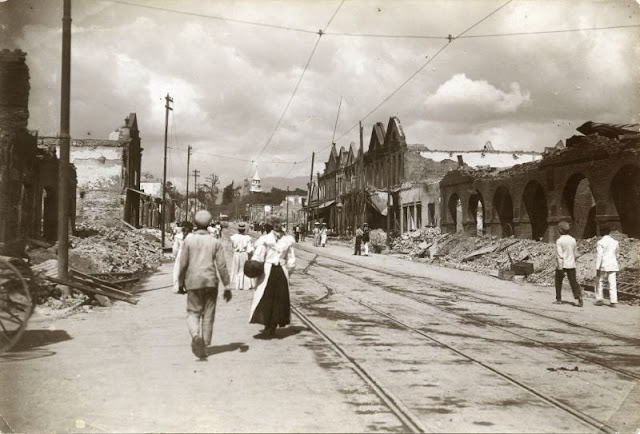
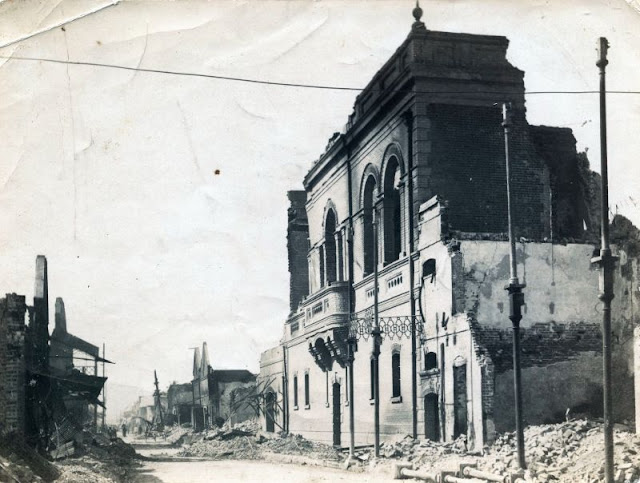
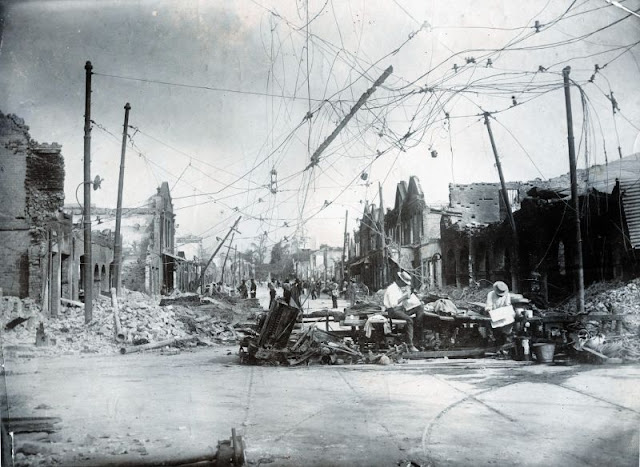
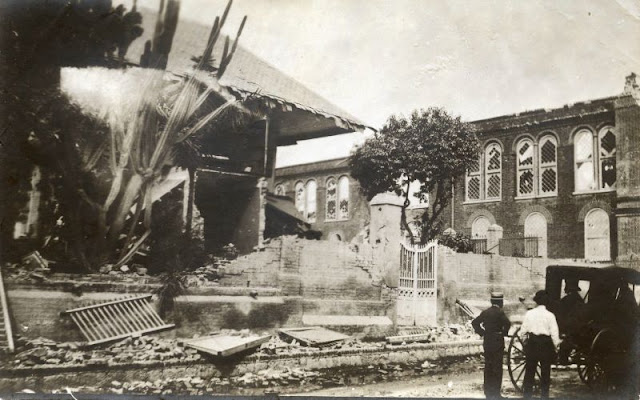
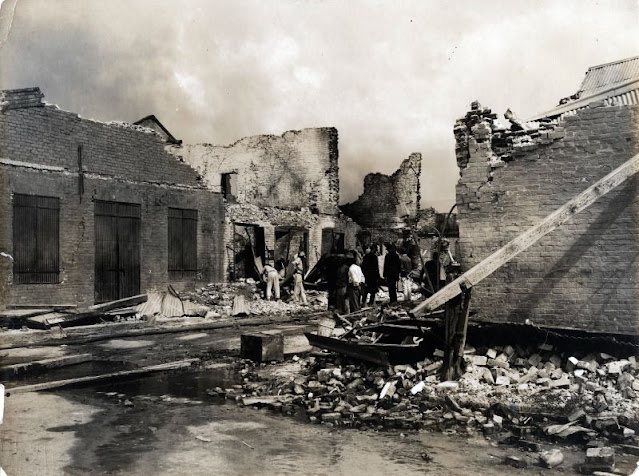
35 Incredible Photos of the 1907 Kingston Earthquake

The 1907 Kingston earthquake which shook the capital of the island of Jamaica with a magnitude of 6.2 on the moment magnitude scale on Monday January 14, at about 3:30 p.m. local time (20:36 UTC), is described by the United States Geological Survey as one of the world's deadliest earthquakes recorded in history.

Every building in Kingston was damaged by the earthquake and subsequent fires, which lasted for three hours before any efforts could be made to check them, culminating in the death of about 1,000 people, and causing approximately $30 million in material damage ($833.25 million in 2020).

Shortly after, a tsunami was reported on the north coast of Jamaica, with a maximum wave height of about 2 m (6–8 ft).

Here below is a set of incredible photos that shows street scenes of Kingston after the earthquake in 1907.

Earthquake devastation, Kingston, Jamaica, 1907

1907 Earthquake Damage, Kingston, Jamaica

Cleaning up the damage, Kingston, 1907

Colonial Bank after the Earthquake, Kingston, Jamaica, 1907

Corner of King and Harbour Streets taken 8 days after the disaster, Kingston, Jamaica, 1907

October 21, 2016

24 Amazing Vintage Photos Show the Change of Kingston, Jamaica in the 1930s

Kingston is the capital and largest city of Jamaica, located on the southeastern coast of the island. It faces a natural harbour protected by the Palisadoes, a long sand spit which connects the town of Port Royal and the Norman Manley International Airport to the rest of the island.

Here below is an amazing collection of rare vintage photos capturing everyday life of Kingston in the 1930s.


May 3, 2016

35 Rare Vintage Photos of Everyday Life in Jamaica Before 1900

Here is an amazing collection of rare photos that shows the life in Jamaica from between 1860s to 1890s.

A native wash woman at Bog Walk, Jamaica, 1899

A rural village in Jamaica in the 1890s

Banana plantation, Jamaica, ca. 1890s

Bog Walk, Jamaica, 1865

Cane cutters, Jamaica, 1891


FOLLOW US:
FacebookTumblrPinterestInstagram

CONTACT US


Browse by Decades

Popular Posts

Advertisement

09 10