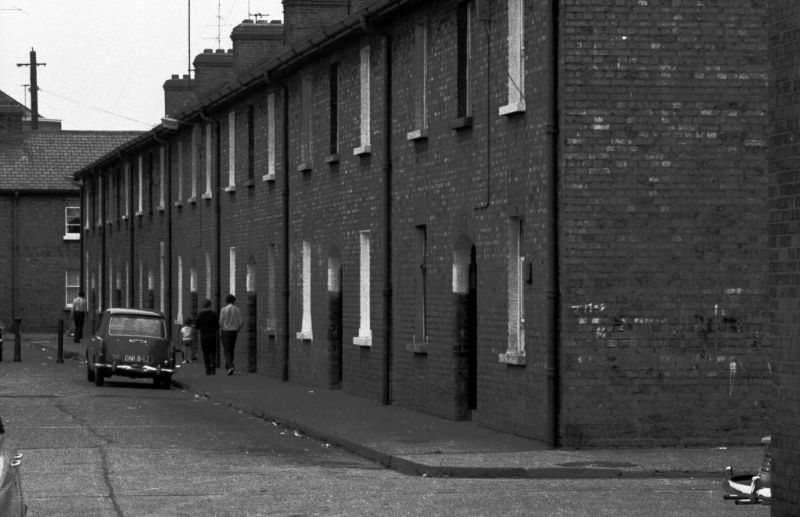
Bring back some good or bad memories


ADVERTISEMENT
Showing posts with label Ireland. Show all posts

April 16, 2025

A Glimpse of Ireland in 1972 Through Amazing Photos

Ireland in the early 1970s were a mix of old and new. Narrow roads bustled with bicycles, pushcarts, and a growing number of cars, often small and practical. Shopfronts displayed hand-painted signs, and local butchers, grocers, and pubs lined the streets. People wore modest clothing—women in headscarves and long coats, men in caps and tweed jackets. Children played freely outside, kicking footballs or skipping rope.

In cities like Dublin and Cork, buses rumbled past Georgian buildings, and street vendors sold newspapers or fruit from carts. In smaller towns, life moved slower—farmers delivered goods in vans or on horseback, and church bells marked the rhythm of daily life. The atmosphere was lively but grounded in tradition, capturing a society on the edge of modern change.

These amazing photos, taken by a traveler to Ireland in 1972, were found by David Pirmann.

Carrick-On-Shannon. Main Street, Ireland, 1972

Carrick-On-Shannon. Main Street, Ireland, 1972

Ballybofey, Ireland, 1972

Ballintubber Abbey, Ireland, 1972

Clifden, Ireland, 1972

January 11, 2024

Portrait of the O’Halloran Sisters Who Fended Off the Officers Evicting Their Family During the Irish Land War in 1887

The Irish Land War was a conflict between the farmer tenants and their landlords that started in 1879. The two girls to the right are twins, the girl next to them is their sister, and the leftmost woman is their mother Harriet. The sisters were named Annie, Honoria and Sarah.

Female members of the O’Halloran family from Bodyke. Photo taken June 1887.

A widely publicized eviction took place on June 10, 1887 near Bodyke in east Clare. The farm in question was held by John O’Halloran. Women played an important defensive role in evictions during the Land Wars, and the O’Halloran sisters – Honoria, Annie and Sarah – and their mother, Harriet, were by no means unique in their fierce resistance during the siege on their homestead. The family held out for hours against an armed invading force, which according to the Freeman’s Journal (June 11, 1887) numbered 400 men.

The O’Halloran holding in the townland of Lisbareen, southwest of Bodyke village, consisted of about 18 acres rented from Colonel O’Callaghan at an annual cost of £23 10s, with an additional drainage charge of £2 10s. Some years previous, the rent had been raised to £33 but was subsequently reduced when the tenants took the case to the Land Court. Despite this reduction, the O’Hallorans owed two years’ rent in large part due to the construction of a new two-storey slated house and outhouses; reports differ but the building work seemed to have cost between £176 and £220, which the O’Halloran family had in part borrowed from the Board of Works (Irish Times, June 15, 1887; Cork Examiner, June 11, 1887).

In the weeks leading up to the eviction, the family made the necessary defensive adjustments to the house: constructing earthworks in the vicinity of the house, digging a trench around its perimeter, barricading the windows and doors, and making small apertures at strategic points in the walls like loopholes. They also stockpiled pitchforks, wooden poles and sandbags.

On the day of the eviction, present in the house were the three O’Halloran sisters, two of their brothers – Frank and Patrick – and their mother Harriet, while the Freemans Journal (June 21, 1887) reported that a young girl of only eight or nine years was also present and took part in the resistance, but whether or not she was another of Harriet’s daughters is unclear. Outside the farmhouse, Michael Davitt – founder of the Irish National Land League – was in attendance; prior to the siege, he attempted to dissuade the family from the use of pitchforks. Also in attendance in support of the family were a number of local clergymen and MP Joseph Richard Cox.
​
Armed with rifles, bayonets, picks, axes, huge iron crowbars and shields, the bailiffs, RIC and soldiers led by Colonel Turner arrived at the farmstead at about 10.30 am, as a large crowd of tenants were gathering. Also present were the agents for the property (Hosford and Delmege) and Sheriff Croker. The family busied themselves boiling a mixture of dirty water and meal, and when the bailiffs cautiously approached the house, the O’Halloran sisters threw the boiling substance at them through the loopholes. The police threatened to shoot but the family remained defiant to the enthusiasm of the spectators. The magistrate present, a Mr Crotty, instructed the women that if they continued to break the law, they would be sent to jail but they took no notice of such threats. Subsequently, the ‘Emergency men’ advanced under the protection of shields and umbrellas, and began to use crowbars on the gable wall. In response, Frank started firing slates down upon them, to a chorus of “Don’t, don’t,” while one of the O’Halloran girls courageously challenged the troops shouting, “Come now, if you dare.”

Eventually, the police managed to prop a scaling ladder against the house. About half a dozen policemen attempted to climb the ladder but were forcibly pushed off it by Frank using a long wooden pole, including District Inspector Hill who hurt his arm in the fall. After several attempts Constable Naughton (reported as Norton in some newspapers), managed to enter through an upstairs window. Once the policeman was inside, Honoria caught the long blade of his bayonet with her bare hands, at which point Frank overpowered Naughton to prevent any injury to her hands. Honoria – then armed with the bayonet – ran to the window and dispersed the gathering policeman using her newly acquired weapon. Immediately, Fr Hannon entered the building via the ladder. While the family intended to throw Naughton out the window, the priest convinced them to reconsider knowing that the police would surely fire on them if they did so. By this time, more policemen had managed to enter the house. As Fr Hannon held Frank to prevent further conflict, one of the policemen confronted Harriet who had been showering sand and stones from a back window on the authorities below. The priest let go of Frank so he could go to his mother’s aid but by this time the O’Halloran family could hold out no longer. All of the O’Halloran family members were taken into custody having been charged with assaulting District Inspector Hill and Constable Naughton, and while most of them were immediately released, some were brought to Limerick Jail to await the trial.
​
As events unfolded inside the O’Halloran family home, a number of shocking incidents took place outside. The Cork Examiner (June 11, 1887) reported that members of the Constabulary knocked a man of seventy years to the ground, and every time he attempted to stand, he was pushed over again and again until Fr Glynn interceded on his behalf, while a young man was also brutally attacked by the policemen, after the eviction had come to an end, for jeering at the authorities as they left the scene. 

In the days following the eviction, the event garnered much media attention with detailed accounts appearing in all the national and regional newspapers relaying the “exciting” and “extraordinary” scenes. The pluckiness, daring and defiance shown that day was commented upon in many publications, with the Cork Examiner (June 11, 1887) referring to the resisting party as “the indomitable O’Halloran family.”  In the aftermath of the eviction, a public meeting was held locally by Davitt and Cox where they commended the strength of the O’Halloran family, and in particular Harriet’s heroic defense of her home.  

The case was heard in Ennis Courthouse on June 20, 1887. The presiding magistrates were Cecil Roche and J. M. Kilkelly. At the opening of the case, a circus band started playing outside and Roche declared angrily – to the amusement of all present – that he would hold the musicians in contempt of court if they did not desist. ​

Following statements by the plaintiffs and witnesses, Frank and Patrick were sentenced to three months imprisonment and hard labor, while Honoria and Annie received a sentence of one-month imprisonment with hard labor; Sarah and Harriet were not sentenced. In a lengthy speech, Judge Roche declared the sentence a miscarriage of justice and that he wholly disagreed with his colleague Kilkelly believing he was far too lenient on the O’Halloran family. He stated that the attack on Naughton was “brutal and savage” and described the conduct of the sisters as “extremely violent” (Cork Examiner, June 21, 1887). After a recess, Kilkelly addressed the court saying that he did not deserve the observations made by Roche and that he was trying to do his duty impartially and fairly. While he stated that he would not continue on the bench that day and would retire immediately, no other magistrate was available to take his place and so he continued on the bench in Ennis Courthouse to hear the remaining cases. It is heartening to note that by the time of the 1901 and 1911 censuses, some members of the O’Halloran family were still residing in Lisbareen, including Harriet who was then the landowner.

(This original article was published on Herstoric Ireland)

January 4, 2024

Historical Photos From the Irish Land War in the Late 19th Century

The Land War was a period of agrarian agitation in rural Ireland that began in 1879. It may refer specifically to the first and most intense period of agitation between 1879 and 1882, or include later outbreaks of agitation that periodically reignited until 1923, especially the 1886–1891 Plan of Campaign and the 1906–1909 Ranch War. The agitation was led by the Irish National Land League and its successors, the Irish National League and the United Irish League, and aimed to secure fair rent, free sale, and fixity of tenure for tenant farmers and ultimately peasant proprietorship of the land they worked.

From 1870, various governments introduced a series of Land Acts that granted many of the activists’ demands. William O’Brien played a leading role in the 1902 Land Conference to pave the way for the most advanced social legislation in Ireland since the Union, the Land Purchase (Ireland) Act 1903. This Act set the conditions for the break-up of large estates by government-sponsored purchase.

Alongside the political and legal changes, the “Long Depression” affected rent yields and landlord-tenant relations across all of Europe from the 1870s to the 1890s. Below is a collection of 25 historical photographs from the Irish Land War from the late 19th century:

Police use a battering ram to forcibly evict a tenant, 1888.

The eviction of Thomas Considine at Moyasta, County Clare, 1888.

Police shield themselves against hot water thrown by tenants while carrying out an eviction, 1888.

Constables surround the home of boatbuilder Francis Tully on land owned by the Marquis of Clanricarde at Woodford, County Galway, 1888.

A building in Mitchelstown bears an anti-eviction banner and has its windows barricaded with brush to repel attacks, 1887.

December 28, 2023

Demonstration of Artificial Arms at Blackrock Special Hospital, 1921

An item about the versatility and mobility of artificial arms at Blackrock Special Hospital in Dublin, Ireland, 1921.


The Dublin Arm was invented in 1921 and was a significant advancement in artificial limb technology. It operated using a Bowden cable mechanism, where cables connected to the user’s residual limb enabled hand or hook movements.

By contracting specific muscles, users could control the cables, allowing them to grasp objects and perform various tasks with improved dexterity. This pioneering prosthetic limb set the stage for future advancements in the field.

September 23, 2023

Swimming Lessons in Killaloe, Co. Clare, Ireland, 1971

In Killaloe, County Clare an alternative method of swimming instruction has had a high success rate. Killaloe County Clare is situated on the banks of the river Shannon. At Pier Head, large numbers of children from Killaloe and adjoining Ballina gather regularly for swimming lessons, under the tutelage of Peter Lacy.


Thanks to this volunteer swimming instructor, a painter and decorator by trade, over one hundred children can now swim with confidence and enjoy the water. It is never a case of throwing them in at the deep end, as all beginners learn safely with the assistance of a rope harness. This popular pastime is facilitated by a man who admits that his teaching is based purely on theory.

February 24, 2023

Incredible Photos From the Kennedy Family’s Trips to Ireland in the 1930s

In June 1963, JFK became the first sitting US president to visit Ireland. There are many gorgeous photos of the trip to Ireland, which would sadly be his last, all of them imbued with a sense of respect, awe, and history in the making.

Photos from the Kennedy family’s trips to Ireland in the 1930s could not be more different. They're the classic tourist photos that any family who's taken a trip to Ireland and seen the major attractions has: kissing the Blarney Stone, walking the streets of Dublin, posing at the Giants Causeway, riding a horse through the lakes and valleys of Killarney. Many of the photos are candid or surreptitious shots, some are blurry, smudged, or out of focus.
 
Plucked from the Kennedy family’s photo albums they were digitized and stored for posterity in the archives of the John F. Kennedy Presidential Library and Museum in Boston.
 
Kathleen Kennedy (left) rides on horseback with an unidentified woman (center) and an unidentified boy through the Gap of Dunloe in Killarney National Park, Killarney, Ireland, during a Kennedy family trip in 1937.

Joseph P. Kennedy, Jr. (center, surrounded by several unidentified people), sits on the basalt rock at Giant’s Causeway in Bushmills, Northern Ireland, during a Kennedy family trip in 1937.
Rose Fitzgerald Kennedy poses in front of the United States Legation in Dublin, Ireland, during a Kennedy family trip.

Kick and Joe, Jr. with their mother Rose, on board the SS Washington en route to Ireland.

Kathleen Kennedy (wearing hat) and Joseph P. Kennedy, Jr. (smoking a pipe), stand on the grass with their arms around each other outside Blarney Castle in Blarney, Ireland, during a Kennedy family trip.

October 14, 2022

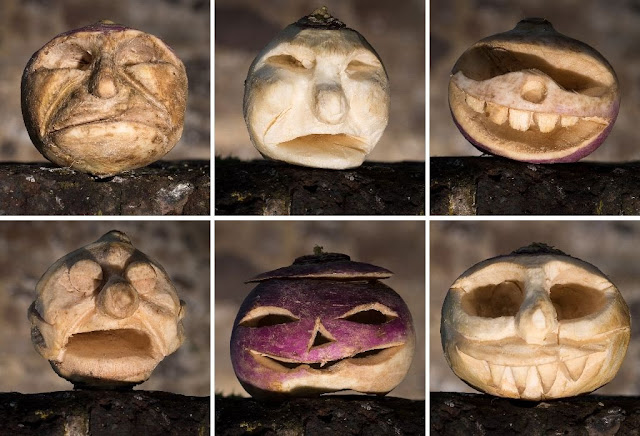
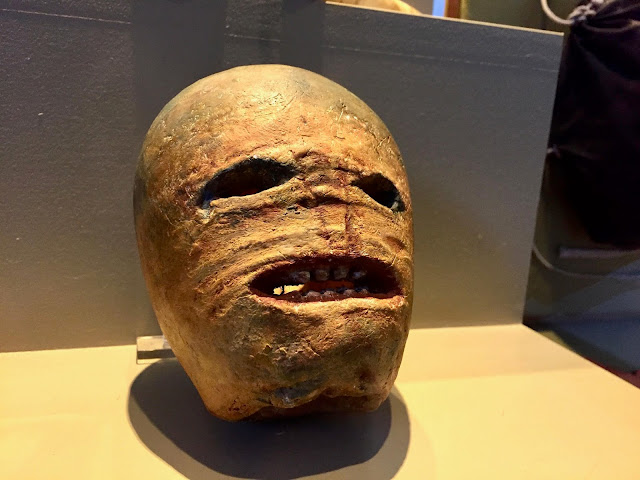
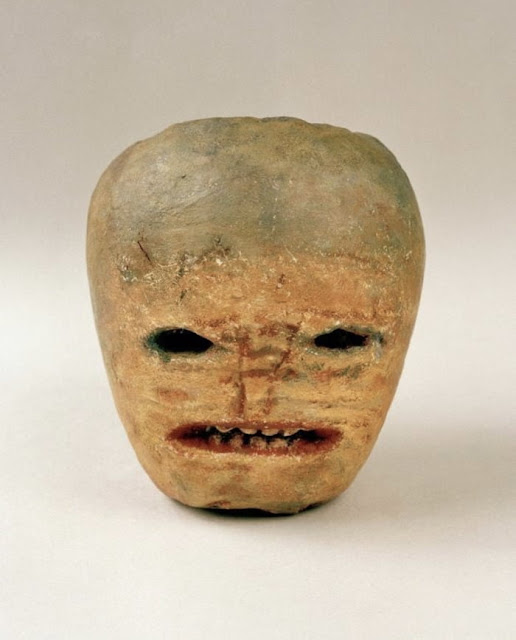
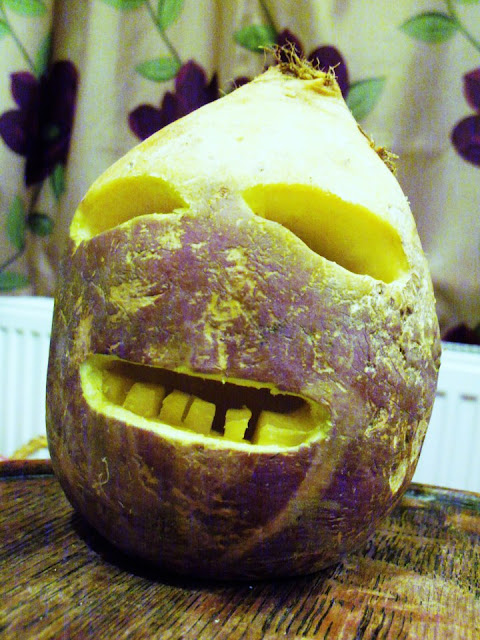
Before Pumpkins, the Irish Carved Jack-O’-Lanterns From Turnips and Potatoes

The jack-o’-lantern tradition dates back centuries, when people in Ireland decorated turnips, beets, and potatoes to frighten away a mythical character named Stingy Jack. Irish immigrants brought the tradition to America, home of the pumpkin, and the popular fruit became an integral part of Halloween.


According to the folktale, Stingy Jack was having a drink with the Devil but didn’t want to pay for his drink. To fix this problem, he persuaded Satan to transform into a coin that Jack could use. However, Jack decided to put the coin in his pocket, next to a silver cross. This silver cross prevented the Devil from changing back. Jack made a deal that the Devil would not bother him for a year and is not allowed to take his soul if Jack dies.

A year later, Jack meets the Devil again. Jack convinced the Devil to climb a tree and pick fruit. Whilst the Devil was up in the tree, Jack carved a cross into the bark of the tree so the Devil could not come down. Jack then made another deal, which stated that the Devil could not bother him for 10 years.

Jack died a while after this. He was going to go to Heaven but God did not want him there, so he was to be sent to hell. However, the Devil was not allowed to claim his soul and didn’t want him anyway, and so he was forced to wander the Earth. The Devil gave him a lump of burning coal, which Jack put into a hollowed-out turnip. The Irish people who saw him would refer to him as “Jack of the lantern”, which was eventually shortened to “Jack O’Lantern”.

People in Ireland and Scotland would start carving faces into turnips and potatoes, to frighten Stingy Jack away and repel other wicked spirits. Immigrants from the British Isles who came to the United States of America bought the story with them. Except they started using pumpkins instead of turnips and potatoes, hence why carved pumpkins are called Jack O’Lanterns.


September 13, 2022

The Earliest Color Photos of Ireland Taken by Two Frenchwomen

These stunning pictures, taken by Marguerite Mespoulet and Madeleine Mignon-Alba during their 2-month-long trip to Ireland in 1913, are believed to be the first color photos of Ireland ever taken.

Galway, 1 May 1913.

The pair was part of a worldwide project titled “The Archives of the Planet.” French banker and philanthropist Albert Kahn created the project to compose a “kind of photographic inventory of the surface of the earth as it was occupied and organized by Man at the beginning of the 20th century.” His project captured some of the first color photographs taken in Ireland, the United States, Norway, Vietnam, and Brazil.

Black and white photography had been around for decades, but color photography was cutting-edge technology at the beginning of the twentieth century. The women, who were novice photographers, used this new technology developed by French inventors called autochrome color plates.

Main Ní Tuathail, a 14-year-old girl from Claddagh wearing a traditional Claddagh dress, Galway, 26 May 1913.

Through the lenses of their Autochrome Lumière cameras, these adventurer intellectuals documented priceless moments of remote villages, Irish rural settlements, lives of locals adhering to traditional Gaelic values, ancient Celtic monuments, prominent Christian sites, green landscapes, cemeteries, street settings from Galway city and much more.

 Take a trip back in time to 1910s Ireland through these 25 stunning photographs:

Traditional Irish knitwear, An Spidéal, Galway, 1 May 1913.

Mother and child outside a dwelling, Claddagh, Galway, 25 May 1913.

Selling fish at the port of Galway, 26 May 1913.

August 20, 2022

26 Fascinating Black and White Snapshots of Dublin Life in the 1970s

The 1970s was a decade full of important events in Ireland and Dublin.

In October 1970, former US President Richard Nixon made his official state visit to the country. On January 1, 1973, Ireland became a member of the European Communities at the same time as the United Kingdom and Denmark. June 1973 marked the official retirement at age 90 of President Éamon de Valera, making him the oldest head of state in the world.

View down North Earl Street, December 1971.

Dublin was also affected to varying degrees by "the Troubles". In 1972, angry crowds in Dublin burned down the British Embassy in Merrion Square in protest at the shooting of 13 civilians in Derry on Bloody Sunday (1972) by British troops. The city, however, did not generally experience paramilitary violence directly, with the exception a period in the early to mid-1970s when it was the target of several loyalist bombings.

The 1972 and 1973 Dublin bombings killed 3 people and injured 185. The worst bomb attacks, however, occurred on Talbot street in 1974. The Dublin and Monaghan Bombings on 17 May 1974 were a series of terrorist attacks on Dublin and Monaghan in the Republic of Ireland which left 33 people dead (26 of them in Dublin), and almost 300 injured.

View from Talbot Street and North Earl Street, 1971.

In the early 1970s the Irish government canceled the hitherto annual Easter parade commemorating the Rising of 1916 and in 1976 banned it, fearing it was serving as a recruiting tool for illegal republican paramilitaries. Nevertheless, the Provisional republican movement organized a demonstration 10,000 strong on Easter Sunday.

Take a trip down memory lane to Dublin in the 1970s through these fascinating black and white pictures:

A group of children playing on a merry-go-round in Ballymun, August 1970.

Former US President Richard Nixon's motorcade passes the GPO on O'Connell Street, October 1970.

A view of a traffic jam in Dublin, March 1971.

August 11, 2022

30 Vintage Photographs Capture Life in Dublin in the Early 1970s

The 1970s was a decade full of important events in Ireland and Dublin. In October 1970, former US President Richard Nixon made his official state visit to the country. This decade also saw the capital city's footprint growing steadily with housing transforming the landscape of the West of Dublin. On January 1, 1973, Ireland became a member of the European Communities at the same time as the United Kingdom and Denmark. June 1973 marked the official retirement at age 90 of President Éamon de Valera, making him the oldest head of state in the world.

These brilliant pictures of Dublin were taken by Heinrich Klaffs in 1971 and 1973. For more fascinating vintage photographs, make sure to take a look at Klaff's Flickr site.


July 10, 2022

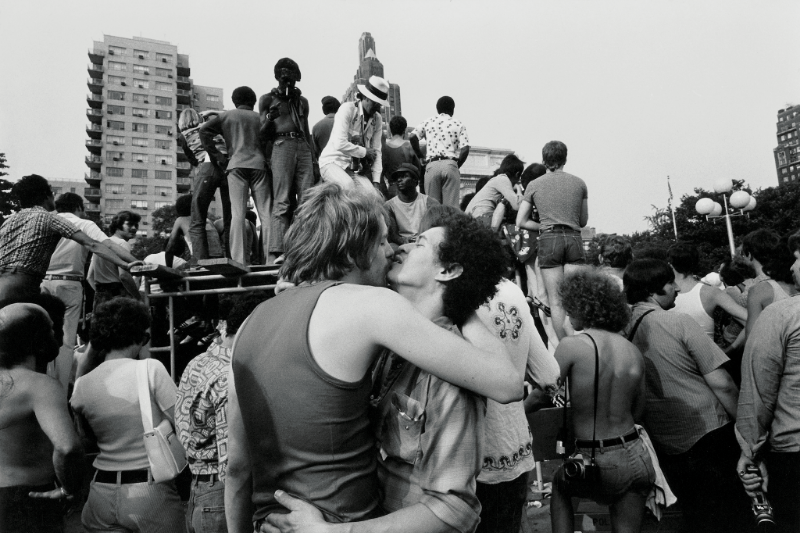
Oddballs and Activists: Jill Freedman’s Incredible Street Photography

Jill Freedman (October 19, 1939 – October 9, 2019) is a highly respected New York City documentary photographer best known for her street and documentary photography. After college, Freedman traveled to Israel and England before taking up copywriting jobs in New York to sustain herself. She had not grown up taking photographs, but she said in New York one day she “woke and wanted a camera.”

In a 2017 interview with The Guardian, Freedman said activism and protests had been the catalysts for her photography: “I studied sociology and anthropology and now realize that what I’ve been doing with my camera all these years is documenting human behavior. But I was taking pictures in my head long before I became a photographer. It was the Vietnam war that changed everything for me. I was angry and wanted to photograph anti-war demonstrations, so got my first camera.”

Freedman has published seven books: Old News: Resurrection City;  Circus Days;  Firehouse;  Street Cops;  A Time That Was: Irish Moments;  Jill’s Dogs; and Ireland Ever.


July 6, 2022

The Ambassador Cinema in Dublin, Ireland From the Late 1970s and Early 1980s

These photos of the cinema from the 1970s and ’80s display the artistic skills of Dublin signwriter Kevin Freeney (1919-1986). His first job for the venue was producing the sign for the 1978 Sean Connery’s film The First Great Train Robbery, later he was assisted by his nephew who helped with the artwork in the backroom of the cinema.

In the book “Dublin Street Life & Lore” by Kevin C. Kearns, the author mentions the work of Mr Freeney. He wrote “Signwriting goes back at least three generations in his family. Back in the 1930’s he rambled through Dublin’s streets on a bike or with a pushcart carrying his paints and brushes. In that period the city’s streetscapes were elegantly embroidered with handwritten shop and pub fascias. Having done “at least 700 pubs and shopfronts” in Dublin, the most famed streets — O’Connell, Henry, Grafton, and Capel— all carried his personalised three-dimensional relief lettering and ornamentation. His fellow craftsmen hailed him as a Master.”


July 3, 2022

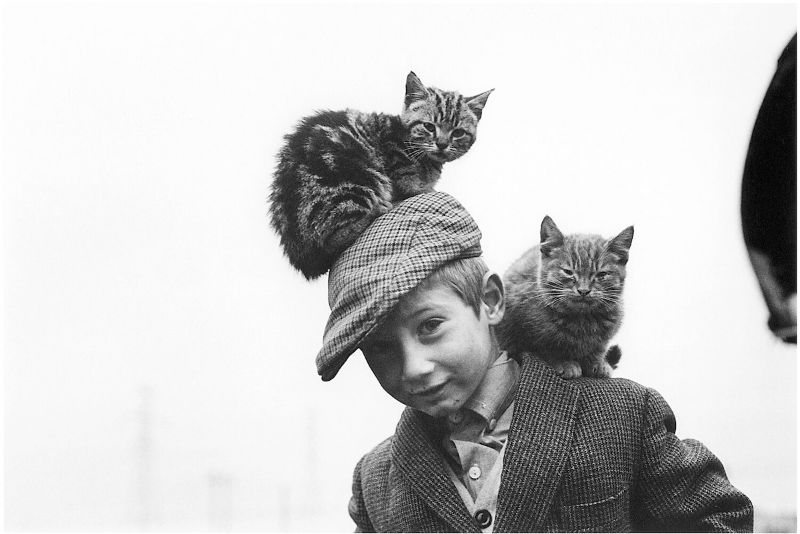
Intimate Vintage Portraits Documented the Lives of Irish Travelers Outside Dublin in the Late 1960s and Early 1970s

When Alen Macweeney returned to his native Ireland in the 1960s, after working as Richard Avedon’s assistant, he first intended to do a photo essay about W.B. Yeats. His research led him to cover another quintessentially Irish subject, one up to then neglected in photojournalism and Irish society in general. 

“In search of a tinker woman as a subject,” notes Michael Miller at Hudson-Housatonic Arts, Macweeney found “a sprawling field of caravans, shed, and horses… on the outskirts of Dublin.” He also found himself “immersed in the life of the people then called tinkers, but now more respectfully known as travellers, for the next five years.”

From 1965 to 1971, Macweeney documented the lives of Irish Travellers, and in so doing, “without meaning to,” he eventually “became one of the foremost amateur anthropologists of Traveller culture,” a people invisible to most of his countrymen and women.


FOLLOW US:
Facebook • Tumblr • Pinterest • Instagram

CONTACT US


Browse by Decades

Popular Posts

Advertisement

09 10