Bring back some good or bad memories


ADVERTISEMENT
Showing posts with label Czechoslovakia. Show all posts

July 2, 2026

28 Amazing Photographs of the Prague Astronomical Clock From Between the Late 19th and Early 20th Centuries

The Prague astronomical clock, or Prague Orloj, is a medieval astronomical clock attached to the Old Town Hall in Prague, the capital of the Czech Republic. The Orloj is mounted on the southern wall of the city’s Old Town Hall in the Old Town Square.

The clock mechanism has three main components – the astronomical dial, representing the position of the Sun and Moon in the sky and displaying various astronomical details; statues of various Catholic saints stand on either side of the clock; “The Walk of the Apostles,” an hourly show of moving Apostle figures and other sculptures, notably a figure of a skeleton that represents Death, striking the time; and a calendar dial with medallions representing the months. According to local legend, the city will suffer if the clock is neglected and its good operation is placed in jeopardy; a ghost, mounted on the clock, was supposed to nod its head in confirmation. According to the legend, the only hope was represented by a boy born on New Year’s night.

The late 19th and early 20th centuries were a transformative era for the Orloj. During this time, the clock evolved from a neglected, semi-functional relic into a celebrated national symbol of Czech cultural revival, right before facing near-destruction at the end of World War II.

By the mid-19th century, the clock was in poor condition and frequently stopped working. A massive, milestone restoration completed in 1866 completely modernized the clock’s appearance and mechanical reliability. The distinct wooden figures of the 12 Apostles that parade every hour were newly installed in the upper windows during this restoration. Celebrated Czech painter Josef Mánes was commissioned to create a brand-new, intricately painted lower calendar dial. His design featured 12 medallions depicting rural bohemian life matched to the signs of the zodiac. In 1865, a golden crowing rooster was added above the Apostle windows to signal the conclusion of the hourly mechanical show.

Following the 1866 restoration, Prague authorities realized that exposing Josef Mánes’ masterpiece painting to the elements would ruin it. The original Mánes calendar dial was carefully removed and moved to the Prague City Museum for safekeeping. It was replaced on the tower by an exact structural copy. After another round of reconstructions on the Old Town Hall facade, the golden rooster mechanism was fully finalized and played for the public for the first time on New Year’s Eve on December 31, 1882. The local Prague clockmaking company L. Hainz officially took over the maintenance and regular repair of the clock in the 1860s, a stewardship role they proudly maintained well into the 20th century.

The early 1900s brought massive technological adjustments and political upheaval to Prague, directly impacting how the clock told time. In 1912, the astronomical dial was modified to formally integrate Central European Time (German Civil Time). This update divided the standard day into 12 equal hours mapped to standard European timekeeping, though the complex internal gear adjustments meant it didn’t run perfectly until decades later. Following the collapse of the Austro-Hungarian Empire in 1918, Czechoslovakia declared its independence right in front of the clock tower. The clock was heavily embraced as a triumph of historic Czech engineering during this patriotic surge.

The darkest moment in the clock’s modern history occurred at the very end of WWII. On May 7–8, 1945, Nazi forces used anti-aircraft guns and incendiary shelling on the Old Town Square to suppress the Czech resistance broadcasting from the town hall. The building caught fire, the wooden Apostles and the calendar face burned to ashes, and the heavy medieval iron mechanism was severely warped by the extreme heat. The clock remained completely motionless and silent until a massive community-led restoration brought it back to life in 1948.


June 5, 2025

The Story of Josef Menšík, the Last Owner and Knight of Strakonicku Castle in Dobrš

This is Josef Menšík, the last owner and knight of Strakonicku castle in Dobrš who tried to stop a convoy of German tanks while wearing a suit of armor and seated on a horse when they tried to cross into Czechoslovakia in 1938.


Born in 1870 in the Bohemian Forest, Menšík developed a fascination with history from a young age.

In 1911, he purchased the crumbling Dobrš Castle and dedicated his life to restoring it. He rejected modern conveniences, living without electricity, and filled the fortress with medieval artifacts, many of which he smuggled from abroad.

For decades, Menšík lived as a self-styled knight. Locals often saw him riding his horse in full armor, teaching history to anyone willing to listen. His castle became a place for schoolchildren to visit and learn about the Middle Ages while seeing his amazing collection of relics.


In 1938, as German forces were about to invade Czechoslovakia, Menšík’s beliefs were tested. Following the Munich Agreement, Nazi tanks began crossing into the Sudetenland. Most citizens could do little but watch in despair as their country was occupied.

Menšík refused to stay passive. When he heard that German forces were coming near Bučina, he put on his armor, got on his horse, and rode out to block the road. Armed with a sword and halberd, he positioned himself directly in the path of the advancing tanks.

The German soldiers were stunned by the surreal sight. Some hesitated, unsure of how to respond, while others laughed or gestured dismissively, believing Menšík to be mad. Eventually, the tanks moved forward, forcing him aside, but his act of defiance, though it didn’t stop the occupation, inspired many.


Josef Menšík lived to see the end of the war but passed away in 1945 at the age of 75. He became a local legend, remembered as a man who stood by his principles and dared to face an invader.

April 8, 2025

Exploring Czechoslovakia in 1990 Through Fascinating Photos

In 1990, the streets of Czechoslovakia were alive with a mix of optimism, change, and tension. In cities like Prague, crowds gathered in public spaces, reflecting the newfound freedom after the fall of the communist regime. The streets were filled with people of all ages, celebrating the end of censorship and state control, while also confronting the challenges of transitioning to a democratic society.

Soviet-era monuments stood alongside new billboards promoting capitalist ideals, and the first McDonald’s had just opened in Prague. People were wearing a mix of old, utilitarian clothing and more Western-style fashions, symbolizing the shift towards a more open society. Street vendors sold both traditional items and new consumer goods, and the air was filled with a sense of hope, uncertainty, and the possibility of change.

These fascinating photos were taken by Wilford Peloquin that show street scenes in Czechoslovakia in August 1990.

Cheb, Czechoslovakia, August 1990

Cheb, Czechoslovakia, August 1990

Brno, Czechoslovakia, August 1990

Brno, Czechoslovakia, August 1990

Cesky Krumlov, Czechoslovakia, August 1990

November 6, 2023

40 Incredible Photos of Prague After the Liberation in 1945

The Prague offensive was the last major military operation of World War II in Europe. The offensive was fought on the Eastern Front from 6 May to 11 May 1945. Fought concurrently with the Prague uprising, the offensive significantly helped the liberation of Czechoslovakia in 1945. The offensive was one of the last engagements of World War II in Europe and continued after Nazi Germany’s unconditional capitulation on 8/9 May.

The city of Prague was ultimately liberated by the USSR during the Prague offensive. All of the German troops of Army Group Centre (Heeresgruppe Mitte) and many of Army Group Ostmark (formerly known as Army Group South) were killed or captured, or fell into the hands of the Allies after the capitulation.

These photos were collected by Wayne Huebner that show street scenes of Prague after the liberation around 1945.

Prague. Charles Bridge and Hradčany, 1945

Prague. Charles Bridge, 1945

Prague. Charles Bridge, 1945

Prague. Charles Bridge, 1945

Prague. Charles Bridge, 1945

February 6, 2023

Just Before Dissolution, 30 Fascinating Photos Capture Street Scenes of Czechoslovakia in 1992

Czechoslovakia was a landlocked country in Central Europe, created in 1918, when it declared its independence from Austria-Hungary. In 1938, after the Munich Agreement, the Sudetenland became part of Germany, while the country lost further territories to Hungary and Poland.

Between 1939 and 1945, the state ceased to exist, as Slovakia proclaimed its independence and the remaining territories in the east became part of Hungary, while in the remainder of the Czech Lands the German Protectorate of Bohemia and Moravia was proclaimed.

After World War II, the pre-1938 Czechoslovakia was reestablished, with the exception of Carpathian Ruthenia, which became part of the Ukrainian SSR (a republic of the Soviet Union).

From 1948 to 1989, Czechoslovakia was part of the Eastern Bloc with a command economy. Its economic status was formalized in membership of Comecon from 1949 and its defense status in the Warsaw Pact of 1955. A period of political liberalization in 1968, the Prague Spring, ended violently when the Soviet Union, assisted by other Warsaw Pact countries, invaded Czechoslovakia.

In 1989, as Marxist–Leninist governments and communism were ending all over Central and Eastern Europe, Czechoslovaks peacefully deposed their communist government during the so-called Velvet Revolution, which began on 17 November 1989 and ended 7 days later when all of the top Communist leaders resigned.

On 31 December 1992, Czechoslovakia peacefully split into the two sovereign states of the Czech Republic and Slovakia as the result of national tensions of the Slovaks. Just before dissolution, these fascinating photos from Sludge G show what street scenes of Czechoslovakia looked like in 1992.

Brno. Tatra T3 trams, Czechoslovakia, 1992

Brno. Mahen Theatre (Mahenovo divadlo), Czechoslovakia, 1992

Brno. Tatra car No. 1527, route 17 to Modřice, Czechoslovakia, 1992

Brno. The leading T3 car is No. 1519, route 14 to Modřice, Czechoslovakia, 1992

Frenštát pod Radhostěm. Market Square, Czechoslovakia, 1992

February 1, 2023

45 Vintage Photos of Czechoslovak Matchbox Labels in 1959

A match is a tool for starting a fire. Typically, matches are made of small wooden sticks or stiff paper. One end is coated with a material that can be ignited by friction generated by striking the match against a suitable surface.

Czechoslovak matchbox labels in 1959

Wooden matches are packaged in matchboxes, and paper matches are partially cut into rows and stapled into matchbooks. The coated end of a match, known as the match “head”, consists of a bead of active ingredients and binder, often colored for easier inspection.

There are two main types of matches: safety matches, which can be struck only against a specially prepared surface, and strike-anywhere matches, for which any suitably frictional surface can be used. Because of the substance used to coat each match, this makes them non-biodegradable.

Historically, the term match referred to lengths of cord (later cambric) impregnated with chemicals, and allowed to burn continuously. These were used to light fires and fire guns and cannons. The word ‘match’ derives from Old French ‘mèche’, referring to the wick of a candle.

Here below is a vintage photo collection that shows Czechoslovak matchbox labels in 1959.

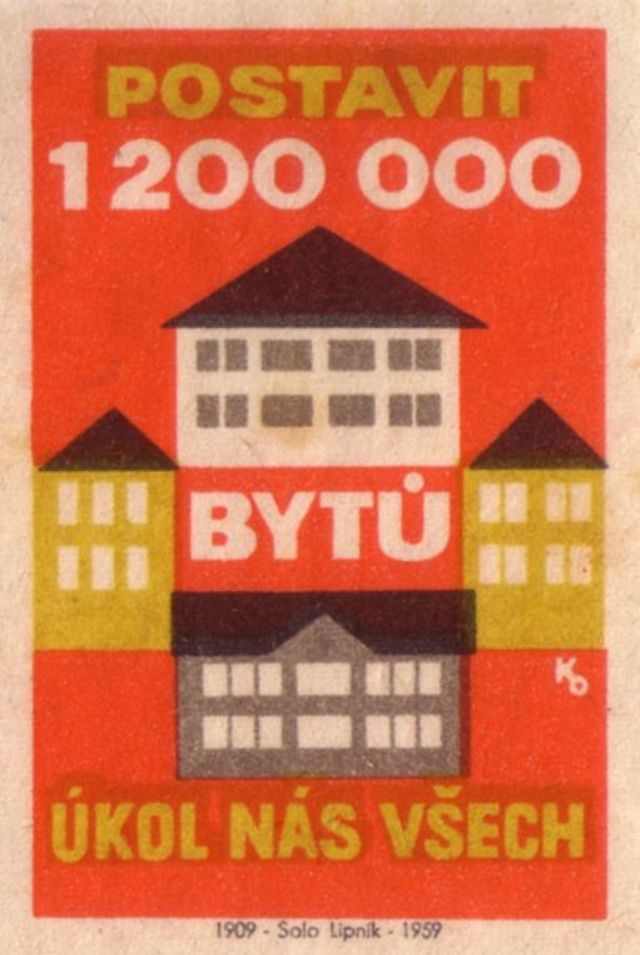
1.2 million to build, a task for us all, 1959

A healthy refreshment, 1959

A young nurse for every scout camp, 1959

Alcoholism destroys society, 1959

Brushes for clothing, 1959

May 20, 2021

30 Color Photos Capture Street Scenes of Czechoslovakia in 1970

Czechoslovakia was a sovereign state in Central Europe, created in October 1918, when it declared its independence from Austria-Hungary.

Czechoslovakia in July 1970

From the Communist coup d'état in February 1948 to the Velvet Revolution in 1989, Czechoslovakia was ruled by the Communist Party of Czechoslovakia. The country belonged to the Eastern Bloc and was a member of the Warsaw Pact and of Comecon. During the era of Communist Party rule, thousands of Czechoslovaks faced political persecution for various offences, such as trying to emigrate across the Iron Curtain.

In January 1993, Czechoslovakia split into the two sovereign states of the Czech Republic and Slovakia.

These vintage color photos were taken by Philippe Guillot that show street scenes of Czechoslovakia in July 1970.

Bouzov Castle (14th century)

Cheb. The town hall

Czechoslovakians

Karlovy Vary (Carlsbad). Family outing for Soviet officers

Karlovy Vary (Carlsbad). Fashion model posing in front of a hot spring

May 9, 2021

13 of the Strangest Polka Album Covers

The polka is originally a Czech dance and genre of dance music familiar throughout all of Europe and the Americas. It originated in the middle of the nineteenth century in Bohemia, now part of the Czech Republic. The polka remains a popular folk music genre in many European and American countries, and is performed by many folk artists.


Polka is a music and dance style that originated in Europe in the 1830s and came to American society when people immigrated from Eastern Europe. A fast style in 2/4 time, and often associated with the pre–World War II era, polka remains a dynamic “niche” music in America.

While you would never call the polka genre “self-serious”, some musicians have really taken it to the limit. Here’s a selection of 13 of the strangest polka album covers through past eras.

1. James Last – Happy Polka 2 (1972)

James is really selling the whole “Happy” part of the “Happy polka”.

2. Li’l Richard & His Polka All Stars – Wine, Girls and Goodtimes (1976)

The fact that the girls that Li’l Richard (not Little Richard) is canoodling with look as though they are related to him takes this cover from “seedy” to “full on disturbing”.

3. Los Forasteros de Monterrey – Polkas Pa’ Echar Estilo (1975)

This is the only known attempt to combine the allure of a Bond girl, the grit of Fistful of Dollars, and the unabashed goofiness of polka music.

4. Tijuana Sauerkrauts – Happy Polkas Recorded in Munich (1973)

This is a real “You got your braunschweiger in my salsa / You got your salsa in my braunschweiger” situation. Polka goes South of the border!

5. Whoopee John – The Great One

Like Elvis, photographers could only shoot Whoopee John from the waist up, as he was deemed “too suggestive” to young girls.

January 29, 2021

45 Vintage Cover Photos of Czech Weekly News Pestrý Týden in 1927

Pestrý týden was a Czech illustrated weekly magazine published November 2, 1926 to April 28, 1945, during the First and Second Czechoslovak Republics and during the Protectorate of Bohemia and Moravia.


The magazine helped establish top photo-reporters of the 1930s, such as Karel Hájek, Václav Jírů and Ladislav Sitenský. Published and printed by Grafické závody (‘Graphic Works’) by Václav Neubert and Sons, based in Smíchov, Prague it was issued in 963 numbers.

Here below is a collection of vintage cover photos of Czech weekly news Pestrý týden in 1927.


January 25, 2021

Rare Images of Louis Armstrong on His Visit to Prague in 1965

When Louis Armstrong visited Prague in March of 1965, at which time he was truly an international star. These rare images from TresBohemes captured moments of this Jazz great on his visit to Prague in 1965.


FOLLOW US:
FacebookTumblrPinterestInstagram

CONTACT US


Browse by Decades

Popular Posts

Advertisement

09 10