Bring back some good or bad memories


ADVERTISEMENT
Showing posts with label Colorado. Show all posts

January 15, 2025

50 Wonderful Photos of a Colorado River Raft Trip in 1980

High in the pristine Rocky Mountain wilderness of Colorado, the mighty Colorado River begins. The Colorado River is world-renown for its legendary whitewater rapids; some of the largest whitewater in North America froths deep within the canyons of Utah and Arizona. These gargantuan and spectacularly clad canyons and landscapes through which the Colorado River plunges are no less famous.

Imagine this: rafting the Colorado River all the way through (if that were possible) would take you past 5 National Parks, and a combination of 6 National Monuments, Conservation & Recreation Areas and State Parks. Endless in scenic wonder and majesty, any trip along this river will be the adventure of a lifetime.

Can you think of any other river that can do all that? These wonderful photos from Debra Wells that show a Colorado River raft trip of a girl named Lisa and her friend in 1980.


October 31, 2024

45 Vintage Snaps of People at Halloween Parties From the 1970s

Halloween parties in the 1970s were vibrant and often reflected the decade’s eclectic culture. People embraced creative and sometimes DIY costumes, often inspired by popular movies, TV shows, and music. Classic monsters like vampires, witches, and ghosts remained popular, but there was also a rise in costumes inspired by the counterculture, such as hippies and rock stars.

Halloween parties were common, with themes ranging from haunted houses to disco-themed bashes, reflecting the era’s dance craze. Costume contests were popular, and people would often gather for games like bobbing for apples or ghost stories.

The music at Halloween parties included everything from rock ‘n’ roll to disco, with songs that evoked spooky themes. The popularity of artists like Alice Cooper, whose theatrical performances often included Halloween themes, also influenced party atmospheres.

Overall, Halloween in the 1970s was a lively mix of traditional customs and the innovative spirit of the era. These fascinating photos were taken by Nick DeWolf that show portraits of people at Halloween parties at Hotel Jerome, Aspen, Colorado from 1975 to 1979.


September 27, 2024

Just Another Day on the Job in 1890

“You kids these days don’t know what it means to streamgage! In my day, we used to sit in rickety wood boxes, sweating all day long in the hot sun and wearing our best suits!” 
Measuring the velocity of streams in a cable suspended stream-gaging car at Arkansas River near Canyon City, Colorado. The photograph was taken in 1890.

March 6, 2024

Marvelous Photographs of Young Women Working on Ski Resorts in Aspen in 1971

Most people’s notion of ski bum is a shiftless young male who spends most of his time searching for good powder, but the ski bums of Aspen, Colo. aren’t like that at all. They are prettier, for one thing, and many of them have lived in the resort town for more than two years. They consider the skier’s life not a parenthetical experience but a real alternative to urban existence, one free from pollution, noise and the frustration of having to choose between marriage a a less than satisfying job. The only problem they have in Aspen is finding a way to survive.

With 900 newcomers arriving every year in the 1970s, there was a sharp shortage of both jobs and housing. But the air was fresh and clean and the longer the women stayed, the prettier they seemed to look. At the moment in 1971, six out of 10 new arrivals were women—but when the word got out the ratio could change fast.

Tubing was a popular sport at Snowmass Mountain. The women piled into old truck tubes and race down a 40-yard course. The slope was iced to give additional speed and there were hay bales at the bottom. Jeeps provide both transportation and sport at Aspen. Even in 20° weather they were used without tops.

Women come to Aspen from all over the country and they all want jobs, but for each good position there are 40 applicants. Housing is practically nonexistent and prices are tourist-level high. So Aspen women learn to improvise. They share food, apartments, clothes and even jobs—anything to be able to afford $250 for the most important expenditure of all, a season lift ticket.

When the snow melts in April there is hiking, mountain climbing and trout fishing to while away the months until winter, or (to those who can afford it) Mexico for the spring and Laguna Beach for the summer. The women figured why wait until you’re 40 to have fun. “I felt guilty at first coming out here because I was having such a good time,” one said, “but not anymore.” They consider Aspen home and try to make sure they didn’t lose their  apartments if for any reason they had to go away. “The reason we stay,” said New Yorker Chris Elkins, “is that there’s a real sense of community. People are easy to meet and they let you be what you want to be.”


December 26, 2023

35 Wonderful Photos of Colorado in the Mid-1950s

Colorado is a state in the Mountain West subregion of the Western United States. It encompasses most of the Southern Rocky Mountains, as well as the northeastern portion of the Colorado Plateau and the western edge of the Great Plains. Colorado is the eighth most extensive and 21st most populous U.S. state.

Colorado is bordered by Wyoming to the north, Nebraska to the northeast, Kansas to the east, Oklahoma to the southeast, New Mexico to the south, Utah to the west, and touches Arizona to the southwest at the Four Corners. Colorado is noted for its landscape of mountains, forests, high plains, mesas, canyons, plateaus, rivers, and desert lands. Colorado is one of the Mountain States and is often considered to be part of the southwestern United States. The high plains of Colorado may be considered a part of the midwestern United States.

Denver is the capital, the most populous city, and the center of the Front Range Urban Corridor. Colorado Springs is the second most populous city. Residents of the state are known as Coloradans.

These wonderful photos were found by Dean Avants that show what Colorado looked like in the mid-1950s.

The Glory Hole Tavern, Central City, Colorado, circa 1953

"Fairplay - Home Of Prunes The Burro" sign, Colorado, circa 1954

"Gold King Mine" road sign, Cripple Creek, Colorado, circa 1954

Colorado, circa 1954

Cripple Creek road sign, Colorado, circa 1954

July 24, 2023

You Can Actually Visit Indiana Jones’ Boyhood Home in Colorado

Many don’t know, but Colorado is home to Indiana Jones himself. In Indiana Jones and The Last Crusade, (1989) Henry Jones Jr. traveled to his father’s home in Antonito, Colorado. The house he visited in the movie still stands today!

Near the beginning of the movie a young Indiana Jones, played by River Phoenix, has several scenes in the house that help to set up the back story of where and when the action oriented archaeologist obtained his signature fedora.

The house, built in 1888, has since been kept by a number of individuals, eventually turning into an Indiana Jones themed Bed and Breakfast, and you can book a room for yourself and relive some movie history.


June 24, 2022

Stage Entering Red Mountain Town, Ouray County, Colorado, ca. 1885

This photograph of what appears to be an open-topped stage descending into Red Mountain was taken by legendary Western photographer William Henry Jackson (1843–1942) around 1885.


At 11,300 feet above sea level, built in terrain that could be rocky and rugged, marshy and muddy, frozen and buried in twenty-foot-deep snows, Red Mountain Town was never destined to become a long-lived town –– although to judge by some of the architecture of its later buildings, there were certainly people who wished otherwise.

In the late 1870s, miners began establishing camps in the Red Mountain District between Ouray and Silverton on both the north and south sides of Red Mountain Pass. Many of the camps were as ephemeral as the will-o-wisp, but after John Robinson discovered the Yankee Girl Mine in the district in 1882, a boom was spurred, and towns and camps seemed to sprout like mushrooms after a heavy rain. These included Sweetville; Red Mountain City, which was later renamed Congress; Rogerville, also known as Rogersville; Albany; Hudson, later called Barilla; Park City; Chattanooga; Guston; Ironton; and Red Mountain. By 1883, there were nearly forty producing silver mines in the Red Mountain District –– an area of less than eight square miles.

Red Mountain began life in the spring of 1879 as Sky City. It was soon moved when the summer thaw revealed that the town had been built in swampy soil. It was renamed Red Mountain Town after the move, and, after Red Mountain City’s name was changed to Congress by the Post Office, Red Mountain Town became known simply as Red Mountain. Mines around Red Mountain, most notably the National Belle, employed hundreds of miners, and the town was home to around a thousand people at its peak. The Red Mountain District altogether is thought to have a population of around 10,000.

By 1890, the population had declined to 598, but the town still maintained a telephone office, post office, a jail, two newspapers, numerous saloons, and a schoolhouse for the miners’ children. A great fire in August 1892 burned all of the (by then rather lovely) buildings on Main Street. Only the rail depot and the jail survived. The people largely rebuilt. But the repeal of the Sherman Silver Purchase Act and the Panic of 1893 nearly ended the Red Mountain and the entire Red Mountain District. Many mines closed, including Red Mountain Town’s all-important National Belle Mine.

Then another fire swept through in 1895. Only forty people still lived in town the following year. The nearby Guston Mine closed in 1897, reducing employment opportunities to almost nothing. Then railroad pulled out. By 1899, there were only twelve people living in Red Mountain Town.

The mines were consolidated and started up again in 1901, but they never really became profitable again. Yet the Red Mountain District remains the second greatest silver district (behind Leadville) in Colorado history.

June 16, 2022

The Elk Mountain Pilot Newspaper Office in Irwin, Gunnison County, circa 1880s

Volume 1, Number 1 of Irwin’s weekly newspaper The Elk Mountain Pilot was released on June 24, 1880. According to a blurb in that issue, the first issue had actually been published the week before, with the very first copy having been sold to the miner John M. Blakey. That issue must not have been numbered.
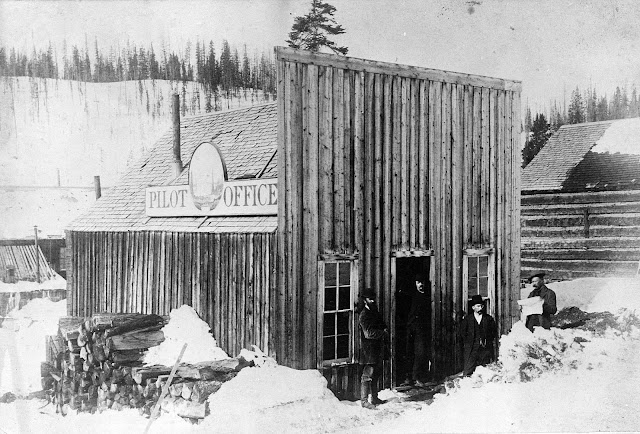

The Pilot opened after John E. Phillips moved his newspaper from the already-dwindling mining town of Rosita in Custer County to the newly-opened mining camp of what was then still known as Ruby or Ruby Camp, about ten miles west of Crested Butte. Ruby had sprung up on what then was still Ute reservation land after overeager prospectors had discovered silver in Ruby Gulch in the summer and fall of 1879. A prospector named Richard Irwin made one of the largest early strikes in the area, and by the summer of 1880, the name Irwin for the camp had come into more common use (although on the 1880 national census, the name Ruby was still used).

Phillips moved his press as close as he could get it to Irwin by freight wagon, but deep snow prevented the wagon from making it all the way to the new camp. Philips and his associates finished bringing it to Irwin in pieces carried in packs as they snowshoed over the snowbound pass. Reportedly, it took several trips.

For the first year of the Pilot’s operation, Phillips had taken on John L. Lacey as business partner, and both men were listed inside the paper as editors and proprietors, but by July 1881, Phillips was running the paper alone.

Irwin is situated in a geographically unique location that causes enormous amounts of snow to dump on it, almost 600 inches per year, in fact, two to three times as much as Crested Butte receives just ten miles away. Despite the rigors of surviving such a winter, prospectors moved in quickly after the fall 1879 silver discovery to stake claims before the expected spring rush. They were right to so do.

By the end of the summer of 1880, around twenty-five mines were in operation in and around Irwin. The new town had amassed thousands of residents living in hundreds of buildings and no doubt even more tents. Twenty-three saloons and gambling parlors were already open, as were various stores and a post office, a stamp mill and a sampling works, six sawmills, three churches, a bank, a theatre, and several hotels and boarding houses. The town could even boast its own brass band, a jail, and two town marshals. By 1882, 5,000 people lived in Irwin.

Irwin’s future seemed so secure that a waterworks was built in 1883 and fire hydrants were installed on the main street. Of course, most of the mines closed later that year.

Thousands of people left Irwin almost as quickly as they had arrived. By 1884, the population was a mere fraction of what it had been. Even the town cemetery was closed in 1885. Limited mining kept the town from complete abandonment for a few more years, but the post office finally closed in 1900. Irwin was a complete ghost town by the 1920s. Today a few of the old buildings have been restored as getaway residences for both winter and summer outdoors enthusiasts, and some new houses have been built in the area as well.

John E. Phillips stayed on for a while, but knew when it was time to move. He reestablished The Elk Mountain Pilot in Crested Butte in 1884, where it continued to be published by several different publishers until at least 1920.

June 10, 2022

B. Ware and I. Steele, Pawnbrokers, Ironton, 1886

The traveling Western photographer Charles Goodman took this photograph of the cheekily-named pawnbrokers “B. Ware and I. Steele,” which also offered “plain sewing,” in the San Juan mountain town of Ironton on September 8, 1886.


Located few miles south of Ouray at a time when the rugged terrain and weather could make such a trip last many hours or occasionally even days, Ironton was an important transportation and freighting hub for the mines in the area. It was the first stop on Otto Mears’s famous toll road that would later become the basis for the Million Dollar Highway.

Ironton was established as Copper Glen in 1883, but within months the more prosaic name of Ironton was in common use, and as such it was incorporated in 1884. The town grew quickly, and soon had more than a hundred buildings and wooden sidewalks. Like all of the mountain towns in Colorado, the Panic of 1893, the last American depression of the nineteenth century, hit it hard, but its importance as a transportation hub allowed it to bounce back quickly. Its post office, for example, closed in 1893, but was reopened just the following year.

But the slow decline in mining eventually did take its toll. The population dwindled away. The post office closed for good in 1920. Two of the last men living there, the brothers Ernest Oliver Milton Larson (1891–1964) and Harry E. L. Larson (1889–1959) continued mining their own claim until their deaths. Milton was the last person to live in the town. Milton appeared on the T.V. panel show “I’ve Got a Secret” on December 18, 1961.

June 1, 2022

Denver and Rio Grande Railroad Train Running the Narrow Gauge Track Through the Animas River Canyon, ca. 1880s

Durango was built as a company town by the Denver and Rio Grande (D&RG) Railway in 1880 with the goal of having a depot in the San Juan Mountains that would have given the company access to the ore freight coming from the mines there. The first D&RG narrow gauge train made it to Durango in August 1881. Construction quickly began on a narrow gauge route from Durango to Silverton.

The new forty-five mile-long route, which followed the Animas River through the Animas Canyon, was completed in July 1882. It is the same route run today by the famous Silverton Train of the Durango & Silverton Narrow Gauge Railroad.

Photographer William Henry Jackson (1843–1942) took this photograph of a D&RG train high up a cliff face above the Animas River sometime between about 1885 and about 1890.

In 1897, Jackson had joined the Detroit Photographic Company (later the Detroit Publishing Company), bringing with him more than 10,000 negatives for the company to publish as postcards and prints. Copies of numerous of his originally black and white photos were colored by artists, then reproduced by the chromolithographic “Photochrom” process, often meticulously so, as this one was. Although Detroit Photographic sold these prints as standard postcards for the general public, those with deeper pockets could buy them carefully reproduced in books and as very high-quality, frameable prints.

Jackson died at the age of ninety-nine, having produced some 80,000 photographs of the American West in his lifetime.

May 28, 2022

Go-Devil on the Little Bookcliff Railway, 1903

The Go-Devil was a gravity driven rail car that ran on the Little Bookcliff (LBC) Railway from 1892, when the railway opened, to about 1907. The LBC was a narrow gauge railway that ran from Grand Junction to Carpenter, a coal mine camp in the Bookcliffs, from 1889 to 1925.

(Photo courtesy Museums of Western Colorado)

The LBC was incorporated on September 11, 1889, by William Thomas Carpenter and several other Grand Junction business owners. The purpose of the 12-mile railroad was to haul coal from the Bookcliff mines owned by Carpenter to Grand Junction. Construction began in 1890 and progressed in sections until the rails finally reached the coal camp in the Bookcliffs in June 1892.

Although the railroad was built to haul coal, it was also used for excursions. Many locals traveled from Grand Junction to Carpenter for picnics and hiking. There were special Memorial Day excursions where families would go out to Carpenter, gather up the abundant wildflowers growing there in the spring, and return to Grand Junction to decorate their loved ones' graves.

Some of the more thrill-seeking visitors would ride back to town on the Go-Devil. The Go-Devil consisted of some boards bolted together and attached to a set of handcar wheels. It coasted down the tracks from Carpenter to Grand Junction at break-neck speeds.

Although you can no longer ride the Go-Devil, you can still see it at Cross Orchards Historic Site at 3073 F Road in Grand Junction.

May 24, 2022

Interurban Electric Train Between Grand Junction and Fruita, Colorado, 1911

Between July 14, 1910, and October 31, 1928, there was a daily electric passenger train service between Fruita and Grand Junction. Up to twelve cars were run along a sixteen-mile-long, standard-gauge rail line each way daily, at a cost of fifty cents per passenger for each one-way trip. Children using the train to and from school paid five cents for a round-trip ticket. The trip took about one hour each way, and the tracks meandered along the county roads through the orchards between the two towns, giving it the unofficial nickname, the “Zigzag Route.” Its official nickname, the “Fruit Belt Route,” was painted on the sides of the train cars. But the electric sign at the depot in Fruita just called it the “Interurban.” That’s the name that stuck.


It was operated by the Grand Junction and Grand River Valley Railway, a subsidiary of the Grand Junction Electric, Gas & Manufacturing Company. The electricity that powered the trains was transmitted by overhead electric wires supported by red-and-white poles that lined the route. One of its other purposes was to run separate flatbed rail cars during summer months to carry produce collected from farms along the route for transportation to the Denver & Rio Grande Railroad depot in Grand Junction for shipment to points east.

The fifty cent charge might seem steep for the time, but the amount of time it cut off a shopping trip to the “big city” was worth the cost for many –– at least for a while. After the “Fruita Highway” was improved in the early- and mid-1920s, automobile traffic between the towns soon made that the faster trip for those who could afford cars, and Interurban usage began to dwindle. Passenger service finally ended in 1928. Expanded truck usage cut into freight traffic as well, and that service ended in 1935. In 1936, the company was dissolved and the tracks were torn up for scrap and sent to a foundry in Pueblo.

May 15, 2022

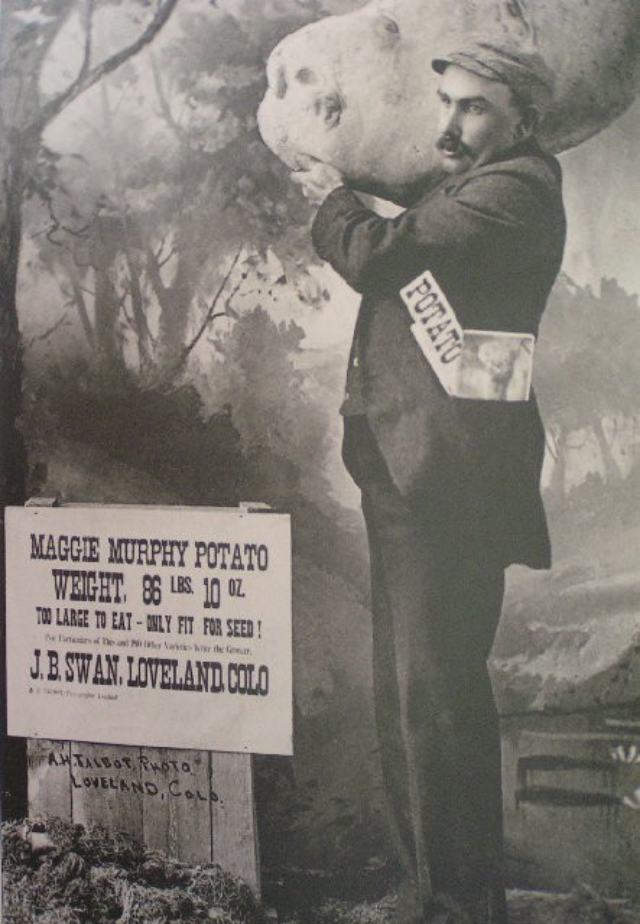
The Mammoth Potato, the First Ever Viral Photo From 1894

The words “mammoth” and “potato” do not often go together. But in 1894, W. L. Thorndyke, a news reporter in Loveland, Colorado, decided to help a man named Joseph B. Swan. Swan was a farmer from outside Loveland who was looking to promote his farm. Thorndyke and Swan decided to enlist the help of Adam H. Talbot to capture a photograph that would do just that. The photograph that they created depicts a very large potato on Swan’s shoulder. This photo did not take long to circulate. An editor who thought it was funny first picked it up, then many more followed. Today, this photograph is considered to have possibly been the first viral photograph.

The widely circulated image of Joseph B. Swan holding the supposed potato.

To make the photo, Talbot took a photo of a potato and enlarged it to mammoth size. He then cut out a wooden board the size and shape of this enlarged image and he attached the photograph to the board. Finally, he posed Swan holding this giant faux-potato on his shoulder.

Copies of the photograph began to circulate around the community. In the beginning, Joseph Swan never intended for people to even believe that his picture was real. He simply wanted to use this understanding people already had of large produce to his benefit. However, once the photo started circulating it was hard to stop people from this misinterpretation. It was inevitable that people would think it was a real potato especially, because something like this had never been done before. Lots of people asked for parts of the potato or seeds so they could grow their own. Some even wanted to put the potato on display. When people came to his farm and asked about the mammoth potato he would initially tell them the truth of the advertisement. However, he later claimed that it had been stolen, and he did not know where it was.

Whether this was to save his pride in not actually having such a large potato or simply laziness at retelling the story so many times is hard to tell. This is true of many circulating viral photos even today. Once it gets out of hand in this way it is hard to stop the ideas of the general public, and it is often easier to go along with their outrageous beliefs.

May 10, 2022

Members of the Glenwood Springs Fire Department Posing in Front of the Hotel Glenwood, Colorado, circa 1888

The Hotel Glenwood first opened its doors in 1884. It was financed in part by town founder Isaac Cooper, and other investors who in anticipation of new businesses opening and visitors staying in Glenwood once the railroad arrived in Glenwood Springs in 1887.


The hotel began as a two-story wooden structure and over the years became an ornate three-story upscale destination with 75 rooms that could accommodate up to 200 guests. The high-end hotel attracted wealthy guests including “Silver King” Horace Tabor and his wife Baby Doe, and famous western gunslinger John “Doc” Holliday who died there in 1887.

On December 14, 1945, the Hotel Glenwood was destroyed by fire.

May 4, 2022

Tunnel Through Snowslide, Otto Mears’s Toll Road Between Ouray and Silverton, Colorado, 1888

The effects of winter can be very long-lasting in Colorado’s Rocky Mountains. A spring 1888 avalanche (snowslide) still covered Otto Mears’s wagon and freight toll road between Ouray and Silverton when Colorado and Utah’s semi-itinerant photographer Charles Goodman took this photograph a few months later on July 6th. Goodman took several photographs from the same spot that day.


As was often the case, this snowslide was deep enough and long enough that removal of all the snow would have been far too large of a task. Locals dug a tunnel through it that was large enough to admit one-way wagon traffic. We don’t know if any shoring beams were erected inside the tunnel, but even if the walls were just made of snow, the weight of it would have compressed and strengthened the sides quite a bit.

The weather and terrain make avalanches very common in the Rockies. This is especially true of the San Juan Mountains of Western Colorado. Snowslides were reported to have killed about 200 people in Colorado in the winter of 1886-1887.

April 29, 2022

Vintage Photographs Capture Main Street in Grand Junction During the Operation Foresight Project, 1962

In the 1950s, Grand Junction was thriving due to the Uranium Boom. Growth was expected to rise, and the arrival of commercial stores and shopping malls across America kick-started this forward-thinking initiative. Alongside Joe Lacy, Dale Hollingsworth, and Leland Schmidt, a city committee created a construction redesign for Main Street. Strides to make the area safe for pedestrians, as well as planning for parades, led to the winding path the street now takes. It was officially completed in 1962.

Even with all the success, the length of time downtown was under construction irked some Grand Junction citizens. Oral history interviewee Grace Wade mentions how beautiful it all came out, but notes other citizen’s reactions. “When they began to do the Operation Foresight the downtown was the biggest mess you ever saw in your life. And everyone just knew they were going to hate it. And of course, I think it’s just simply beautiful!”


Before the street renovation, Main Street was very wide, making crossing it difficult. Traffic was heavy and often fast, and the traffic lights set at the corners of the intersections were not ideally placed for driver viewing. The street also had angle-in parking, so drivers had to back out directly into the traffic.

Operation Foresight’s purpose was to deliberately slow down traffic and Main Street could effectively become a pedestrian-friendly downtown shopping park. Bench shelters and information kiosks were built. The serpentine walls and planters beautified the project. It was such a novel project, it gained national attention and awards, and earned Grand Junction the All-America City award from the National Civic League.

April 27, 2022

Storefronts on Colorado Avenue, Telluride, ca. 1890

This vintage photo shows two of the storefronts in the Roma building on the 100 block of Colorado Avenue in Telluride in about 1890.

(Photo courtesy Telluride Historical Museum)

The shop on the left is the OK Clothing House. The shop on the right is a general merchandise store. John Adams, the owner of the store is standing in front of his business, along with several other people.

April 23, 2022

Funny Snapshots of Fruita Union High School Graduation Antics, Colorado, ca. 1941

Texas native Ottis Littlejohn joined the Civilian Conservation Corps after he graduated high school in 1941, and was stationed with the roadbuilding crew at Colorado National Monument. He befriended several local people while he was here, including his sweetheart and a fellow he refers to as “Red” McCormick. Littlejohn either took these snapshots of McCormick and his classmates goofing around in costumes during graduation week, or he acquired them from him.

According to a note Littlejohn wrote on the back of one of the following photos, McCormick graduated from Fruita Union High School in 1941. At the time, Fruita Union High School was the building that is today Fruita Middle School.

“Red” himself appears wearing two different costumes, that of the cigar-chomping fellow with his arm around the “football player” and the “pretty girl,” and that of the more rube-like fellow standing next to the girl in the “Bo-Peep” dress.


April 21, 2022

Saw Pit Store, Colorado, 1940

This photo was taken by Russell Lee for the Farm Security Administration (FSA) in September 1940, and titled “Store, the one and only, Saw Pit, Colorado.”


Sawpit, in San Miguel County, is located about 12 miles northwest of Telluride. Originally named Seymour, the town of Sawpit was founded in 1892 as a stop on the Rio Grande Southern Railroad. Lumber was needed to fuel the growth of mining in the region and a sawpit was built where logs were rolled over the pit and sawed into lumber by two men, one positioned on top and one below in the pit.

The town was incorporated as Sawpit in 1897. The original Sawpit Store, seen here in the photo above, was built in the 1920s. There is still a general store, Sawpit Mercantile, there today. The town population was 40 at the 2010 census, making Sawpit the fourth least populous incorporated town in the state of Colorado.

April 19, 2022

Cross-Country Skiers in the San Juan Mountains, Colorado, ca. 1910

This mixed group of men and women were photographed around 1910 in Animas Forks or Eureka demonstrating their skis. The photo comes from one of the many antique photo albums in the Gunnison Pioneer Museum’s collection.


People have used skis to move about in the snows of Colorado for generations. Scandinavian immigrants brought the useful custom with them to the United States, and it transferred readily to the residents and pioneers of mountainous and snowy landscapes as a near necessity.

Skis were frequently called “Norwegian Snowshoes” in the last decades of the nineteenth century, a comment both on their Scandinavian origin and on the prosaic reality that they were not yet used so much for sport as they were for transportation. Residents of Colorado’s mountain towns might find themselves using them almost daily as their towns were snowed in over the long winters.

The skis themselves were generally longer than the skis used today, and were typically fashioned locally from planks that had been steam-bent and cut to points at the tips. Instead of the dual poles used today, skiers used just one long pole to help stabilize and propel themselves, resulting in a motion akin to that used by an English canal punter or Venetian gondolier. When skis were used for speed going downhill, as some miners habitually did when returning from mines high above towns, the pole was generally held between the legs and pointed to the rear so it could be lowered to create braking drag when needed.


FOLLOW US:
FacebookTumblrPinterestInstagram

CONTACT US


Browse by Decades

Popular Posts

Advertisement

09 10