Bring back some good or bad memories


ADVERTISEMENT
Showing posts with label Cape Town. Show all posts

August 23, 2022

35 Fascinating Vintage Color Photos Documented Life in Cape Town in the 1960s

Harrison Forman (1904-1978) was a prominent photojournalist, explorer, author, and fellow of the American Geographical Society. As a foreign correspondent, Forman’s images and articles appeared in the New York Times, Times of London, Life, Look, Collier’s, Harpers, and Reader’s Digest

Forman traveled the world with the eye of an anthropologist.  He was fascinated by the lives, culture, economies, governments and infrastructure of each place he visited.  Known in his heyday as the “Modern Day Marco Polo,” Forman was often the first Westerner to have access to the people and places he visited and seemed to always be in the right place at the right time, witnessing significant moments in history and documenting them with his photography. 

Take a look at life in Cape Town in the 1960s through these 35 beautiful and fascinating pictures taken by Forman:

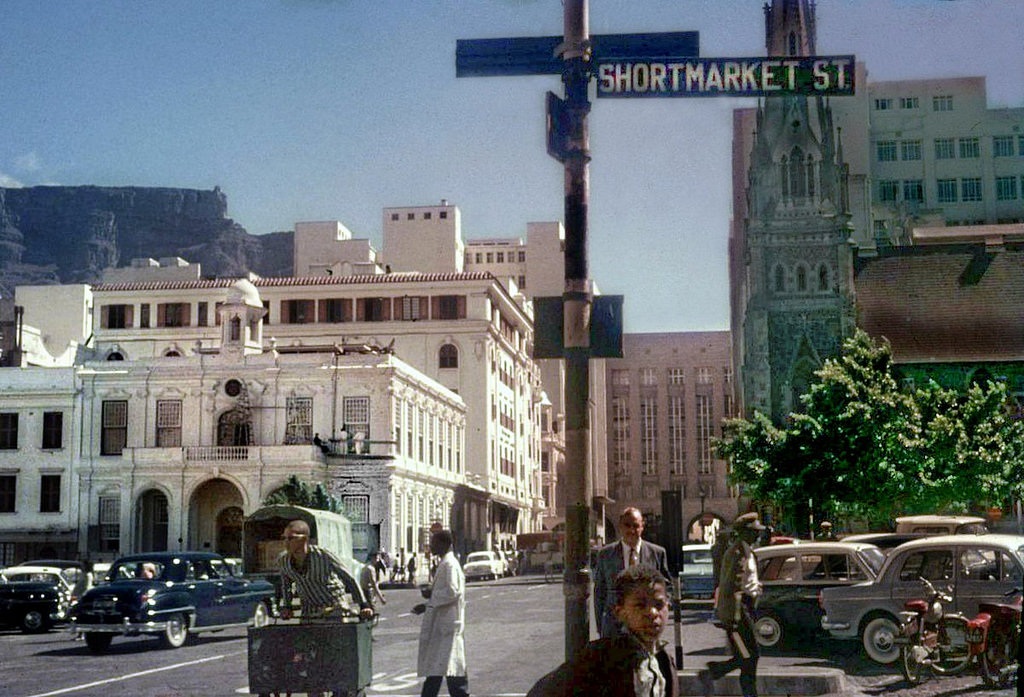
Pedestrians crossing street

Malay boys in Cape Town

Women at slums in Cape Town

Cars parked across from Cape Town City Hall

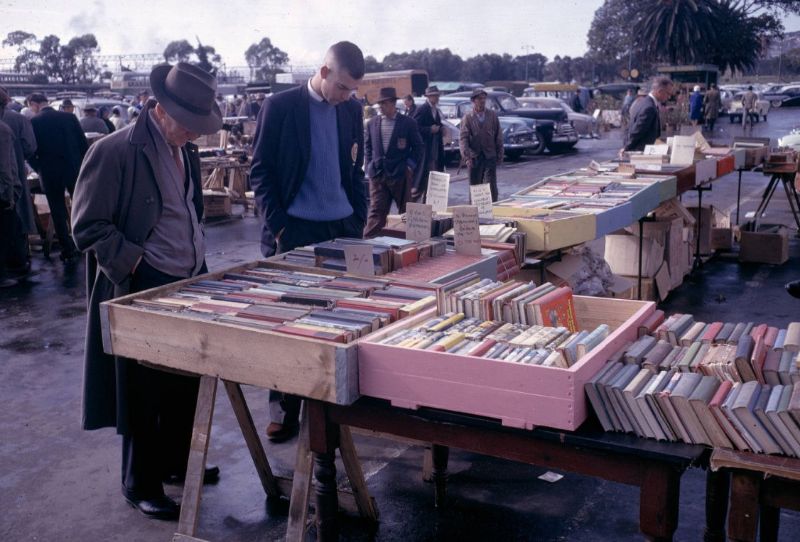
Books for sale at Cape Town market

March 22, 2022

Fascinating Vintage Color Snapshots From a Trip Through Africa in 1970

In 1970, British traveler and photographer Allan Hailstone took a trip from London to Africa that took in six cities and four countries. He traveled to Cape Town and back with stopovers in Cairo, Nairobi, Pretoria, Johannesburg and Salisbury in Rhodesia (now Harare in Zimbabwe).

“My arrival in Cairo was a culture shock, as it would be today, but I had experienced Morocco in 1960 and so I knew to some extent what sort of atmosphere to expect.” He told MailOnline Travel. “Rhodesia was fascinating because the country had declared itself independent of British rule in 1965, and the so-called Smith regime was regarded as illegal by the UK and one was advised not to visit. There were no UK consular links, and the only country friendly to it was South Africa. The only air link was from South Africa so I had to travel there from Johannesburg, then return to Johannesburg, rather than visiting it en route.

“South Africa existed under apartheid. I found the people intelligent and cultured. I remember that it was commonplace in Cape Town to see men playing chess in the street. The hotel where I stayed gives an example of the very cheap pricing. It was a luxury hotel, and I had a suite of rooms at £5 per night, which even then was ridiculously cheap. It had a closed-circuit TV in the lobby, which attracted much interest as ordinary TV did not exist.”

Take a look back at Africa in 1970 through these fascinating images. For more photographs, visit Hailstone's brilliant Flickr site.

Midan Tahrir (Liberation Square), Cairo

Cairo

Nile Hilton Hotel, Cairo

Cairo

Sunset over the Nile, Cairo

June 22, 2021

Beautiful Postcards of Cape Town in the 1960s

Cape Town is the second-most populous city in South Africa, after Johannesburg, and also the legislative capital of South Africa.

Cape Town in the 1960s

Colloquially named the Mother City, it is the largest city of the Western Cape province and forms part of the City of Cape Town metropolitan municipality. The Parliament of South Africa is situated in Cape Town. The other two capitals are located in Gauteng (Pretoria the executive capital where the Presidency is based) and in the Free State (Bloemfontein the judicial capital where the Supreme Court of Appeal is located).

The city is known for its harbor, for its natural setting in the Cape Floristic Region, and for landmarks such as Table Mountain and Cape Point. Cape Town is home to 49% of the Western Cape’s population.

Here below is a set of beautiful postcards from mallix that shows what Cape Town looked like in the 1960s.

Company Gardens, circa 1965

Kirstenbosch, circa 1965

Mailship in the Duncan Dock, circa 1965

Adderly Street, 1966

Camps Bay, 1966

January 12, 2020

Childhood Photos of the Rosenkowitz Sextuplets, the World’s First Surviving Sextuplets

Anyone living in Cape Town during the seventies knew about the six babies that were born on January 11, 1974. The three boys (David Peter, Grant Vincent, Jason Solomon) and three girls (Emma Louise, Nicolette Anne, Elizabeth Rebecca) were born by caesarian section.

The Rosenkowitz sextuplets were born at Mowbray Maternity Hospital, in Cape Town South Africa. Their total birth weight was 24 lb 1 oz (10.9 kg), with individual birth weights ranging from 2 lb 6 oz (1.1 kg) to 4 lb 6 oz (2.0 kg). They were the first sextuplets known to have been born alive anywhere in the world.

The sextuplets became instant celebrities with journalists from across the world clamoring to report on the challenges of caring for six newborns. Throughout their early childhood, their progress was closely followed by the South African media.


July 2, 2018

50 Candid Polaroids of Ordinary People in Cape Town in the Early 1960s

The area known today as Cape Town has no written history before it was first mentioned by Portuguese explorer Bartholomeu Dias in 1488. The German anthropologist Theophilus Hahn recorded that the original name of the area was '||Hui !Gais' – a toponym in the indigenous Khoe language meaning "where clouds gather." All knowledge of the previous inhabitants of the region was derived from fossil evidence and from rock art in the area.

From 1959 to 1963 Bobby Graham's father took some candid Polaroid snaps of ordinary people in Cape Town. The photographs capture everyday life in the South Africa's capital, and show us what Cape Town people wore in the 1960s.


December 28, 2017

30 Beautiful Color Photographs Capture Everyday Life in Cape Town, South Africa From Between the 1950s and 1970s

Cape Town is a coastal city in South Africa. It is the second-most populous urban area in South Africa after Johannesburg. It is also the capital and primate city of the Western Cape province.

The discovery of diamonds in Griqualand West in 1867, and the Witwatersrand Gold Rush in 1886, prompted a flood of immigrants to South Africa. Conflicts between the Boer republics in the interior and the British colonial government resulted in the Second Boer War of 1899–1902, which Britain won. In 1910, Britain established the Union of South Africa, which unified the Cape Colony with the two defeated Boer Republics and the British colony of Natal. Cape Town became the legislative capital of the Union, and later of the Republic of South Africa.

In the 1948 national elections, the National Party won on a platform of apartheid (racial segregation) under the slogan of "swart gevaar". This led to the erosion and eventual abolition of the Cape's multiracial franchise, as well as to the Group Areas Act, which classified all areas according to race. Formerly multi-racial suburbs of Cape Town were either purged of unlawful residents or demolished. The most infamous example of this in Cape Town was District Six. After it was declared a whites-only region in 1965, all housing there was demolished and over 60,000 residents were forcibly removed.] Many of these residents were relocated to the Cape Flats and Lavender Hill. Under apartheid, the Cape was considered a "Coloured labour preference area", to the exclusion of "Bantus", i.e. Africans.


June 7, 2016

Humans of Cape Town: 37 Fascinating Color Portrait Photos of Ordinary South Africans From the 1960s

These interesting vintage color photos from the archives of Bobby Graham whose father took photos of ordinary people in Cape Town from 1959 to 1963. By the end of it, he really had a gift for capturing the natural sense of a person.


May 7, 2016

40 Wonderful Color Photographs Capture Street Scenes of Cape Town, South Africa from between the 1950s and 1970s

These color vintage photographs offer a unique glimpse into the lives of South Africans who would feel the full force of apartheid through the 1950s and beyond...


Adderley street, c.1950s

Greenmarket Square, c.1950s

UCT Rag, 1954

Adderley street, 1955

St. George's street, 1955

December 10, 2015

The Spirit of District Six: 32 Interesting Black and White Photographs Capture Everyday Life of Cape Town, South Africa in 1970

Now in his 70s, the South African photographer Cloete Breytenbach began working as a journalist on an Afrikaans-language newspaper in Cape Town in 1951 and went on to an international career. But Cape Town remained his home base, and “District Six,” his moving series of photographs at White Box, is set there.

District Six was the name of an area that was Dutch colonial farmland in the 18th century and by the 20th had become a lively part of Cape Town. Its population was racially and ethnically mixed, but most of its real estate was controlled by absentee white landlords who over the years let the working-class neighborhood fall into decay. By the 1960s it had become seriously run-down and an embarrassment to nearby “white” Cape Town.

In 1966, under apartheid, the city declared District Six to be an official white area. As a result, virtually the entire population was forced out and moved, some far from the city. In the late 1970s, when the neighborhood was finally empty, the governmentbrought in bulldozers and leveled it.

Mr. Breytenbach took the photographs in this show during the years of transition, when the neighborhood, though in poor repair, was vital and busy. He documented the everyday life of the cultures that mingled there in images of religious ceremonies, social events, markets and domestic interiors. The pictures, seen one by one, are not remarkable, but collectively and in the context of their history, they are. (via The New York Times)

Shy young girl and not so shy pet regard the camera with interest, District Six, Cape Town, South Africa.

Eaton Place. Although in a ramshackle state, the Victorian style buildings still reminded the observer of times gone past, District Six, Cape Town, South Africa.

Rope skipping in Upper Ashley Street (now named Blinde Street), District Six, Cape Town, South Africa. These quaint cottages survived the bulldozers and have, since, been turned into upmarket townhouses.

One of the most prominent landmarks in District Six was the 'seven steps' - a popular meeting place for gangs and locals alike.

Catching a ride on the back of a passing vehicle made for great entertainment, District Six, Cape Town, South Africa.

January 19, 2015

30 Candid Photographs Capture Cape Town's Night Life in the Late 1960s

These photographs were taken by photographer Billy Monk in Cape Town nightclubs in 1967-69. The unusual narrative of his life and work has often been related and embellished upon, and has become entwined with our perceptions of the images. In essence, he was born in 1937, and worked as a nightclub bouncer for Les Catacombs Club in Cape Town in the late 1960s when he was around 30 years of age. He later moved to the West Coast and lived in Port Nolloth periodically until his death in 1982.

Using a Pentax camera with 35mm focal-length lens, Billy Monk photographed the nightclub revellers and sold the prints to his subjects. His close and long friendships with many of the people in the images allowed him to photograph them with extraordinary intimacy in all their states of joy and sadness. His images of nightlife seem carefree and far away from the scars and segregation of apartheid that fractured this society in the daylight.

In 1969 Monk stopped taking photographs at the club. Ten years later his contact sheets and negatives were discovered in a studio by Jac de Villiers who recognised the significance of his work. He arranged a first exhibition of the work in 1982 at the Market Gallery in Johannesburg. Monk could not make the opening and two weeks later, en route to seeing the exhibition, he was tragically shot dead in a fight and never saw his exhibition. Recently De Villiers revisited Monk's contact sheets and curated the exhibition of the classic images along with some that have not been shown before.

Since the images were first seen in 1982, they have been critically acclaimed and celebrated on the rare occasions that they have been shown. The images raise the question why they continue to resonate so strongly with viewers 40 years later, and it is perhaps because of the remarkable pathos and empathy Billy Monk had for his subjects, regardless of their disposition, circumstances and transgressions.


FOLLOW US:
FacebookTumblrPinterestInstagram

CONTACT US


Browse by Decades

Popular Posts

Advertisement

09 10