Bring back some good or bad memories


ADVERTISEMENT
Showing posts with label Berlin. Show all posts

May 4, 2026

Berlin 1966: Life in a Divided City Through Stunning Vintage Photos

In the mid-1960s, Berlin’s street scenes offered a striking visual narrative of a city divided yet pulsating with a unique, contrasting energy.

While the Berlin Wall stood as a stark, grim reminder of geopolitical tensions, the daily life on either side revealed a fascinating mix of grit and glamour. In West Berlin, the Kurfürstendamm buzzed with the neon lights of modern cinemas, sleek Mercedes-Benz sedans, and fashionable pedestrians embracing the height of the “Economic Miracle.” Conversely, the streets of East Berlin showcased a more somber, socialist grandeur, characterized by wide boulevards like Karl-Marx-Allee and the distinctive hum of Trabants.

These vintage photos capture a pivotal moment in history, a city of ruins transforming into a stage for the Cold War, where every corner told a story of resilience, political theater, and the undeniable spirit of the Berliners.

East Berlin. Humboldt University of Berlin, 1966

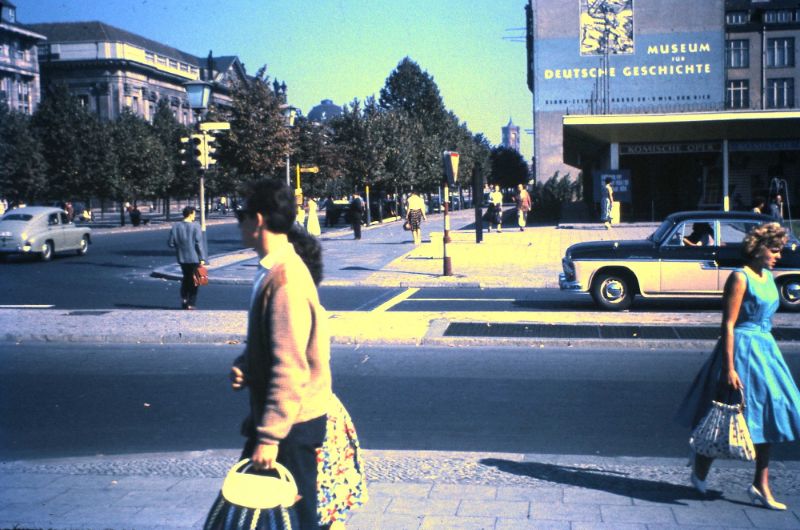
East Berlin. On the left is the German Historical Museum on Unter den Linden. On the right, the historic building is the Kronprinzenpalais, with Schinkelplatz behind it, 1966

East Berlin. On the left is the State Opera on Unter den Linden, with St. Hedwig’s Cathedral behind it, 1966

East Berlin. On the right is the State Opera on Unter den Linden, 1966

East Berlin. On the Spree, in front of the Old National Gallery, 1966

March 20, 2026

In 1963, Heinz Meixner Orchestrated a Daring Escape From East Berlin to Smuggle His Fiancée and Her Mother

Berlin Wall was erected in 1961 to divide east and west Berlin and, more precisely, to prevent people from East Berlin (the Soviet-held area) from escaping to West Berlin (governed by the Allied Forces). It went down in 1989, marking the end of the Cold War.

Checkpoint Charlie (aka Checkpoint C) is the most famous border-crossing point, designated for diplomats, foreigners, and members of the Allied Forces (1961-1990). The West Berlin part of the checkpoint – with Adler Cafe right next to it – consisted of a minimalist guard house and a sandbag barrier, which looked oddly unimpressive compared to the Eastern part’s infrastructure.

The infamous Checkpoint Charlie in 1961.

In 1963, Heinz Meixner, an Austrian lathe operator, orchestrated a daring escape from East Berlin to smuggle his fiancée, Margarete Thurau, and her mother to the West. Their story is one of the most famous escapes involving Checkpoint Charlie.

Meixner had fallen in love with Thurau while working in East Berlin, but she was denied permission to emigrate. To bypass the Berlin Wall, Meixner devised a plan to drive under the border barriers rather than through them.

While crossing the border on a motor scooter, Meixner feigned engine trouble to secretly measure the height of the steel barrier at Checkpoint Charlie, finding it was 37.5 inches (95 cm) high. He searched for a car low enough to fit and settled on a red Austin-Healey Sprite. To ensure clearance, he removed the windshield and let air out of the tires, bringing the car’s height down to about 35.5 inches (90 cm).

Shortly after midnight on May 5, 1963, the trio made their attempt. Margarete huddled in the small space behind the driver’s seat. Her mother was placed in the trunk, protected by 30 bricks Meixner had packed around her to stop potential bullets from border guards.


Meixner drove to the East German side and handed over his passport. When the guard directed him toward a customs shed for inspection, he instead slammed on the accelerator. He ducked his head as the car zipped under the steel barrier. He cleared the bar with only about an inch to spare, reaching the American sector of West Berlin so fast that he left 96-foot skid marks when he finally braked.

The escape was successful, and the story became a sensation, later documented in the Mauermuseum (Museum Haus am Checkpoint Charlie). In response to this specific “under-the-barrier” tactic, East German authorities soon added vertical steel bars beneath the horizontal checkpoint beams to prevent future attempts.

May 6, 2024

30 Fascinating Photos Capture Street Scenes of Berlin in the Early 1970s

In the early 1970s, Berlin was a city marked by its division. The Berlin Wall, constructed in 1961, divided the city into East and West Berlin. It was a time of political tension, cultural experimentation, and social change.

West Berlin, despite being surrounded by East Germany, had a vibrant cultural scene, with bustling streets, vibrant nightlife, and a thriving arts community. The cityscape included a mix of modern buildings and historic architecture, with landmarks such as the Brandenburg Gate and the Reichstag Building.

However, the presence of the Wall served as a constant reminder of the Cold War tensions between East and West. These fascinating photos were taken by Robert Rynerson that show street scenes of Berlin in 1970 and 1971.

Berlin - Above a new Bus Rapid Transit station for Line 84 on the Stadtautobahn

Berlin - Along the Landwehr Canal

Berlin - Bus lane

Berlin - Gõrlitzer Bahnhof was redundant due to its location in the American Sector, serving a line that went to Poland via the city of Gõrlitz in East Germany

Berlin - Gõrlitzer Bahnhof was redundant due to its location, but in the dense, low-income Kreuzberg district its Bahnhofsvorplatz was a useful green space

January 18, 2024

Sophia Loren, Yvonne de Carlo, and Gina Lollobrigida at the Ball of Stars at the Berlin Film Festival in 1954

Gina Lollobrigida refused to have her photo taken with Sophia Loren, it was only resolved when Yvonne de Carlo agreed to be pictured in the middle of two warning parties.


When the Italian actress Gina Lollobrigida passed away at the age of 95 on January 16, 2023, her fellow actress Sophia Loren has admitted she was devastated when she heard the news and insisted her “light” will go on forever. She said: “Yesterday I was too heartbroken and I couldn’t find the words. Dear Gina, your body is extinguished but the light of your star will shine over us and in our hearts forever. I love you Gina! Sophia.”

During their heyday in the Golden Age of Hollywood, Gina – who was best known for her roles in the likes of The Hunchback of Notre Dame and Solomon and Sheba – was pitted against Academy Award-winning star Sophia as a rival in an “annoying” attempt to drum up publicity, which ended up lasting for half a century.

Sophia said: “She and her publicists started this rivalry with me that lasted for 50 years. It was really annoying. We are different and have completely different career paths. I wanted to be an artist more than anything else, I wanted a high-level career.”

Gina was one of the biggest stars of European cinema in the 1950s and 1960s, but when her career declined, she became a photographer and sculptor. Often described as “the most beautiful woman in the world,” the Beautiful But Dangerous star was one of the last surviving icons of the era and as recently as 2018, she performed on Italy’s version of Strictly Come Dancing.

October 8, 2023

A Female Photographer at Work Over the Roofs of Berlin, ca. 1910

Women in journalistic professions were a rarity in Wilhelmine Germany. Nonetheless, some women did succeed in establishing themselves as journalists – initially, they did so by working for the women’s newspapers and magazines that had been around since the middle of the nineteenth century; later on, they also worked for large newspapers.

In this photograph from 1910, a female photographer surveys metropolitan Berlin from a crane being used in the construction of the Stadthaus (City Hall) on Molkenmarkt. The City Hall was built as an extension of the Rotes Rathaus (Red City Hall), whose large tower can be seen at the right. The Berliner Dom (Berlin Cathedral) can be seen in the background off to the left.


During World War II, the allied bombing campaigns and fierce fighting during the Battle of Berlin heavily damaged all three structures, but they have since been restored.

April 10, 2023

Berlin in the 1930s Through Vintage Photos

The 1930s was one of the most tumultuous decades for Germany. Already crippled by the debt they accrued from World War One, the European nation faced even tougher times following the ripple effects of Wall Street’s stock market crash. With such instability and poverty, the population was receptive to the words and promises of Adolf Hitler and the Nazi Party, setting in motion a chain of events that would greatly–and tragically–alter the course of history.

The grip of Nazism in the German capital of Berlin had begun the decade before, but it hit fever pitch in 1930 as Hitler and his Nazi Party launched a campaign to be voted into parliament. There were thousands of meetings, torchlight parades, propaganda posters and millions of Nazi newspapers in circulation. Hitler restored much of the population’s hope with vague promises of employment, prosperity, profit and the restoration of German glory.

On election day in September 14, 1930, the Nazis were voted into parliament and thus became the second largest political party in Germany. This power increased by 1933, with Hitler named the Chancellor of Germany.

Here below is a set of vintage photos that shows what Berlin looked like in the 1930s.

Unter den Linden, the middle promenade, and the Brandenburg Gate, Berlin, circa 1930s

Alexanderplatz and the Berolina column, Berlin, circa 1930s

Brandenburg Gate with a guards parade, Berlin, circa 1930s

Brandenburg Gate, Berlin, circa 1930s

Fredericks Bridge with the National Gallery, Berlin, circa 1930s

January 6, 2023

40 Fascinating Photos Capture Berlin Cinemas in 1983

The film industry in Germany can be traced back to the late 19th century. German cinema made major technical and artistic contributions to early film, broadcasting and television technology. Babelsberg became a household synonym for the early 20th century film industry in Europe, similar to Hollywood later.

Germany witnessed major changes to its identity during the 20th and 21st century. Those changes determined the periodization of national cinema into a succession of distinct eras and movements.

These fascinating photos were taken by friedrich1955 that show cinemas in Berlin in 1983.


December 22, 2022

33 Amazing Photos of a Berlin House in the Late 1940s

Here is an album of amazing photos that was scanned by Jack Salen, inherited from Helga Salen (Helga Borck). Helga Borck’s father was Werner Borck and mother was Margarete Borck (Margarete Blume), from Berlin, Germany.

Interior of Helga’s House at 6 Hermannstraße, Zehlendorf, Berlin, Germany in 1948 and 1949

These photos captured exterior and interior of Helga’s House at 6 Hermannstraße, Zehlendorf, Berlin, Germany in 1948 and 1949.

Bathroom in Helga's Berlin House, 6 Hermannstraße, Zehlendorf, Berlin, Germany, 1948-49

Bathroom in Helga's Berlin House, 6 Hermannstraße, Zehlendorf, Berlin, Germany, 1948-49

Bedroom in Helga's Berlin House, 6 Hermannstraße, Zehlendorf, Berlin, Germany, 1948-49

Dog at stairs, Helga's Berlin House, 6 Hermannstraße, Zehlendorf, Berlin, Germany, 1948-49

Dressing room in Helga's Berlin House, 6 Hermannstraße, Zehlendorf, Berlin, Germany, 1948-49

December 17, 2022

40 Amazing Color Photos Capture Street Scenes of Berlin in the Late 1950s

By the 1950s, the German capital had become a divided microcosm of the Cold War. East Berlin was controlled by the communist government of East Germany while the western half of the city was occupied and supplied by the United States and its allies.

Life in Berlin’s communist section was beset with problems. While a large number of East Berliners supported communism after the war, many became disillusioned with its lack of progress and freedom. The East German government placed pressure on workers with ambitious production quotas and targets. Essential items like food, clothing and accommodation were subsidized by the government – but there were often shortages or long queues. East Germany’s industrial priorities meant that fewer consumer goods and luxuries were produced.
East Germans were always mindful of the Stasi (‘State Security’), one of the Soviet bloc’s largest and most pervasive secret police agencies. From the early 1950s, it was difficult for East Germans to travel to nations beyond the Soviet bloc. The border between East and West Germany was transformed into a line of barbed wire, fortifications and guards, running from Czechoslovakia to the Baltic Sea.

These amazing color photos were taken by Allan Hailstone that show street scenes of East and West Berlin in 1959.

East Berlin. Unter den Linden. At the junction with Friedrichstrasse, looking east. Berliner Dom and Rotes Rathaus can be seen in the distance, September 11, 1959

East Berlin, September 11, 1959

East Berlin. Alexanderplatz, at the junction with Unter den Linden, looking north, September 11, 1959

East Berlin. Alexanderplatz, September 11, 1959

East Berlin. Berliner Dom (Berlin Cathedral), September 11, 1959

December 4, 2022

32 Fantastic Postcards of West Berlin in the 1960s and 1970s

After the end of the war, Germany was on its way to rebuild. A divided microcosm of the Cold War by the 1950s, West Berlin, however, was able to emerge from the severe rubble and successfully transformed into a “showcase of the West” from the economic miracle.

Take a look back at West Berlin through these 32 fantastic postcards:


October 28, 2022

500 Motorcycles Decorate Walls at German Auto Show, 1929

Motorcycles by the hundreds covered the walls of the exhibition buildings at the Motor Show in Berlin, 1929. As shown in the photo, the cycles were hung seven-deep upon the walls, with a row of machines fitted with side-car equipment occupying a ledge beneath. More than 500 motorcycles were used in assembling this unique exhibit. The purpose of the novel arrangement was to save expense because of the high cost of floor space.


Americans might think it peculiar to give so much emphasis to motorcycles at an auto show, but the two-wheeled vehicle is much more popular abroad than in the United States.

August 30, 2022

45 Fascinating Color Photos Capture Street Scenes of Berlin in 1954

By the 1950s the German capital had become a divided microcosm of the Cold War. East Berlin was controlled by the communist government of East Germany while the western half of the city was occupied and supplied by the United States and its allies.

Life in Berlin’s communist section was beset with problems. While a large number of East Berliners supported communism after the war, many became disillusioned with its lack of progress and freedom. The East German government placed pressure on workers with ambitious production quotas and targets. Essential items like food, clothing and accommodation were subsidized by the government – but there were often shortages or long queues. East Germany’s industrial priorities meant that fewer consumer goods and luxuries were produced.

These fascinating color photos from Robert Rynerson were taken by U.S. Army soldier Edmund von Nordeck who was stationed in the U.S. Army’s Berlin Brigade hospital that show street scenes of Berlin in 1954.

1952 BVG (West) prototype motor-trailer set, Berlin, 1954

Funkturm Berlin, Berlin, 1954

Kaiser Wilhelm Memorial Church, Berlin, 1954

279th Station Hospital, Berlin, 1954

279th Station Hospital, Berlin, 1954


FOLLOW US:
FacebookTumblrPinterestInstagram

CONTACT US


Browse by Decades

Popular Posts

Advertisement

09 10