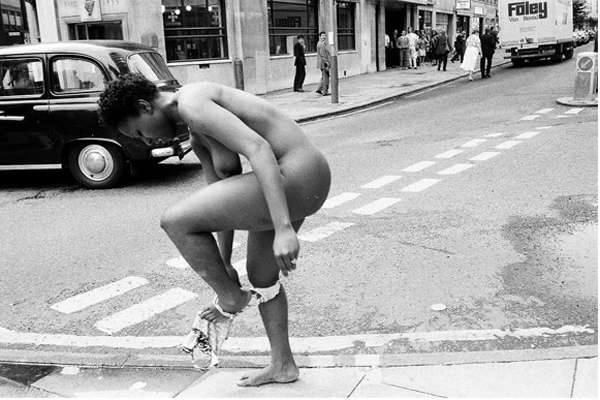
Bring back some good or bad memories


ADVERTISEMENT

September 20, 2011

Glamorous Levitating Fashion Photography for Harper’s Bazaar, 1965

Today, we see a lot of photographers capturing pictures of their subjects in mid-air, whether they be models in an ad campaign or photographers who shoot themselves.

What some people may not realize is that, in photography, this levitating act has been around for decades. Melvin Sokolsky's 1965 photo spread entitled Fly, for the Spring Collection in Harper's Bazaar, is proof.

In these photographs, fashion models are seen floating across rooftops and caught leaping over elegant diners. And they look stunning!


September 14, 2011

Amazing ’80s London Street Photography by Johnny Stiletto

No other city has the variety of hairstyles male and female that parade the streets of London. The bouffant, the duck arse, the white wings of power swept over the ears, the coxcomb punk, the flat top, the social outrider's bowl cut. They're all there to make a place. In respect of the hair of the 80s, the rest of the world was dead from the neck up.

Bought a 35mm camera at the beginning of 1980, Johnny Stiletto spent the next 10 years walking around London taking half a roll of black and white a day and photograph whatever happens. Here are 16 unique street photographs of London taken by Stiletto when it was the style, musical, political and fashion capital of the world.


September 9, 2011

Rare Behind The Scenes Photos From the Making of 1977 Film 'Star Wars'

Star Wars is an American epic space opera film series created by George Lucas. The first film in the series was originally released on May 25, 1977, under the title Star Wars, by 20th Century Fox, and became a worldwide pop culture phenomenon, followed by two sequels, released at three-year intervals.


September 6, 2011

Fascinating Colorized Photos of Bedouin People From the Late 19th Century

At the end of the 19th century Orientalisme is in fashion, some photographers specialized themselves about these landscapes, making images thanks to an early color process: Photochrom.

The Photochrom was invented in the 1880s by Hans-Jakob SCHMID (1865-1924), an employee of the Swiss publishing company Orell Füssil & Cie. We obtained the technique from a black and white photographic negative, basing on the process of color lithography. Thanks to the Photochrom, it was now possible to put many colors in the photograph. However, we had not still reached automatic work. In other words, we had to retouch each image manually according to the color. The choice of color required the interpretation of a performer to have more details in the photo. Consequently, the photochrom prints did not seem natural. At the beginning of the 20th century, they were quickly sold out in tourist spots, particularly in the Middle East.

Palestine, which had just opened doors to the Occident under the Ottoman Empire, flourished rapidly in the middle of the 19th century as a melting pot of civilization and, for the Europeans, as a recovered paradise. The photographs on Palestine provoked a new and striking sensitivity to Europeans.

Bedouin man

Sheik

Bedouin shepherds

Mothers and children

Syrian Bedouin shepherds

Water carrier

Jews in Jerusalem

September 4, 2011

Feelin' Groovy: Fascinating Color Photographs Showing High School Fashions in 1969

In 1969, photographer Arthur Schatz went to a California high school to do a photo-essay for LIFE magazine on an emerging trend in fashion. The results seemed to find the youth of the time developing an identity for their generation.


In contrast to the popular fashions and styles of certain decades — the Gibson Girl of the 1890s and early 1900s, the flapper of the Roaring Twenties, the "New Look" of the Fifties — there was no single reigning style in the 1960s. Even as the slim-cut trousers and shift dresses of the late Fifties crept in, Mod miniskirts and go-go boots found their way over from London to mingle with the bell-bottomed jeans and fringed vests of the latter part of the decade. By 1969, the fashion choices of tens of millions of young American men and women were as variegated and ever-evolving as the world around them.

Cultural transformation was an irresistible force during the Sixties, and across America and around the globe civil rights, women's and gay liberation, the sexual revolution and, of course, the explosive soundtrack of R&B, soul and rock and roll informed everything from politics to fashion.

By 1969, America's youth had not only soaked in more visual and auditory stimuli in a few years than most previous generations combined, but had re-imagined virtually all of that input in the form of sartorial self-expression. In light of that new, global sensibility, Beverly Hills high schooler Rosemary Shoong's homemade "stunning leather Indian dress" wasn't just a dress. It was a time and a place, man. And it was out of sight.

Students at Woodside High in California, 1969.

High school students wearing "hippie" fashion, 1969.

High schooler Lenore Reday stops traffic while wearing a bell-bottomed jump suit in Newport Beach, Calif., 1969.

High school fashions, 1969.

High school fashions, 1969.

September 3, 2011

Pictures of Skateboarding in California in the 1970s

Skateboard culture in California in the 1970s has left an indelible mark on the sport and on America's cultural identity, and photographer Hugh Holland perfectly captured the spirit of this golden age from 1975-1978.


September 2, 2011


FOLLOW US:
Facebook • Tumblr • Pinterest • Instagram

CONTACT US


Browse by Decades

Popular Posts

Advertisement

09 10