Bring back some good or bad memories


ADVERTISEMENT

March 3, 2011

March 1, 2011

21 Historical Pictures of Vietnam War You Probably Haven't Seen Before

Communist troops captured Saigon on April 30, 1975, ending one of the most bitter conflicts ever to involve the United States. Here are some incredible photos from the Vietnam War you probably haven’t seen before:

U.S. military action in Vietnam was a piece in the global Cold War struggle. After Vietnamese nationalists overthrew French colonialists in the 1950s, the country was divided between the Communist north and the anti-Communist south. In the ensuing conflict, Washington backed the south, fearing that a Communist takeover could cascade through Southeast Asia. The first U.S. forces engaged in the conflict in secret, by way of Cambodia. As the civil war intensified in the 1960s, the United States expanded its operations in the region, deploying some 3 million American troops over time, but U.S. forces struggled to gain ground as they fought in difficult and unfamiliar terrain against extremely capable in guerrilla fighters. As the war dragged on and casualties mounted, opposition to the war exploded. By the time American forces withdrew in 1975 and Saigon fell to Ho Chi Minh's Communists, 58,000 Americans and between 1 million and 2 million Vietnamese had died. It was the longest war in U.S. history and the most unpopular American war of the 20th century. In this 1965 photo, paratroopers cross a river in the rain near Ben Cat, in the south.

The South Vietnamese regime backed by the United States in the early days of the conflict was notoriously corrupt and authoritarian. President Ngo Dinh Diem, who was part of the Catholic minority, populated his government and military with Catholics, fomenting widespread unrest among the country's Buddhist majority. In this image taken June 11, 1963, Buddhist monk Quang Duc burns himself to death at a busy Saigon intersection to protest persecution of Buddhists. The picture came to represent the failure of the Diem regime and a growing public relations problem for the U.S. Several months later, Diem was overthrown, executed and buried in an unmarked grave.

Hovering U.S. Army helicopters pour machine gun fire into a tree line to cover the advance of South Vietnamese ground troops in March 1965. The troops were moving to attack a Viet Cong camp northwest of Saigon near the Cambodian border.

A Vietnamese man holds the body of his child as South Vietnamese Army Rangers look down from their armored vehicle near the Cambodian border on March 19, 1964.

An unidentified U.S. Army soldier sports the slogan "War Is Hell" on his helmet in Vietnam on June 18, 1965.

February 26, 2011

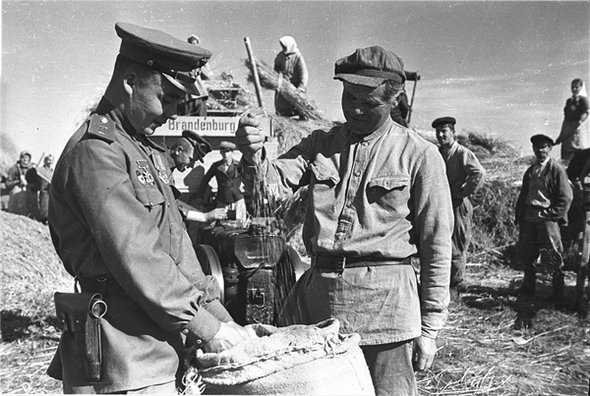
Rarely Seen Photos of World War II

World War II photos taken in the former USSR during World War II on the occupied territories. These are photos from family archives posted online by grandchildren of those who took part in the war: the authors of most of them remain unknown. Some of the photos belong to the Soviet journalists: Dmitri Baltermants and Vladimir Lupejko.

The photographs are cruel and shocking, but they should teach us about life and how precious it is. We are all equals during our short life on this planet and all nations should embrace others and cease all conflicts. For the better future of our children, may the history never repeat itself.


February 25, 2011

Old Photos of the First Generation of Computers

Computers, and technology in general, have come a long way in today’s world. The modern world is actually shaped and defined through the usage of computers, those neat little gadgets that do the hard work for you. Modern computers are also perfectly capable of entertaining, organizing, reminding, even surprising you. That wasn’t always the case.

Here is glimpse of the history of computers and their humble beginnings. These computers may not have been as powerful as modern computers, but they’re old black and white photos are intriguing nevertheless. If for no other reason, then because those old computers were capable of filling a whole room with their robust circuitry. Enjoy these old photos of the first generation of computers.

AVIDAC, Argonne’s first digital computer, began operation in January 1953. It was built by the Physics Division for $250,000. Pictured is pioneer Argonne computer scientist Jean F. Hall.

The CSIRAC was Australia’s first computer. The name stands for CSIR originally stood for “Council for Scientific and Industrial Research”. This name was in effect from 1926 to 1949.

The computer history at NTNU is much older than the computer departments. The very first computer at NTNU was called DIANA, or DIfferential ANAlysator. This was an analog electronic computer built by Jens Glad Balchen and the Division of Cybernetics in the years between 1952 and 1955.

A press conference for what is considered the first computer, the Electronic Numerical Integrator and Calculator (ENIAC), was held at the University of Pennsylvania on February 1, 1946. The machine (shown here with a technician) took up an entire room, weighed 30 tons and used more than 18,000 vacuum tubes to perform functions such as counting to 5,000 in one second.

ENIAC, costing $450,000, was designed by the U.S. Army during World War II to make artillery calculations. The development of ENIAC paved the way for modern computer technology–but even today’s average calculator possesses more computing power than ENIAC did.

February 13, 2011

February 11, 2011

A Rare Look Inside the Harley-Davidson Factory From Their Early Days

In 1901, 20-year-old William S. Harley drew up plans for a small engine with a displacement of 7.07 cubic inches (116 cc) and four-inch (102 mm) flywheels. The engine was designed for use in a regular pedal-bicycle frame. Over the next two years, Harley and his childhood friend Arthur Davidson worked on their motor-bicycle using the northside Milwaukee machine shop at the home of their friend, Henry Melk. It was finished in 1903 with the help of Arthur’s brother, Walter Davidson. Upon testing their power-cycle, Harley, and the Davidson brothers found it unable to climb the hills around Milwaukee without pedal assistance. They quickly wrote off their first motor-bicycle as a valuable learning experiment.

Work immediately began on a new and improved second-generation machine. This first “real” Harley-Davidson motorcycle had a bigger engine of 24.74 cubic inches (405 cc) with 9.75 inches (25 cm) flywheels weighing 28 lb (13 kg). The machine’s advanced loop-frame pattern was similar to the 1903 Milwaukee Merkel motorcycle (designed by Joseph Merkel, later of Flying Merkel fame). The bigger engine and loop-frame design took it out of the motorized bicycle category and marked the path to future motorcycle designs. The boys also received help with their bigger engine from outboard motor pioneer Ole Evinrude, who was then building gas engines of his own design for automotive use on Milwaukee’s Lake Street.

The prototype of the new loop-frame Harley-Davidson was assembled in a 10 ft × 15 ft (3.0 m × 4.6 m) shed in the Davidson family backyard. Most of the major parts, however, were made elsewhere, including some probably fabricated at the West Milwaukee railshops where oldest brother William A. Davidson was then toolroom foreman. This prototype machine was functional by September 8, 1904, when it competed in a Milwaukee motorcycle race held at State Fair Park. It was ridden by Edward Hildebrand and placed fourth. This is the first documented appearance of a Harley-Davidson motorcycle in the historical record.

In January 1905, small advertisements were placed in the Automobile and Cycle Trade Journal offering bare Harley-Davidson engines to the do-it-yourself trade. By April, complete motorcycles were in production on a very limited basis. That year, the first Harley-Davidson dealer, Carl H. Lang of Chicago, sold three bikes from the five built in the Davidson backyard shed. Years later the original shed was taken to the Juneau Avenue factory where it would stand for many decades as a tribute to the Motor Company’s humble origins until it was accidentally destroyed by contractors cleaning the factory yard in the early 1970s.

In 1906, Harley and the Davidson brothers built their first factory on Chestnut Street (later Juneau Avenue), at the current location of Harley-Davidson’s corporate headquarters. The first Juneau Avenue plant was a 40 ft × 60 ft (12 m × 18 m) single-story wooden structure. The company produced about 50 motorcycles that year.

Here are some rare photographs from inside the Harley motorcycle factory from the 1910s and 1920s.


January 22, 2011

The Story Behind the Iconic Image “V-J Day in Times Square” Taken by Alfred Eisenstaedt on August 14, 1945

Alfred Eisenstaedt’s photograph of a sailor kissing a woman in Times Square, after news broke of the Japanese surrender in World War II, has lived a storied life since it was taken on August 14, 1945. Often called “The Kiss,” it remains the iconic image of celebration at war’s end, a black-and-white bookend separating an era of darkness from the beginning of a time of peace. It is also an unsolved mystery of identity, a physics problem and, more recently, a source of controversy for those who see in it not mutual revelry but evidence of sexual assault.

V-J Day in Times Square, a photograph by Alfred Eisenstaedt, was published in LIFE in 1945 with the caption, “In New York's Times Square a white-clad girl clutches her purse and skirt as an uninhibited sailor plants his lips squarely on hers.”

Because he was photographing rapidly changing events during the celebrations, Eisenstaedt did not have an opportunity to get the names and details. The photograph does not clearly show the face of either person involved, and numerous people have claimed to be the subjects. The photograph was shot just south of 45th Street looking north from a location where Broadway and Seventh Avenue converge. It was taken at 5:51 p.m. ET with a Leica IIIa.

“People tell me that when I am in heaven they will remember this picture,” he wrote in his 1985 book, Eisenstaedt on Eisenstaedt: A Self-Portrait. “I turned around and clicked the moment the sailor kissed the nurse. If she had been dressed in a dark dress I would never have taken the picture. If the sailor had worn a white uniform, the same. I took exactly four pictures. It was done within a few seconds.”

U.S. Navy photo journalist Victor Jorgensen captured another view of the same scene, which was published in The New York Times the following day. Jorgensen titled his photograph “Kissing the War Goodbye”. It shows less of Times Square in the background, lacking the characteristic view of the complex intersection so that the location needs to be identified, it is dark and shows few details of the main subjects, and it does not show the lower legs and feet of the subjects.


Unlike the Eisenstaedt photograph, which is protected by copyright, this Navy photograph is in the public domain as it was produced by a federal government employee on official duty. While the angle of the photograph may be less interesting than that of Eisenstaedt’s photo, it clearly shows the actual location of the iconic kiss occurring in the front of the Chemical Bank and Trust building, with the Walgreens pharmacy signage on the building façade visible in the background.

The photo has also remained the subject of intense scrutiny. Who were these two individuals, who made history with a fleeting encounter in Times Square? Their identities were unknown, and the subject of debate, for years. After decades of dispute, the couple in the 1945 photograph were revealed to be the American sailor George Mendonsa and nurse Greta Zimmer Friedman.

Greta Friedman was 21 years old on August 14, 1945. After reporting to work at a dentist’s office, she heard the news: Japan had surrendered, and World War II was coming to an end. She wandered into Times Square when a passing sailor locked her in an unexpected embrace. “I did not see him approaching, and before I know it I was in this vice grip,” she told CBS news in a 2012 interview. “It wasn’t my choice to be kissed. The guy just came over and grabbed. That man was very strong. I wasn’t kissing him. He was kissing me”.

The kisser was the 22-year-old George Mendonsa of Newport, Rhode Island. He was on leave from the USS The Sullivans (DD-537) and was watching a movie with his future wife, Rita, at Radio City Music Hall when the doors opened and people started screaming the war was over. George and Rita joined the partying on the street, but when they could not get into the packed bars decided to walk down the street. It was then that George saw a woman in a white dress walk by and took her into his arms and kissed her, “I had quite a few drinks that day and I considered her one of the troops—she was a nurse”.

Alfred Eisenstaedt’s beautiful image has become the most famous and frequently reproduced picture of the 20th century, and it forms the basis of our collective memory of that transformative moment in world history.


FOLLOW US:
Facebook • Tumblr • Pinterest • Instagram

CONTACT US


Browse by Decades

Popular Posts

Advertisement

09 10