Bring back some good or bad memories


ADVERTISEMENT
Showing posts with label Valentine. Show all posts

February 3, 2026

22 Funny “Hospital” Valentine’s Day Cards From the Early 20th Century

In the very early 20th century, the “patent medicine” industry was still booming. Companies like Smith’s Bile Beans and Lash’s Bitters realized that people were more likely to keep a card if it was colorful and funny.

A common card from this era might show a man clutching his stomach while looking longingly at a woman. The text would read something like: “I’d be yours if my liver were better!” On the back, it would explain that the only way to win her heart was to first cure your “sluggish bile” with their specific brand of pills. These weren’t just cards; they were tiny, romanticized health interventions.

Not all medical Valentines were sweet. In the 1910s and 1920s, “Vinegar Valentines” were incredibly popular. These were anonymous, mean-spirited postcards sent to people you didn’t like. If someone was a hypochondriac or particularly clumsy, they might receive a card with a caricature of a bandaged fool. A common trope was a card sent to single women depicting them as a "sour-faced nurse" with a caption like: “You’re a pill that no one wants to swallow.” It was a brutal era for medical humor!

After WWI, the image of the nurse shifted from a “sour” figure to a romanticized hero. This is when the medical puns we know today began to take their modern shape. Cards from the 1920s and 1930s often featured a nurse in a crisp white cap literally stitching a broken heart back together with a needle and thread.

Unlike the digital, sleek cards of today, early 20th-century cards used chromolithography. This gave them a distinct “vibrant but slightly off-register” look. They often used “mechanical” elements—like a flap you could lift (a doctor’s bag that opens to reveal a heart) or a wheel you could turn to change the “diagnosis” of the sender’s love.


February 10, 2025

Humorous Photos of Valentine’s Day Cards in the Late 19th and Early 20th Centuries

Valentine’s Day cards in the late 19th and early 20th centuries were elaborate and sentimental, reflecting the era’s romantic ideals. Victorian-era cards often featured intricate lace designs, floral motifs, and detailed illustrations, sometimes with embossed features or ribbons. They were typically made from high-quality paper and often included poems or love messages.

During the early 20th century, mass production and advances in printing technology made cards more affordable, leading to a wider variety of designs, including humorous or whimsical themes. Cards often had embellishments like glitter or cut-outs, and they became a popular way to express affection, moving beyond just romantic relationships to include friends and family.

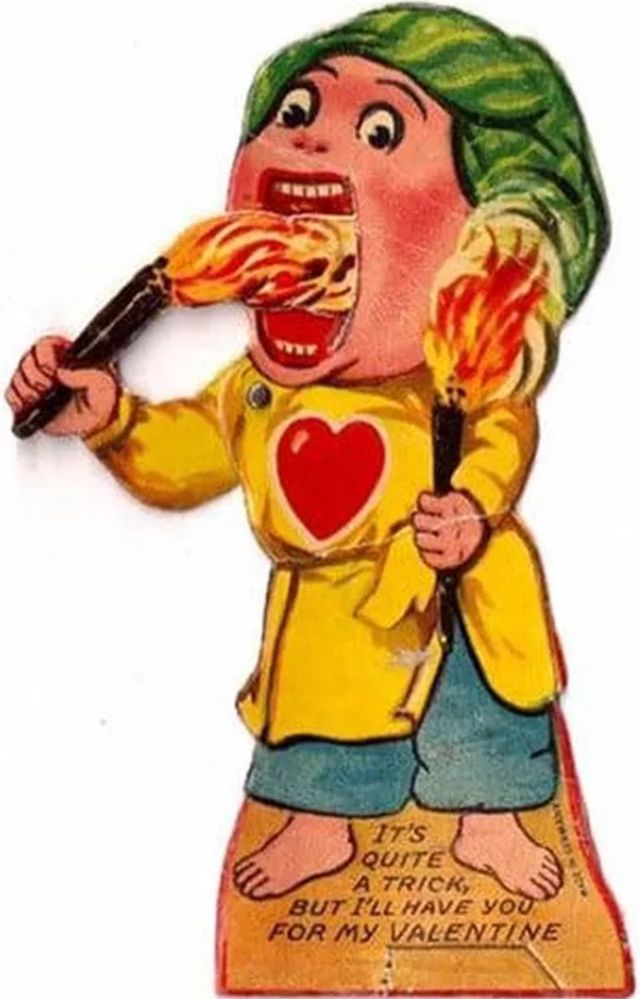
Here below is a set of humorous photos that shows Valentine’s Day cards in the late 19th and early 20th centuries.

Above All - I Want You for My Valentine!

A Valentine Reminder

Burning Love

Cupid's Don'ts

Cupid's Stolen My Heart Which He's Bringing to You

18 Adorable Vintage Cowboy-Themed Valentine’s Day Cards From the Early 20th Century

Valentine’s Day cards from the early 20th century were known for their intricate designs, romantic themes, and playful illustrations. Cowboy-themed cards were often colorful, playful, and filled with Western imagery. These cards typically featured illustrations of cowboys, cowgirls, horses, and desert landscapes, often paired with charming or humorous romantic messages.

Dressed in traditional Western attire—wide-brimmed hats, boots, bandanas, and chaps. Many were printed using lithography techniques, often in bright reds, yellows, and blues. Some cards were cut into unique shapes, such as a cowboy on horseback or a heart-shaped lasso.

Here’s a selection of 18 adorable and funny cowboy-themed Valentine’s Day cards from the early 20th century:


February 8, 2025

To My Valentine: George Willard Bonte’s Tuck Postcards From the Early 20th Century

George Willard Bonte found solace in the unusual. He was an author, artist, poet, cartoonist and political consultant. He was a native of Cincinnati, Ohio, and completed his education at the Cincinnati School of Technology before moving to New York City in 1900 to assume the position of assistant art editor at the New York Herald. After his first six years in New York he advanced to editor of the art department and held that position until 1920. During 1912 and 1913, Mr. Bonte served in a dual role by adding the responsibilities of Sunday editor to his weekly routine.

G. W. left the newspaper business for new opportunities at the end of 1920. He then worked at doing illustrations and promotional pieces in the motion picture industry until 1936, when he retired.

One of Mr. Bonte’s favorite pastimes was the creation of original comic art and cartooning. As early as 1908 Bonte signed contracts with the Raphael Tuck Company at their New York office and in 1911 and 1928 at their offices in London. Research is incomplete but two famously popular sets were produced at Tuck’s. One of which, GARDEN TRUCK, TO MY VALENTINE was checklisted by Stan Davidson and is presented here.

Few of Bonte’s Tuck postcards are signed, but in lieu of signatures Bonte often used a cat-like character with a heart-shaped face as his signature d’artiste.

George Willard Bonte died at his home on West 95th Street in New York City on March 13, 1946. He was 73.


February 9, 2024

Strange and Amusing Love Postcards From the Early 20th Century

For those interested in this strange but amusing art form, here are six postcard designs from the British publisher, Birn Brothers, Ltd., 67 Bunhill Row, London, England. The set, printed in Germany, may well be from a production era just prior to the First World War. The main characters on each card are the couple who are much enamored with one another and their umbrella. The artist has very cleverly set the man and woman behind the umbrella in a way that they form a silhouette within a rather ordinary “rainy-day” in London scene.

The brothers opened their business in 1905 in northeast London on Bunhill Row. From the 1860s the site had been an integral part of the warehouse district in which commodities from around the world were stored for sale and distribution. The Birn brothers operated printing presses on four floors until 1964, after which the neighborhood was transformed by luxury high-rise apartment houses that in essence redefined the area as residential.

Birn’s reputation evolved based on the high-quality paper used for their greeting cards and postcards. It was a larger operation than most. The cardstock is embossed and of medium-plus weight. The set here is a good example, although this set likely came from one of their Bavarian affiliates. Also in ordinary production, contrary to their reputation were thousands of cheap paper children’s books and young adult novels – the forerunners of what today are known as graphic novels and chapter books.


February 3, 2024

Fantasy Fruits and Vegetable Head Man Postcards by Bernhardt Wall From the Early 20th Century

In an old (50 years ago) issue of Postcard Collector the author of an article about Bernhardt Wall called him the “King of Postcards.” If the estimate that he did the artwork for more than five thousand postcards is true, it is a well-deserved title. Most collectors of artist-signed postcards know his name, but it may be fair to say that many collectors have no idea of the range of topics Wall illustrated.


One of the most adorable of his efforts is the circa 1910, 14-card set known as Wall’s Animated Fruits and Vegetables. The title on each card is based on a common popular expression, i.e., You’re the Apple of My Eye, that contains the name, or a homonym, (carrot or karat) of a fruit or vegetable within it. Most are cute, but some are far-fetched, since, to the best of this writer’s knowledge, it is not possible to “cabbage” someone or something. And, further more if you know how to “melon,” we would like to join you.

1. Apple


You Are the Apple of My Eye

The phrase the apple of one’s eye dates back at least to the ninth century, but it was probably used in conversation long before that time. Originally, the apple of one’s eye referred to the pupil of the human eye. People believed that the pupil was a round, solid object. In a time without proper eye care, sight was a precious commodity. It wasn’t long before the apple of one’s eye became a metaphor for something precious. This metaphor was used several times in the King James version of the Bible, as in Psalms: “Keep me as the apple of thine eye, hide me under the shadow of thy wings.”


2. Cabbage


I’d Like To Cabbage You Myself

Good luck!


3. Ears (Corn)


I’m all Ears, Tell Me All About It

Having one’s ear is meant to put someone at ease. Life is sometime troublesome and all that is needed to ease stressful situations is to have an opportunity to tell someone or cry on someone’s shoulder. I’m all ears is a statement of willingness to help.


4. Cucumber


I’m as Cool as a Cucumber but, My Heart is Warm

The phrase was first found in a poem by the British poet John Gay. In a 1732 anthology he wrote, New Song on New Similes. The phrase means to be very calm, without worries. It describes a person who is unaffected by pressure. One interesting fact about As Cool as a Cucumber; the meaning of the word “cool” in the phrase doesn’t mean having a low temperature, on the contrary, it means assured and composed.


5. Eyes (Potato)


I Have my Eyes on You

Having one’s eyes on someone can be an expression of admiration or a reminder that the watcher is being mindful of his duty to keep the other from harm or injury. It can also mean that someone is keeping watch to be able to imitate the actions of the person being watched – often used this way in the financial world.


February 1, 2024

The Oldest Surviving Valentine’s Day Letter in the English Language, 1477

This is probably the oldest surviving Valentine’s letter in the English language. It was written by Margery Brews to her fiancé John Paston in February 1477.


Describing John as her “right well-beloved valentine,” she tells him she is “not in good health of body nor of heart, nor shall I be till I hear from you.” She explains that her mother had tried to persuade her father to increase her dowry – so far unsuccessfully. However, she says, if John loves her he will marry her anyway: “But if you love me, as I trust verily that you do, you will not leave me therefore.” There was a happy ending to the story, as the couple would eventually marry.

The letter comes from one of the largest collections of 15th century English private correspondence, known as the Paston letters. The collection offers a unique glimpse in to the personal lives of the Paston family from Norfolk – the family name comes from a Norfolk village about twenty miles north of Norwich.

The Pastons had risen from peasantry to aristocracy in just a few generations: the first member of the family about whom anything is known was Clement Paston (d. 1419), a peasant, who gave an excellent education to his son William, enabling him to study law. John and Margery's son, William, would become a prominent figure at the court of King Henry VIII.

Transcript, in present day English:
Unto my right well-beloved Valentine John Paston, squire, be this bill delivered.

Right reverent and worshipful and my right well-beloved valentine, I recommend me unto you full heartedly, desiring to hear of your welfare, which I beseech Almighty God long for to preserve unto his pleasure and your hearts desire. And if it pleases you to hear of my welfare, I am not in good health of body nor of heart, nor shall I be till I hear from you. For there knows no creature what pain that I endure, And even on the pain of death I would reveal no more. And my lady my mother hath laboured the matter to my father full diligently, but she can no more get than you already know of, for which God knoweth I am full sorry. But if you love me, as I trust verily that you do, you will not leave me therefore. For even if you had not half the livelihood that you have, for to do the greatest labour that any woman alive might, I would not forsake you. And if you command me to keep me true wherever I go, indeed I will do all my might you to love and never anyone else. And if my friends say that I do amiss, they shall not stop me from doing so. My heart me bids evermore to love you truly over all earthly things. And if they be never so angry, I trust it shall be better in time coming. No more to you at this time, but the Holy Trinity have you in keeping. And I beseech you that this bill be not seen by any non earthly creature save only yourself. And this letter was written at Topcroft with full heavy heart.

Be your own Margery Brews.

February 14, 2023

The Oldest Known Surviving Valentine, a Poem Composed in Prison by Charles d’Orléans to His Wife in 1415

Born in 1394, Charles d’Orléans was a member of the French royal family, the grandson of King Charles V of France (r. 1364–1380) and nephew of King Charles VI (r. 1380-1422). He became Duke of Orléans at the age of fourteen after the assassination of his father. On 25 October 1415, Charles fought at the Battle of Agincourt when France was catastrophically defeated by England. The twenty-one-year-old was captured on the battlefield and brought back to England where he remained as a political prisoner for the next twenty-five years. He was finally released in 1440 and spent the last years of his life in France, dying in 1465.

Despite the political turmoil that surrounded his life, Charles is best remembered as a gifted writer of romantic, witty and sometimes wistful poetry. He wrote over 500 poems in the course of his life, with a particularly prolific period during his years of captivity. Charles wrote in both Middle French and Middle English, the latter of which he learned to speak fluently while in England.

Charles has been credited with writing the first Valentine card, in the form of a poem for his wife. Charles wrote the poem in 1415 at age 21, in the first year of his captivity while being held prisoner in the Tower of London after having been captured by the British at the Battle of Agincourt. The Battle of Agincourt forms the centerpiece of Shakespeare’s historical play Henry V, in which Charles appears as a character with a number of lines. At age 16, Charles had married the 11-year-old Bonne of Armagnac in a political alliance, which explains the age difference he mentions in his poem. Unfortunately, Charles would be held prisoner for a quarter century and would never see his wife again, as she died before he was released.

Beginning of Charles’ poem “Je suis desja d'amour tanné,” in a 15th-century copy of his personal manuscript.

Je suis desja d'amour tanné,
Ma tres doulce Valentinée,
Car pour moi fustes trop tart née,
Et moy pour vous fus trop tost né.
Dieu lui pardoint qui estrené
M'a de vous, pour toute l'année.
Je suis desja d'amour tanné,
Ma tres doulce Valentinée.

Bien m'estoye suspeconné,
Qu'auroye telle destinée,
Ains que passast ceste journée,
Combien qu'Amours l'eust ordonné.
Je suis desja d'amour tanné,
Ma tres doulce Valentinée.

(I am already sick of love,
My very gentle Valentine,
Since for me you were born too late,
And I for you was born too soon.
God forgives him who has estranged
Me from you for the whole year.
I am already sick of love,
My very gentle Valentine.

Well might I have suspected
That such a destiny,
Thus would have happened this day,
How much that Love would have commanded.
I am already sick of love,
My very gentle Valentine.)

February 7, 2023

20 Racist Vintage V-Day Cards From the Early 20th Century Will Make You Wish Valentine’s Day Never Existed

In the early 1900s, racist imagery was widely used in consumer products—even Valentine’s Day cards—and relied on caricatures and stereotypes to create humor.

Harvey Young, Jr., an Associate Professor at Northwestern gave a talk on racist V-Day ephemera and had this to say: “They capture in a material object the racial discourse occurring at the moment... You can really get a sense of how common and everyday and widely accepted these cards were. It gestures to this past moment when racism was more apparent in society.”


February 5, 2023

Lucky Swastikas on a Vintage Valentine’s Day Card

Prior to the 1930s, the swastika was a symbol present in several different cultures with some variance in meaning, appearing in Asia, Europe and North America. It was greatly popular in the 1900s and 1910s, in the U.S often found on New Year’s cards and postcards as well as other paper goods and assorted commercial items. It was used as a symbol by the 45th Infantry division of the United States Army.

There was flour sold under the Swastika brand as well as the symbol’s appearance on several product logos and labels. This changed when the Nazi party, who had adapted it as their own in 1920, rose to prominence in the 1930s. The symbol’s original meanings and past popularity still remain overwhelmed by this infamous association.

On Valentine cards, its presence is rare, even on cards produced at the height of its popularity. Here it appears on the card back, as an incidental symbol on the stickers used to adhere the ribbon to the cards.


February 2, 2023

Some Vintage Photographs of Marilyn Monroe Posing for Valentine’s Day

Marilyn Monroe was the ultimate sex symbol. With her platinum blonde locks, hourglass figure and famous beauty mark, she rose to fame as a actress, model and singer in the 1950s.

Unlike many stars in Hollywood today, Monroe possessed an alluring quality that left her image ingrained in the minds of people everywhere. It was moments like these that made her an icon and still give her relevancy today, even decades after her death.

Happy Valentine’s Day to all of you, Marilyn Monroe lovers!


February 14, 2022

“Votes for Women!” A Collection of 22 Vintage Suffrage-Themed Valentine’s Day Cards From the 1920s

February 14th isn’t just Valentine’s Day – it’s also League of Women Voters’ Day! The League was founded by suffragist Carrie Chapman Catt on February 14, 1920. Catt was instrumental in helping pass the 19th Amendment, which secured women the right to vote. Ever since, the League has been at the forefront of efforts to strengthen our democracy, including registering and educating voters.

Prior to passage of the 19th Amendment, suffragists used holidays like Valentine’s Day to promote the cause of “Votes for Women.” The National Woman Suffrage Association (NAWSA), the League’s predecessor, even created its own suffrage postcards!


FOLLOW US:
FacebookTumblrPinterestInstagram

CONTACT US


Browse by Decades

Popular Posts

Advertisement

09 10