Bring back some good or bad memories


ADVERTISEMENT
Showing posts with label Maryland. Show all posts

July 4, 2026

Soapbox Auto Race at July 4th Celebration at Salisbury, Maryland in 1940

The Soapbox Auto Race, often called a Soap Box Derby, is a youth racing program in the United States where children build and race unpowered, gravity-driven cars down a hill. These events are popular in the United States, ranging from local community races to major national championships.

The concept of soapbox racing originated in 1933 when Myron Scott, a photographer for the Dayton Daily News in Ohio, witnessed boys racing homemade cars down a hill. Inspired by the idea, he organized a larger, more formal race. The success of this event led to the establishment of the All-American Soap Box Derby in 1934, with Chevrolet as a national sponsor.

In 1935, the race moved to Akron, Ohio, due to its central location and hilly terrain. A permanent track, Derby Downs, was built in Akron in 1936 with the assistance of the Works Progress Administration (WPA), and it remains the site of the national championship today.

Over the years, the Soap Box Derby gained immense popularity, especially in the 1950s and 60s, drawing tens of thousands of spectators and attracting celebrities. While originally for boys, girls were first allowed to compete in 1971, and in 1975, Karen Stead became the first girl to win the All-American Soap Box Derby.

Below are some vintage photographs documented a soapbox auto race during July 4th celebration at Salisbury, Maryland in 1940:


December 5, 2023

Vintage Photographs of Women Testing Weapons During World War II at Aberdeen Proving Ground, Maryland

Maryland’s Aberdeen Proving Ground opened in 1917 and today is the military’s oldest weapons-testing facility in the United States. It’s a big operation. At its peak in World War II, Aberdeen had housing for more than 27,000, and today it still employs more then 12,000 people.

Through its first decades APG was a man’s world. But that changed during World War II. The soldiers who once worked the testing grounds but had been deployed overseas were at first replaced by male civilians. Then as the draft hit hard, the civilians began to disappear and in their place came thousands of women.

These women come from everywhere. Many have husbands in the Army. Others have husbands who also work at Aberdeen. They wear bright-colored slacks, and their “firing fronts” are a rippling blend of pink. blue and orange, mixed with white and black powder from the guns. They serve on crews of all weapons up to the 90-mm A.A.’s. [anti-aircraft guns]. They handle highly technical instruments. They drive trucks, act as bicycle messengers, swab and clean vehicles. A few of them have even been tested as tank drivers, but that work, with its physical bruises, is still a little too tough for them.


January 13, 2023

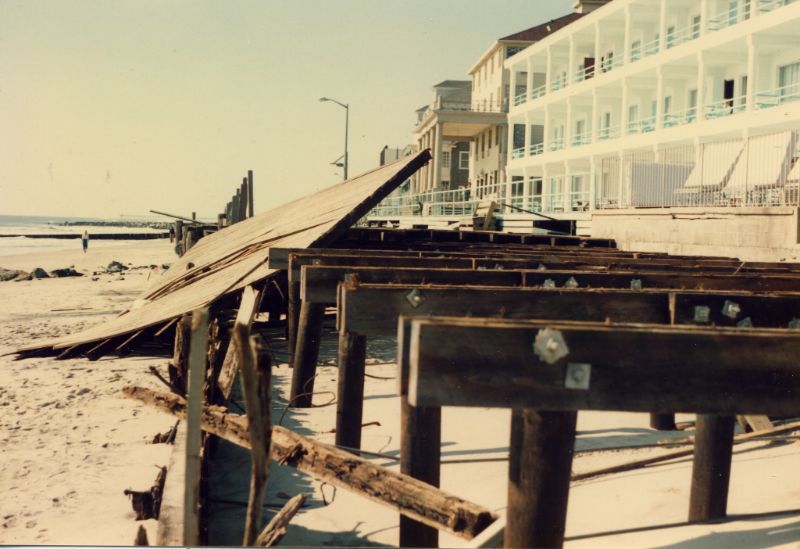
Photos of Ocean City After Hurricane Gloria in 1985

Hurricane Gloria was a powerful hurricane that caused significant damage along the east coast of the United States and in Atlantic Canada during the 1985 Atlantic hurricane season. It was the first significant tropical cyclone to strike the northeastern United States since Hurricane Agnes in 1972 and the first major storm to affect New York City and Long Island directly since Hurricane Donna in 1960.

Hurricane-force winds and gusts affected much of the path, which knocked down trees and power lines. This left over 4 million people without power, causing the worst power outage in Connecticut history related to a natural disaster. The extended power outage on Long Island, affecting 1.5 million people at some point, caused the Long Island Lighting Company to be shut down and be replaced with a public company. Fallen trees caused six of the storm’s fourteen deaths.

In North Carolina, high waves damaged many homes along the Outer Banks and caused heavy beach erosion. High waves also damaged piers, boats, and docks throughout the Mid-Atlantic states. Flooding forced several highways to close, and in Pennsylvania, thousands were forced to evacuate their homes. The storm surge destroyed 48 homes on Long Island, while the winds damaged the roofs of many more. Widespread crop damage occurred, amounting to about $20 million (1985 USD). Overall damage in the United States was estimated at $900 million.

These photos were taken by History Lover that show the aftermath of Hurricane Gloria in Ocean City, Maryland in 1985.


March 17, 2021

Vintage Photographs of St. Patrick’s Day Celebrations in Baltimore in the 1970s

The photos are in black and white, but be sure that everyone was in green. Here’s a selection of 12 vintage photographs from The Baltimore Sun’s archives that show what St. Patrick’s Day celebrations looked like in Baltimore in the 1970s.

Susie Cook pours a stiff dram of usquebaugh in Sweeney’s bar amid a crowd of St. Patrick’s Day revelers smiling with happy Irish eyes. March 18, 1970. (The Baltimore Sun)

…and comely lasses dance a jig in front of the Pratt. March 1973. (The Baltimore Sun)

March, 1976. (Pearson, The Baltimore Sun).

Don’t spill it: it’s precious. Forty out of breath sprinters tried to go 100 yards without spilling their beer from tray borne cups during the 8th annual Great Annapolis Beer Race, celebrating St. Patrick’s Day. The winner was David A. Woyeke, 29, an Annapolis hi-fi salesman, who said after his victory, “This is the first and last one.” March, 1976. (The Baltimore Sun)

One of the 43 units that took part in yesterday’s St. Patrick’s Day parade in a chilly breeze steps out briskly at Baltimore and Calvert streets. March 1976. (Pearson, The Baltimore Sun).

December 27, 2019

Rare and Amazing Photos Show Street Scenes of Maryland in the Early 20th Century

Maryland is a state in the Mid-Atlantic region of the United States, bordering Virginia, West Virginia, and the District of Columbia to its south and west; Pennsylvania to its north; and Delaware to its east. The state's largest city is Baltimore, and its capital is Annapolis.

Among its occasional nicknames are Old Line State, the Free State, and the Chesapeake Bay State. It is named after the English queen Henrietta Maria, known in England as Queen Mary, who was the wife of King Charles I.

Sixteen of Maryland's twenty-three counties, as well as the city of Baltimore, border the tidal waters of the Chesapeake Bay estuary and its many tributaries, which combined total more than 4,000 miles of shoreline.

Although one of the smallest states in the U.S., it features a variety of climates and topographical features that have earned it the moniker of America in Miniature. In a similar vein, Maryland's geography, culture, and history combine elements of the Mid-Atlantic, Northeastern, and South Atlantic regions of the country.

These amazing photos from Ann Longmore-Etheridge that captured street scenes of Maryland in the 1900s and 1910s.

Firefighters, Frederick, Maryland, circa 1900

Bittle Farm, Myersville, Maryland, circa 1900

Bittle Farm, Myersville, Maryland, circa 1900

Braddock Springs, Braddock Heights, Maryland, circa 1900

Dairy Truck of C. W. Martz, Frederick, Maryland, circa 1900

June 3, 2018

The Prince George’s County Memorial Library Bookmobile in Woodmore, Maryland, 1951

In the early 1900s, a librarian could purchase a bookmobile for as little as $1,000. By the late 1930s, there were as many as 60 bookmobiles nationwide. The Great Depression and two World Wars then sharply curtailed services and bookmobile production around the country.

During the boom years of the 1950s, bookmobile production resurged. Many credit the Library Services Act of 1956 for expanding bookmobile services to reach more than 30 million people in smaller rural communities.

Here's some interesting vintage photos of the Prince George’s County Memorial Library bookmobile in Woodmore, Maryland on July 18, 1951.


December 29, 2017

Fascinating Black and White Photos That Capture Street Scenes of Baltimore in the Early 1970s

These impressive black and white photos from ubarchives that captured street scenes of Baltimore, Maryland from 1971 to 1974. They were taken by Robert Breck Chapman who began his career in photography working for Baltimore's Model Cities, going on to work for the City's Urban Services Agency, Housing and Community Development, and as the unofficial photographer of Mayor Kurt Schmoke.


June 2, 2016

October 8, 2015

27 Historical Photographs From the Great Baltimore Fire in 1904

The Great Baltimore Fire raged in Baltimore, Maryland, United States, on Sunday, February 7, and Monday, February 8, 1904. It destroyed much of central Baltimore, including over 1,500 buildings covering an area of some 140 acres (57 ha).  It is considered historically the third worst conflagration in an American city, surpassed only by the Great Chicago Fire of 1871, and the San Francisco Earthquake and Fire of 1906.

In the aftermath, 35,000 people were left unemployed. Over $150 million (in 1904 USD) worth of damage was done, which is approximately $3.84 billion in 2014 dollars. Immediately after the fire, The Baltimore News quoted Mayor Robert McLane: “To suppose that the spirit of our people will not rise to the occasion is to suppose that our people are not genuine Americans. We shall make the fire of 1904 a landmark not of decline but of progress.” McLane then refused assistance, “As head of this municipality, I cannot help but feel gratified by the sympathy and the offers of practical assistance which have been tendered to us. To them I have in general terms replied, ‘Baltimore will take care of its own, thank you.’”

Two years later, on September 10, 1906, The Sun reported that the city had risen from the ashes and that “One of the great disasters of modern time had been converted into a blessing.”

Here are some vintage photographs of this terrible fire:

Alexander Brown and Sons Building, Looking south-east from Calvert Building

During the fire

Anderson and Ireland Hardware Store

Baltimore St. W of St. Pau after the great fire

Baltimore Street between Calvert Street and Guilford Street in ruins after Great Fire of 1904

March 9, 2015

Pictures of Women Testing New Machine Guns at the Aberdeen Proving Ground in 1942

Workers at the Aberdeen Proving Ground in Maryland testing machine guns, 20mm aircraft caynon, sighting on a Bofors AA gun, and a prototype carbine from June, 1942 until December, 1942.

Woman firing a machine gun at Aberdeen Proving Ground.

Loading shells for Bofors Anti-Aircraft guns.

Testing a 30 cal. machine gun at Aberdeen Proving Ground.

Women firing machine guns at Aberdeen Proving Ground.

Women firing machine guns at Aberdeen Proving Ground.


FOLLOW US:
FacebookTumblrPinterestInstagram

CONTACT US


Browse by Decades

Popular Posts

Advertisement

09 10