Bring back some good or bad memories


ADVERTISEMENT
Showing posts with label LGBT. Show all posts

August 24, 2026

The Last Photos of Felice Schragenheim and Lilly Wust Together; Hours Later, Felice Was Captured by the Gestapo!

Felice Schragenheim and Lilly Wust, photographed by the Havel river on August 21, 1944, laughing, embracing, using a timer to photograph themselves in the sun. Hours later they went home and found the Gestapo waiting. These are the last photos ever taken of them together.


Felice Schragenheim (nicknamed “Jaguar”) and Elisabeth “Lilly” Wust (nicknamed “Aimée”) shared a passionate, high-risk lesbian relationship in Nazi Berlin during World War II. Their story is documented through surviving letters, poems, photos, diaries, and Lilly’s later recollections; it formed the basis of Erica Fischer’s 1994 book Aimée & Jaguar and the 1999 German film of the same name.

In November 1942, the two women were introduced at a café in Berlin. On the surface, they belonged to completely different, violently opposed worlds. Elisabeth Wust was a 29-year-old German woman, married to a Wehrmacht soldier who was away at the front. She was the mother of four sons and a recipient of the Nazi “Mother’s Cross,” living a relatively privileged life as an exemplar of Nazi womanhood. Felice Schragenheim was a 20-year-old Jewish woman living in hiding. After her grandmother was deported, Felice assumed a fake identity (“Felice Schrader”) and actively worked with the Jewish underground resistance. She even managed to get a job working at a Nazi-run newspaper to maintain her cover.

Felice, fascinated by the danger and drawn to Lilly, took the initiative to woo her. The two began a passionate secret relationship, communicating through a flurry of love letters and poems. In their writings, they adopted the pet names that would later make their story famous: Felice became “Jaguar” and Lilly was “Aimée” (French for “beloved”).

As their relationship deepened, the stakes grew impossibly high. When Felice finally revealed her true identity as a Jewish resistance worker, Lilly did not turn her in. Instead, she vowed to protect her. Lilly filed for divorce from her husband, and in May 1943, Felice moved into Lilly’s home, ostensibly acting as a caretaker for Lilly’s children.

In June 1943, the couple drafted their own marriage contract, and a few months later, they exchanged rings, an extraordinary act of commitment and queer defiance in the heart of the Third Reich.

Lilly’s “books of tears”: Berlin, August 21, 1944 – February 28, 1945. This is the first of a total of four diaries by Lilly Wust, which she began on the day Felice was transported away, August 21, 1944. It is written in the green ink that Felice used for her letters and poems.


Marriage contract between Elisabeth Wust and Felice Schragenheim, Berlin June 26, 1943.

June 26, 2025

The Enduring Love Story of Alice B. Toklas and Gertrude Stein

The love story of Alice B. Toklas and Gertrude Stein is one of the most enduring and influential partnerships in literary and artistic history. Their relationship spanned nearly four decades, from their meeting in Paris in 1907 until Stein’s death in 1946.


Alice B. Toklas arrived in Paris on September 8, 1907, and on her very first day, she met Gertrude Stein. The connection was immediate and profound. Toklas later described Stein as a “golden brown presence,” her voice “deep, full, velvety like a great contralto’s, like two voices.” They fell instantly in love and remained inseparable.

Their home at 27 rue de Fleurus became the legendary salon of the Parisian avant-garde. It was a hub where leading figures of modernism in literature and art, such as Pablo Picasso, Henri Matisse, Ernest Hemingway, F. Scott Fitzgerald, and many others, gathered for conversation, intellectual exchange, and to view Stein and her brother Leo's impressive art collection.

While Gertrude Stein was the renowned writer and public figure, Alice B. Toklas was the indispensable partner behind the scenes. Toklas acted as Stein's confidante, lover, cook, secretary, typist, editor, and muse. She meticulously managed their household, typed Stein’s manuscripts, and provided the domestic tranquility that allowed Stein to focus on her groundbreaking work. Their affection was evident in the notes they left for each other around the house, signed “DD” (Darling Darling) and “YD” (Your Darling), and their nicknames “Lovey” and “Baby.”

In 1933, Stein published her most commercially successful work, The Autobiography of Alice B. Toklas. This unique book was written by Stein but narrated in Toklas’s voice, offering a witty and insightful account of their shared life and the vibrant artistic circles they inhabited. The book brought international recognition to both women.

Their bond remained strong through significant historical events, including both World Wars. During World War I, they volunteered to deliver hospital supplies for the American Fund for French Wounded, driving across France in a Ford they affectionately named “Auntie.” They also survived the German occupation of Paris during World War II, a testament to their resilience and the protection afforded by their connections.

Their nearly four-decade-long partnership ended with Gertrude Stein’s death in 1946 from stomach cancer. According to Toklas, Stein’s final words were, “What is the answer?” and then, when no reply came, “In that case, what is the question?” After Stein’s death, Toklas continued to live in their shared home and dedicated herself to preserving and promoting Stein’s literary legacy. Toklas also became a published author in her own right, most famously with The Alice B. Toklas Cook Book (1954), which notably included a recipe for hashish fudge.

In the 1980s, a cabinet in the Yale University Beinecke Library, which had been locked for an indeterminate number of years, was opened and found to contain some 300 love letters written by Stein and Toklas. They were made public for the first time, revealing intimate details of their relationship. Stein’s endearment for Toklas was “Baby Precious,” in turn Stein was for Toklas, “Mr. Cuddle-Wuddle.”


December 1, 2024

Funny Photos of the Dolly Parton “Look Alike” Contest at the Annual Cherry Grove Fair, 1978

The Dolly Parton “look alike” contest in 1978 was part of the annual Cherry Grove Fair. Community events like this give Cherry Grove its unique history. Cherry Grove, located on Fire Island, New York, has long been known for its vibrant LGBTQ+ culture and festive gatherings.

Dolly Parton is an American singer, songwriter, multi-instrumentalist, record producer, actress, author, business-woman, and philanthropist, known primarily for her work in country music. The contest was held in front of the Monster where the volleyball tournament happens. In a simpler time a homespun event like this brought community together for fun and laughter.

Participants would have dressed up in Dolly’s iconic style — big blonde wigs, rhinestone-studded outfits, and exaggerated makeup. Contestants might have also performed Dolly’s famous songs like “Jolene” or “9 to 5,” showcasing their charisma and paying homage to the country music legend. Entrants included Drag Queen Terri Warren; eighteen contestants including one female took part, and fun was had by all.


June 29, 2024

Historical Pictures From the First Pride Marches in 1970

On June 28, 1970, on the one year anniversary of the Stonewall Uprising, the first Pride marches were held in New York, Los Angeles and Chicago. Thousands of LGBT+ people gathered to commemorate Stonewall and demonstrate for equal rights. The events of Stonewall and the liberation movements that followed were a direct result of prior decades of LGBT+ activism and organizing. In particular, Pride traditions were adapted from the “Reminder Day Pickets” held annually (1965-1969) on July 4 at Independence Hall in Philadelphia, Pennsylvania.

But in 1969, July 4 came just a week after the New York City police arrested patrons inside New York City’s Stonewall Inn. The Reminder march bore the first sign of splintering as some marchers didn't dress according to the code. They didn’t walk together; they held hands with their partners, outraging group leaders. In the wake of Stonewall, a more radical energy was spreading across the country.

One year later, in 1970, activists like Brenda Howard brainstormed an alternative set of marches that would embrace the new ethos of gay liberation. Their solution was Christopher Street Liberation Day—a celebration that commemorated the anniversary of Stonewall every June 28. Planning documents for the march, according to Katherine McFarland Bruce’s book Pride Parades, emphasized that, unlike at the Reminder marches, “no dress or age regulations shall be made for this demonstration.” These marches would also be national in scope—in a foreshadowing of Pride celebrations today, they wanted “a nationwide show of support” for gay rights.

The new tactics proved a success. During the first Christopher Liberation Day in 1970, so many marchers showed up that the New York iteration stretched for 15 blocks according to a contemporaneous report from The New York Times. Chicago and San Francisco held liberation marches of their own—as did Los Angeles, where activists only received the right to gather after the ACLU fought against a last-ditch attempt by the city to block the parade.

This first generation of Pride marches were more inclusive than any before. Participants donned big wigs and kissed their partners. Whereas transgender people were excluded from the Reminder marches, the Street Transvestites Action Revolutionaries (STAR), an early transgender organization launched by Stonewall protestors Sylvia Rivera and Marsha P. Johnson, formed a significant contingent on Christopher Street Liberation Day. A new era had begun.


June 8, 2024

Dr. John Fryer, aka “Dr. Henry Anonymous” During the 1972 Convention of the American Psychiatric Association in Dallas

In 1972, Dr. John Fryer risked his career to tell his colleagues that gay people were not mentally ill. His act sent ripples through the legal, medical, and justice systems.

Barbara Gittings, Frank Kameny, and Dr. John Fryer (Dr. H. Anonymous) at the American Psychiatric Association’s 1972 national convention in Dallas. (Photo by Kay Tobin Lahusen, via New York Public Library)

On the second day of the annual convention of the American Psychiatric Association in 1972, something extraordinary happened.

While the assembled psychiatrists, mostly white men in dark suits, settled into rows of chairs in the Danish Room at the Adolphus Hotel in Dallas, a disguised figure had been smuggled through the back corridors. At the last minute, he stepped through a side curtain and took his place at the front of the room.

There was an intake of breath in the audience. The man’s appearance was grotesque. His face was covered by a rubber Nixon mask, and he was wearing a garish, oversized tuxedo and a curly fright wig. But the outlandishness of his outfit diminished in importance once he began to speak.

“I am a homosexual,” he began. “I am a psychiatrist.”

For the next 10 minutes, Henry Anonymous, M.D. — this is what he had asked to be called — described the secret world of gay psychiatrists. Officially, they did not exist; homosexuality was categorized as a mental illness, so acknowledging it would result in the revocation of one’s medical license, and the loss of a career. In 42 states, sodomy was a crime.

Dr. John E. Fryer is credited with paving the way for the American Psychiatric Association to remove homosexuality from its list of mental disorders.

The reality was that there were plenty of gay people in the A.P.A., psychiatry’s most influential professional body, the masked doctor explained. But they lived in hiding, concealing every trace of their private life from their colleagues.

“All of us have something to lose,” he said. “We may not be under consideration for a professorship; the analyst down the street may stop referring us his overflow; our supervisor may ask us to take a leave of absence.”

This was the trade-off that had formed the basis of the masked man’s life. But the cost was too high. That’s what he had come to tell them.

“We are taking an even bigger risk, however, in not living fully our humanity,” he said. “This is the greatest loss, our honest humanity.”

He took his seat to a standing ovation.

April 14, 2024

Police Photograph of Geraldine Portica, Arrested for Violating Cross-Dressing Law in 1917

The caption on original photograph, from the scrapbooks of San Francisco Police Chief Jesse Cook, reads: “This is not a girl, but a boy, who was reared by his mother as a girl and has always dressed as a girl and went to school as a girl and has never associated with anyone else but girls and was employed as a chambermaid on 6th St. when arrested, he is a native of Mexico and speaks several languages, his English with the Spanish accent, he is now waiting to be deported to Mexico by the U.S. Gov. Dec. 27th, 1917.”

The 1917 photo of Geraldine Portica following her arrest.

Geraldine was arrested for the crime of female impersonation, the notion that it goes against God and nature to display yourself as something that your not, the notion of racial passing was at real concern to conservative Americans. They were alarmed at the thought that there would be people among them who would behave white but had mixed race heritage. The notion of pretending to be something you’re not was seen as undermining American values.

She shows that at exactly the same time that arrests for female impersonation were high (especially among the west coast). There is an interesting culture development in theatre that men dressing as women on stage becomes a highlight in economy. Theatrical cross dressing was acceptable because it was safe. It was confined on stage, people can laugh at it. Cross dressing in public was seen as unacceptable because it isn’t easy to control or understand who they are/ what is going on- difficult to identify what a real woman was. 1866 onwards cross dressing is criminalized.

April 13, 2024

Intimate Portraits of Trans and Cross-Dressing Sex Workers in Santiago, Chile in the 1980s

Paz Errázuriz (born 1944) is a Chilean photographer. She documented marginalized communities such as sex workers, psychiatric patients, and circus performers during the military dictatorship of Chile. Errázuriz has said about her work: “They are topics that society doesn’t look at, and my intention is to encourage people to dare to look.”

She was a teacher at a primary school when Augusto Pinochet overtook Chile’s Presidential Palace in 1973, inspiring her to begin her photography career. She is the co-founder of the Association of Independent Photographers (AFI). Originally titled the “Asociación de Fotógrafos Independientes,” she helped create the AFI in 1981 to make it easier for artists in Chile to find legal support and organize group art shows.

Errázuriz is also a collaborator for the magazine Apsi and of diverse press agencies. She is known for her work in marginalized communities. Errázuriz goes on to say about her work: “...what I photograph has to do with people who are not at the center, who stand outside and have always been subordinated to power.”

Errázuriz began her career in the 1970s, and ever since she has been a voice for subordinate groups in society, more specifically, in Chile. She was a primary school teacher at the time when she started her photography, and was slowly taking pictures “under the radar.”


March 9, 2024

Vintage Photographs Capture Everyday Life of the Rootworks Lesbian Commune in the 1970s

Ruth Mountaingrove (1923–2016) was a photographer, writer, poet, and artist who moved to Oregon in 1971. She joined the community of Mountain Grove, a lesbian commune where she lived for two years with her partner, Jean. She eventually co-founded Rootworks, a lesbian land in Southern Oregon. At Rootworks, Ruth and others led photography workshops aimed at empowering women through art. Photos were a way for these women to examine the differences between the way men pictures women and the way women saw themselves.

The land was used as a safe, creative, intentional space for women to host events, from retreats to spiritual festivals, a place for women to learn new and useful skills, a refuge from daily patriarchal oppression, and a space for building connections with other women and nature, with an emphasis on personal growth.

Materially, these lands went without amenities, including electricity, bathrooms, running water, and heating. Women on the land struggled with fighting their personal battles with sexual, physical, and emotional violence, internalized misogyny, and finding their own identities, while attempting to create an oppression-free space. This led to endless conversations on racism, sexism, and homophobia, as well as the necessity of navigating a community forum in which all issues could be honestly, openly, and equitably discussed. Through communes like Rootworks, women were able to lead a rural and safe life among like-minded women.


February 3, 2024

Here is F. Scott Fitzgerald, Author of “The Great Gatsby,” in Drag, ca. 1916

These photographs were taken in 1916 and depict F. Scott Fitzgerald dressed in drag to promote his college musical-comedy troupe’s performance of The Evil Eye at the Princeton Triangle Club. The young Great Gatsby author was in his third year at Princeton University and The New York Times on January 2, 1916 reviewed his performance positively— calling him “the most beautiful girl” in the production.

Fitzgerald posing for publicity photos for The Evil Eye, a musical he wrote in 1916 for the Princeton Triangle Club.

Fitzgerald had dropped out of Princeton to serve in the army—but he never actually saw combat. Soon after the U.S. entered the war in April 1917 he signed up for three weeks of military training and took the officer’s exam. He returned to school in September but soon received a commission as second lieutenant in the infantry and reported for training to Fort Leavenworth, Kansas, in November. (The captain in charge of his training platoon was Dwight D. Eisenhower.)

During 1918 he was stationed at Camp Zachary Taylor, near Louisville, transferred to Camp Gordon in Georgia, and then to Camp Sheridan in Alabama. When the war ended on November 11, Fitzgerald’s regiment was still waiting to embark for France. He was discharged from the army in February 1919.

December 27, 2023

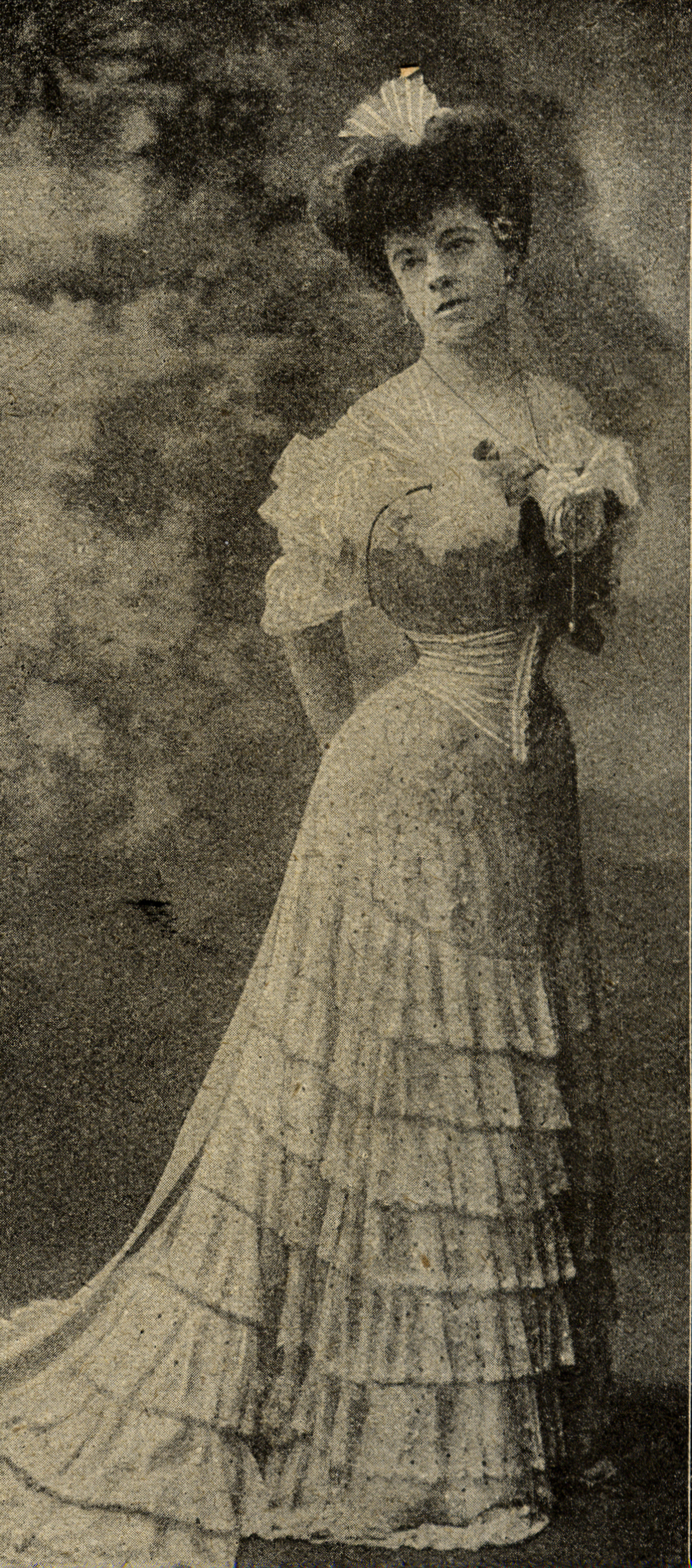
A Sailor in Drag, Wearing a Milkmaid Costume, 1906

The man in drag is apparently Able Seaman Arthur Roach, a crew member of the H.M.S. Prince of Wales. He poses as a milkmaid behind a wooden fence and in front of a painted background. He is wearing a rather odd hybrid fancy-dress outfit, part showgirl/courtesan (ruffles and jewelry), part little girl at the seaside (very short skirt, bucket and spade).

(Photographic postcard by H.J. Bond, 1906)

September 4, 2023

The Tragic Story of Dina Alma de Paradeda, the First Brazilian Trans Woman to Gain Fame in Europe

Dina Alma de Paradeda, usually known simply as Alma de Paradeda (1871–1906), was a Brazilian socialite, known for the circumstances of her death (poisoning herself in front of a doctor, who, after examining the body, revealed she was assigned male at birth) and subsequent media interest in the story; the numerous testimonies of it made her one of the first documented and known by name transgender women either of South American origin or living in Central-Eastern Europe.


Alma de Paradeda was born in 1871 as Alfred (or Alfredo) H., to a Brazilian woman, and probably a Spanish consul, and a count from Rio de Janeiro, and had at least one brother. After her father’s death, her mother remarried, this time to an affluent German doctor who lived in Brazil.

Between 1899 and 1900, de Paradeda was already a prominent figure of Berlin urning balls. During one of them in 1903, she met Magnus Hirschfeld, who later described the meeting several times in his writings. He mentioned her wearing a Parisian red silk evening dress, with laces worth more than 2000 franks.

de Paradeda frequented the local that Hirschfeld visited and was raising the interest of the local social circles, so Hirschfeld started the conversation with her. de Paradeda was described as a woman of many talents, including piano playing, cooking, and handcrafts such as hat decoration. She was also supposed to be a good conversationalist who stoked interest with her stories from Brazil or Paris, dispelling any initial doubt or distrust caused by her height or low voice. Many sources refer to her tall but very slender figure and her elegance in expensive fashion and accessories.


Shortly after meeting Hirschfeld, de Paradeda traveled to Paris, where she was known as Comtesse de Paradeda, and surrounded herself with material goods, servants and invited people to her refined apartment. Somewhere in Paris she met a ‘modest’ (as described by Hirschfeld) German teacher named Edgar Töpfer, who came there to study French. On October 28, 1906, de Paradeda left Paris and moved to Breslau as Töpfer’s fiancée, meeting his friends and family and renting a new apartment. She was friendly with the landlord, who let her repaint the apartment and remodel it, and was called “Aunt Didi” by the landlord’s daughter.

Despite everyday visits from her fiancé, de Paradeda was very jealous of him and his friends, who distrusted and questioned her. Their private investigation of de Paradeda’s past found her stepfather, recently returned from Brazil to Germany, and that he had a stepson named Alfred, but not a stepdaughter named Alma. de Paradeda threatened Töpfer with death in case of breaking the engagement. After finally breaking the engagement, he denounced his ex-fiancée to the police (one insight claims that the denouncement happened only after de Paradeda attempted to break into his apartment). When the commissioner of criminal police arrived at de Paradeda’s apartment, the countess remained calm and serious, giving the police officer no reason to intervene. Nevertheless, de Paradeda was distraught by the intervention enough to call her trusted doctor (who was indisposed and sent an assistant). de Paradeda refused the assistant’s order to undress and undergo a medical examination. On his insistence, she asked for a moment for herself and disappeared for a moment in another room. After a few minutes she came back, sat down in front of the doctor and, having already announced her readiness to be examined, suddenly fell on the ground, and within a minute, she was dying in violent convulsions. The commissioner who previously visited the apartment found a stale body and a completely confused physician, who examined the body, revealing it was physically male.

The story of a “male bride from Breslau” was published in newspapers worldwide, including the German language Indiana Tribüne in the USA and Poverty Bay Herald in New Zealand. Two books inspired by the countess’ story were written: Mein Zimmerherr by Marie Römer, who claimed to be the landlord and to tell the true story, and the fictionalized, loosely inspired by the real events Tagebuch einer männlichen Braut (Diary of a male bride). Röhmer’s book resembles newspaper articles in fragments, which makes her claims to be the landlord debatable.

April 1, 2023

Len and Cub: A Hidden Relationship Brought Into the Light Through Early 20th Century Photographs

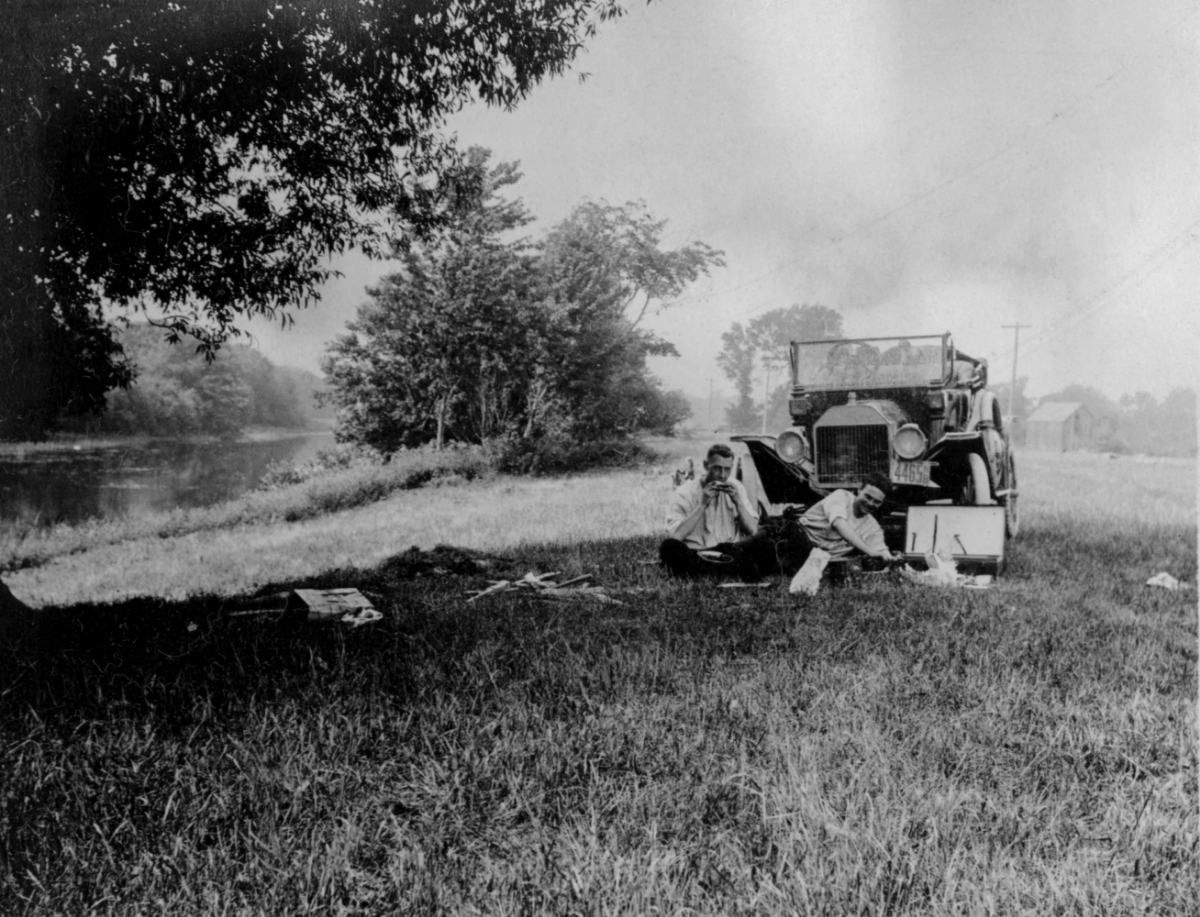
Leonard “Len” Keith and Joseph “Cub” Coates fell for each other in early 20th-century New Brunswick, at a time and place where queer relationships were taboo. Their story was almost lost forever—until a collection of tender photographs brought their romance into the light.


Len was born in 1891, and Cub was born 8 years later. They grew up in the rural New Brunswick village of Havelock in the early 20th century. The two were neighbors, and they clearly developed an inseparable relationship. Len was an amateur photographer and automobile enthusiast who went on to own a local garage and poolhall after serving in the First World War. Cub was the son of a farmer, also a veteran of the First World War, a butcher, contractor, and lover of horses.

Their time together is catalogued by Len’s photos, which show that the two shared a mutual love of the outdoors, animals, and adventure. Photographs of Len and Cub on hunting and canoe trips with arms around each other’s shoulders or in bed together make clear the affection they held for each other. Their story is one of the oldest photographic records of a same-sex couple in the Maritimes.

Unfortunately, these adventures would cease when Len was outed as a homosexual by community members in the early 1930s and forced to leave Havelock. Cub, however, remained seemingly untainted by scandal and stayed in Havelock until 1940, when he married Rita Cameron, a nurse born in Chatham, and relocated to Moncton after the Second World War. He would go on to become a prominent figure in New Brunswick’s harness racing circles before his death in 1965. Len never returned to Havelock, residing near Montreal before succumbing to cancer in 1950.

The photos were donated to the Provincial Archives of New Brunswick decades after his death by Havelock resident and local historian, John Corey, who had purchased the albums at the Keith family’s estate sale in 1984. Growing up, John heard stories of Len and Cub from his father, Roy Manford Corey, who had been a classmate of Len’s. When John donated the albums [to the Provincial Archives of New Brunswick] in 2011, he described the pair as “boyfriends”—a term noted by the archivist in the collection’s finding aid. The archivist also noted, after a conversation with John, that Len had been “driven out of town for being a homosexual” by a group of Havelock men. This anecdote is written on an envelope containing a photo of one of the men responsible for Len’s outing.

Len’s photos of their life and tells the story of their relationship against the background of same-sex identity and relationships in rural North America of the early 20th century. Although Len was outed and forced to leave Havelock in the 1930s, the story of Len and Cub is one of love and friendship that challenges contemporary ideas about sex and gender expression in the early 20th century.


August 22, 2022

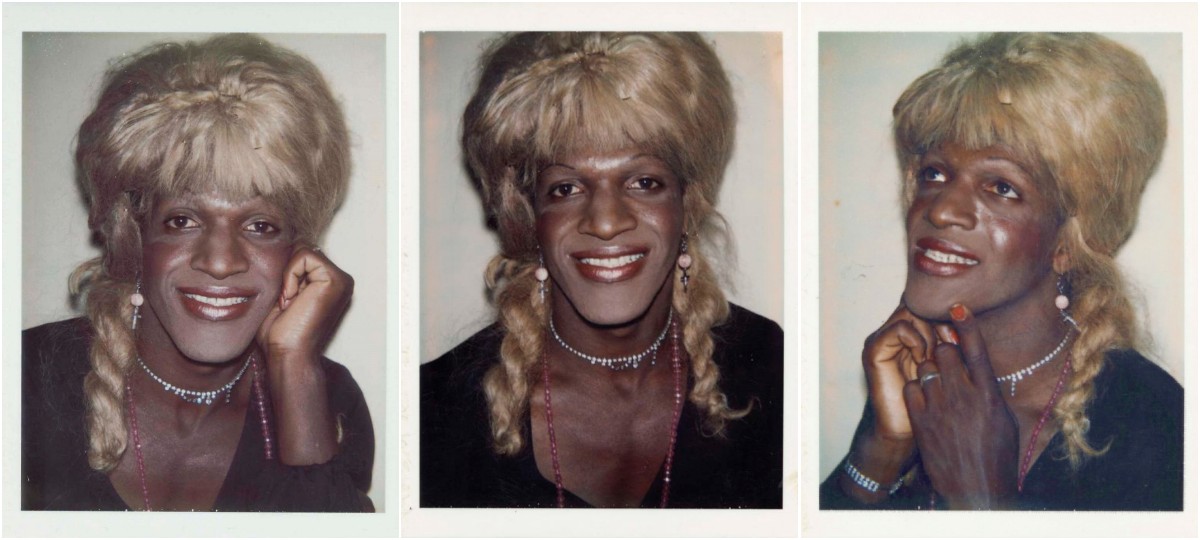
Polaroids of Marsha P. Johnson Taken by Andy Warhol, 1974

These Polaroid portraits of Marsha P. Johnson by Andy Warhol derive from his series Ladies and Gentlemen, which focuses on drag queens and trans women, primarily of color. At the time (and still today), transgender communities were at severe risk of various forms of discrimination, poverty, and violence. Significantly, when Warhol’s series was first shown, he did not identify his subjects by their names, effectively objectifying them as “other.”


As a trans star, Marsha experienced “so much violence-from the police, the outside world, and often from lesbian and gay activists and artists.” She first came to Warhol’s studio space, the Factory—then located on Union Square—at his invitation in the summer of 1974.

Working on commission for Luciano Anselmino, an art dealer based in Turin, from Warhol made 105 paintings in four sizes depicting trans women. Marsha did not attract much of Warhol’s attention: in Ladies and Gentlemen, “a mere two canvases out of the hundreds [sic] Warhol produced” are portraits of her. Neil Printz, the editor of Warhol’s catalogue raisonné, wrote that the artist may have felt that “she was not charismatic enough as a model.”

Andy Warhol photographing Marsha P. Johnson with a Polaroid camera.

Despite Warhol’s evident indifference, Marsha’s glamour and generosity of spirit clearly shine through in his portrait of her. In 1970, she joined her friend, the trans activist Silvia Rivera, in founding Street Transvestite Action Revolutionaries (STAR) to fight for the rights of transgender and queer youth. She was also an HIV-positive organizer with ACT UP, and an important figure in the Stonewall Riots. That same year, she helped organize the first-ever Gay Pride March. Throughout her life, Marsha pushed for greater visibility and acceptance of the trans community, inspiring the generation of activists who came after her.


FOLLOW US:
Facebook • Tumblr • Pinterest • Instagram

CONTACT US


Browse by Decades

Popular Posts

Advertisement

09 10