Bring back some good or bad memories


ADVERTISEMENT
Showing posts with label Cuba. Show all posts

July 2, 2025

Beautiful Photos of Life in Rural Cuba in the Mid-1950s

In the mid-1950s, life in rural Cuba was marked by simplicity, hard work, and deep ties to the land. Most countryside residents were farmers or agricultural laborers, working on sugarcane, tobacco, or coffee plantations—industries that dominated the Cuban economy.

Despite the island’s glamorous image in Havana, rural areas often lacked access to electricity, healthcare, and education. Many families lived in modest wooden homes, relying on traditional farming methods and close-knit community life. Daily routines were shaped by the seasons, harvest cycles, and local customs.

While rural Cuba was rich in culture and resilience, poverty and inequality were widespread, contributing to the social tensions that helped fuel the Cuban Revolution just a few years later. These beautiful photos by Orpha Leatherman offer a rare glimpse into rural Cuban life in the mid-1950s.

Boy and woman drawing water from well, Cuba, circa mid-1950s

Children and pigs, Cuba, circa mid-1950s

Cuban children seated outdoors, Cuba, circa mid-1950s

A typical Cuban school, Cuba, circa mid-1950s

Caritas in Rancho Veloz, Cuba, circa mid-1950s

October 22, 2022

Just Before the Cuban Revolution, These Vintage Photos Show What Life of Cuba Looked Like in 1950

The Cuban Revolution was an armed revolt conducted by Fidel Castro and his fellow revolutionaries of the 26th of July Movement and its allies against the military dictatorship of Cuban President Fulgencio Batista. The revolution began in July 1953, and continued sporadically until the rebels finally ousted Batista on 31 December 1958, replacing his government.

26 July 1953 is celebrated in Cuba as Día de la Revolución. The 26th of July Movement later reformed along Marxist–Leninist lines, becoming the Communist Party of Cuba in October 1965.

Just before Just before the Cuban Revolution, these fascinating photos were found by Norman Gates that show what life of Cuba looked like in 1950.

Big red American car, Cuba, 1950

A store in Cuba, they were still using horses for transport in 1950

A Cuban farm, 1950

A village in Cuba with tile roofs, 1950

Baez station, Cuba, 1950

June 2, 2022

Fascinating Photos of Cuba in the Mid-1980s

By the 1980s, Cuba’s economy was again in trouble, following a decline in the market price of sugar and 1979’s decimated harvest. Desperate for money, Cuba’s government secretly sold off paintings from national collections and illicitly traded for U.S. electronic goods through Panama.

Increasing numbers of Cubans fled to Florida, who were labelled “scum” by Fidel Castro. In one incident, 10,000 Cubans stormed the Peruvian Embassy requesting asylum, and so the U.S. agreed that it would accept 3,500 refugees. Castro conceded that those who wanted to leave could do so from Mariel port. Hundreds of boats arrived from the U.S., leading to a mass exodus of 120,000; Castro’s government took advantage of the situation by loading criminals and the mentally ill onto the boats destined for Florida.

In 1980, Ronald Reagan became U.S. president and then pursued a hard line anti-Castro approach. These fascinating photos were taken by Javier Gallego that show street scenes of Cuba in 1985.

Havana. Plaza de la Revolución, 1985

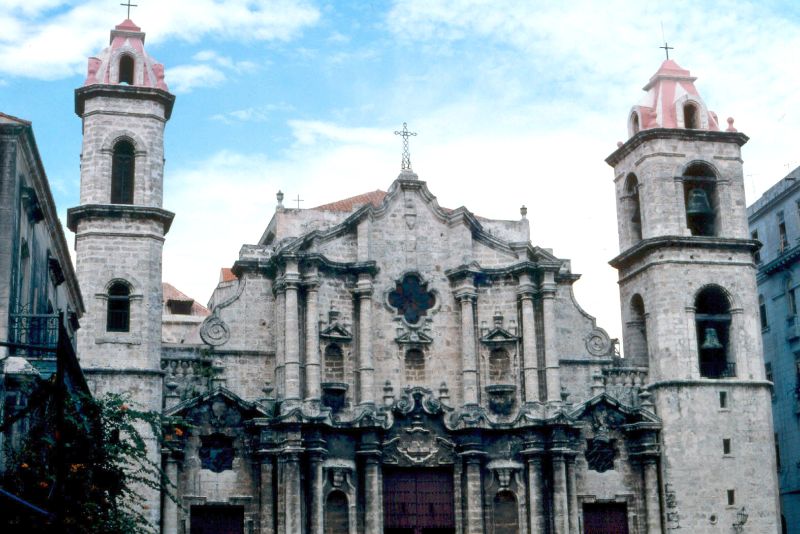
Havana Cathedral, 1985

Havana street scenes, 1985

Havana. National Capitol of Cuba (El Capitolio), 1985

Havana. Parque Lenin, 1985

March 11, 2021

Cuban Ladies in the 1990s Through Amazing Photos

In Cuba, women have equal constitutional rights as men in the economic, political, cultural and social fields, as well as in the family.


Along with Afro-Cuban women, women in Cuba, formerly a marginalized group, were able to gain higher educational levels and equal advancements in their respective careers. The 1975 Family Code was designed to allow Cuban women to share the household duties fairly with their spouses. Job opportunities were available in the cities and as a result, many Cuban women left the countryside to work and live in the cities.

Since the “Special Period in the Times of Peace” in the 1990s, women have stepped to the forefront of life in Cuba, calling for a step towards an existence without sexism. Sexism in Cuba goes hand in hand with the racism experienced by Afro-Cubans. Black women receive the lowest paying jobs and have the highest rates of unemployment and the lowest education levels. They often live with the threat of gender violence. 

Even though Cuban women achieved a lot of parity during the Cuban Revolution, there was still a lot of disparity prevalent in Cuban society.

These fabulous photos from Michael G Spafford that captured beautiful portraits of women in Havana in 1994.


January 1, 2021

Life of Cuba in the Mid-1990s Through Fascinating Photos

The Special Period in Time of Peace in Cuba was an extended period of economic crisis that began in 1991 primarily due to the dissolution of the Soviet Union and, by extension, the Comecon. The economic depression of the Special Period was at its most severe in the early to mid-1990s.

It was defined primarily by extreme reductions of rationed foods at state-subsidized prices, the severe shortages of hydrocarbon energy resources in the form of gasoline, diesel, and other petroleum derivatives that occurred upon the implosion of economic agreements between the petroleum-rich Soviet Union and Cuba, and the shrinking of an economy overdependent on Soviet imports.

The period radically transformed Cuban society and the economy, as it necessitated the introduction of organic agriculture, decreased use of automobiles, and overhauled industry, health, and diet countrywide. People were forced to live without many goods and services that had been available since the beginning of the 20th century.

These fascinating photos were taken by Michael G Spafford that show street scenes of Cuba, mostly Havana in 1994.


October 6, 2020

Vintage Photographs of American Soldiers Posing With Human Skulls in Colon Cemetery in Havana From the Early 1900s

The Colon Cemetery was founded in 1876 in the Vedado neighborhood of Havana, Cuba to replace the Espada Cemetery in the Barrio de San Lázaro. Named for Christopher Columbus, the cemetery is noted for its many elaborately sculpted memorials.

In Colon Cemetery is the site of the celebrated ‘boneyard’. A single grave in the cemetery cost $10 in rent for five years. At the end of the five years, if the remains were not claimed, the bones were thrown into the boneyard (sometimes known as ‘bone pile’) by the cemetery authorities.

In the 1890s, American soldiers often removed skulls and bones and drove through the streets of Havana displaying them. Their commander, General Brooke ordered the practice to stop and gave instructions for the pit to be covered over.

These vintage photographs here show American soldiers stood on the thirty foot deep pile play around and holding up bones in the shape of the skull and crossbones. Some photographs were taken and sold commercially as souvenir postcards to send home to their loved ones. How times have changed!


May 6, 2020

20 Amazing Photos of “Luxurious” Lada Stretched Limousines

Lada is a brand of cars manufactured by Russian automobile manufacturer AvtoVAZ (originally VAZ). The Lada brand appeared in 1973, and it has since become the main brand for AvtoVAZ vehicles. The name Lada is derived from a type of small boat in Slavic language, symbolized by the car’s logo.

In more than 30 years of production, there were not a single limousine among them, so the Russians did their best to show their vision of what they would called “Pullman”.

To begin with, the car was cut, equipped with spacers in the body, reinforced bridges and a new crankshaft, after which, when welding was completed, the masters also attended to painting the car in a nice bright blue color, combined with bluish tinted side windows. The drive had to be made front, and an old Toyota turbo engine was installed under the hood, so there is no doubt about the traction capabilities of the limousine. Russian drivers reacted positively to the refinement of the classic Lada.

In Cuba, after suffered through a decade of auto-import stagnation, the Soviet-made Lada became the car of choice during the 1970s. In a bit of Cold War gamesmanship, the USSR even built a Lada plant on Cuban soil. Castro’s government gave out Ladas for exemplary work; driving one was seen as a sign of status, even though the state technically still owned all vehicles. By the 1980s, one in three cars in Cuba was a Lada, including most police cars and taxicabs.


April 4, 2020

20 Fascinating Photos of Ernest Hemingway in Cuba

A series of vintage photographs capture Hemingway during his residence in Cuba, where he spent his time with his wife, his cats, and the locals, fishing with Gregorio Fuentes, the inspiration for his novel The Old Man and the Sea, and received the Nobel Prize in Literature in October 1954:

1940. (Lloyd Arnold)

1945.

1946.

1950s. (Francoise De Mulder)

1950s. (Philippe Giraud)

March 24, 2020

Vintage Photos Capture Life in Cuba in 1983

Fred W. McDarrah was the first staff photographer at The Village Voice, and an essential chronicler of the Beat Generation and counterculture movements from the 1960s. In 1983, he visited Cuba and captured everyday life, street scenes and people of the country (mostly in Havana).

Pedestrians walk past cars parked in front of the Cubatur travel office (on Calle 25 near Calle L), Havana.

A 1955 Buick Special parked in front of a single-story residence off Via Blanca, near Varadero.

A dilapidated 1952 Chevrolet Deluxe parked outside a residential mansion in the Miramar neighborhood, Havana.

View, across the Malecon, of the historic Hotel Nacional de Cuba (architects McKim, Mead and White, 1930), Havana.

Nighttime view of a neon sign marking the 130th anniversary of the birth of Jose Marti, Havana.

March 4, 2020

Miami and Havana Vacation of a Couple in 1950 Through Beautiful Pics

A set of beautiful pics from Richard that shows a couple in their vacation in Miami, Florida and Havana, Cuba in 1950.

Cuba. Hotel Nacional, Havana

Cuba. Hotel Nacional, Havana

Cuba. Hotel Nacional, Havana

Cuba. Moro Castle

Cuba. Moro Castle


FOLLOW US:
Facebook • Tumblr • Pinterest • Instagram

CONTACT US


Browse by Decades

Popular Posts

Advertisement

09 10