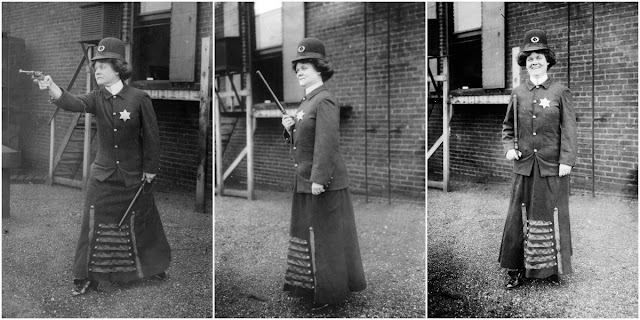
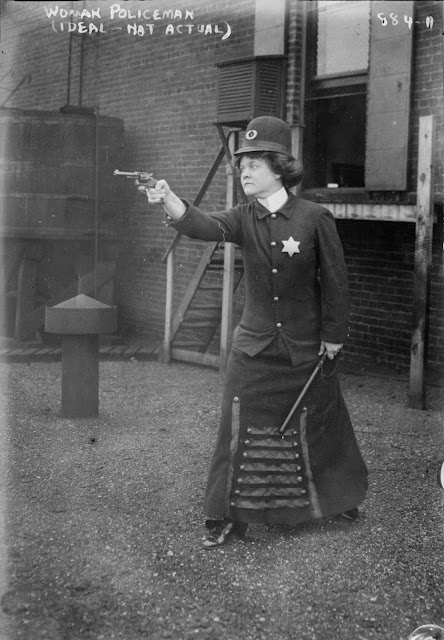
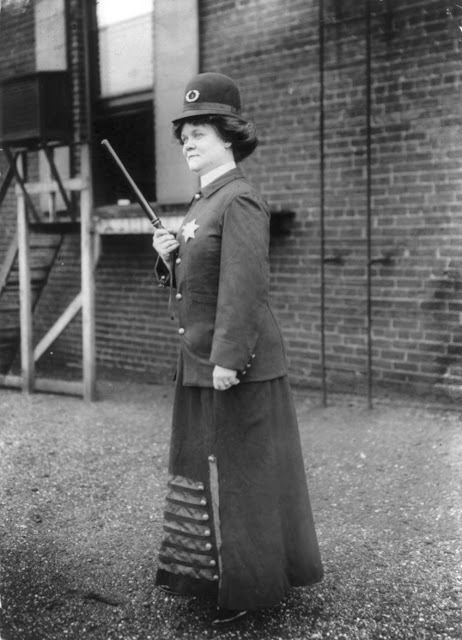
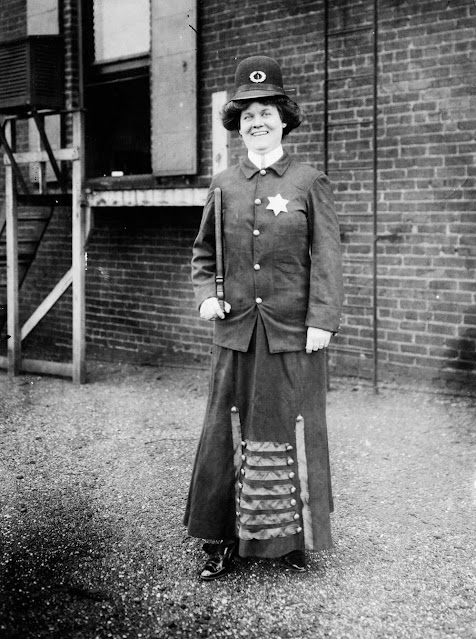
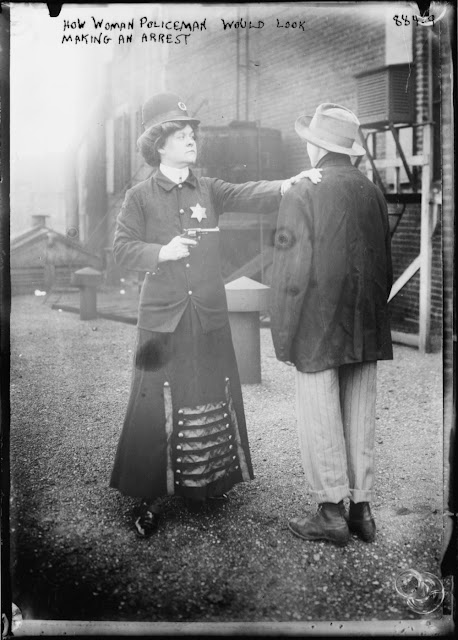
| Many people could not even imagine what a female police officer would look like so this Ohio suffragette demonstrated what a policewoman would look like making an arrest. |
November 27, 2021
January 23, 2021
Incredible Then-and-Now Photos Show How Cincinnati Has Changed in 70 Years
Settled in 1788, Cincinnati is a major city in the U.S. state of Ohio and the government seat of Hamilton County. It is located at the northern side of the confluence of the Licking and Ohio rivers, the latter of which marks the state line with Kentucky.
![]() |
| Then-and-now Cincinnati |
The city is the economic and cultural hub of the Cincinnati metropolitan area, the fastest growing economic power in the Midwestern United States based on increase of economic output. It is Ohio’s largest metropolitan area and the nation’s 29th-largest. Cincinnati is the third-largest city in Ohio and 64th in the United States.
A series of photos from Michael G Smith taken between 1939 and 1941 by his grandfather Nelson Ronsheim compared with photos of the same location that he took in 2009. How much has Cincinnati changed in 70 years?
![]() |
| Laurel St. (now Ezzard Charles) looking west toward Union Terminal. Original photo April 1939 by Nelson Ronsheim. 2009 photo by Michael G Smith |
July 24, 2020
Stunning Vintage Photos Captured Inside the Cincinnati Old Main Library, One of the Most Beautiful Libraries in America
May 2, 2020
At the Height of Her Career in the 1950s, Jayne Mansfield Even Modeled for This Awesome Hot Water Bottle!
“Just to sell a hot-water bottle shaped like a woman doesn’t have pizzazz. It’s got to have some presence. So why not sell Jayne Mansfield?” – Don Poynter
![]() |

| The illustrated ad for the Jayne Mansfield Hot Water Bottle. One should presume Mansfield is wearing the nightie purchased by Poyner for the promotional ad. |
![]() |
| An ad for the Jayne Mansfield Hot Water Bottle on the newspapers in 1957. |
At one point, there was even a proposal to do a life-size version, but the idea was eventually rejected as being too vulgar. It was a rare occasion of good judgment being exercised in the course of her career.
The hot water bottle is tacky enough, but the advertising on the box that it comes in is even worse:
“The ‘Hugging’ Hot Water Bottle”
“Designed with the Male in Mind”
“For the Man Who Has Everything, Including a Few Aches and Pains –– Preferred by Arctic Explorers.”
“We Don’t Know How, But They Say It Can Be Used As an Ice Pack –– Perfect As a Cocktail Shaker”
Poynter’s copyright is on the bottom of the left foot. He initially made a plaster model based on photos sent by Mansfield, but eventually traveled to her L.A. home to re-sculpt, where she modeled for it.
“I did it for a week,” Poynter said. “I could have done it in two days, but why rush?” Priced at just under $10, about 400,000 were sold before Mansfield died in a 1967 auto accident. Today, it’s a collector’s item. “People write me letters because my name is on it and ask, ‘My grandfather died and we found this doll. What is it?’”
![]() |
| Poynter pictured with Mansfield and her hot water bottle. |
![]() |
| A surreal shot of Jayne Mansfield floating in her pool surrounded by her novelty hot water bottles designed by Don Poynter. |
April 10, 2018
25 Gorgeous Photographs of the Cincinnati's Old Main Public Library Before It Was Demolished in 1955
![]() |
| Cast-iron book alcoves lined the sides of the Main Hall. |
The library was once one of Cincinnati’s most stunning buildings... and one of the country’s most beautiful public libraries. Now it’s a parking garage. (The building, which was located in Downtown Cincinnati at 629 Vine St. -- just a few blocks from the current Main Library -- was demolished in 1955.) These photos remain, giving us a haunting glimpse into the past.
![]() |
| Main Library, ca. late 19th century. |
![]() |
| Newspaper room, 1899. |
![]() |
| Reading Room, 1899. |
![]() |
| Catalogers, 1899. |
![]() |
| Vestibule, Main Library, ca. 1900. A glimpse of the Main Hall can be seen through the doorway at the top of the steps. |
December 16, 2017
Everyday Life of Cincinnati in the Late 1930s Through Nelson Ronsheim's Lens
Though skilled with pen and brush, Ronsheim gravitated to photography as a means of artistic expression. From as early as 1923, he mastered the use of a complex camera to record life in Cincinnati. After acquiring additional photographic equipment in 1938, Ronsheim embarked on an intense effort to capture on film the familiar scenes of his native city.
![]() |
| Cincinnati in 1938-39 by Nelson Ronsheim |
As a student of history, Ronsheim appreciated the transitional nature of the late 1930s and sought to preserve in photographs the city as he knew it, anticipating that these images would become more fascinating with time.
This period of intense photographic activity lasted just four years, brought to an end by World War II's rationing of fuel and raw material. Yet Ronsheim created roughly 800 images of Cincinnati during this time. He entered photographs in the Master Photo Finishers of America annual contests in 1939 and 1940 and each year received several awards.
These amazing pictures from Michael G Smith that were taken by Nelson Ronsheim documenting everyday life of Cincinnati in 1938 and 1939.
![]() |
| A streetcar riding the Mt. Adams incline provides the backdrop for children on the steps up the hill, November 1938 |
![]() |
| Construction of Columbia Parkway viaduct over Eggleston Avenue in January 1938 |
![]() |
| Construction of the Columbia Parkway Viaduct over Eggleston Avenue, looking north, January 1938 |
![]() |
| Kenton St. overpass looking west down Florence Ave., January 1st, 1938 |
![]() |
| Kilgour St. in Mt. Adams as seen from Fort Washington Way ramp, below Columbia Parkway, 1938 |