Bring back some good or bad memories


ADVERTISEMENT
Showing posts with label Brussels. Show all posts

September 30, 2026

20 Amazing Black and White Photos of the 1958 Brussels World’s Fair

These amazing black and white photos, via Alex Clymans, capture the 1958 Brussels World’s Fair, also known as Expo 58. The images showcase the futuristic architecture, international pavilions, and the iconic Atomium that became the symbol of the event.

Crowds of visitors, modernist structures, and the optimistic atmosphere of the postwar era are all preserved in these striking shots. The photos offer a vivid visual record of one of the most memorable world’s fairs of the 20th century.

Atomium at the 1958 Brussels World’s Fair

Atomium at the 1958 Brussels World’s Fair

American pavilion at the 1958 Brussels World’s Fair

American pavilion at the 1958 Brussels World’s Fair

American pavilion at the 1958 Brussels World’s Fair

September 6, 2025

The Symbol of Brussels and Belgium: Amazing Photos of the Construction of the Atomium in 1957 and 1958

The Atomium is a landmark modernist building in Brussels, Belgium, originally constructed as the centerpiece of the 1958 Brussels World’s Fair (Expo 58). Designed by the engineer André Waterkeyn and the architects André and Jean Polak as a tribute to scientific progress, as well as to symbolize Belgian engineering skills at the time, it is located on the Heysel/Heizel Plateau in Laeken (northern part of the City of Brussels), where the exhibition took place. It is the city’s most popular tourist attraction, and serves as a museum, an art centre and a cultural destination.

The Atomium stands 102 meters (335 ft) tall, making it one of the tallest structures in Belgium. Its nine 18-meter-diameter (59 ft) stainless steel clad spheres are connected in the shape of a unit cell that could represent an iron crystal magnified 165 billion times. Steel tubes connecting the spheres enclose stairs, escalators and a lift (in the central, vertical tube) to allow access to the six visitable spheres, which contain exhibit halls and other public spaces. The top sphere includes a restaurant with a panoramic view of Brussels.

The construction of the Atomium was a technical feat. In January 1955, a first project was presented by the engineer André Waterkeyn, director of the economic department at Fabrimétal, the Federation of Companies in the Metal Fabricating Industry (now known as Agoria). The architects André and Jean Polak were responsible for the concept’s architectural transposition, drawing up numerous sketches in the process. The company received assistance from the consulting engineers Artémy S. Joukoff and André Beckers, who were supported by the V. Daniel design office. Construction of the foundations began in March 1956 and the building, erected by the Jambes-Namur Construction Workshops, was completed less than a month before the inauguration of Expo 58, on April 17, 1958.

Originally, the Atomium was intended to be a temporary structure, designed to last only for the duration of Expo 58. However, its immense popularity and success led to it being preserved and becoming a major landmark of Brussels and Belgium. Due to its temporary nature, the building required a major restoration, which took place from 2004 to 2006. The renovation included replacing the aging aluminum cladding with new stainless steel panels and modernizing the interior spaces. Today, the Atomium remains a popular tourist attraction, housing permanent and temporary exhibitions and offering a panoramic view of the city from its uppermost sphere.


January 18, 2024

45 Fascinating Photos of Brussels World’s Fair in 1958

Expo 58, also known as the 1958 Brussels World's Fair, was a world’s fair held on the Heysel/Heizel Plateau in Brussels, Belgium, from 17 April to 19 October 1958. It was the first major world’s fair registered under the Bureau International des Expositions (BIE) after World War II.

Expo 58 was the eleventh world's fair hosted by Belgium, and the fifth in Brussels, following the fairs in 1888, 1897, 1910 and 1935. In 1953, Belgium won the bid for the next world’s fair, winning out over other European capitals such as Paris and London.

The theme of Expo 58 was “Bilan du monde, pour un monde plus humain” (in English: “Evaluation of the world for a more humane world”), a motto inspired by faith in technical and scientific progress, as well as post-war debates over the ethical use of atomic power.

The exhibition attracted some 41.5 million visitors, making Expo 58 the second largest World’s Fair after the 1900 Exposition Universelle et Internationale de Paris, which had attracted 48 million visitors. Since Expo 58, Belgium has not organized any more world’s fairs.

Here below is a set of fascinating photos from gbfernie5 that shows Brussels World’s Fair in 1958.

Atomium from near the Luxembourg Pavilion, Brussels World's Fair, Brussels, Belgium, 1958

A "Pousse Pousse" (a motorised tricycle) with the driver and one tourist outside the French Pavilion, Brussels World's Fair, Brussels, Belgium, 1958

A Folk Art and Toy Display inside the Soviet Pavilion, Brussels World's Fair, Brussels, Belgium, 1958

Aluminium Pavilion next to Atomium, Brussels World’s Fair, Brussels, Belgium, 1958

American Pavilion, Brussels World’s Fair, Brussels, Belgium, 1958.

August 1, 2023

Brussels in the Early 1980s Through Fascinating Photos

Brussels is a region of Belgium comprising 19 municipalities, including the City of Brussels, which is the capital of Belgium. The Brussels-Capital Region is located in the central portion of the country and is a part of both the French Community of Belgium and the Flemish Community, but is separate from the Flemish Region (within which it forms an enclave) and the Walloon Region.

As the economic capital of Belgium and a top financial centre of Western Europe with Euronext Brussels, Brussels is classified as an Alpha global city. It is also a national and international hub for rail, road and air traffic, and are sometimes considered, together with Belgium, as the geographic, economic and cultural crossroads of Europe. The Brussels Metro is the only rapid transit system in Belgium. In addition, both its airport and railway stations are the largest and busiest in the country.

Brussels is known for its cuisine and gastronomic offer (including its local waffle, its chocolate, its French fries and its numerous types of beers), as well as its historical and architectural landmarks; some of them are registered as UNESCO World Heritage Sites. Principal attractions include its historic Grand-Place/Grote Markt (main square), Manneken Pis, the Atomium, and cultural institutions such as La Monnaie/De Munt and the Museums of Art and History.

These fascinating photos were taken by Michel Huhardeaux that show street scenes of Brussels in 1980 and 1981.

Avenue des Celtes, Etterbeek, 1980

Barrière de Saint Gilles, Saint-Gilles, 1980

Barrière de Saint Gilles, Saint-Gilles, 1980

Barrière de Saint Gilles, Saint-Gilles, 1980

Barrière de Saint Gilles, Saint-Gilles, 1980

January 24, 2023

Brussels in the Late 1950s Through Amazing Black and White Photos

Brussels is a region of Belgium comprising 19 municipalities, including the City of Brussels, which is the capital of Belgium. The Brussels-Capital Region is located in the central portion of the country and is a part of both the French Community of Belgium and the Flemish Community, but is separate from the Flemish Region (within which it forms an enclave) and the Walloon Region.

Brussels is the most densely populated region in Belgium. The Brussels Region covers 162 km2 (63 sq mi), a relatively small area compared to the two other regions.

As the economic capital of Belgium and a top financial centre of Western Europe with Euronext Brussels, Brussels is classified as an Alpha global city. It is also a national and international hub for rail, road and air traffic, and are sometimes considered, together with Belgium, as the geographic, economic and cultural crossroads of Europe. The Brussels Metro is the only rapid transit system in Belgium. In addition, both its airport and railway stations are the largest and busiest in the country.

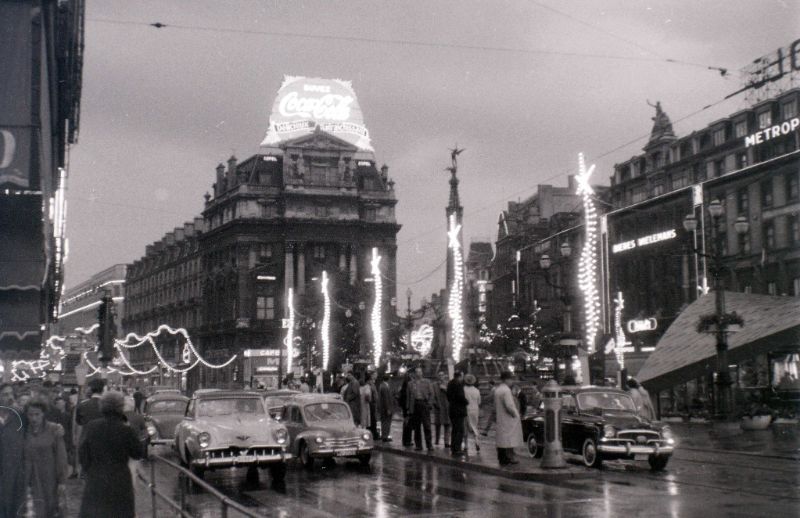
These amazing black and white from Allan Hailstone that captured street scenes of Brussels in 1958 and 1959.

Boulevard Adolphe Max, Brussels, 1958

Boulevard Adolphe Max seen from Place Rogier, Brussels, 1958

Bourse district, Brussels, 1958

Bourse district, Brussels, 1958

Bourse district, Brussels, 1958

December 12, 2022

30 Vintage Photographs of the Expo 58 in Brussels

Expo 58, also known as the 1958 Brussels World’s Fair, was a world’s fair held on the Heysel/Heizel Plateau in Brussels, Belgium, from April 17 to October 19, 1958. It was the first major world’s fair registered under the Bureau International des Expositions (BIE) after World War II.

Expo 58 was the eleventh world’s fair hosted by Belgium, and the fifth in Brussels, following the fairs in 1888, 1897, 1910 and 1935. In 1953, Belgium won the bid for the next world’s fair, winning out over other European capitals such as Paris and London.

Nearly 15,000 workers spent three years building the 2 km2 (490 acres) site on the Heysel/Heizel Plateau, 7 kilometers (4.3 mi) north-west of central Brussels. Many of the buildings were re-used from the 1935 World’s Fair, which had been held on the same site.

The theme of Expo 58 was “Bilan du monde, pour un monde plus humain” (Evaluation of the world for a more humane world), a motto inspired by faith in technical and scientific progress, as well as post-war debates over the ethical use of atomic power.

The exhibition attracted some 41.5 million visitors, making Expo 58 the second largest World’s Fair after the 1900 Exposition Universelle et Internationale de Paris, which attracted 48 million visitors. Since Expo 58, Belgium has not organized any more world’s fairs.

These vintage photographs were taken by Allan Hailstone that show the Expo 58 in Brussels, Belgium in 1958.

The theme of many advertisements was the Expo 58 World Fair, Brussels, 1958

Atomium, Expo 58 World Fair, Brussels, 1958

Atomium, Expo 58 World Fair, Brussels, 1958

Britannia pub at U.K. pavilion, Expo 58 World Fair, Brussels, 1958

Britannia pub at U.K. pavilion, Expo 58 World Fair, Brussels, 1958

November 15, 2022

36 Stunning Kodachrome Slides of the 1958 Brussels World’s Fair

Expo 58, also known as the 1958 Brussels World’s Fair, was a world’s fair held on the Heysel/Heizel Plateau in Brussels, Belgium, from April 17 to October 19, 1958. It was the first major world’s fair registered under the Bureau International des Expositions (BIE) after World War II.

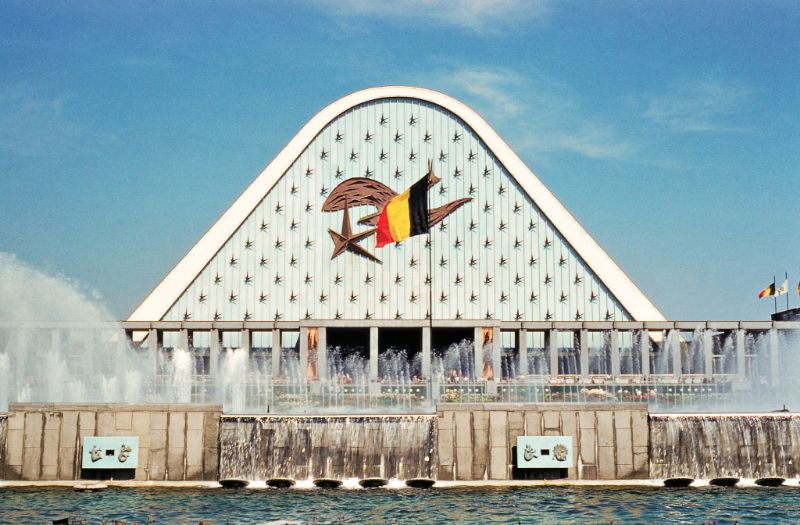
Water Stairs and Atomium.

Expo 58 was the eleventh world’s fair hosted by Belgium, and the fifth in Brussels, following the fairs in 1888, 1897, 1910 and 1935. In 1953, Belgium won the bid for the next world’s fair, winning out over other European capitals such as Paris and London.

The theme of Expo 58 was “Bilan du monde, pour un monde plus humain” (in English: “Evaluation of the world for a more humane world”), a motto inspired by faith in technical and scientific progress, as well as post-war debates over the ethical use of atomic power. 

More than forty nations took part in Expo 58, with more than forty-five national pavilions, not including those of the Belgian Congo and Belgium itself.

Belgium Square and Reception Hall.

The site is best known for the Atomium, a giant model of a unit cell of an iron crystal (each sphere representing an atom). More than 41 million visitors visited the site, which was opened with a call for world peace and social and economic progress, issued by King Baudouin I. Notable exhibitions include the Philips Pavilion, where "Poème électronique", commissioned specifically for the location, was played back from 425 loudspeakers, placed at specific points as designed by Iannis Xenakis, and Le Corbusier.

The exhibition attracted some 41.5 million visitors, making Expo 58 the second largest World's Fair after the 1900 Exposition Universelle et Internationale de Paris, which attracted 48 million visitors.

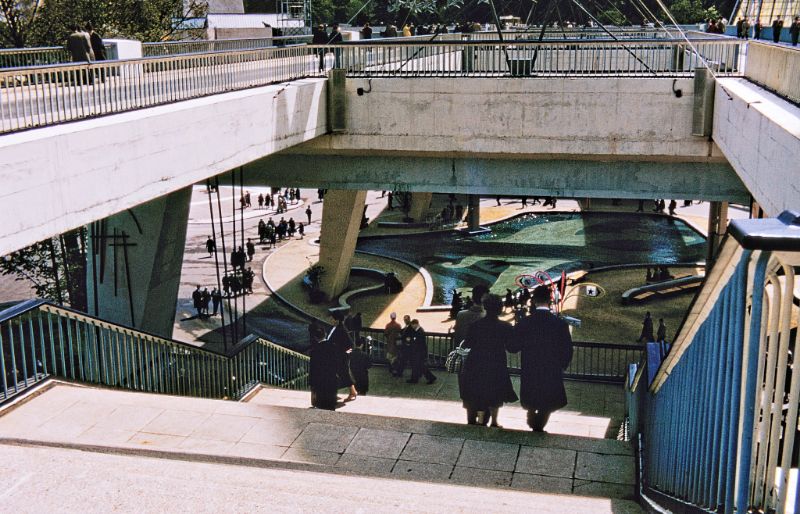
On the Overpass (or Passerelle) just inside the main entrance to the Fair.

Looking down from the Overpass (or Passerelle).

Beneath the Overpass (or Passerelle) & the Aerial Tramway Terminus.

50 Fascinating Snapshots Capture Street Scenes of Brussels in the 1930s and ’40s

Brussels is a region of Belgium comprising 19 municipalities, including the City of Brussels, which is the capital of Belgium. The Brussels-Capital Region is located in the central portion of the country and is a part of both the French Community of Belgium and the Flemish Community, but is separate from the Flemish Region (within which it forms an enclave) and the Walloon Region.


Brussels is the most densely populated region in Belgium, and although it has the highest GDP per capita, it has the lowest available income per household. It covers 162 km2 (63 sq mi), a relatively small area compared to the two other regions. The five times larger metropolitan area of Brussels which makes it the largest in Belgium. It is also part of a large conurbation extending towards Ghent, Antwerp, Leuven and Walloon Brabant.

Brussels is a hub for rail, road and air traffic, and is sometimes considered, together with Belgium, as the geographic, economic and cultural crossroads of Europe. The Brussels Metro is the only rapid transit system in Belgium. In addition, both its airport and railway stations are the largest and busiest in the country.

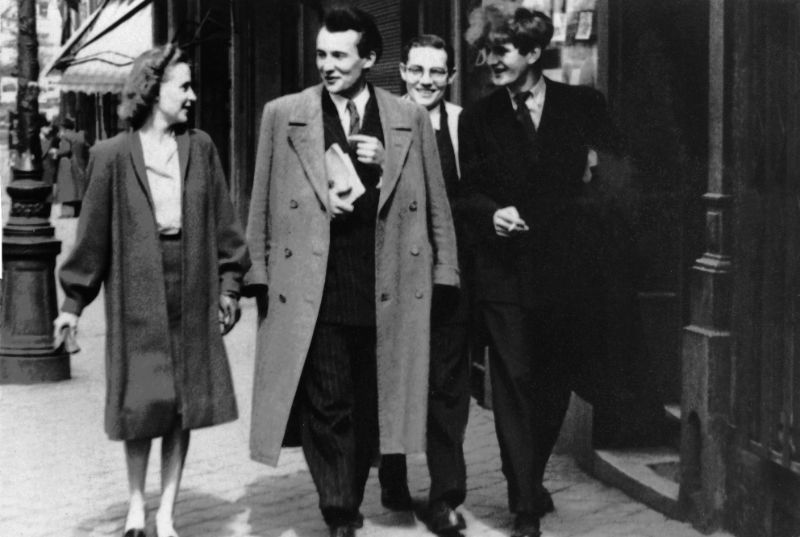
These fascinating snapshots from Alex Clymans captured street scenes of Brussels in the 1930s and 1940s.


September 1, 2018

Beautiful Kodachrome Photos That Capture Street Scenes of Brussels in the 1950s

Brussels is a region of Belgium comprising 19 municipalities, including the City of Brussels, which is the capital of Belgium. The Brussels-Capital Region is located in the central portion of the country and is a part of both the French Community of Belgium and the Flemish Community, but is separate from Flanders (in which it forms an enclave) and Wallonia.

Known for its cuisine and gastronomy, as well as its historical and architectural landmarks, Brussels grew from a small rural settlement on the river Senne to become an important city-region in Europe. Since the end of the Second World War, it has been a major centre for international politics and the home of numerous international organisations, politicians, diplomats and civil servants.

Here below are beautiful Kodachrome photos from dianp that captured street scenes of Brussels in the 1950s.

 Flower Market, La Grand Place, May 1950

 Hotel de Villle, La Grand Place, May 1950

La Grand Place, May 1950

La Grand Place, May 1950

La Grand Place, May 1950

November 27, 2016


FOLLOW US:
Facebook • Tumblr • Pinterest • Instagram

CONTACT US


Browse by Decades

Popular Posts

Advertisement

09 10