Bring back some good or bad memories


ADVERTISEMENT
Showing posts with label Brighton. Show all posts

November 30, 2022

October 4, 2021

Brighton Subculture in the Mid-1990s Through Amazing Photos

Many people wished they could bring back a different kind of celebration from their time in Brighton in the 1990s where their favorite pubs and clubs have since closed down.

Brighton subculture in the mid-1990s

The Zap club and parties on the beach. The Zap, located within the King’s Road arches, is currently branded as The Arch. Acid house filled the venue for most of the 90s, making it a popular place to go for people partying in Brighton.

While many people missed things from the 1990s, others looked deeper into the Brighton’s past to find the things they wanted to see return to the city. These photos were taken by The Quaffer that show the alternative scene in Brighton in 1994.

"We're not Goths!" Ayng and Jenny, white-faced in the Prince George, Trafalgar Street, 30th July 1994

"An individual" in the beer garden of the Hobgoblin, July 1994

Alistair in Brighton Square, The Lanes, August 1994

At the Richmond, August 1994

At the Richmond, August 1994

July 24, 2021

Vintage Color Snapshots of Brighton in the 1970s

Brighton is a seaside resort and one of the two main areas of the city of Brighton and Hove. Once an ancient fishing village, it emerged as a health resort in the 18th century and grew into one of the largest towns in England by the 20th century.

Much of the town became somewhat dilapidated in the 1970s. At the same time, a major investment was being made into the Brighton Marina, while the seafront was much less developed than today. High levels of unemployment in the central districts led to a strong unemployed counter-culture involving squatting. With an elderly population, by the 1970s, Brighton had acquired a reputation as a retirement destination.

Take a look back at Brighton in the seventies through 26 fascinating vintage color snapshots:

Pavilion Buildings, 1974.

Sign, 1970.

Volks Electric Railway, 1971.

Brighton beach, 1972.

Druids Head pub, 1972.

July 3, 2021

Beautiful Vintage Postcards of the Glamorous Butlin’s Ocean Hotel in Saltdean

Opened in 1938 the Ocean Hotel occupied a site of around 4 acres with 344 bedrooms and a dining hall that could seat 300 people. It consisted of a main building shaped like a crescent which contained the whole of the public rooms and some of the bedrooms, and there were six other buildings which contained bedrooms and bathrooms only. The hotel was so arranged that during the winter season the six detached blocks could be closed down and the main building, with its 130 bedrooms, run as a separate hotel. An outdoor swimming pool (later enclosed) was built between the buildings.

During the war the hotel was taken over by the Auxiliary Fire Service and later became a fire service college which was officially opened by the then Home Secretary Herbert Morrision. It was used throuhgout the war and was not handed back until 1952 when the lease was acquired by Billy Butlin for £250,000. Its doors were opened as a holiday centre again on 2 May 1953, after an army of workmen had spent the previous six months restoring the near-derelict building. It soon became popular with honeymooners and Billy Butlin later said the hotel was one of the best investments he'd ever made. (by Butlins Memories)

More fascinating vintage postcards and photographs could be found at Glen’s amazing Flickr site.


July 15, 2020

20 Amazing Vintage Photos of Daddy Long-Legs, a Weird and Wonderful Seaside Railway in Brighton

The 19th century was an age of science and industry, and one where individual inventors could transform the world. These enterprising pioneers are still ritually recalled alongside their inventions: Marconi and radio, Bell and the telephone, Benz and the motorcar. Although far less famous, Brighton’s Magnus Volk also personifies this spirit of technological endeavor.

Volk is chiefly remembered for the railway that bears his name on Brighton seafront: Britain’s first public electric railway that still operates during the summer. Yet Volk’s most extraordinary creation was the Brighton and Rottingdean Seashore Electric Railway. Its car was appropriately named ‘Pioneer’, but it became more commonly known as the ‘Daddy Long-legs’ or the ‘Spider’.

The railway, which cost £30,000 to build – the equivalent of £2.4million in today’s money – opened on November 28, 1896 at Paston Place in Brighton. It was initially a great success, with large crowds queueing up to take a ride through the sea. But disaster struck just six days later when a severe gale wrecked the car and the pier, shutting down the service for eight months.

It was re-opened on July 20, 1897, with the Prince of Wales among those who took a ride on it. But customers became fewer and farther between as the 6d (sixpence) fee for a train that only went six miles per hour grew too much for locals. High tide would often slow the car down and breakdowns were common, causing timetable cancellations for weeks on end.

During the summer of 1900, the service had to be suspended when the track was damaged by the scour from the construction of two concrete groynes to prevent erosion of the cliffs. Then on September 1, 1900, Brighton Corporation gave Volk two months notice to relocate the track to make room for groyne extensions. Volk’s suggestions were rejected and in February 1901 the Borough Surveyor removed a section of the track and the service was suspended. It was officially abandoned the following year.

The elegant car was tied up at the Ovingdean landing stage, where it was left to die a slow death until it was removed for scrap in early 1910. Nothing remains of it now, other than some concrete blocks that supported the rails. But it has left a bewitching visual legacy in the form of numerous photographs and postcards. The railway was such an unviable idea that it was never emulated; there has been nothing else like it in the world. Its impracticality made it unique, and if it were not for the visual evidence, it would almost be hard to believe that it ever really existed.


June 16, 2016

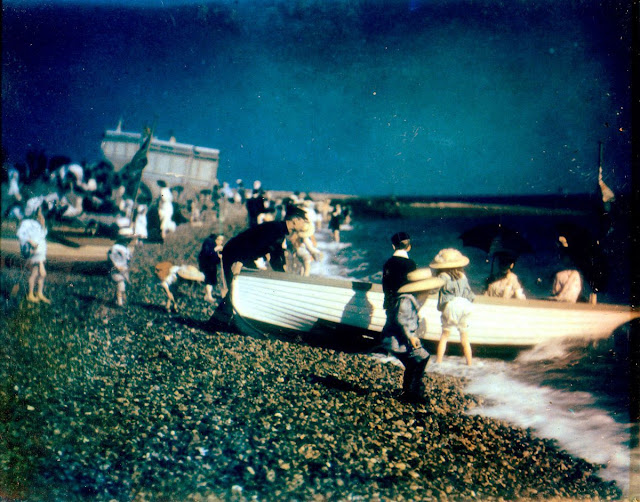
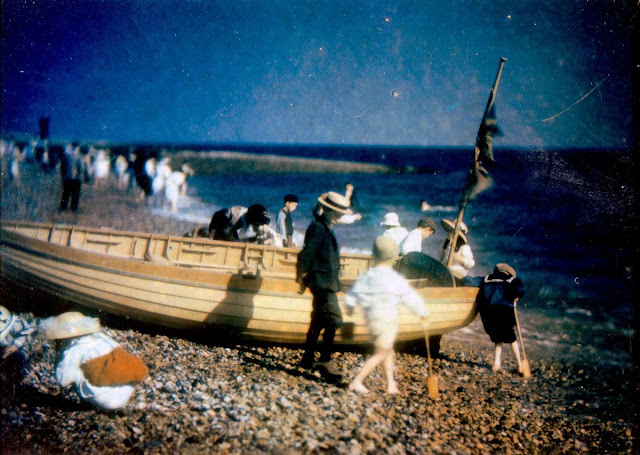
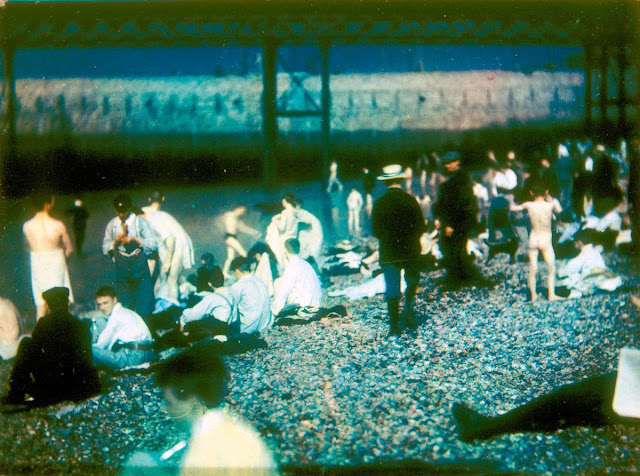
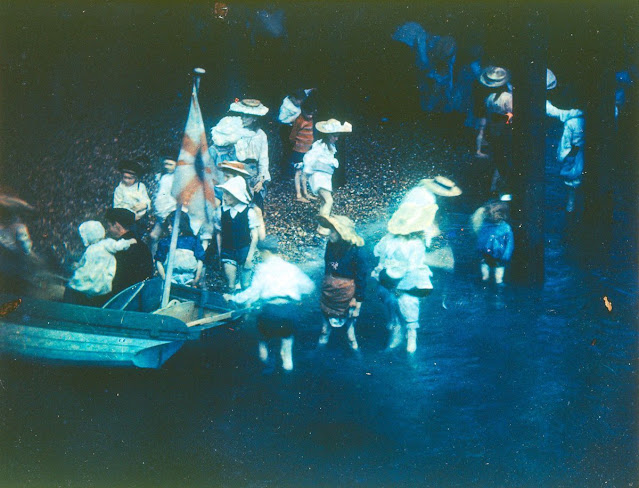
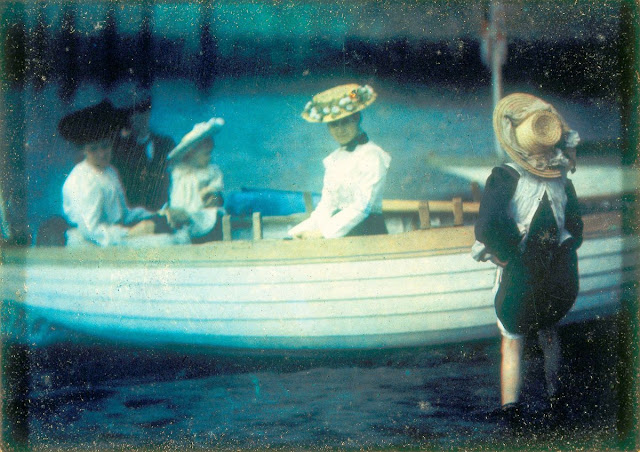
Stunning Color Photographs Capture Daily Life at Brighton Beach in 1906

Otto Pfenninger (1855–1929) was a founding member of the Swiss Photographers Association (1886) and a pioneer of color photography. He moved to Brighton, England where he developed his career as a photographer.

In 1906, Pfenninger built a special camera to his own design using 3-color separated plates from which full-color photographic images could be created. That summer Pfenninger used this tri-color, single exposure camera to create some of the first color photographs, using the parks and beaches of Brighton as scenes.

His camera was based upon J.W. Bennetto’s one-shot camera of 1897 in which three separation negatives were obtained at a single exposure. Pfenninger tried to use the same system but found that the refracted image was shorter from top to bottom, his solution was to add a glass plate at the same angle, but opposite direction, to the Bennetto reflector.

Here’s some of his work:


FOLLOW US:
Facebook • Tumblr • Pinterest • Instagram

CONTACT US


Browse by Decades

Popular Posts

Advertisement

09 10