Bring back some good or bad memories


ADVERTISEMENT
Showing posts with label Austria. Show all posts

February 6, 2026

Fascinating Photos Capture Street Scenes in Vienna During the Mid-1980s

Street scenes in Vienna during the mid-1980s captured a city caught in a beautiful limbo between its imperial past and a grainy, pre-digital modernity. The streets were defined by the rhythmic clatter of vintage red-and-white trams navigating the Ringstraße, passing by ornate facades that still bore the weathered patina of time. In the cobblestone alleys of the Innere Stadt, the air was a mix of roasting coffee from historic Konditoreis and the faint scent of winter coal.

You would see men in heavy loden coats and wide-brimmed hats walking briskly past shop windows displaying intricate cakes, while a younger generation, influenced by the New Wave movement, brought a touch of leather jackets and bold silhouettes to the plazas.

It was a time of “Gemütlichkeit” (coziness) and understated elegance, where the city’s grand plazas felt like vast, open-air living rooms, largely untouched by the frenetic pace of the coming internet age. From the smoke-filled coffee houses to the cobblestone alleys of the Innere Stadt, these fascinating photos, via Morton1905, capture the soul of Vienna in the mid-1980s.


August 12, 2025

Austria in the Early 1960s Through Wonderful Kodachrome Slides

Street scenes in Austria in the early 1960s capture a country balancing postwar recovery with a new era of prosperity and modernity. In Vienna, Salzburg, Innsbruck, and small market towns, cobblestone streets still carried horse-drawn carts alongside compact European cars like the Volkswagen Beetle and the Fiat 500. Shop windows displayed a mix of traditional Austrian goods—dirndls, lederhosen, and handmade chocolates—alongside the latest fashions inspired by Paris and Milan.

Trams clattered along their tracks, children played in public squares, and outdoor cafés bustled with people enjoying coffee and pastries. In alpine villages, locals in Tyrolean hats greeted tourists arriving by train or bus, while city boulevards hummed with the energy of a society embracing both its heritage and the optimism of the 1960s.

The combination of ornate 19th-century architecture, mid-century cars, and timeless human activity created street scenes that today feel both nostalgic and alive with history. Taken by C. E. Hablutzel and shared by David Pirmann, these wonderful Kodachrome slides capture street scenes in Austria in 1960 and 1961.

Vienna State Opera, 1960

Vienna City Hall, 1960

Vienna. Austrian Parliament, 1960

Vienna. Burgtheater with tram, 1960

Vienna. Burgtheater, 1960

February 28, 2025

Vienna in the Early 1960s Through Fascinating Photos

In the early 1960s, Vienna was a city of contrasts, recovering from the devastation of World War II and its aftermath. The city, which had once been the heart of the Austro-Hungarian Empire, was divided into four occupation zones—American, British, French, and Soviet—though it remained officially neutral and independent.

Vienna’s architecture in the 1960s reflected both its imperial past and its postwar rebuilding efforts. Historic buildings stood alongside modernist structures, as the city underwent a period of regeneration. These fascinating photos from huebner family photos that captured street scenes of Vienna in June 1961.

Votive Church (Votivkirche), Vienna, June 24, 1961

Votive Church (Votivkirche), Vienna, June 24, 1961

Votive Church (Votivkirche), Vienna, June 24, 1961

Church of St. Rupert (Ruprechtskirche), Vienna, June 24, 1961

Gardens at the Schönbrunn Palace with a view up to the Gloriette, June 25, 1961

December 29, 2024

Vienna in 1976 Through Fascinating Photos

In the 1970s, the streets of Vienna were a striking blend of old-world elegance and the buzz of modern life. Narrow, cobblestone lanes wound through historic districts, lined with grand Baroque and Gothic buildings, while wider avenues like the Ringstraße showcased imposing imperial architecture.

At the same time, the city was undergoing visible change, with new post-war developments and modernist architecture beginning to emerge, especially around the outskirts and industrial areas. These fascinating photos were found by Shane Egan that show street scenes of Vienna in 1976.


November 24, 2024

30 Fascinating Photos Capture Street Scenes of Vienna in 1953

Street scenes of Vienna in the 1950s reflected both the city’s post-war recovery and its vibrant cultural life. The streets were a mix of old-world charm and emerging modernity, with a visible contrast between the historic architecture and the signs of rebuilding after the war.

People walked or cycled along broad avenues, many of them still wearing wartime or post-war austerity clothing. Cars were relatively few, with many older models dominating the streets, though new cars began to appear by the end of the decade. Trams, an iconic part of Vienna’s public transport system, crisscrossed the city, and the Ringstrasse, the grand boulevard encircling the city center, was a common sight for both locals and tourists.

Despite the recovery, some areas still bore the marks of wartime damage, with ruined buildings and reconstruction work in progress. Yet, a sense of optimism was palpable, as Vienna began to rediscover its place as a cultural and political crossroads in Europe. These fascinating photos were found by Found Slides that show street scenes of Vienna in 1953.

Window shopping, Vienna, Austria , 1953

Billboards in Hoher Markt, Vienna, Austria , 1953

3D in Vienna, Austria , 1953

A bomb damaged building, Vienna, Austria , 1953

Austrian police band and police, Vienna, Austria , 1953

September 6, 2024

30 Fascinating Black and White Photos of Vienna in 1959-60

Vienna in the late 1950s and early 1960s was a city undergoing significant change. Post-World War II, it was recovering from the devastation of the war and the division of the city. The late 1950s marked a period of economic growth and modernization, with Vienna beginning to embrace more contemporary cultural and artistic trends. The city’s architecture started to blend modernist elements with its historic charm.

Culturally, Vienna remained a hub of classical music, but also saw a rise in interest in jazz and other contemporary genres. The intellectual and artistic scene was vibrant, reflecting both the city’s rich history and its evolving present.

Overall, Vienna was transitioning from the somber post-war years to a more dynamic and modern era. These fascinating black and white photos were taken by Libby Hall that show street scenes of Vienna in 1959 and 1960.

The Chestnut Sellers, Vienna, 1959

The Boots, Vienna, 1959

The Tram, Vienna, 1959

Cafe Mozart, Vienna, 1959-60

Enthralled!, Vienna, 1959-60

June 23, 2024

Beautiful Paintings of Vienna by Carl Wenzel Zajicek in the Late 19th Century

Carl Wenzel Zajicek (1860–1923) was a Viennese painter. He was born as one of 24 children of watchmaker Franz Zajicek. Educated in his father's craft, he worked as a watchmaker until 1900, but he practiced artistic painting as an amateur from a young age.

Inspired by Emil Hütter, Zajicek specialized on Vedute of the city of Vienna, and he rose to notability in 1896 with a large panoramic painting.

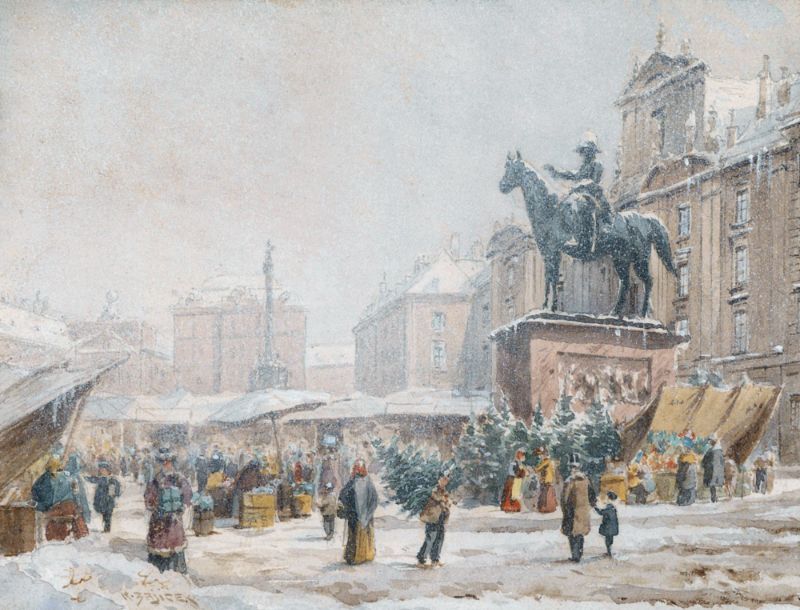
Here below is a set of beautiful paintings of Vienna by Carl Wenzel Zajicek in the late 19th century.

A Christmas Market in Am Hof, Vienna

A Christmas Market in Am Hof, Vienna

Altes Kärntnertortheater, Vienna

Busy activity at the Hoher Markt in Vienna

Jesuit Church and Old University, Vienna

May 17, 2024

35 Vintage Photos Capture Street Scenes of Vienna in 1900

Vienna in the early 1900s was a vibrant and dynamic city, often regarded as the cultural and intellectual epicenter of Europe. This period, often referred to as “Fin de Siècle” Vienna, was marked by significant advancements in the arts, sciences, and philosophy.

Street scenes in early 1900s Vienna featured grand architecture along the Ringstraße, bustling with horse-drawn carriages, trams, and early automobiles. The streets were lively with a diverse population, including elegantly dressed citizens, workers, and a mix of ethnic communities, reflecting the city’s multicultural character.

Here below is a set of vintage photos that shows street scenes of Vienna in 1900.

Vienna. Alsarstrasse, 1900

Vienna. Altes Rathaus, 1900

Vienna. Augustinerstrasse, 1900

Vienna. Franz-Josefs-Kai, 1900

Vienna. Freyung, 1900

April 21, 2024

Vienna Streetcar System: One of the Largest Tram Network in the World

Trams in Vienna are a vital part of the public transport system in Vienna, capital city of Austria. In operation since 1865, with the completion of a 2 km (1.2 mi) route to industrial estates near Simmering, it reached its maximum extent of 292 km (181.4 mi) in 1942. In February 2015, it was the fifth largest tram network in the world, at about 176.9 kilometers (109.9 mi) in total length and 1,071 stations.

The trams on the network run on standard gauge track. Since 1897, they have been powered by electricity, at 600 V DC. The current operator of the network is Wiener Linien. In 2013, a total of 293.6 million passengers travelled on the network’s trams. As of 2013, there were 525 tramcars in Vienna's tram fleet, including 404 trams or tramsets scheduled for service during peak periods, comprising 215 single cars and 189 motor and trailer sets.

These fascinating photos were taken by Robert Rynerson that show street scenes of Vienna, most of them are about its streetcar system in 1970.


March 9, 2024

Wonderful Color Photos Capture People Skiing at Ski Resorts in Switzerland and Austria in 1949-1950

Robert Capa is synonymous with black and white documentation of conflict, from the Spanish Civil War to World War II. Also largely monochrome were the major Capa collections that followed: studies of the Soviet Union and Israel. But the photographer did make extensive use of color, which gradually seeped into his work from 1941 right up until the end of his life. His glossy coverage of high-society European ski resorts are a notable departure from black and white, even if the backdrop to all the color-saturated human activity is the most monochrome of natural landscapes.

In 1948, Robert Capa proposed a story on the grand ski resorts in France, Switzerland and Austria to Holiday magazine. He loved skiing and visited Klosters, the Swiss resort, every year. It was carnival when he arrived in Zürs, and the Austrians took costumes seriously. One skier dressed head to toe as Charlie Chaplin and another transformed them self into a cello. The festivities continued into the evening with fancy dress parties.

In the story, published in the January 1951 issue, Capa wrote about his escapades for the magazine and his troubles with finding a place to stay: “None of [the hotels] had rooms, but every one of them had a gala night, and to enter you had to dress in costume…I rolled up my trousers, turned my vest inside out, put my tie around my head, and went to the Zürserhof.”


FOLLOW US:
Facebook • Tumblr • Pinterest • Instagram

CONTACT US


Browse by Decades

Popular Posts

Advertisement

09 10