Bring back some good or bad memories


ADVERTISEMENT
Showing posts with label Argentina. Show all posts

March 8, 2026

Northern Argentina in the 1930s Through Fascinating Photos

In contrast to the European elegance of Buenos Aires, everyday life in Northern Argentina during the 1930s moved to a different, more ancestral rhythm.

In provinces like Salta, Jujuy, and Tucumán, the decade was defined by a deep connection to the land and colonial traditions that had remained unchanged for centuries. The dusty streets of Andean villages were often filled with pack mules and horse-drawn carts, while the local markets served as the vibrant heart of the community, a place where indigenous heritage and Spanish influence blended into a unique cultural tapestry.

These fascinating photos, via Wolfgang Wiggers, capture the raw, sun-drenched beauty of the North: from the vast tobacco and sugar cane plantations where laborers worked under the immense sky, to the quiet dignity of families gathered outside their adobe homes.

A 100-year-old Indian woman in Northern Argentina, circa 1930s

A group of Indians, Northern Argentina, circa 1930s

A native of Salta, Northern Argentina, circa 1930s

A Pullman wagon, Northern Argentina, circa 1930s

At the edge of the forest, Northern Argentina, circa 1930s

April 11, 2025

35 Amazing Photos Capture Street Scenes of Buenos Aires in the Mid-1990s

Buenos Aires in the mid-1990s was a city caught between nostalgia and transformation. The glamor of its European-style architecture stood in contrast with the growing signs of economic strain.

The streets buzzed with colectivos and conversations—politics, fútbol, and the latest drama from the telenovelas. Newsstands overflowed with magazines, cigarettes, and candy, and street vendors sold choripanes or fake Ray-Bans on every corner. Kids played fútbol on cracked sidewalks, and tango music spilled from open windows or passed buskers in the Subte. Graffiti and political posters clung to walls like layers of urban memory. The scent of exhaust mixed with freshly baked medialunas from corner cafés.

Loud, fast, and unmistakably porteño — that was life in Buenos Aires in 1995. These amazing photos bring the streets of that era back to life.

Buenos Aires street scenes, Argentina, 1995

"Hoy y Manana", Buenos Aires, Argentina , 1995

A Kickabout on the streets of La Boca, Buenos Aires, Argentina, 1995

The Congress Palace building in barrio Balvanera, Buenos Aires, Argentina, 1995

Buenos Aires Metropolitan Cathedral, Argentina, 1995

April 14, 2023

60 Wonderful Color Photographs Capture Everyday Life in Mar del Plata, Argentina in the Summer of 1958

Mar del Plata is a city on the coast of the Atlantic Ocean, in Buenos Aires Province, Argentina. It is the seat of General Pueyrredón district. Mar del Plata is the second largest city in Buenos Aires Province. The name “Mar del Plata” is a shortening of “Mar del Rio de la Plata,” and has the meaning of “sea of the Rio de la Plata basin” or “adjoining sea to the (River) Plate region.” Mar del Plata is one of the major fishing ports and the biggest seaside beach resort in Argentina.

These photos were taken by LIFE photographer Dmitri Kessel in the summer of 1958, where he portrayed the city of yesteryear, with beaches full of tourists, but surrounded by another frame: shops that competed with “modern” umbrellas on the sand, people resting in the unique chairs Bristol, chalets that bordered the Playa Grande sector and even llamas that were the subject of photos by tourists.


March 21, 2022

20 Rare and Amazing Photographs of Buenos Aires, Argentina From the 1870s

Buenos Aires was founded by the Spanish in the 16th century. From the start it was a trading city: its residents are known as ‘porteños’, people of the port.

In the late 19th century, as the capital of an independent Argentina, Buenos Aires became immensely prosperous, known for its rich cultural life and architecture. By contrast, during the second half of the 20th century the city suffered from the national political and economic turmoil.

Since Argentina’s return to democracy in 1983, Buenos Aires has entered a new period of growth and it continues to benefit from its rich cultural inheritance. The Teatro Colón, established in the 19th century, is a world leading opera house. Tango remains one of the city’s main cultural exports, with its own festival, World Cup, dance halls (milongas) and local dance competitions. In 2009 UNESCO officially designated tango as part of the intangible cultural heritage of humanity.


March 6, 2022

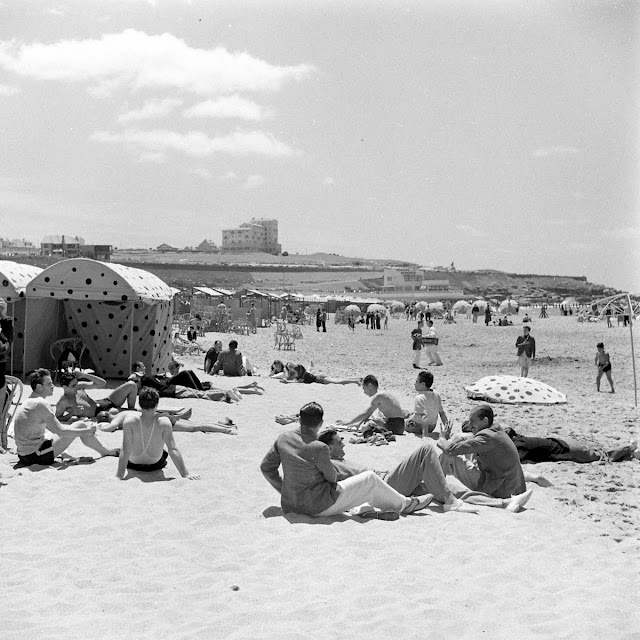
40 Amazing Photographs Capture Daily Life in Mar del Plata, Argentina in 1941

Mar del Plata is the second largest city in Buenos Aires Province, Argentina located on the coast of the Atlantic Ocean. The name “Mar del Plata” is a shortening of “Mar del Rio de la Plata,” and has the meaning of “sea of the Rio de la Plata basin” or “adjoining sea to the (River) Plate region.”

From the 1910s, the residents, mostly new arrived immigrants from Europe, demanded and obtained the control of the Municipality administration. The socialist were the mainstream political force in this period, carrying out social reforms and public investment. The main port was also built and inaugurated in 1916.

The first military coup in Argentina's history took place on September 6, 1930, restoring the conservative hegemony in all levels of Government, including the local one. Although unpopular and fraudulent, this old new order brought some progress and investment to an ailing country in the climax of the Great Depression. Mass tourism began to arrive in this decade, helped by improved roads, but it took off in the 1940s and 1950s, when the development of union-run hotels under the Perón presidency put the city within the reach of Argentina’s middle and working classes.

These amazing photographs below, taken by LIFE photographer Hart Preston (1910–2009), show what life was like in Mar del Plata in the early 1940s.


September 29, 2019

The Story of László Bíró, the Man Who Invented the Modern Ballpoint Pen

László Bíró was a Hungarian-Argentine inventor who patented the first commercially successful modern ballpoint pen. The first ballpoint pen was invented roughly 50 years earlier by John J. Loud, but it did not attain commercial success.


Bíró was born to a Hungarian Jewish family in Budapest, Hungary, on 29 September 1899 to Mózes Mátyás Schweiger and Janka née Ullmann. After leaving school, he began work as a journalist in Hungary.

While working as a journalist Bíró noticed that the ink used in newspaper printing dried quickly, leaving the paper dry and smudge-free. He tried using the same ink in a fountain pen, but found that it would not flow into the tip, as it was too viscous.

László Bíró’s ballpoint pen patent, 1945.

László Bíró’s ballpoint pen patent, 1945.

Bíró presented the first production of the ballpoint pen at the Budapest International Fair in 1931. Working with his brother György, a chemist, he developed a new tip consisting of a ball that was free to turn in a socket, and as it turned it would pick up ink from a cartridge and then roll to deposit it on the paper. Bíró patented the invention in Paris in 1938.

During World War II, Bíró fled the Nazis with his brother, moving to Argentina, in 1943. On 17 June 1943, they filed another patent, issued in the USA as 2,390,636 Writing Instrument, and formed Biro Pens of Argentina (in Argentina the ballpoint pen is known as birome). This new design was supposedly licensed for production in the United Kingdom for supply to Royal Air Force aircrew.

Bíró’s invention Birome.

Birome’s advertising in Argentine magazine Leoplán, 1945.

In 1945, Marcel Bich bought the patent from Bíró for the pen, which soon became the main product of his BIC company. Bic has sold more than 100 billion ballpoint pens worldwide. In November of that same year, promoter Milton Reynolds introduced a gravity-fed pen to the U.S. market, to try to get around Biro’s patent, which was based on capillary action, where fresh ink is drawn out of the reservoir of the pen as ink is deposited on the paper. Because the Reynolds workaround depended on a gravity feed, it did not infringe, but required thinner ink and a larger barrel. The Reynolds Pen was a sensation for a few years, until its reputation for leaking and competition from established pen manufacturers overtook it.

László Bíró died in Buenos Aires, Argentina, on 24 October 1985.

Argentina’s Inventors’ Day is celebrated on Bíró’s birthday, 29 September. A ballpoint pen is widely referred to as a “biro” in many countries, including the UK, Ireland, Australia and Italy.

March 26, 2019

Controversial Backstage Photos of Queen and Diego Maradona in Argentina During “The Game Tour”

The Game Tour was a concert tour by Queen to support their successful 1980 album The Game – which includes the hits like “Another One Bites the Dust” and “Crazy Little Thing Called Love” – and their short trek has become the stuff of myths and legends. This tour saw the band being the first to play in South American stadiums in early 1981.

The tour began on February 28, with two consecutive nights at Estadio Velez Sarsfield in Buenos Aires, where the band drew a crowd of 300,000 people –the largest single concert crowd in Argentine history as of 1982.

Freddie Mercury first met Diego Maradona at a party in Castelar outside Buenos Aires, and invited him to appear on stage during Queen’s final Buenos Aires show. Maradona accepted readily.
“Freddie hadn’t really known who he was, as he was not what you could call a football fan,” laughed Peter Freestone. “Footballers’ thighs, maybe. Rugby players’ thighs, even better!”
Still, Freddie could not help but be amused by the young soccer star. To some extent, he could identify with him: they shared modest stature and an unquenchable thirst for success. Maradona duly appeared to ecstatic applause, whereupon the footballer peeled off his Number 10 team shirt, and swapped it for the rock star’s T-shirt. He then introduced “Another One Bites the Dust”, and retreated, as Queen tore in to one of Argentina’s all-time favorite rock numbers.


These photos were taken on March 8, 1981 backstage at the Buenos Aires stadium Estadio José Amalfitani. Maradona is wearing the British Union Jack shirt of Brian Ma, while Freddie Mercury is wearing a Diego Maradona #10 jersey from the Argentina national team.

When these photos surfaced, Maradona was heavily criticized by the Argentine people for wearing The British Union Jack considering The Falklands War “La Guerra de las Malvinas” between The United Kingdom and Argentina. He defended himself by saying that the photos were taken one full month before the conflict began and one full year before the war had even started.

Here is a photo of Maradona on stage introducing Queen after their encore and before the song “Another One Bites the Dust”. (Notice Brian May in the background wearing the controversial shirt)

Perhaps the Palo journalist was not so stupid when he quizzed Freddie at the asado. He put it to Freddie that the shirt-exchange moment with the nation’s greatest sporting idol had been a ‘demagogic act’. Freddie, incensed by the implication, denounced the suggestion as ‘ridiculous’. He declared it to have been a friendly gesture, nothing more.
“If the audience thinks it’s OK to do such a thing, and appreciates it for what it is, I don’t give a damn what the press might think,” he retorted. “I’m going to do what I like, regardless of whether the press label it ‘demagogic’ or wrong.”

October 26, 2018

Fascinating Color Pictures That Show Bus System of Buenos Aires in 1980

Buenos Aires is the capital and largest city of Argentina. The city is located on the western shore of the estuary of the Río de la Plata, on the South American continent's southeastern coast. "Buenos Aires" can be translated as "fair winds" or "good airs".

The Greater Buenos Aires conurbation, which also includes several Buenos Aires Province districts, constitutes the fourth-most populous metropolitan area in the Americas.

Buenos Aires is a multicultural city, being home to multiple ethnic and religious groups. Several languages are spoken in the city in addition to Spanish, contributing to its culture and the dialect spoken in the city and in some other parts of the country. It was  considered as one of the most diverse cities of the Americas.

A fascinating photo collection from T D that shows bus system of Buenos Aires in 1980.


January 20, 2018

29 Amazing Black and White Photos That Capture Everyday Life of Northern Argentina in 1970

These amazing photos were taken by photographer Juan Rafael Onetto that documented everyday life of Northern Argentina in 1970. The cities include Santiago de Estero, Salta, and especially Jujuy province.


May 21, 2017

A Family From Buenos Aires, Argentina: Lovely Story Through Found Photos in the Early 20th Century

Maria Elena Green del Solar Dorrego was born on August 17, 1893. She was one of four children of her mother Ana Mayobre Lynch and her father Fredrico Green Lumb who were married at Saint John Angelican Church in Buenos Aires on October 18, 1886.

Elena and her family were quite well to do and lived in Buenos Aires, Argentina. She married with Alberto del Solar Dorrego (born in 1888 and had three children from a previous marriage) on September 30, 1915. She's 22 and he's 27.

Maria Elena had both a son and daughter of her own and two stepsons and a stepdaughter.

Here is a lovely story of Maria Elena's family through found images from Suzanne in the late 19th and early 20th centuries.

Maria Elena's First Holy Communion

Maria Elena Green del Solar Dorrego was born on August 17, 1893

Portrait of Maria Elena

Maria Elena strikes a pose

Maria Elena profile


FOLLOW US:
FacebookTumblrPinterestInstagram

CONTACT US


Browse by Decades

Popular Posts

Advertisement

09 10