Taken by Edward Eugene Masters, these vintage photos offer a vivid glimpse into everyday life in Thailand during the 1970s. The images capture ordinary moments across the country: from city streets and local markets to rural scenes, family life, and traditional customs.
Clothing styles, vehicles, shopfronts, and daily activities all reflect a period of gradual change and modernization. The photos preserve a nostalgic and authentic visual record of Thai life more than fifty years ago.
Hill tribe woman, Mae Sai, Thailand, 1972
Ayutthaya, Thailand, 1972
Boat ride near Ayutthaya, Thailand, 1972
Hill tribe people on bridge, Mae Sai, Thailand, 1972
Hill tribe village girl, Chiang Mai, Thailand, 1972
Bangkok in the 1980s was a dynamic city, caught between tradition and rapid modernization. The streets were bustling with a mix of old markets, ancient temples, and emerging skyscrapers. The skyline began to change as new construction projects sprouted up, reflecting Thailand’s economic growth during the period.
The city’s iconic tuk-tuks and colorful street vendors coexisted with new cars and high-end malls. Meanwhile, Bangkok’s nightlife was vibrant, with bars, nightclubs, and karaoke joints drawing locals and tourists alike.
These fascinating photos were taken by David Pirmann that show everyday life in Bangkok in 1987.
A khlong, alternatively spelt as klong commonly refers to a canal in Thailand. As of 2019 there are 1,682 canals in Bangkok, totaling 2,604 kilometers in length. Nine canals are primary flood drainage conduits.
In years past, the Thai capital was crisscrossed by khlongs, and so gained the nickname “Venice of the East”. Khlongs were used for transportation, for floating markets, but also for sewage disposal. Today, most of the khlongs of Bangkok have been filled in, although the Thonburi side of Bangkok (covering areas west of the Chao Phraya River) still retains several of its larger khlongs.
Khlong Saen Saep in central Bangkok is a significant thoroughfare in traffic-congested Bangkok’s public transportation network. These fascinating photos were taken by Nick DeWolf that show life along the canals of Bangkok in 1972.
Bangkok is the capital and most populous city of Thailand. The city occupies 1,568.7 square kilometers (605.7 sq mi) in the Chao Phraya River delta in central Thailand. Bangkok is an extreme primate city, dwarfing Thailand’s other urban centers in both size and importance to the national economy.
The city is an international hub for transport and health care, and has emerged as a centre for the arts, fashion, and entertainment. It is known for its street life and cultural landmarks, as well as its red-light districts. The Grand Palace and Buddhist temples including Wat Arun and Wat Pho stand in contrast with other tourist attractions such as the nightlife scenes of Khaosan Road and Patpong.
Bangkok is among the world’s top tourist destinations, and has been named the world’s most visited city consistently in several international rankings. These fascinating photos were taken by Nick DeWolf that show street scenes of Bangkok in 1972.
Probably many will be interested to see what Bangkok looked like in the 1950s. Postwar Thailand, remaining deeply feudal country, got into a zone of U.S. influence and actively develop the business.
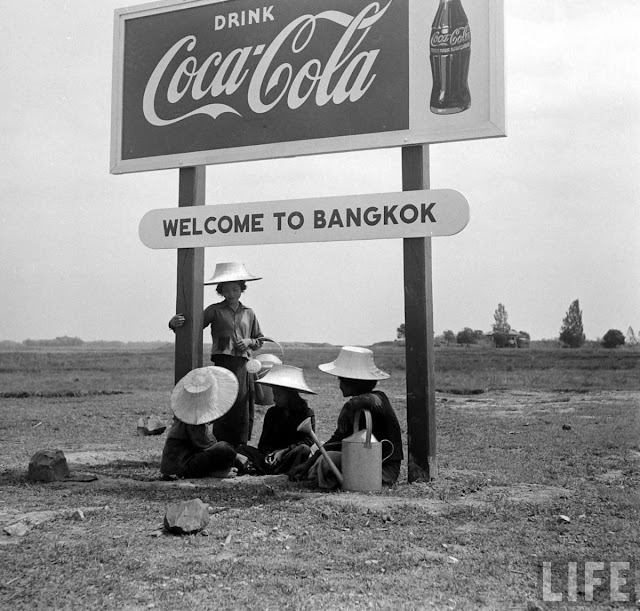
Take a look back in Bangkok through these amazing photographs taken by LIFE photographer Dmitri Kessel in 1951.
The corkscrew car jump in The Man With The Golden Gun (1974) is among the most spectacular stunts in the 007 series. In hot pursuit of Scaramanga (Christopher Lee) in Bangkok, Bond (Roger Moore) steals a red AMC Hornet from a car showroom, coincidentally with a vacationing Sheriff J.W. Pepper (Clifton James) from Live And Let Die (1973) in the passenger seat. During the chase, Bond and Pepper find themselves on the other side of a river forcing Bond to reverse and make a spectacular jump across the water spinning 360 degrees in mid air before landing safely on the other side.
The idea for the set-piece started when stunt driver Joie Chitwood (who worked on Live And Let Die) sent director Guy Hamilton a photograph of a car undertaking a corkscrew jump. The stunt, designed by Raymond McHenry on a computer inspired by his work on a simulation of single vehicle accidents, was part of The American Thrill Show, staged by JM Productions. The so called Astro Spiral Jump had wowed audiences all across the US and was now licensed to The Man With The Golden Gun team to immortalize on film.
Based on mathematical and computerized calculations provided by the Calspan Corporation in New York, the car had to be perfectly balanced so the driver and steering wheel are exactly in the middle. It also had to hit a curved ramp at exactly 48 miles per hour — two tachometers were on board to check this — meaning a long run up was essential.
On June 1, 1974, day 35 of production, the crew, guided by stunt co-ordinator W.J. Milligan Jr, assembled on the canal at Klong Rangsit, Thailand. With the ramp disguised as a tumbledown bridge, the spiral jump was performed by Loren “Bumps” Willert in Bond’s AMC Hornet X Hatchback. Two dummies of Bond and Sheriff Pepper were positioned either side of Willert, who was dressed in black so he wouldn’t register on camera.
“The guy who did the roll had never driven the car before or ever done it,” recalled Guy Hamilton. “He wasn’t concerned because as long as it had the run up, so long as it’s 48 miles per hour, the rest is automatic. You hang on, cross your fingers, and bingo he did it in one take.”
Yet Willert didn’t just do the jump for the cameras; he also did it for an assembled crowd.
“Some people didn’t believe we actually did the stunts,” said marketing executive Hy Smith. “We took about 100 press from Europe in a rented 747 to Thailand. Despite that they saw the car corkscrew 360 degrees from one side of the river to the other, when the picture came out, many of them said it was the most wonderful special effect they’d ever seen.” But the courageous act that wasn’t lost on the star. After witnessing the astonishing jump, Roger Moore told the stunt team: “You fellas make me look good.”
Bangkok is the capital and most populous city of Thailand. The city occupies 1,568.7 square kilometres (605.7 sq mi) in the Chao Phraya River delta in central Thailand.
The city, incorporated as a special administrative area under the Bangkok Metropolitan Administration in 1972, grew rapidly during the 1960s through the 1980s and now exerts a significant impact on Thailand's politics, economy, education, media and modern society.
Bangkok is known for its street life and cultural landmarks, as well as its red-light districts. The Grand Palace and Buddhist temples including Wat Arun and Wat Pho stand in contrast with other tourist attractions such as the nightlife scenes of Khaosan Road and Patpong.
The city is among the world’s top tourist destinations, and has been named the world’s most visited city consistently in several international rankings.
Here below is a set of vintage color photos from jcator that show street scenes of Bangkok in 1955.
The Chao Phraya River is an iconic symbol of Bangkok and a life-giver to Thailand’s various provinces through which it flows. The ‘River of Kings’ has a rich history, acting as a gateway to some of the capital’s most prestigious attractions.
The importance of the Chao Phraya River stretches as far back as the 15th century. Settlers chose the area that is now Bangkok for its fertile lands (it was once a swamp, after all), in addition to its strategic position close to the river’s mouth. The Thai capital was later relocated from Ayutthaya to the Chao Phraya’s western banks (modern-day Thonburi), and later still to the opposite side of the water. Both settlements were ultimately joined as one larger capital, now known as Bangkok (or Krung Thep in Thai).
Modern-day development across Bangkok has evolved the landscape along the river beyond recognition. Authorities have evicted numerous communities along the river in Bangkok during recent years, alleged to have been illegally occupying land. This is to make way for the controversial development of an enormous riverside promenade, stretching all the way from the Rama 7 Bridge in the north to Phra Pinklao Bridge towards the south.
Here, a gallery of 50 amazing photographs of life on the Chao Phraya river taken by Dmitri Kessel for LIFE magazine from the early 1950s.
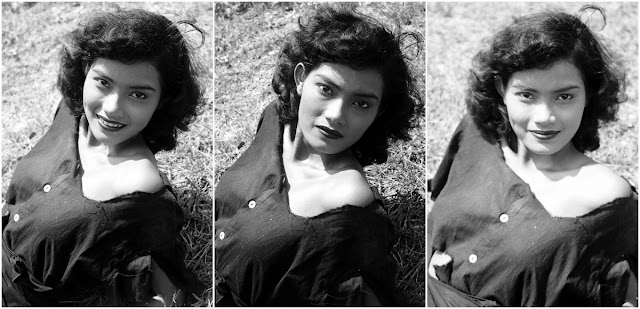
These fascinating portraits of an unknown Bangkok girl were taken by photographer Dmitri Kessel for LIFE magazine in the 1950s.
Dmitri Kessel (1902–1995) was a photojournalist and staff photographer on LIFE magazine known for his courageous coverage of war on the front line, including reports on the liberation of Europe and conflict in the Congo.
Kessel was born as Dmitri Kesselman in Kiev to the family of sugar beet farmers and landowners Solomon and Sonja Keselman. He emigrated to the US via Romania in 1923 (naturalized 1929) to New York City and worked at part-time jobs in the fur industry and for Russian-language newspapers. He attended night classes at City College, then in 1934 attended Ben Magid Rabinovitch’s (1884–1964) School of Photography. His training in photography coincided with rapid changes within the medium itself.
Exploiting his industrial experience and contacts, he specialized in photography for factory owners. This led to his being signed on as a freelance for Henry Luce’s Fortune in 1935, which secured his success as a photojournalist, with assignments to cover World War II from 1939. He became a staffer and war correspondent for LIFE in 1944, and he remained with the magazine until 1972.
Bangkok became the capital of Siam (as Thailand was previously known) in 1782, when General Chao Phraya Chakkri, the founder of the ruling Chakkri dynasty, assumed the throne as Rama I and moved the court from the west to the east bank of the Chao Phraya River.
Since World War II Bangkok has grown with unprecedented rapidity, which caused problems with transportation, communication, housing, water supply, drainage, and pollution. Tourism rose in importance during the Vietnam War, when the city became a popular destination for U.S. military personnel.
Bangkok was beguiling, charming, soft, sophisticated, relatively orderly but always accommodating, adapting to the demands and needs of a modernizing Siamese public and American influences. From the 1950s, rapid changes took place throughout the nation. Free enterprise in commerce was the order of the day and a free-wheeling social scene was swinging. The pleasure-loving, gracious and hospitable Siamese made it easy then for Americans to thrive here.
Bangkok is the capital and most populous city of Thailand. It is known in Thai as Krung Thep Maha Nakhon or simply Krung Thep. The city occupies 1,568.7 square kilometres (605.7 sq mi) in the Chao Phraya River delta in central Thailand.
Bangkok is now a regional force in finance and business. It is an international hub for transport and health care, and has emerged as a centre for the arts, fashion, and entertainment. The city is known for its street life and cultural landmarks, as well as its red-light districts. The Grand Palace and Buddhist temples including Wat Arun and Wat Pho stand in contrast with other tourist attractions such as the nightlife scenes of Khaosan Road and Patpong.
Bangkok is among the world’s top tourist destinations, and has been named the world’s most visited city consistently.
These candid photos were taken by Jack L Green that show the inside of a Bangkok bar in 1972.