Bring back some good or bad memories


ADVERTISEMENT
Showing posts with label Singapore. Show all posts

November 2, 2025

In November 1976, John Lennon Visited Singapore on a Private Trip, Staying Five Days Under a Pseudonym “John Girskin”

In November 1976, John Lennon arrived in Singapore without fanfare. To avoid fans and the press, he checked into the Hyatt Hotel on Scotts Road under the pseudonym “John Girskin.” He stayed alone for five days and reportedly gave strict instructions to the hotel not to disclose his stay.

During his five-day stay, he was mostly holed up at the hotel, where he wrote postcards to friends and family. He also ventured out for some shopping. According to one account, he was “just trying to do average things, like an average person.” He later mentioned in a Rolling Stone interview that his travels during that period took him to Singapore, South Africa, Hong Kong, and Bermuda.

John Lennon at a bar in Bugis, Singapore in 1976.

Despite his efforts to remain anonymous, Lennon was recognized by a fan while shopping at the old Metro Golden Mile department store (which no longer exists today). The fan was a Singapore Airlines flight stewardess named Jzenea Foo. She approached the tall man she thought looked familiar and asked if he was John Lennon. When he confirmed, she was able to quickly ask a friend who was with her to take a picture.

“I was shopping with a friend when I saw a tall man at one of the counters,” Jzenea recalled. “I thought he looked extremely familiar, so I went up to him and asked him if he was John Lennon. When he said ‘yes’ I was so excited. I almost lost my voice, but very quickly I asked my friend, who was carrying a camera, to take a picture of us. He was very nice about it and obliged by going to a corner for a photo.”

“Later when he was going down by the escalator, my friend and I were behind him. He turned around and asked, ‘Are you following me?’ I think he was afraid of being seen by the public,” said Jzenea.

Jzenea Foo pictured with John Lennon, 1976.

The encounter was later reported in the now-defunct Singapore newspaper New Nation on December 11, 1976, under the headline, “The day S’pore Girl ‘caught’ Lennon shopping at the Metro...”

It was also noted that Lennon had kept his hair short enough, which was fortunate, as Singapore at the time had a well-known "Operation Snip Snip" government campaign against men with long hair. Other musicians, such as Kitaro and Led Zeppelin, were reportedly denied entry unless they cut their hair.

June 15, 2022

Incredible Photos of the Bukit Ho Swee Fire, Singapore in 1961

The Bukit Ho Swee fire was a conflagration that broke out in the squatter settlement of Bukit Ho Swee, Singapore on May 25, 1961. This fire resulted in 4 deaths and injured another 54. It also destroyed more than 2,800 houses around the Bukit Ho Swee area, leaving around 16,000 people homeless. The cause of this conflagration was never established. The Bukit Ho Swee fire was the biggest outbreak of fire in Singapore’s history.

The fire was a pivotal point in Singapore’s contemporary history. The scale of the destruction sparked an emergency project to swiftly construct accommodation and resettle the people affected by the disaster. This first public housing project, led by the newly formed Housing and Development Board, would eventually lead the way to the development of public housing throughout the country in decades to come.

These incredible photos from Ronnie Bell were taken in June 1961 that show street scenes of Bukit Ho Swee after the fire.


March 24, 2022

Singapore in the Late 1970s Through Fascinating Photos

With the economic boom of the late 1960s and 1970s, new jobs were created in the private sector. The government provision of subsidized housing, education, health services and public transportation generated new jobs in the public sector. The Central Provident Fund, the country’s comprehensive social security scheme sustained by compulsory contributions by employer and employee, provided the necessary capital for government projects and financial security for the country’s workers in their old age.

By late 1970s, the government changed its strategic focus to skill and technology-intensive, high value-added industries and away from labor-intensive manufacturing. In particular, information technology was given priority for expansion and Singapore became the world’s largest producer of disk drives and disk drive parts in 1989.

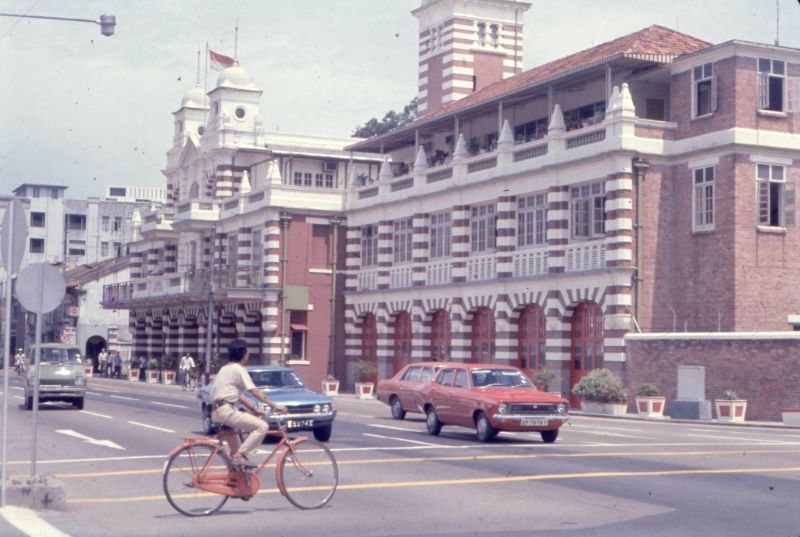
These fascinating photos from genibee captured street scenes of Singapore in the late 1970s.

Hill Street Central Fire Station, Singapore, 1978

Hill Street Central Fire Station, Singapore, 1978

Hill Street Central Fire Station, Singapore, 1978

Hill Street Central Fire Station, Singapore, 1978

Hill Street, Singapore, 1978

October 2, 2021

45 Photos Capture Street Scenes of Singapore in the Early 1970s

Singapore is a sovereign island city-state in maritime Southeast Asia. It is composed of one main island, 63 satellite islands and islets, and one outlying islet, the combined area of which has increased by 25% since the country’s independence as a result of extensive land reclamation projects.


Singapore has the second greatest population density in the world. With a multicultural population and recognizing the need to respect cultural identities, the country has four official languages; English, Malay, Mandarin, and Tamil. English is the lingua franca. Multiracialism is enshrined in the constitution and continues to shape national policies in education, housing, and politics.

After early years of turbulence and despite lacking natural resources and a hinterland, the nation rapidly developed to become one of the Four Asian Tigers based on external trade, becoming a highly developed country; it is ranked ninth on the UN Human Development Index and has the second-highest GDP per capita (PPP) in the world.

Singapore is placed highly in key social indicators: education, healthcare, quality of life, personal safety, and housing, with a home-ownership rate of 91%. Singaporeans enjoy one of the world's longest life expectancies, fastest Internet connection speeds and one of the lowest infant mortality rates in the world.

These fascinating photos were taken by wilford peloquin that show what Singapore looked like in 1971.


January 8, 2021

Rare and Amazing Photographs of David Bowie Wandering Around Singapore in 1983

The Serious Moonlight Tour was launched in May 1983 in support of David Bowie’s album Let’s Dance; 15 countries visited, 96 performances, and over 2.6M tickets sold. The tour garnered mostly favorable reviews from the press. It was, at the time, his longest, largest and most successful concert tour to date, although it has since been surpassed in length, attendance and gross revenue by subsequent Bowie tours.

Stopping by Singapore to perform at the former Singapore National Stadium, David Bowie had a bit of time to roam around the country and even chronicled his adventures — talking to taxi drivers, making new friends with Chinese opera performers, learning about Singapore’s 70s rock culture through a local journalist, and even nearly getting in trouble with a shopping mall security guard in town.


September 27, 2020

45 Amazing Photos Capture Street Scenes of Singapore in 1971

Singapore is a sovereign island city-state in maritime Southeast Asia. It lies off the southern tip of the Malay Peninsula, bordering the Straits of Malacca to the west, the Riau Islands to the south, and the South China Sea to the east.


Singapore is widely regarded to have an incorrupt and meritocratic government, with a fair judiciary and strong rule of law. One of the five founding members of ASEAN, Singapore is also the headquarters of the Asia-Pacific Economic Cooperation (APEC) Secretariat and Pacific Economic Cooperation Council (PECC) Secretariat, as well as many international conferences and events.

Singapore is also a member of the United Nations, World Trade Organization, East Asia Summit, Non-Aligned Movement and the Commonwealth of Nations.

Here below is a set of amazing photos from gcosserat that shows street scenes of Singapore in 1971.


February 19, 2020

25 Fascinating Photos Capture Street Scenes of Singapore in the 1970s

Singapore gained independence as the Republic of Singapore on 9 August 1965 with Lee Kuan Yew and Yusof bin Ishak as the first prime minister and president respectively. In 1967, the country co-founded the Association of Southeast Asian Nations (ASEAN). Race riots broke out once more in 1969.

By the 1970s, Singapore was beginning to industrialise, but Singapore River became badly polluted. In 1977, a successful 10-year clean-up began.

Lee Kuan Yew's emphasis on rapid economic growth, support for business entrepreneurship, and limitations on internal democracy shaped Singapore's policies for the next half-century and the country progressed to a First World country.

These fascinating pics were taken by genibee that show what street scenes of Singapore look like in the 1970s.


April 2, 2018

Singapore in the Mid-1960s Through an Englishman's Lens

These fascinating photos were taken by David Ayres that shows everyday life of Singapore from 1965 to 1967.

Corner of Beach Road and Middle Road; on the right was the Tay Koh Yat ticketing office; about four shops back is the York Kee bar

Dockyard workers going home from Sembawang dockyard

Evening fishing on the south coast of Singapore

Food stall on Albert Street

Hawker stall (the first Satay Club); the building is Singapore Hainan Hwee Kuan (Hui Guan) at the junction of Beach Road and Middle Road

January 24, 2018

January 1, 2018

The Bee Gees, Kitarō, and Led Zeppelin Could Not Perform in Singapore in the 1970s Because of a Hair Campaign

A ban on long hair once existed in Singapore. In the 1960s, a Singapore government policy forbidding any male to sport long hair went into effect. This was in response to the growing popularity of the hippie subculture worldwide; the government deemed such an influence to be negative and detrimental to the country's development.

In 1974, an anti-long hair drive called Operation Snip Snip (yes, it really was called that), was carried out in Singapore. During that time, men with long hair (i.e. hair below the collar, covering the ears, forehead and eyelashes) were seen as untidy and deviant, potentially disrupting social order.


What this entailed was that civil servants who refused to cut their hair short would have their employment terminated.

Posters were also put up around government agencies’ offices that stipulated that “males with long hair will have their need attended to last”. The posters also appeared in different languages:

The government is to step up the campaign against the cult of the long unkempt hair among males in the republic. For some time now certain government departments, like immigration and schools as well as institutions of higher learning had been taking action against males with long and unkempt hair. The campaign will take another step forward when all government offices dealing with the public will display posters in English, Chinese and Malay with the message: 'males with long hair will be attended to last'. (Photo: National Archives of Singapore)

Visitors who refused to cut their long hair were also turned away at immigration. At the Woodlands checkpoint, visitors were made to do quick haircuts at a barber stall nearby:

More than 500 people with long hair are said to have been turned back at the immigration checkpoint in Woodlands and told to get a haircut before entering Singapore since government began 'Operation Snip Snip'. Most of them who had urgent business with their friends and relatives made do with a quick haircut at a barber stall 50 yards away from the checkpoint. (Photo: National Archives of Singapore)

The music scene was also affected because of this policy on long hair. Among others, the Bee Gees, Kitarō, and Led Zeppelin all were forced to cancel their gigs in Singapore because they refused to accommodate the policy.

Jimmy Page and his new band Led Zeppelin had their show cancelled on 14th February, 1972 because they refused to cut their long hair. Also in the same year the Bee Gees were all here in Singapore to play their music but were forced home immediately after performing on stage at the National Theatre on March, 21st because their hair were too long.

British pop group the Bee Bees at Hyatt Hotel, Singapore. From left brothers Barry, Robin And Maurice Gibb. (Photo: National Archives of Singapore)

The campaign gradually eased off in the 1980s.

To be fair to the Singapore government, not only did this island discourage males from sporting long hair. Other countries in the 1970s followed the same trend. Cities like Kuala Lumpur in Malaysia, Seoul in South Korea, Melbourne in Australia and even Dublin in Ireland were strict with male students who sported long hair.

(via Mothership)

September 5, 2017


FOLLOW US:
FacebookTumblrPinterestInstagram

CONTACT US


Browse by Decades

Popular Posts

Advertisement

09 10