Bring back some good or bad memories


ADVERTISEMENT
Showing posts with label Shanghai. Show all posts

November 3, 2021

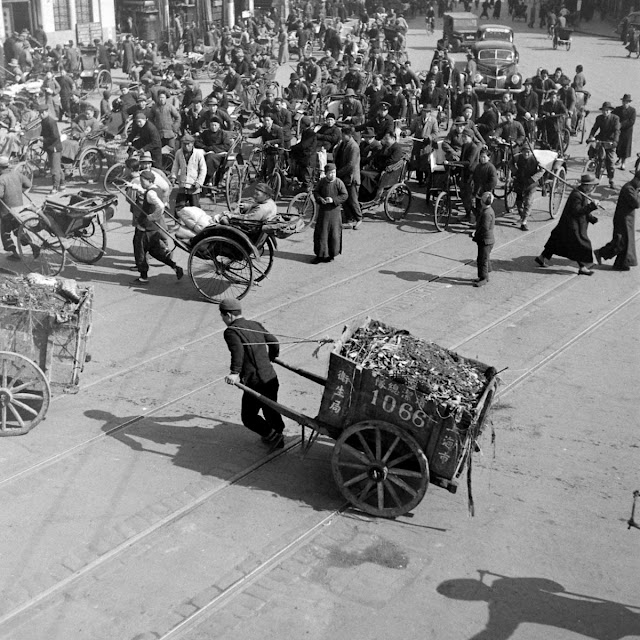
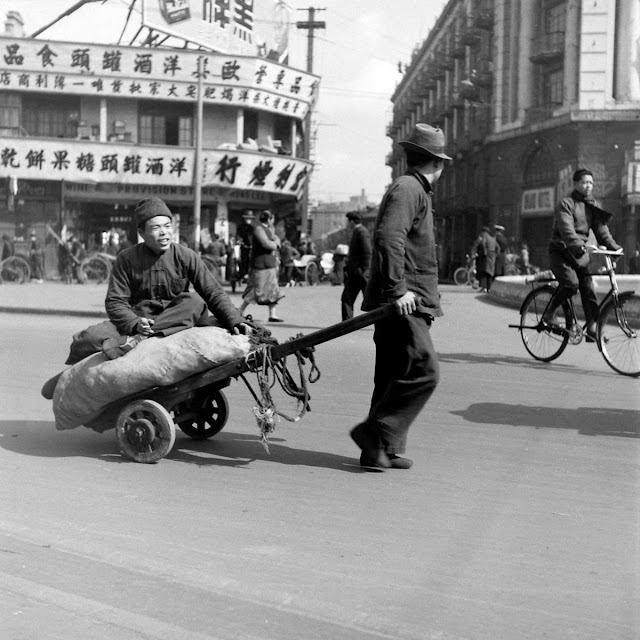
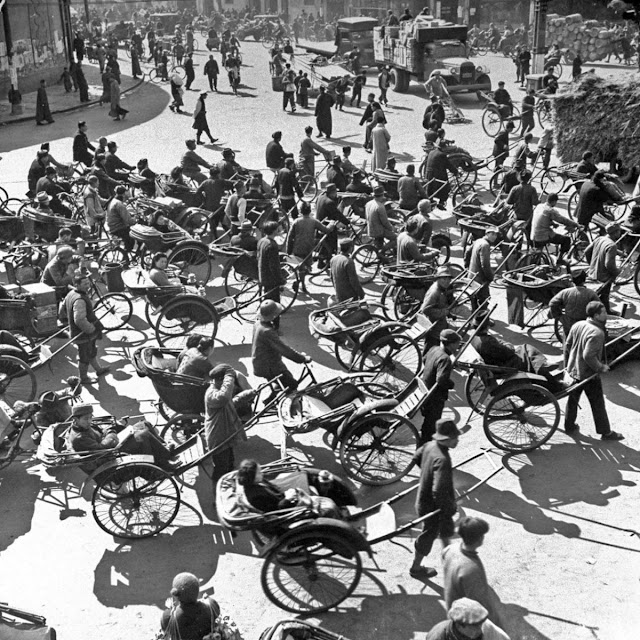
Street Life of Shanghai in 1947

“A great, wicked and quite extraordinary city” was how, in 1947, LIFE described Shanghai. In 1947, four million people had made the City their residence (today, that number is 26 million). It seemed that at any one time, a very substantial proportion of the population was on the Shanghai streets.
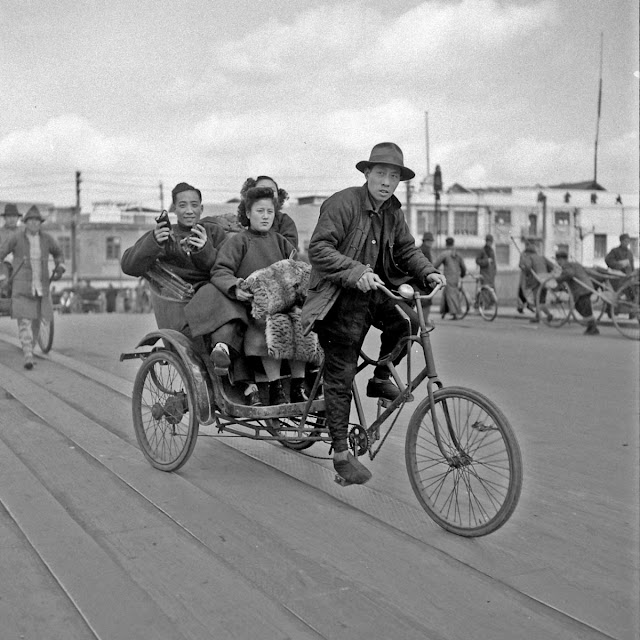
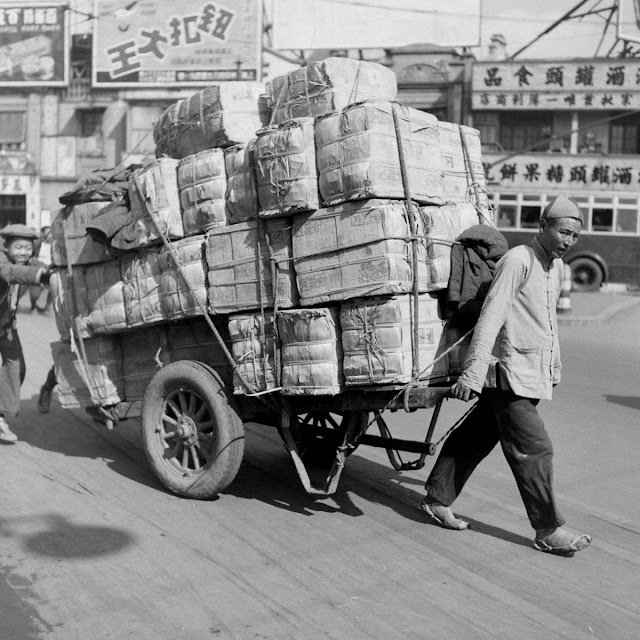
“The traffic has become a monstrous, screaming blend of rickshaws, coolie-powered push carts, limousines, three-wheeled pedicabs, jeeps and six-ton trucks,” exclaimed LIFE.

These vintage photographs, taken by Mark Kauffman (1921-1994), depict some of the many and various human-powered vehicles to be found on the streets of Shanghai in 1947.

Kauffman was an award-winning photographer for LIFE magazine. At 17, he became the youngest photographer ever to shoot a cover for the magazine, when he did a photo portrait of Eleanor Roosevelt. He was a staff photographer for over 30 years, covering events in the United States, Europe and the Far East. He received the White House News Photographers’ Grand Award in 1953. He later served as director of photography for Playboy magazine for five years and was a professor of photography at California Polytechnic State University.


October 5, 2021

50 Photos Capture Street Scenes of Shanghai in the Mid-1970s

Shanghai is one of the four direct-administered municipalities of the People’s Republic of China, governed by the State Council. The city is located on the southern estuary of the Yangtze River, with the Huangpu River flowing through it. It is the most populous urban area in China, the most populous city proper in the world and the only city in East Asia with GDP greater than its corresponding capitals.

Shanghai is a global center for finance, business and economics, research, education, science and technology, manufacturing, tourism, culture and transportation, and the Port of Shanghai is the world's busiest container port.

Shanghai has the largest metro network of any city in the world, the sixth-highest number of billionaires of any city in the world, the fifth-largest scientific research output of any city in the world, and highly ranked educational institutions including four Project 985 universities: Fudan University, Shanghai Jiao Tong University, Tongji University, and East China Normal University.

Shanghai is also known for its sugary cuisine, distinctive local language and vibrant international flair. It is the highest earning tourist city in the world, with the seventh most five-star hotels in the world, and the second tallest building in the world, the Shanghai Tower.

These fascinating photos were taken by Michael Rank that show street scenes of Shanghai in 1976.

Nanjing Road, Shanghai, 1976

Nanjing Road, Shanghai, 1976

Nanjing Road, Shanghai, 1976

Nanjing Road, Shanghai, 1976

Nanjing Road, Shanghai, 1976

February 28, 2019

30 Amazing Black and White Photos That Document Everyday Life of Shanghai in the Mid-1980s

Shanghai is one of the four municipalities under the direct administration of the central government of the People's Republic of China, the largest city in China by population, and the second most populous city proper in the world. It is a global financial centre and transport hub, with the world's busiest container port.

Located in the Yangtze River Delta, it sits on the south edge of the estuary of the Yangtze in the middle portion of the East China coast. The municipality borders the provinces of Jiangsu and Zhejiang to the north, south and west, and is bounded to the east by the East China Sea.

Shanghai has been described as the "showpiece" of the booming economy of mainland China; renowned for its Lujiazui skyline, and museums and historic buildings, such as those along The Bund, as well as the City God Temple and the Yu Garden.

These amazing photos were taken by Belgian-American photographer Jerome De Perlinghi that documented everyday life of Shanghai from between 1985 and 1987.


February 7, 2017

Rare Hand-Colored Photos of Shanghai From the 19th Century

Born in Britain in 1832, William Saunders moved to China in the 1850s and opened a photography studio in Shanghai in 1862. One of the first photographers in the city, Saunders focused primarily on portraiture but also photographed street life, local customs, current events, scenic views, and even executions.

His photographs, intended for tourists and Westernes, were often based on compositions of earlier gouaches made for export. He was one of the main commercial photographers in China in the nineteenth-century.

A series of fifty prints—Portfolio of Sketches of Chinese Life and Character—was published in 1871. This portfolio, in addition to his photographic contributions to Illustrated London News and other publications, disseminated information about life in China to Westerners. Saunders died in 1892.

A Young Lady from Canton: Shanghai not only attracted foreign business people but also immigrants from other parts of China. Saunders’ portraits often featured props signifying the trades or social status of their subjects, but in this case a young woman from Guangzhou stands beside a floor vase holding only a parasol. Her unbound feet and headscarf were typical of the women of Canton (modern-day Guangdong province) in the late Qing era. Image courtesy of the Stephan Loewentheil Historical Photography of China Collection

Shanghai Woman and Child: This woman and girl are said to be from Keangsoo (Jiangsu) province, north of Shanghai. Their hairstyles are typical of the region, while their bound feet indicate how the practise was spread among a wider range of social classes than is often thought. Parasols, which were considered accoutrements of the nobility in ancient China were in high fashion in late Qing dynasty Shanghai. Image courtesy of the Stephan Loewentheil Historical Photography of China Collection

The Hand Carriage: Saunders was fascinated by traditional Chinese technology, much of which he believed predated similar inventions in the West. In this photograph, two men pose on a man-powered vehicle — a wheelbarrow, essentially. The driver stands at the rear. The assertive gazes of the three men suggests an ease in front of the camera that was seemingly rare at the time in China. Image courtesy of the Stephan Loewentheil Historical Photography of China Collection

A Canton Woman: The woman in this portrait, though wearing the traditional silk dress of her native Guangzhou, sits in a Western-style chair in profile — a Western photographic compositional portrait format. Although Shanghai had its own walled Chinese city, many residents chose to live in the foreign settlements. Thus began a mixing of cultures that shaped Shanghai’s openness to foreign influence. Saunders clearly took particular interest in this woman’s elaborate hairstyle, fine clothing, and slippered, unbound feet. Image courtesy of the Stephan Loewentheil Historical Photography of China Collection

Shanghai Woman: According to Saunders, the woman in this portrait, a resident of Shanghai who is seen wearing a typical spring dress, consented to his request to show her unbandaged bound foot. Her feet feature prominently as she sits in a Western-style chair, fixing the camera with a direct, proud gaze. Image courtesy of the Stephan Loewentheil Historical Photography of China collection

February 2, 2016

Amazing Photographs Capture Everyday Life of Old Shanghai During the 1920s and 1930s

Old Shanghai was a city unlike any other. Notable for its free port, it was where the whole world came to work and play. Disparate Europeans and adventuring Americans rubbed shoulders with Jewish émigrés, Japanese expats and Russians: it was indeed a city with many faces.

In the 1920s, an eighteen year old Frenchman called Louis-Philippe Messelier set forth for the city of Shanghai to partake in the buzzing wool trade there. Based in the French concession of Shanghai, he juggled his business career with taking photographs as a journalist for the French Journal of Shanghai.

Louis-Philippe Messelier was everywhere: down the streets to see the ritual processions, the acrobats and the snake charmers; at the races with the local aristocracy; inside film studios; on the top of roof taking aerial views; in the countryside admiring the beauty of antic remains or fishermen’s cottages. He captured everything in a sincere and singular manner.

Snake charmer, Shanghai, 1929

Japanese ladies in Shanghai's harbor, 1930

Shanghai, the Bund, 1929

Crowd and boats on the bund N°1, Shanghai, 1929

Crowd and boats on the bund N°2, Shanghai, 1929

January 19, 2016

Last Days of Shanghai: Photos by Jack Birns Give Us a Sense of What China Was Like From 1947-1949

Shipping out to China in December 1947 with three ten-year-old German cameras and a plum assignment from LIFE magazine, Jack Birns was fulfilling a boyhood dream. The reality was something else: refugees and prostitutes, soldiers and beggars, street executions and urban protests photographed in difficult and often dangerous circumstances amidst the poverty, corruption, and chaos of an expanding civil war.

By then the ruling Nationalist Party had been battling the Communist threat for more than two decades, and Birns focused his camera on the human drama unfolding as war pressed ever closer to the country's financial, cultural, and commercial capital. His effort to show China's misery up close ran afoul of Time-Life publisher Henry R. Luce's fervent anti-communism, and for half a century many of these historic photographs lay unpublished in Time-Life's archives.

Seen through the lens of hindsight, Birns' photographs give us a sense not only of what China was like more than fifty years ago, but also of why the warfare, weariness, and desperation of the time proved such fertile soil for communist revolution.

Today these everyday scenes of ordinary people—pedicab drivers, street vendors, bar girls, police, politicians, prisoners—tell a story of national resilience and dignity in the midst of enveloping poverty, repression, and fear. Birns's stark black and white photographs capture the dramatic end of an era, but they also look forward, letting us glimpse how Shanghai's past prefigures the city's commercial and cultural revival in the 1990s.


March 20, 2014

24 Amazing Black and White Photos Capture Daily Life in Shanghai During the First Half of the 20th Century

The development of “Modern Shanghai” started at the beginning of the 20th century. Municipal government and public facilities brought by international settlements; telegrams, telephones, and movies, balls, and other Western lifestyles brought by technological development; these factors collectively created a unique city: Shanghai. Photo is of 1902, of the Shanghai Volunteer Corps proceeding along Nanjing Road, participating in a parade. The Shanghai Volunteer Corps were established in 1853, with the purpose of protecting foreigners against the chaos of war. (Photo source: Shanghai: 1842-2010, Portrait of a Great City Post Wave Publishing)

Photo is of 1906, Shanghai’s business street. At the time, Shanghai had already become the most bustling city in China’s East and even the entire country, with flourishing commerce. Getty/UIG

Due to the needs of trade communications and the development of telegraph technology, Shanghai’s banking business developed quickly, already becoming one of the Far East’s financial hubs by the start of the 20th century. Photo is of 1913, inside the International Savings Society on Shanghai’s Avenue Edward (today’s Yan’an East Road). The International Savings Society was established by the French in October 1912, where it operated until 1937 when it was outlawed by the Nationalist government. (Photo source: Shanghai: 1842-2010, Portrait of a Great City Post Wave Publishing)

Apart from feelings of unfairness brought by the foreign concessions, Shanghai locals also accepted the dividends brought by the foreign concessions. It became China’s fastest developing city at the beginning of the 20th century, escaping the Taiping Heavenly Kingdom and Boxers catastrophes, the people here also being the very first to experience a true modern city, experience the media, advertisements, films, high-level education, etc. Photo is of Shanghai in the early 20th century, near the Hongkou market, where everyday were many local fishermen, peasant farmers, and butchers came to sell their goods. Corbis

1907, workers for The Shanghai Electric Construction Co. Ltd. on Nanjing Road laying streetcar trolley rails. This was Shanghai’s first railed streetcar line, that ran mostly along the business street, from Jingan Temple to the Shanghai Club Building, a total of 6.04 kilometers, its main stop located at the Shanghai Club Building. (Photo source: Shanghai: 1842-2010, Portrait of a Great City Post Wave Publishing)

October 18, 2013

March 5, 2013

Beautiful Shanghai Studio Portraits From the 1920s

In 1921, Sioma Lifshitz, also known as Sam Sanzetti, a Russian of Jewish heritage, jumped on a British boat from Vladivostok, beginning an incredible journey to Shanghai.

Born in 1902 on Russia’s Crimean Peninsula, Sanzetti never attended school, but received education from his schoolteacher father. At 13, he followed his parents to Harbin, China, where he worked two years as a delivery boy in a department store. When his family moved back to Russia, Sanzetti began working construction rebuilding a demolished foundry, and his employer dispatched him to Vladivostok to acquire some parts. “There,” said Sanzetti, “I was prevented by the Japanese from carrying out my mission and was forced into hiding. The day after Japan’s ‘slaughter night,’ I escaped to Shanghai.” At that point, he was 17.

In the years that followed, Sam Sanzetti made a living shining shoes. Eventually, he opened a photo studio, and business expanded until he was operating four Shanghai branches and employing 41. The studio was first located on 73 Nanking Road (today 73 Nanjing Dong Lu), near the Bund and just behind the Palace hotel (today Swatch Art Peace Hotel).


Construction on the Cathay Hotel (today Peace Hotel) was on-going at that time very and the opening in 1929 certainly also helped his business. The central position in the business center allowed him to become the photographer of the rich and famous in Shanghai, surely meeting with other successful business people of the time.

Over three decades, he took more than 20,000 photos and attracted celebrity clients, including the Italian envoy to Shanghai during the Mussolini regime, the local representative of the Pope, India nobles, the mother of Soong Tse-ven (1891-1971), a prominent businessman and politician of early 20th-century China, movie stars, and tycoons.

As the most successful photography studio in Shanghai at the time, he catered primarily to the middle class and above, who could afford such an expense.


FOLLOW US:
Facebook • Tumblr • Pinterest • Instagram

CONTACT US


Browse by Decades

Popular Posts

Advertisement

09 10