Bring back some good or bad memories


ADVERTISEMENT
Showing posts with label Serbia. Show all posts

March 18, 2026

Milunka Savić, a Serbian War Heroine Who Became the Most Decorated Female Combatant in the History of Warfare

In 1912, Milunka Savić made a decision that would define her life and etch her name into history. When her brother was too ill to serve in the Balkan Wars, she cut her hair, donned men’s clothing, and joined the Serbian army under the name Milun Savić.

Milunka fought undetected for nearly a year, proving herself to be an elite soldier and a gifted grenadier. Her secret was only revealed during the Second Balkan War (1913) at the Battle of Bregalnica, where she was wounded in the chest by a Bulgarian shell. While treating her injuries, army doctors discovered “Milun” was actually a woman.

When her true identity was revealed, her commanding officer was in a bind. She was one of his best soldiers, but military law didn’t exactly have a “decorated female infantry” clause. He offered her a transfer to a nursing division. Milunka refused, insisting she belonged on the front lines. The officer told her he would think it over and give her an answer the next day. Milunka reportedly stood at attention and replied: “I will wait.” After standing in the cold for only an hour, the officer relented and sent her back to the infantry.

During the Great War, Savić’s reputation reached international proportions. She was a key member of the elite “Iron Regiment.” Her skill with hand grenades was particularly feared; she was known for her "accuracy of a sniper" when clearing enemy trenches.

In 194, she earned her first Order of the Star of Karađorđe with Swords (Serbia’s highest award) after capturing 20 Austrian soldiers single-handedly. In 1916, she captured 23 Bulgarian soldiers alone. For this, she received a second Star of Karađorđe. She is the only woman to ever receive the French Croix de Guerre 1914–1918 with a gold palm. She was also awarded the British Order of St Michael and St George, the Russian Order of St. George, and the French Legion of Honour (twice).

Despite her fame, Milunka’s later years were defined by quiet selflessness. After the war, she turned down an offer to move to France (where she would have received a comfortable pension) to stay in Belgrade. She worked as a cleaning lady, a bank teller, and a factory worker. However, she used her modest means to adopt and raise over 30 orphaned children in addition to her own daughter. She was largely forgotten by the public until the 1960s, when a resurgence of interest in WWI veterans brought her story back to the forefront.

Milunka Savić died in 1973 at the age of 84. Today, she is remembered as a national hero in Serbia, a woman who went to war for her brother and ended up becoming a legend of the 20th century.


June 6, 2021

The Story of Baba Anujka, the World’s Oldest Serial Killer

Known variously as the Banat Witch or the Witch of Vladimirovac, but best known as Baba Anujka, Ana di Pištonja was an accomplished amateur chemist and a convicted killer from the village of Vladimirovac, Yugoslavia (in Serbia). She poisoned at least 50 people and possibly as many as 150 in the late 19th and early 20th centuries. She was apprehended in 1928 at age 90 and sentenced to 15 years in prison in 1929 as an accomplice in two murders. She was released due to old age after spending eight years in prison.


Not a lot is really known about Anujka’s youth as records are incomplete or just missing as many are for that time period. According to some sources, she was born in 1838 in Romania to a rich cattleman and moved to Vladimirovac in the Banat Military Frontier province of the Austrian Empire around 1849. However, she claimed that she was born in 1836. She attended private school in Pančevo with children from rich families, and later lived in her father’s house.

Baba Anujka allegedly became a misanthropist at age 20 after being seduced by a young Austrian military officer; she contracted syphilis from him before he left her broken-hearted. After that, she sought seclusion and started to show interest in medicine and chemistry. She spoke five languages. She later married a landowner named Pistov or di Pištonja with whom she had 11 children, only one of whom survived to adulthood. Her husband was much older than she, and died after 20 years of marriage. She continued to pursue her chemistry studies after his death.


Anujka made a laboratory in one wing of her house after her husband died, and she earned a reputation as a healer and herbalist in the late 19th century. She was popular with wives of farmers who sought her help for health problems, and she earned a respectable income which enabled her to live comfortably. She produced medicines and mixtures which would make soldiers ill enough to escape military service, and she also sold poisonous mixtures which she branded “magic water” or “love potions”. She sold the so-called “magic water” mostly to women with abusive husbands; they would give the concoction to their husbands, who would usually die after about eight days.

Anujka’s “love potion” contained arsenic in small quantities and certain plant toxins that were difficult to detect. When told about a marriage problem, Anujka would ask her client, “How heavy is that problem?”, which meant, “What is the body mass of the victim?” She was then able to calculate the dose needed. Anujka’s victims were usually men, typically young and healthy. Her clients claimed at her trial that they did not know that her “magic water” contained poison, but that they believed that she had some kind of supernatural powers to kill people using magic. Anujka’s potions killed between 50 and 150 people.

In the 1920s, Anujka had her own “sales agent”, a woman named Ljubina Milankov, whose job was to find potential clients and take them to Anujka’s house. The price of Anujka’s “magic water” fluctuated between 2,000 and 10,000 Yugoslav dinars.


Her downfall came through one of her regular clients, a woman named Stana Momirov who had previously killed her husband with one of Anujka’s love potions, as well as frequently purchasing herbal remedies from her. When Momirov remarried and a rich relative of her new husband died in similar circumstances she was arrested and questioned, implicating Anujka in the two killings.

A second death occurred nearly a year later, after Anujka sold a woman a potion with which to murder her husband’s father. After the man’s 16-year-old granddaughter was duped into administering the poison, the man fell ill and died. Nearly 18 months later Anujka was arrested, along with six others involved in the two killings. Her co-defendants turned the blame on her, claiming that they never knew the potions were poison and that they believed the deaths had been caused by Anujka’s supernatural powers. In response, Anujka denied ever selling them potions of any kind, insisting the entire case was an attempt to shift the blame onto her.

Ultimately, Anujka was sentenced to 15 years in prison for her role in the two murders. She was released after serving eight years on compassionate grounds. She died in 1938 in her home in Vladimirovac at the age of 100.


March 5, 2021

26 Funny Vintage Album Covers Released by Šaban Bajramović From Between the 1960s and 1990s

Šaban Bajramović (April 16, 1936 – June 8, 2008) was a Serbian vocalist and recording artist of Romani ethnicity. He was one of the most internationally critically acclaimed Romani singer-songwriters. Due to his eminent impact on music in Eastern Europe, he was dubbed the “King of Romani music.” During his career, which spanned over four decades, he recorded 50 singles and 20 albums, and he is believed to have written 700 songs.


At 19 years he ran away from the army, out of love. As a deserter, he was sentenced to three years prison on the island Goli Otok. He spent his time as a good goalkeeper in the prison football team. Because of his nimbleness and speed, they called him “Black Panther.” Soon he forced his way into the prison orchestra that played, among other things, jazz (mostly Louis Armstrong, Frank Sinatra, and sometimes John Coltrane) with Spanish and Mexican pieces.

After Goli Otok, his intensive music career began. He made his first record in 1964, with the recording act Crna mamba (Black Mamba). He continued to produce music with Crna mamba for 20 years. The highlight of their career was their performance for Indira Gandhi in India, where he gained the title “King of Romani music.” He also performed to Yugoslav politician Josip Broz Tito.

In the early nineties, he recorded “Đelem, Đelem,” which is considered the Romani people’s ethnic anthem. At the time, he decided to change his stage presence, starting to wear sunglasses while performing.

Bajramović was a prominent figure in Serbian music presenting Romani music in modern Serbian. Due to his enormous influence, on 12 August 2010, a statue to honor his impact was built. The statue had been vandalized multiple times. Time Magazine polled Bajramović in the top 10 best jazz musicians.


November 2, 2020

20 Black and White Photographs Capture Scenes of Knez Mihailova Street, Belgrade in 1983

Knez Mihailova Street is the main pedestrian and shopping zone in Belgrade, and is protected by law as one of the oldest and most valuable landmarks of the city. Named after Mihailo Obrenović III, Prince of Serbia, it features a number of buildings and mansions built during the late 1870s.

The street follows the central grid layout of the Roman city of Singidunum, as one of the main access roads to the city corresponds to the modern street today. The main axis of urban development was along the street, which was the main route of communication (via cardo).

One kilometer long Knez Mihailova Street was in 1979 included on the list of Spatial Cultural-Historical Units of Great Importance, and as such is protected by the Republic of Serbia.

These black and white photographs of Knez Mihailova Street below were taken by Bane Djordjevic in the spring of 1983.


August 30, 2020

20 Amazing Vintage Photographs That Capture Women’s Street Styles of Belgrade in the 1960s and 1970s

During the 1960s and 1970s, Belgrade was masterfully immortalized by photographer Branislav Bane Djordjevic, who paid special attention to female beauty, elegance, and fashion.


Djordjevic was a local music professor who has left a deep mark in the world of domestic photography since he was a patient observer of everything that was happening in Knez Mihailova Street.

As a member of the Belgrade Photo Club, he often photographed life on the streets and, thanks to his keen eye and sense of aesthetics, built a recognizable style and captured the time, fashion and beauty of the time.


March 29, 2019

Studio Portrait of Actress Olga Ilić by Milan Jovanović, 1900

Upper body shot of Olga Ilić. She is wearing the see-through costume of Śakuntalā from Kalidasa's ancient Hindu drama "The Recognition of Śakuntalā".


This picture is considered the first semi-nude photograph in Serbia. Olga Ilić, later Ilić-Hristilić (1880, Thessaloniki – 1945, Belgrade), was a famous Serbian actress. She was born the illegitimate daughter of Marija Gašparović and a Frenchman. Mother and daughter moved to Niš after Olga’s father had died. In Niš Olga started her acting career at the age of fourteen and pursued it as a travelling actress and playing at different theaters throughout the Balkans (e.g., Belgrade, Novi Sad, Leskovac, Niš, Skopje).

(© Muzej Pozorišne Umetnosti Srbije/ Museum of Theater Art of Serbia)

October 4, 2016

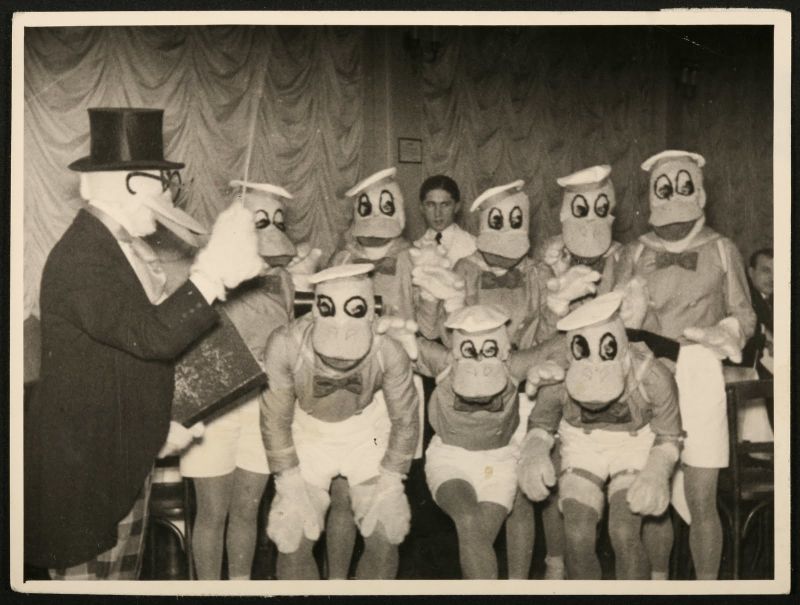
Disney Cosplay From Serbia in the 1930s

These two photos of enthusiastic Disney fans were taken in Serbia sometime in the 1930s. The former depicts a gang of grown men wearing history's most unnerving Donald Duck costumes; the latter is a bunch of Mickey Mouse-faced children playing the cello with some unnamed pig matron.


(via io9)

May 8, 2015


FOLLOW US:
Facebook • Tumblr • Pinterest • Instagram

CONTACT US


Browse by Decades

Popular Posts

Advertisement

09 10