Bring back some good or bad memories


ADVERTISEMENT
Showing posts with label Oklahoma. Show all posts

November 14, 2024

Rare Photographs Taken During the Making of the Film “The Outsiders” in Tulsa, Oklahoma in 1982

The Outsiders is a 1983 American coming-of-age crime drama film directed by Francis Ford Coppola. The film is an adaptation of the 1967 novel of the same name by S. E. Hinton.

The film was shot on location in Tulsa, Oklahoma. Filming took place from March 29 to May 15, 1982. A newspaper used to show a story about the three greasers saving the kids in The Outsiders includes a real story from 1982 regarding the death of a man hit by a train in Boston. Coppola chose Tulsa, where Hinton wrote the novel, to bring authenticity to the film, which made iconic local landmarks integral parts of its scenery.

These rare candid photographs were taken by Bixby High School Science teacher Jim Jordan during filming at the school. Mr Jordan was also an extra during the filming at Woodland Hills Mall.


July 17, 2024

July 16, 1935: The World’s First Parking Meters Were Installed in Oklahoma City, Oklahoma

On July 16, 1935, the world’s first parking meter was installed in Oklahoma City. It was invented by Carl Magee as a solution to parking congestion. The problem was that people who worked downtown occupied all of the parking spots, which forced retail customers to park far away from stores. The new parking meters solved this problem—and you could park for only 5 cents per hour!

Conceptualized in 1932 by Oklahoma Cityan, Carl C. Magee, the parking meter was a modern solution to a modern vexation, parking congestion. Magee arrived in Oklahoma City from New Mexico in 1927. In his former life he had worked as a reporter for an Albuquerque newspaper, had exposed the Teapot Dome scandal, and had testified against Secretary of the Interior Albert B. Fall. Magee was later arrested for manslaughter in an altercation with a New Mexico judge but was acquitted. Surviving these episodes, he came to Oklahoma City to start a newspaper, the Oklahoma News.

Traffic congestion problems in 1920s and 1930s Oklahoma City typified those of most major American cities of the day. In Oklahoma in 1913 there had been an estimated three thousand cars; by 1930 there were five hundred thousand, most of which were registered in Oklahoma County and the capital city. The problem was that people who worked downtown occupied all of the parking spots every day, forcing retail customers to park far away from stores. The city had placed time limits on parking, with enforcement performed by traffic police who chalked tires, marked time, and gave tickets on hourly rounds. The parking situation came under scrutiny by the Oklahoma City Chamber of Commerce in 1932. Appointed chair of the Traffic Committee, Magee assumed the task of solving the problem.

Magee decided that the situation required the invention of a small, windable, inexpensively made, mechanical device to “time” the use of each parking space. In 1932 he designed and built a crude model and on December 21, 1932, filed for a patent. In order to refine the concept and build a real working prototype, he joined forces with the Oklahoma State University Engineering Department. Together, they sponsored a design competition with prize money of $160 for the winning design and $240 for the submission of a working model. The contest ran from February 17 through May 6, 1933. Several students built models, but unfortunately none of the submissions was acceptable. Professor H. G. Thuesen joined the project soon afterward and enlisted the help of Gerald A. Hale, former engineering student and 1927 OSU graduate. For the new model, dubbed the “Black Maria,” they created the interior parts; a local plumber made the exterior shell. By late 1933 McGee, Thuesen, and Hale began looking for a manufacturer.

The MacNick Company of Tulsa, makers of timing devices used to explode nitroglycerin in oil wells, contracted to manufacture the unit. On July 16, 1935, 175 meters were installed and tested on fourteen blocks in Oklahoma City, and when the system proved successful, the city placed meters all over downtown. Magee then raised money from 125 businessmen and incorporated the Dual Parking Meter Company, with offices in the Commerce and Exchange Building, Oklahoma City. The units were first trademarked as the “Dual” and later as the “Park-O-Meter,” under patents held by Magee. After World War II a new organization, Magee-Hale Park-O-Meter Company, manufactured the product in Oklahoma City, and Dual was sold to an Ohio company.

The impact of the parking meter was threefold. First, it straightened out Oklahoma City’s parking problem. Second, it brought revenue into the city coffers through meter money (a nickel an hour) and parking fines (a twenty-dollar fine for each violation). Third, it stimulated a huge growth in the assessed valuation of downtown commercial property. Carl C. Magee had started a trend, and parking meters sprang up in cities across the nation.

In the mid-1980s, a digital version was introduced, replacing the mechanical parts with electronic components: boards, keyboards, and displays. This allowed the meter more flexibility, as an EEPROM chip can be reconfigured more easily than corresponding mechanical components.

By the beginning of the 1990s, millions of parking meter units had been sold worldwide. Still, the market was already looking into new solutions, like the collective pay and display machines and new forms of payment that appeared along with electronic money and communication technologies.


June 5, 2024

The World’s First Shopping Carts Were Introduced at Humpty Dumpty Grocery Stores in Oklahoma City on June 4, 1937

On June 4, 1937, Sylvan Goldman introduced the shopping cart, in the Humpty Dumpty supermarket chain in Oklahoma City, of which he was the owner. With the assistance of a mechanic named Fred Young, Goldman constructed the first shopping cart, basing his design on that of a wooden folding chair. They built it with a metal frame and added wheels and wire baskets. Another mechanic, Arthur Kosted, developed a method to mass-produce the carts by inventing an assembly line capable of forming and welding the wire. The cart was awarded patent number 2,196,914 on April 9, 1940 (Filing date: March 14, 1938), titled, “Folding Basket Carriage for Self-Service Stores.” They advertised the invention as part of a new “No Basket Carrying Plan.”


The invention did not catch on immediately. Men found them effeminate; women found them suggestive of a baby carriage. “I’ve pushed my last baby buggy,” offended women informed him. After hiring several male and female models to push his new invention around his store and demonstrate their utility, as well as greeters to explain their use, his folding-style shopping carts became extremely popular and Goldman became a multimillionaire by collecting a royalty on every folding design shopping cart in the United States.


Sylvan Goldman also manufactured the more familiar and more modern “nesting cart” under a license granted by Telescope Carts, Inc. In 1946, Orla Watson, co-founder of Telescope Carts, Inc. developed an innovative “nesting” shopping cart that did not require disassembly after each use as Goldman’s designs did, and which allowed for the shopping carts to telescope, or “nest,” by simply shoving the carts together. Goldman patented his own “Nest-Kart” over a year later in 1948, so an interference investigation was ordered by Watson of Telescope Carts, Inc. for alleged patent infringement during the same time period. In a compromise solution, Goldman agreed to relinquish his rights on his existing patent and agreed to pay the sum of $1 for counterfeit damages. In return, Telescope Cart, Inc. agreed to an exclusive license granted to Goldman’s company for the production of the telescoping, or “nesting,” cart. The telescoping cart, based on the patent issued to Watson, forms the basis of the shopping cart designs used to the present, and all royalties for the new design were paid to Telescope Carts, Inc. until their patent expired.

January 2, 2024

Auto Transport Passing Through Eufaula, Oklahoma, February 1940

Here’s a load of 1940 Pontiacs being hauled by a 1939 GMC in February 1940. They’re passing a parked 1938 Ford Standard. Immediately behind them is a 1940 Dodge. The car behind the Dodge is a 1938 Ford Deluxe or a 1939 Ford Standard. Amid the traffic, the Coca-Cola sign and the Pontiacs there magically appears a 7-Up delivery truck. The photo was taken in Eufaula, Oklahoma by photographer Russell Lee for the Farm Security Administration.


Russell Lee’s photographs from that day did include shots of a short parade, in which a marching band was followed by a few gentlemen giving rides to others in wheelbarrows. The notes from the photos in the Library of Congress archives gave no clues of the occasion, but the local newspaper did. According to the Feb. 15, 1940 Indian Journal (the official publication of the City of Eufaula, Oklahoma), the local Jaycees were planning a “Street Comedy Act,” including a marching band, as the culmination of competition between two teams to increase the chapter’s membership. The “comedy act” would involve having the losing team’s members giving wheelbarrow rides to the winning team’s members.

January 21, 2023

Amazing Color Photos of Tulsa, Oklahoma in the 1940s and ’50s

Tulsa is the second-largest city in the state of Oklahoma and 47th-most populous city in the United States. It is the principal municipality of the Tulsa Metropolitan Area. The city serves as the county seat of Tulsa County, the most densely populated county in Oklahoma, with urban development extending into Osage, Rogers, and Wagoner counties.

For most of the 20th century, the city held the nickname “Oil Capital of the World” and played a major role as one of the most important hubs for the American oil industry. It is situated on the Arkansas River between the Osage Hills and the foothills of the Ozark Mountains in northeast Oklahoma, a region of the state known as “Green Country”.

Considered the cultural and arts center of Oklahoma, Tulsa houses two art museums, full-time professional opera and ballet companies, and one of the nation’s largest concentrations of art deco architecture.

These amazing color photos from Michael Lins that captured street scenes of Tulsa in the 1940s and 1950s.

Christ the King Parish, Tulsa, Oklahoma, circa 1940s

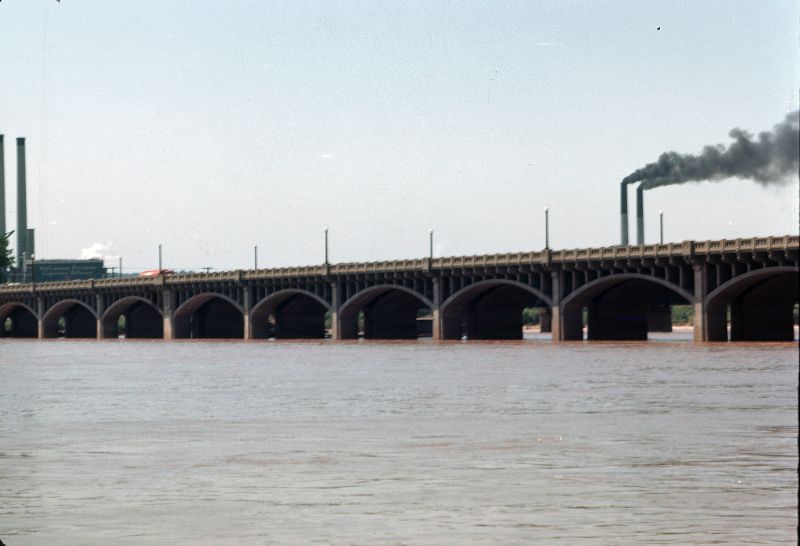
The Route 66 Arkansas River bridge in, Tulsa, Oklahoma, circa late 1940s

11th St., looking west from Trenton Ave., Tulsa, Oklahoma, 1941

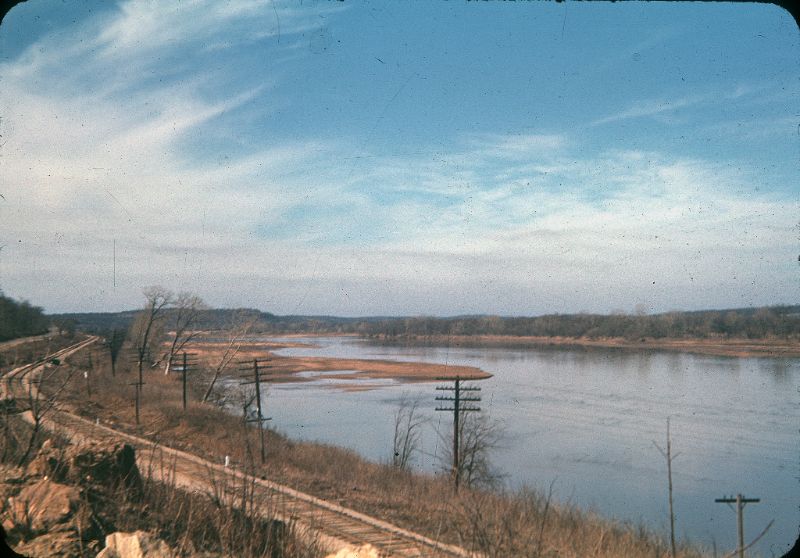
Arkansas River, Oklahoma Highway 51 and Frisco Tracks, West of Tulsa, Oklahoma, 1941

Boston Ave., looking south from 4th St., Tulsa, Oklahoma, circa 1945

January 14, 2022

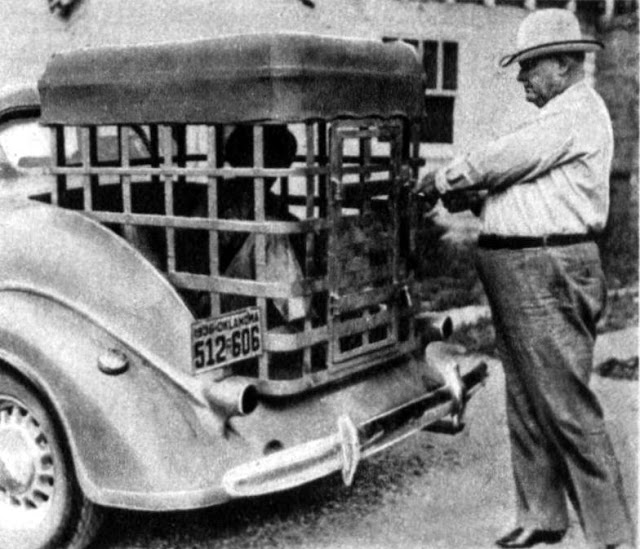
Portable Auto Jail Houses Fugitive, 1936

A new style in portable “hoosegows” was set by an Oklahoma police official when he built a steel cage on the back of his passenger auto in 1936. The “jail” was used to bring back a fugitive who had escaped from the McAlester, Oklahoma, prison. He had been recaptured by Pittsburgh, Pennsylvania, police.

This home-built, portable "hoosegow" was used by Alex Watson, of the McAlester, Okla., prison, to bring back an escaped fugitive who was recaptured over 1,000 miles away.

Alex Watson, transfer agent of the prison, drove 1,000 miles to bring back the prisoner. The “jail” was made by ripping off the lid of the luggage compartment of a regular coupe automobile and screwing down an sill-welded steel cage. An awning protected the prisoner from the sun, and a cushion provided the interior “comforts” of the jail. The prisoner was released from the cage for brief exercise periods throughout the trip.

September 1, 2017

Vintage Photographs Capture Everyday Life of 17-Year-Old Twins Betty and Barbara Bounds in Tulsa, Oklahoma, 1947

When LIFE photographed 17-year-old identical twins Betty and Barbara Bounds in 1947, the magazine was more concerned with what the Bounds sisters had to say about the life of the postwar American teenager than that of a twin.


Photographer Nina Leen captured the lives of the Bounds’ teenaged cohort in Tulsa, Oklahoma, from their hairstyles (they “wear it shoulder-length”) to their accessories (“combs are often carried in sock”) to their interests (“boys and parties”).

Contrasts in teen-age clothes are shown by Betty Bounds (right), wearing a dainty 1947 outfit, while Barbara poses in sloppy get-up.

Chores are receiving new respect, for 1947 teen-agers think of marriage much more seriously than their wartime equivalents did. Note the frilliness of Betty's shorts.

Identical twins Barbara and Betty Bounds eat al fresco with their parents in Tulsa, Okla.

Barbara and Betty Bounds pose in matching outfits, 1947.

Although teen-age girls are more romantic and less boisterous than they used to be, they still like to put on some old clothes, whizz around with boys and even get a little grease on their hands.

September 4, 2016

31 Vintage Photos of Downtown Oklahoma City in the 1940s

Take a look at these vintage photos that captured Downtown Oklahoma City in the 1940s to see the changing of the capital and largest city of the state of Oklahoma after more than 70 years.


1st Street (Park Ave) and Broadway, 1946

1st Street (Park Ave.), 1946

American National Building, January 11, 1946

Baltimore Building, Oct. 1944

Broadway Avenue, October 4, 1947

May 25, 2015

Geronimo, Leader of the Bedonkohe Apache, Taking a Drive in a Locomobile Model C, 1905

The photograph of Geronimo driving a car was actually taken on June 11, 1905, at the Miller brothers’ 101 Ranch, located southwest of Ponca City, Oklahoma. The car is a Locomobile, and the Indian in full headdress to Geronimo's left is Edward Le Clair Sr., a Ponca Indian.


Geronimo so admired Le Clair’s beaded vest that it was presented to him later in the day. When Geronimo died in 1909, he was buried in the vest. The photograph was taken during a special 101 Ranch show for the U.S. press. Thousands of newspaper editors and reporters flocked to it.

July 10, 2012


FOLLOW US:
FacebookTumblrPinterestInstagram

CONTACT US


Browse by Decades

Popular Posts

Advertisement

09 10