Bring back some good or bad memories


ADVERTISEMENT
Showing posts with label Norway. Show all posts

February 5, 2026

Unique Portraits of the Sámi People by Roche/Bonaparte From the 19th Century

In 1884, Prince Roland Bonaparte led an anthropological expedition to Northern Norway (Finnmark) and Sweden to document the Sámi people. The majority of the photography for this project was executed by his expedition photographer, G. Roche.

Unlike contemporary photographers who captured candid lifestyle shots, Roche and Bonaparte used the “en face” (frontal) and profile formula. This was a standardized, quasi-scientific method designed to document physical traits.

The collection includes over 100 portraits of Sámi individuals. Many of the subjects are identified by name in the archives, such as Jol Andersen (a Sea Sámi man from Finnmark), Anna Hurri, and Niels Larsen Pilto.

Subjects often wear traditional gákti (Sámi clothing) but are placed against neutral backgrounds or within rigid frames. Some portraits even include “number plates” or height scales, reflecting the era’s obsession with racial categorization.

While the portraits are the most famous, the expedition also captured Sámi dwellings (lavvu), boats, and the Arctic landscape, providing a broader context of 1880s Northern Norway.


August 13, 2025

The Romantic Norwegian Landscapes of Anders Askevold

Anders Askevold (1834–1900) was a Norwegian painter celebrated for his luminous landscapes and serene animal studies, particularly of cattle in pastoral settings. Born in Askvoll, Norway, Askevold trained first in Bergen before studying in Düsseldorf under the influence of the Düsseldorf School, which emphasized detailed, romanticized depictions of nature.

Askevold’s works often combined dramatic Norwegian scenery—fjords, mountains, and valleys—with tranquil rural life, creating a harmonious balance between grandeur and intimacy. He achieved considerable success in Europe, exhibiting in Paris, Berlin, and other cultural capitals, and was awarded medals at several international exhibitions.

Askevold’s paintings, marked by soft light, meticulous detail, and a sense of calm, remain significant representations of 19th-century Norwegian art, reflecting both national identity and the era’s romantic vision of nature.

Anchored Sailing-Vessels in a Fjord

A Fjord in Norway

At Dalen in the Nærøyfjord

At the Watering Place

Bakka in the Nærøyfjord

June 23, 2025

40 Amazing Photochrom Prints of Norway in the 1890s

Norway in the 1890s was a country on the brink of major transformation. Though still in a political union with Sweden (established in 1814), growing nationalist sentiment was building momentum toward full independence, which would be achieved in 1905.

The economy during this decade was shifting from rural and agricultural traditions to early industrialization. Hydropower development began laying the groundwork for future industrial growth, particularly in regions like Telemark. Fishing and maritime trade remained vital to coastal communities, while emigration to North America continued at high rates as Norwegians sought better opportunities abroad.

Culturally, the 1890s were rich with national romanticism. Artists, writers, and composers like Edvard Grieg and Knut Hamsun helped define a distinct Norwegian identity rooted in the landscape, folklore, and rural life. The expansion of railways and steamship routes also began to connect more remote parts of the country, changing how Norwegians lived, traveled, and interacted.

It was a decade of growing confidence, where tradition and modernity coexisted—and often collided—on the path to a fully independent Norway. Below is a collection of amazing Photochrom prints offering a glimpse of Norway in the 1890s.

Karl Johans Gate with the Royal Palace, Christiania, Norway, circa 1890s

Fish market, Bergen, Norway, circa 1890s

A Lapp family, Norway, circa 1890s

Andrée’s Station at Danskøya, Spitsbergen, Norway, circa 1890s

Bondhus glacier and lake, Hardanger Fjord, Handanger, Norway, circa 1890s

May 12, 2025

Norwegian Bank Bus, 1959

A creative solution to bring financial services to people living in remote and sparsely populated areas. These buses were fully equipped to function as mobile bank branches, allowing residents in rural villages to access essential banking services without having to travel long distances to a town. The bank bus would follow a regular route, stopping in different villages on specific days, making it a vital link between rural communities and the banking system during that time.

October 12, 2024

Visiting Quarantined Family and Friends at Ullevål Hospital, Oslo, Norway in 1905

In the spring of 1905, Ullevål Hospital in Oslo stood as a sentinel against the spread of illness, its walls a barrier between the afflicted and the outside world. The hospital, with its stately architecture and solemn atmosphere, had become a focal point of hope and concern for the city’s residents, as quarantine protocols were strictly enforced to manage the outbreaks that occasionally swept through the region.

(Photo by Anders Beer Wilse)

On a crisp day in early spring, the grounds of Ullevål Hospital were abuzz with an unusual blend of anxiety and determination. Families and friends gathered outside the hospital’s imposing gates, their faces pressed against the iron bars as they tried to catch glimpses of loved ones inside. The air was thick with the mingled scents of spring blossoms and antiseptic, a reminder of the delicate balance between life and health.

Visitors, each with a story of their own, came to offer comfort and solidarity. They carried with them not just parcels of food and letters, but also messages of encouragement wrapped in small, handmade gifts—a knitted scarf, a jar of honey, a cherished book. These tokens, carefully prepared and wrapped, were a testament to the enduring human spirit that transcended the barriers of quarantine.

The scenes at Ullevål were poignant and hopeful. Families held brief, often muted conversations through the windows, their words carried on the breeze between the glass panes. They spoke in hushed tones, their voices occasionally rising with laughter or falling with concern. The visitors' eyes, often teary but resolute, reflected the deep bonds of affection that persisted despite the physical separation.

Inside the hospital, the patients, though separated from their loved ones, found solace in the knowledge that their family and friends were outside, steadfast in their support. The medical staff, too, played a crucial role, providing not just care but also a comforting presence to those isolated from their everyday lives.

This daily ritual of visiting, filled with a mix of longing and encouragement, captured the essence of a time when medical advancements were still catching up with human resilience. The quarantine measures, though stringent, could not diminish the warmth of human connection and the indomitable spirit of those who endured them.

In the heart of Oslo, Ullevål Hospital became more than a place of healing—it was a symbol of hope and solidarity, where the distance imposed by quarantine could not sever the bonds of love and care that defined the community.

October 12, 2023

30 Fascinating Vintage Photographs of Sonja Henie From the 1920s and 1930s

The first figure skater to become an international celebrity was Norwegian-born American ice skater Sonja Henie. She made figure skating popular and profitable by introducing ballet routines into her performances and amazing audiences with her spectacular spins. After winning three Olympic gold medals and 10 consecutive world amateur championships, she became a professional skater and starred in a series of motion pictures.


Sonja Henie was born on April 8, 1912, in Oslo (then called Christiania), Norway. Her father was a wholesale fur merchant and former bicycle champion. Sonja started ballet lessons when she was five years old. She received her first pair of ice skates for the Christmas after her sixth birthday, and her older brother taught her how to skate. Sonja won the Oslo children’s figure skating championship at age eight and the Norwegian national championship at age 10. Her parents hired a private tutor for her academic education and engaged top professionals to coach her in ballet and skating.

Her Olympic experience began as a participant in the 1924 Winter Games in Chamonix, France, when she was only 11 years old. While continuing to win the Norwegian championship every year for 14 consecutive years, she became the Scandinavian champion in 1926 and won the first of 10 consecutive world championships in 1927, at the age of 14.

On a visit to London in the summer of 1927, Henie saw a dance performance by the Russian ballerina Anna Pavlova and decided to incorporate ballet into her free skating. That novelty contributed to her gold medal victory at the 1928 Winter Olympics in St. Moritz, Switzerland. She went on to win Olympic gold medals in 1932 at Lake Placid, New York, and 1936 at Garmisch-Partenkirchen, Germany. In 1937 the king of Norway made her a Knight First Class of the Order of St. Olaf.

Shortly after winning the 1936 Olympic title and the 1936 world championship, Henie went professional. Under contract with Chicago promoter Arthur Wirtz, she performed 17 highly successful ice shows in nine U.S. cities in March and April 1936. A performance in Los Angeles that may led to a motion picture contract with 20th Century-Fox. One in a Million (1936) and Thin Ice (1937) were the first of her 10 successful movies over the next decade. In 1938 only Shirley Temple and Clark Gable were bigger box office attractions.

From 1938 through 1951 Henie also starred in an annual touring production called the “Hollywood Ice Review,” promoted by Wirtz. After quarreling with Wirtz over contract terms, Henie produced her own ice show in 1951–52. She appeared in skating spectacles and television specials. Her autobiography, Wings on My Feet, was published in 1940.

Henie became a U.S. citizen in 1941. In 1945 she visited Oslo and toured U.S. Army hospitals in Europe as a guest performer. Her two marriages to Americans in the 1940s both ended in divorce. After her third marriage, to Norwegian shipbuilder Niels Onstad in 1956, she no longer performed but focused her attention and her considerable wealth on modern art. Henie and Onstad established a museum of modern art near Oslo in 1968. She died of leukemia on October 12, 1969, in an airplane en route from Paris to Oslo.


September 3, 2021

The Beautiful Borgund Stave Church in Norway, Built From Wood Without a Single Nail From the Late 12th Century

Norway became a Christian nation during the tenth and eleventh centuries, following the age of the Vikings. No sooner had the new religion taken hold than a period of church building began which lasted for several centuries.

The Borgund Stave Church (Norwegian: Borgund Stavkyrkje) was built sometime between 1180 and 1250 AD outside of what is now Lærdal, Norway at the end of the longest fjord (Sogn fjord) in the country. It is one of the oldest and best preserved stave churches in Norway.

Built by the same people that built Viking longboats many of the construction techniques are similar. Norway has a long history of wood construction, probably due to large forests and rough terrain. It was one of a few countries that refused to build their early churches out of stone and instead chose wood to build places of worship.

The stave churches were built of a special type of fir called “malmfuru” (no longer available) which was very hard, with great size and straight trunks. The closest approximation to this favored fir in North America is the Douglas fir of the Pacific Northwest. It is of Douglas fir the Chapel in the Hills is constructed.

Although simple in appearance the techniques used to build the church are intricate and a marvel of engineering. The name Stavkirke comes from the use of staves (the large pillers) used to support the church structure. The church was built on a foundation of flat stones used to elevate the foundation beams from the ground and moisture. The walls were made from vertical planks topped with four more beams to support the roof.

The first churches would have had simple peaked roofs. The typical stave church became taller and taller, with a series of roofs, each one offset and becoming smaller as the church reached toward the sky. To support all this, an intricate system of beams and additional staves became necessary. In addition to the main body of the church, very often there was built a covered passageway, or “ambulatory,” entirely around the outside of the structure. This provided additional protection to the foundation from the harsh weather found in the region.

The only metal used was on the ornate door furnishings and locks. Instead of nails, they used wooden dowel pins. This may very well be one of the reasons why some stave churches have stood for over eight hundred years. The wooden dowels allow the building to expand and contract with the changes in temperature and humidity, instead of being rigidly held in place with iron hardware.


July 15, 2021

A Norwegian University Student’s Secret Street Photography From 1890s Oslo

Known mostly as an accomplished mathematician and physicist from Norway, Carl Størmer (Fredrik Carl Mülertz Størmer) also enjoyed a very unusual side hobby at the time. With a bulky camera hidden in his clothes, Størmer walked around Oslo, Norway and secretly capture candid moments of passersby. As his subjects were always caught in their natural states, Størmer’s photography stands in striking contrast to portraiture of the era that largely consisted of serious and grave images against decorative settings.


Most of his photos were taken in the 1890s by using a C.P. Stirn Concealed Vest Spy Camera, which he got in 1893 when he was a 19-year-old student at the Royal Frederick University (now, University of Oslo). “It was a round flat canister hidden under the vest with the lens sticking out through a buttonhole,” he told the St. Hallvard Journal in 1942. “Under my clothes, I had a string down through a hole in my trouser pocket, and when I pulled the string the secret camera took a photo.”

Størmer tended to capture people exactly at the time they were greeting him on the street. “I strolled down Carl Johan, found me a victim, greeted, got a gentle smile, and pulled.” He described. “Six images at a time and then I went home to switch [the] plate.” In total, the Norway's very first paparazzi took a total of about 500 of these black-and-white photos.


March 17, 2021

Norway After Liberation: Historical Photos of German Prisoners of War in Norway, 1945

The German occupation of Norway began on 9 April 1940 after German forces invaded the neutral Scandinavian country of Norway. It ended on 8 May 1945, after the capitulation of German forces in Europe. Throughout this period, Norway was continuously occupied by the Wehrmacht.

Civil rule was effectively assumed by the Reichskommissariat Norwegen (Reich Commissariat of Norway), which acted in collaboration with a pro-German puppet government, while the Norwegian King and legitimate government continued to operate in exile from London.

This period of military occupation is in Norway referred to as the “war years” or “occupation period”.

German prisoners of war from Elverum camp being processed prior to embarkation from Norway to Germany. Here prisoners play cards to pass the time at the embarkation camp at Mandal prior to boarding boats for Germany.
German prisoners of war being processed prior to embarkation from Norway to Germany. Here prisoners rest at the embarkation camp at Mandal prior to boarding boats for Germany.

German prisoners of war at Elverum camp being processed prior to embarkation from Norway to Germany. Here prisoners repack their belongings after the interrogation and search processes.

German prisoners of war at Elverum camp being processed prior to embarkation from Norway to Germany. Here prisoners prepare to move to the embarkation camp at Mandal.

German prisoners of war from Elverum camp prepare for embarkation from Norway to Germany. Before leaving the embarkation camp at Mandal a final screening of prisoners was carried out by walking the prisoners past two Gestapo men and one ‘Quisling’ woman who were to identify any of their former colleagues trying to pass themselves off as ordinary German soldiers.

March 3, 2021

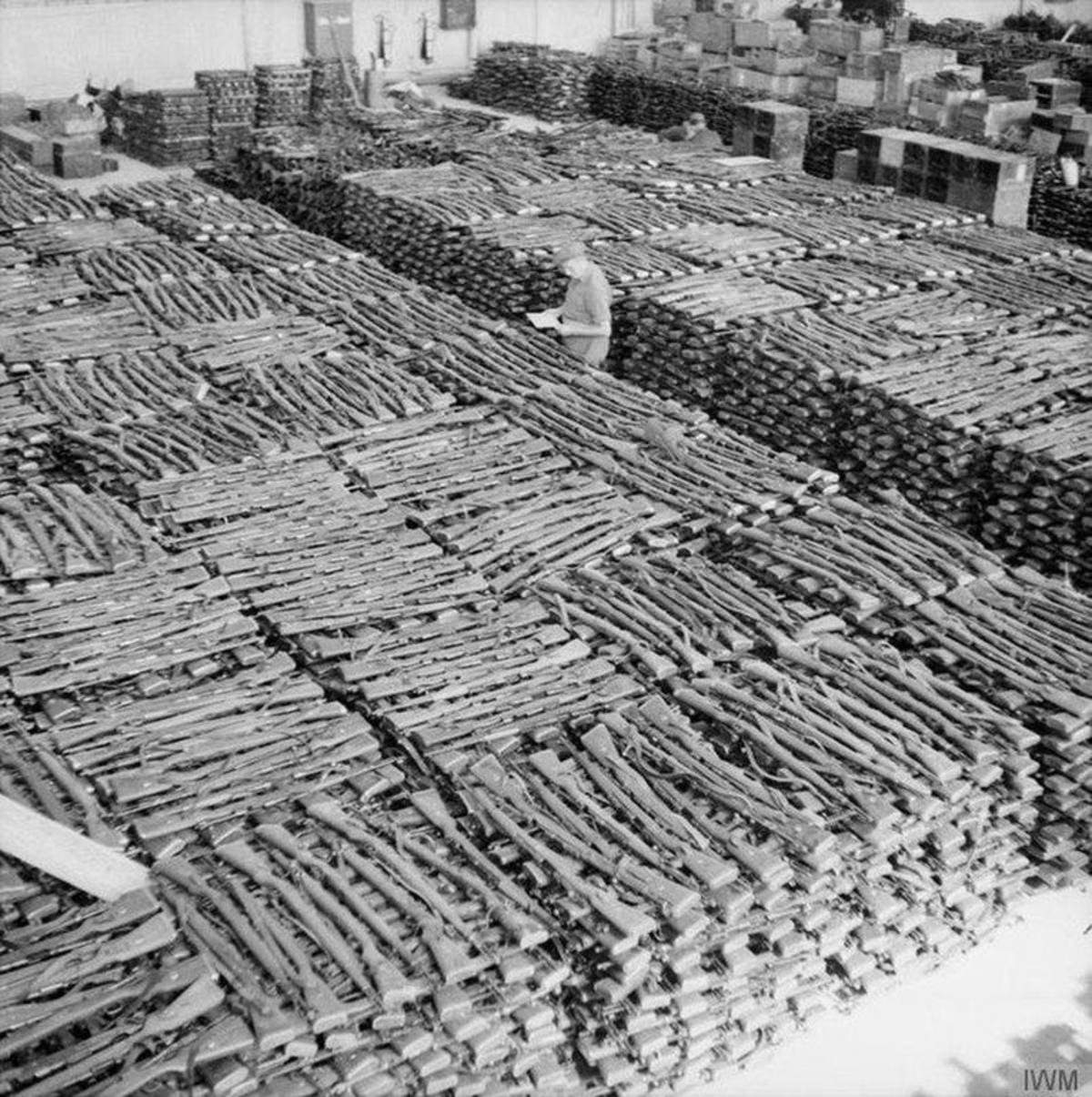
Captured German Kar98k Rifles at Stavanger, Norway, After the Surrender of Germany in 1945

Storeroom at Solar aerodrome, Stavanger, holding some of the estimated 30,000 rifles taken from German forces in Norway after their surrender.

(Photo: Imperial War Museums)

In Operation Doomsday, the British 1st Airborne Division acted as a police and military force during the Allied occupation of Norway in May 1945, immediately after the victory in Europe during the Second World War. The division maintained law and order until the arrival of the remainder of Force 134, the occupation force. During its time in Norway, the division was tasked with supervising the surrender of the German forces in Norway, as well as preventing the sabotage of vital military and civilian facilities.

The German Instrument of Surrender was delivered on May 8 to General Franz Böhme, the commander of all German forces stationed in Norway, and the 1st Airborne Division landed near Oslo and Stavanger between May 9 and May 11. The majority of the transport aircraft carrying the division landed safely, but three planes crashed with a number of fatalities. The division encountered little of the expected German resistance.

Operational duties included welcoming back King Haakon VII of Norway, looking after Allied ex-prisoners of war, arresting war criminals and supervising the clearing of minefields. The division was also able to confirm the deaths of the British airborne troops that had taken part in Operation Freshman, an unsuccessful attempt to disrupt the German atomic weapons program in November 1942. The division returned to Britain at the end of August and disbanded two months later.

December 5, 2020

30 Amazing Photos Show Norwegian Weddings From the Early 20th Century

Sogn og Fjordane was a county in western Norway, when it was merged to become part of Vestland county. Bordering previous counties Møre og Romsdal, Oppland, Buskerud, and Hordaland, the county administration was in the village of Hermansverk in Leikanger municipality. The largest town in the county was Førde.

Although Sogn og Fjordane has some industry, predominantly hydroelectricity and aluminium, it is predominantly an agricultural area. Sogn og Fjordane is also home to the Urnes Stave Church and the Nærøyfjord, which are both listed by UNESCO as world heritage sites.

The Western Norway University of Applied Sciences has campuses in Sogndal and Førde.

Here below is a set of amazing photos from Fylkesarkivet i Vestland that shows weddings in Sogn og Fjordane in the 1900s and 1910s.


November 14, 2020

Small Town Life of Sunnfjord, Norway in the Early 20th Century Through Amazing Photos

Sunnfjord is a traditional district in Western Norway located in Vestland county. It includes the municipalities of Askvoll, Fjaler, Flora, Førde, Gaular, Jølster, Naustdal, and the southernmost parts of Bremanger. It covers an area of about 4,476 square kilometres (1,728 sq mi) and has a population about 8% of the population of Vestland county.

Life of Sunnfjord, Norway in the early 20th century

The central geographical characteristic of the Sunnfjord region are the fjords: Dalsfjorden and Førdefjorden. It is a tourist region, with waterfalls, fishing, white-water rafting, glaciers, hiking, and scenery–including Jostedalsbreen National Park.

The area was the site of the largest air battle over Norway during World War II, and a museum is dedicated to the event in Naustdal. There are two airports in Sunnfjord: Førde Airport, Bringeland, just outside the town of Førde, and Florø Airport, just outside the town of Florø. The European route E39 highway passes through the region, going north and south.

These amazing photos from Fylkesarkivet i Vestland were taken by Norwegian photographer Olai Fauske that show small town life of Sunnfjord, Norway in the 1900s and 1910s.

A group of people gathered outside Bakkeselet mountain hut at Brulandsstølen mountain farm

A game of croquetAdd caption

A group of people gathered outside Steinaselet mountain hut at Halbrendsstølen monutain farm

A halibut was caught close to Bjønnaholmen in the fjord Førdefjorden

A man and a horse portrayed at Teigen in Førde. The house in the background is Kristian Ulltang's kome "Nøysomhet" (moderation). Photographer Olai Fauske was UIltangs neighbour


FOLLOW US:
Facebook • Tumblr • Pinterest • Instagram

CONTACT US


Browse by Decades

Popular Posts

Advertisement

09 10