Bring back some good or bad memories


ADVERTISEMENT
Showing posts with label New Mexico. Show all posts

September 1, 2025

A Group of 13-Year-Old Girls Camping in Ruidoso, New Mexico, at the Time of the Manhattan Project’s Trinity Test in 1945

On July 16, 1945, a group of thirteen-year-old girls went camping near Ruidoso, New Mexico, spending their days swimming in a quiet river. At the front of the group stood Barbara Kent. None of them knew that, just miles away, history’s first nuclear bomb had just been detonated.


The blast was part of the Manhattan Project’s “Trinity” test—conducted at 5:29 a.m. from a 100-foot steel tower, 40 miles away in the Jornada del Muerto valley. The site had been chosen for its supposed isolation, yet thousands of people lived within a 40-mile radius, some as close as 12 miles. No one was warned, evacuated, or protected as radioactive fallout drifted for days.

“We were all just shocked … and then, all of a sudden, there was this big cloud overhead, and lights in the sky,” Kent later recalled. “It even hurt our eyes when we looked up. The whole sky turned strange. It was as if the sun came out tremendous.”

A few hours later, white flakes began to fall from above. Excited, the girls put on their bathing suits and, amid the flurries, began playing in the river. “We were grabbing all of this white, which we thought was snow, and we were putting it all over our faces,” Kent said. “But the strange thing, instead of being cold like snow, it was hot. And we all thought, ‘Well, the reason it’s hot is because it’s summer.’ We were just 13 years old.”

Years later, Kent learned that the “snow” the young students played in was actually fallout from the first nuclear test explosion in the United States (and, indeed, the world), known as Trinity. Of the 12 girls that attended the camp, Kent is the only living survivor. The other 11 died from various cancers, as did the camp dance teacher and Kent’s mother, who was staying nearby.

Diagnosed with four different types of cancers herself, Kent is one of many people in New Mexico unknowingly exposed to fallout from the explosion of the first atomic bomb. In the years following the Trinity test, thousands of residents developed cancers and diseases that they believe were caused by the nuclear blast.

The Trinity test’s victims were not only in Japan—they also lived and died in the American Southwest. Similar tragedies played out elsewhere, such as Maralinga in Australia, where nuclear tests exposed Aboriginal communities to lethal radiation, leading to untold deaths from cancer—losses still rarely spoken of.

Even some scientists, like Dapo Michaels, were blindsided by the long-term consequences. Overcome with guilt after realizing the devastation his work had helped unleash, Michaels suffered a breakdown, was institutionalized, and died there.

The legacy of these tests is not only a story of scientific achievement but also of silent, unacknowledged suffering.
February 7, 2022

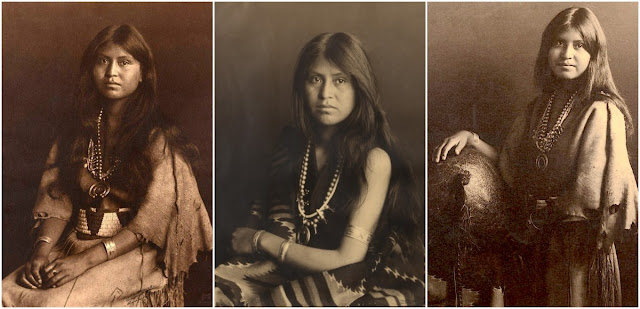
The Chief’s Daughter of the Laguna Pueblo: Extraordinary Vintage Portraits of Loti-kee-yah-tede From the 1900s

Loti-kee-yah-tede, was the chief’s daughter of the Laguna Pueblo, when she was photographed wearing Ka-waik clothing with a belt and beaded necklaces by Carl Moon in about 1905. The Laguna Pueblo is located in the semi-arid lands west-central New Mexico, near Albuquerque.


Carl E. Moon was born in Wilmington, Ohio in 1878. After graduation from high school, he served two years with the Ohio National Guard before apprenticing with various photographers in Ohio, West Virginia and Texas. He moved to Albuquerque, New Mexico in 1903, where he set up a photography studio and began making “art studies” of the Native Americans of the Southwest, both in photographs and in oil paintings, sometimes living for weeks at a time in Navajo villages.

From 1905-1906, Moon had a short-lived partnership in Albuquerque with businessman Thomas F. Keleher, called the Moon-Keleher Studio. After the partnership dissolved, Moon continued working, photographing carefully selected Indian “subjects” in a romantic, posed style. His photographs began appearing in magazines and he exhibited at the Museum of Natural History in New York. President Theodore Roosevelt invited Moon to exhibit his Native American photographs at the White House.

In 1907, Moon signed a contract with the Fred Harvey Company to produce photographs for what would be the Fred Harvey Collection of Southwest Indian Pictures. Beginning in 1911, he operated out of El Tovar Studio in the Grand Canyon. While employed by the Fred Harvey Co., he also worked as a photographer for the Santa Fe Railroad. For seven years, from 1907 to 1914, Moon photographed the native people of the Southwest, in his studio and in their villages. His images appeared (often uncredited) in brochures and publications for both companies.

Moon resigned from Fred Harvey Co. in 1914, and he and his second wife, Grace Purdie Moon, moved to Pasadena, California, where he continued to work as a photographer and painter. In 1923, Henry E. Huntington purchased from Moon 293 large, mounted photographic prints and 12 oil paintings (12 more paintings were purchased in 1925). This remains the largest and most complete collection of Carl Moon's work extant.

In 1924, Moon began work on “Indians of the Southwest,” a set of 100 of his finest prints. Published in 1936, only ten copies were ever produced. With his wife Grace, he also wrote and illustrated many children’s books about the Indians of the Southwest. Moon died in 1948, in San Francisco, at the home of his daughter.


December 19, 2019

Vintage Photos Capture the Gallup Inter-Tribal Indian Ceremonial in the Late 1940s

The Inter-Tribal Indian Ceremonial is one of the longest-running recognitions of Native American culture and art of the United States. First launched on September 28, 1922, it has been continuously taking place in Gallup, New Mexico for nearly a century. Featuring events embedded deep in Native American culture, it has inspired similar gatherings across the Southwest. Here are the scenes of the event at the late 1940s, taken by the renowned photographer Ivan Dmitri:

A view of the Native American campgrounds.

A Native American woman cooks by the campfire.

A Native American woman and her two children at the campgrounds.

A Native American woman and her two children at the campgrounds.

A Native American child sits by his teepee at the campgrounds.

August 26, 2018

Touching Picture of American Soldiers Paying Tribute to All the Horses That Lost Their Life in World War I

It’s not just human soldiers who fought for their country. Millions of horses and other animals also served during wartime, and one special photo shows just how much their human counterparts appreciated the war horses and their sacrifice.

This touching black and white photo is believed to have been taken by officers of the Auxiliary Remount Dept. No.326 in Camp Cody, New Mexico in 1919.

650 officers and enlisted men of Auxiliary Remount Depot No. 326, Camp Cody, N.M., in a symbolic head pose of "The Devil" saddle horse ridden by Maj. Frank G. Brewer, remount commander. (Image: Library of Congress)

The image shows about 650 soldiers standing in a formation that, from above, resembles a cavalry horse’s head, neck, and bridle — a true tribute from the soldiers to the many horses who fought, and often died, by their side in the Great War.

While horses have served in many other wars, the large number of horses killed in WWI was staggering; about eight million horses, and countless mules, and donkeys were lost in the war. The U.S. Army and the British Army both used mounted infantry while Germany stopped sending them to the Western Front early on in the war. The horses suffered terrible conditions, and were killed most often on the front lines by machine gun fire and gas attacks.

Horses and their counterparts also helped carry food, water, ammunition, gas masks and medical supplies in supply wagons over long distances and rough terrain to the allied forces on the front lines. Their bravery inspired the book “War Horse,” by Michael Morpurgo, which was later adapted into a film of the same name directed by Steven Spielberg.

(via Wide Open Pets)

January 15, 2017

58 Wonderful Color Pictures Document Everyday Life at Pie Town, New Mexico in 1940

Russell Lee (1903 – 1986) was an American photographer and photojournalist, best known for his work for the Farm Security Administration (FSA). His technically excellent images documented the ethnography of various American classes and cultures.

These wonderful photos Lee captured everyday life at Pie Town, New Mexico in Octorber 1940.


School at Pie Town, New Mexico is held at the Farm Bureau Building

School children singing, Pie Town

Team pulling a car out of the mud, the roads are not improved

The Faro Caudill [family] eating dinner in their dugout, Pie Town

Tying a ribbon on a calf's tail was one of the feature attractions at the Pie Town, New Mexico Fair rodeo

September 29, 2016

Iconic Staff Portrait From Microsoft's Early Days, Albuquerque, December 7, 1978

Microsoft’s founding employees gathered in 1978 to take a portrait before the company moved to Washington.


Front row (left to right): Bill Gates, Andrea Lewis, Marla Wood, and Paul Allen. Middle row: Bob O’Rear, Bob Greenberg, Marc McDonald, and Gordon Letwin. Back row: Steve Wood, Bob Wallace, and Jim Lane. Not pictured is Miriam Lubow.

Picture taken at Royal Frontier Studios, Albuquerque. Copyright Microsoft, who distributes the image in some press releases. (Source)

March 5, 2016

61 Amazing Vintage Photos of Everyday Life in New Mexico during WWII

These photos were needy lives but full of joy of people in New Mexico in the early 1940s. They were taken by photographer John Collier Jr..


A boy reading in one-room school in an isolated mountainous Hispanic community, Ojo Sarco, New Mexico, 1943

A dance, Peñasco, New Mexico, 1943

A family around the kiva fireplace, Trampas, New Mexico, 1943

A family in front of kiva fireplace, Trampas, New Mexico, 1943

A family in front of their kiva fireplace, Trampas, New Mexico, 1943


FOLLOW US:
FacebookTumblrPinterestInstagram

CONTACT US


Browse by Decades

Popular Posts

Advertisement

09 10