Bring back some good or bad memories


ADVERTISEMENT
Showing posts with label Hawaii. Show all posts

October 29, 2026

Vintage Kodachromes of the 1960 Aloha Week Parade

These vintage Kodachrome photos capture the vibrant spirit of the 1960 Aloha Week Parade in Honolulu, Hawaii.

Established in 1946 to celebrate Hawaiian culture and heritage, Aloha Week featured colorful floral floats, pāʻū riders in traditional attire, marching bands, and the Royal Court making their way through the streets of Waikiki.

The rich, saturated colors of Kodachrome film beautifully preserve the tropical flowers, bright costumes, and festive atmosphere of the event. These images offer a nostalgic and vivid glimpse of mid-century Hawaiian pageantry more than sixty years ago.

Aloha Week parade, Honolulu, Hawaii, 1960

Aloha Week parade, Honolulu, Hawaii, 1960

Aloha Week parade, Honolulu, Hawaii, 1960

Aloha Week parade, Kalakaua Ave, Honolulu, Hawaii, 1960. Lots of pineapples going on here

Aloha Week parade, Kalakaua Ave, Honolulu, Hawaii, 1960

March 2, 2026

Honolulu Parades in 1975 Through Fascinating Photos

The Honolulu parades of the 1970s were a vibrant explosion of color and cultural pride, capturing Hawaii in a unique transitional era. During this decade, major celebrations like the King Kamehameha Day Floral Parade and the Aloha Festivals became grand spectacles that drew locals and tourists alike to the sun-drenched streets of Waikiki. These parades were famous for their stunning Pāʻū riders, women in flowing, colorful equestrian capes representing each island, and magnificent floats entirely adorned with tropical blooms like plumeria, orchids, and hibiscus.

Beyond the floral displays, the 1970s parades reflected a deep Hawaiian Renaissance, a period of renewed interest in traditional music, hula, and language. Amidst the backdrop of vintage muscle cars and the bustling, developing skyline of Honolulu, the marches featured traditional marching bands, vibrant hula halau, and the gentle sounds of steel guitars.

These fascinating photos, courtesy of Mark Susina, capture the Aloha spirit in its prime. From the vibrant floral floats to the traditional Pāʻū riders, this collection offers a stunning look at Honolulu's festive streets in 1975.


August 30, 2025

The People’s Queen: 32 Amazing Portraits of Queen Emma of Hawaii From the 19th Century

Born on January 2, 1836, in Honolulu, Queen Emma Kaleleonālani Naʻea Rooke was a Hawaiian royal whose life was dedicated to the welfare of her people. Her biological parents were High Chief George Naʻea and High Chiefess Fanny Kekelaokalani Young. Following Hawaiian tradition, she was adopted at birth by her childless maternal aunt, Chiefess Grace Kamaʻikuʻi Young Rooke, and her husband, Dr. Thomas Rooke, a British physician. This upbringing provided Emma with a unique blend of Hawaiian and British influences.

Educated at the Chiefs’ Children’s School (later renamed The Royal School) alongside other royal children, Emma grew up speaking both Hawaiian and English. She was a talented and well-rounded young woman, skilled in music (particularly the piano), dancing, horseback riding, and gardening.

In 1856, Emma married her childhood friend, Alexander Liholiho, who became King Kamehameha IV. They reigned together until his death in 1863. The couple shared a deep concern for the Hawaiian people, whose population was being decimated by foreign diseases. Together, they founded The Queen’s Hospital (now The Queen’s Health Systems) in 1859. They personally went door-to-door to raise funds for the hospital, which was established to provide care for the native population.

In 1858, Queen Emma gave birth to a son, Prince Albert Edward Kauikeaouli. The young prince was the heir to the throne and a source of great joy for the kingdom. However, tragedy struck in 1862 when Prince Albert died at the age of four. A year later, a grief-stricken King Kamehameha IV also passed away. After these devastating losses, Queen Emma took the name Kaleleonālani, which means “The flight of the heavenly chiefs,” in their memory.

As a widowed queen, Emma dedicated her life to humanitarian and charitable causes. She continued her work with the Anglican Church in Hawaiʻi, raising funds for the construction of The Cathedral of St. Andrew, and also founded St. Andrew’s Priory School for Girls in 1867 to provide quality education.

In 1874, following the death of King Lunalilo without an heir, Queen Emma became a candidate for the Hawaiian throne. Known as “The People’s Queen” due to her widespread popularity and humanitarian efforts, she ran against David Kalākaua. While she had strong support from native Hawaiians who saw her as a direct link to the Kamehameha dynasty and her pro-Hawaiian and pro-British sentiments, Kalākaua won the legislative election. Despite the defeat and a subsequent riot by her supporters, Emma eventually recognized Kalākaua as the rightful king.

Queen Emma died on April 25, 1885, at the age of 49. Her legacy is one of compassion, dedication, and leadership. She is remembered for her significant contributions to the health, education, and spiritual well-being of the Hawaiian people.


August 16, 2025

Photos From the V-J Day Celebrations in Hawaii When the News Is Announced of the Surrender of Japan on August 14, 1945

On August 14, 1945, when word reached Hawaii that Japan had accepted the Allies’ terms of surrender, effectively ending World War II, the islands erupted in spontaneous, around-the-clock celebrations.

In Honolulu — especially along Hotel Street, which was the city’s bustling entertainment district for sailors and soldiers — crowds poured into the streets. Thousands of servicemen from Pearl Harbor, Hickam Field, and other nearby bases joined civilians in a whirlwind of parades, dancing, drinking, and shouting. Church bells rang, sirens wailed, and ships in the harbor blasted their horns.

Many accounts describe sailors tossing their caps into the air, embracing strangers, and even commandeering vehicles for joyrides. The scene was chaotic but mostly good-natured — a cathartic release after years of tension, rationing, and the heavy losses of the Pacific War. Honolulu police and military shore patrols were out in force to keep order, but they often just let the exuberance run its course.

Hawaii’s reaction carried a special emotional weight. Pearl Harbor had been the site of the December 7, 1941, attack that brought the U.S. into the war, and for many in the islands, the surrender announcement felt like a full-circle moment. Newspapers the next morning were filled with bold headlines like “JAPS QUIT!” and “PEACE!,” capturing both the relief and the raw, wartime language of the era.


February 22, 2024

The Story Behind the Photo of Stevie Nicks, George Harrison and Bob Longhi in Hana, Hawaii in 1978

Stevie Nicks told Maui News shortly after Bob Longhi’s death in 2012. “Had it not been for Longhi, I wouldn’t have gone to Hana to hang out with George for two days.” The photo of the trio hanging in Hana has special significance for Fleetwood Mac’s legendary singer, who brings it when she goes on tour.


“The photo was taken by my best friend, Mary (DeVitto),” Stevie explained. “She had given me a copy of it a long time ago, and I had it made into an 8x10 and put in a little frame. When I go on the road it goes right on my makeup mirror, so before I go on stage, whether it’s with Fleetwood Mac or me in my solo career, the three of us are looking back at me and that has been my inspiration every single night. There’s lots of nights where you kind of go, I wish I didn’t have to go on stage tonight, I’m tired, I don’t feel like doing it, and I look at George Harrison and look at Longhi and look at me and I go, well, you just have to, because it’s important, it’s important to make people happy, so get out of your chair, put on your boots and go out there and do your thing.”

The purpose of George’s visit to Maui in 1978 was to write songs for his new album George Harrison, but also so he and his then-girlfriend and future wife, Olivia Arias, could relax before becoming parents for the first time. The two musicians were having fun coming up with lyrics together in Hana. “We were writing a sort of parody of ‘Here Comes the Sun,’ but we were writing ‘Here Comes the Moon,’” she continued. “Longhi was saying, ‘you guys are writing about the moon instead of the sun,’ and I said, that’s because by then we were all such night birds.

“I had met George before that at a record party in Mexico in Acapulco for Rumours. Longhi saw George all the time. He drove me and my friend Sara and Mary to George's house in Hana. And we just hung out and wrote and sang and talked. I had been famous for not even quite three years and we were talking with George about being famous and what it meant and what you had to give up.”

Flash forward 30 or so years. During Stevie’s trip to Maui in late May 2012, she gave Bob a copy of the historic photo. The news of his death stunned her.

“It’s so strange, in the last six months I lost my mom and my godson OD’d and I kind of went underground after that. Then I went to Hawaii and went to see Longhi and spent several hours at his house with four of my best girlfriends.

“He was feeling great and he looked great and was excited about life. He was happy and glowing. We had such a great time. I had made an album in 2010 (In Your Dreams) that we filmed over a year at my house. It's a documentary and I wanted to show him it, but I ended up having to go back to Los Angeles. I’m so sorry I didn’t get to show him the documentary because he would’ve loved it so much, because it was an album made like the albums we made in the old days with a big house and 20 people there every day and dinners every night, like in the true form of Led Zeppelin. I’m really grateful I had those couple of hours with him.”

Since Longhi’s opened in the late 1970s, over the years Stevie performed there, “a bunch of times,” she noted. “Mick probably played a gazillion times and if I was there I went, too. Mick has always loved Maui, that’s why the rest of us went to Maui. Because Mick was always there, whenever there was a vacation all of us followed suit. And the first thing I do when I get to Maui is go to Longhi’s.”

Cherishing the memories of her time spent on Maui Stevie concludes: “We were laughing when we got together this time and reminisced about our trip to Hana with George Harrison. We were really young then. We were rocking and beautiful and crazy. And that was all going down on Maui. And Longhi’s was like a sanctuary for all of us. I hope so much his kids will keep it alive and jumping because I can’t imagine Lahaina without Longhi’s. I think his spirit will always be there. He loved it so much. It’s a diamond amongst all the other jewels.”

January 26, 2023

35 Fascinating Kodachrome Slides Capture Hawaiian Shows in the 1950s

Hawaii is a state in the Western United States, located in the Pacific Ocean about 2,000 miles (3,200 km) from the U.S. mainland. It is the only U.S. state outside North America, the only state that is an archipelago, and the only state in the tropics.

Hawaii comprises nearly the entire Hawaiian archipelago, 137 volcanic islands spanning 1,500 miles (2,400 km) that are physiographically and ethnologically part of the Polynesian subregion of Oceania.

Of the 50 U.S. states, Hawaii is the eighth-smallest in land area and the 11th-least populous, ranks 13th in population density. Two-thirds of the population lives on O’ahu, home to the state’s capital and largest city, Honolulu.

Hawaii is among the country’s most diverse states, owing to its central location in the Pacific and over two centuries of migration. As one of only six majority-minority states, it has the country’s only Asian American plurality, its largest Buddhist community, and the largest proportion of multiracial people. Consequently, it is a unique melting pot of North American and East Asian cultures, in addition to its indigenous Hawaiian heritage.
Although its relative isolation results in one of the highest costs of living in the United States, Hawaii is the third-wealthiest state. These fascinating Kodachrome slides from ixxidust were taken by his father that show Hawaiian shows around 1953.


January 23, 2023

Extraordinary Photographs of Surfers in Oahu, Hawaii in 1963

In May of 1963, as the surf craze swept the U.S. and popular images of surfers tempted newcomers into the water in the days before wetsuits were common, LIFE magazine had a message its readers: Surfing was fun but it wasn’t all fun and games. It was also dangerous, especially when it came to the waves  off the North Shore of Oahu.

And yet a brave group of surfers sought out the big waves anyway, for what LIFE called the “peril and ecstasy” of the sport’s toughest waves. Enabled by new innovations in balsa wood surfboards that had opened new vistas to surfers in the 1940s, the surfers  returned again and again, despite the risks.

Looking at these photos by George Silk, it’s not hard to see what drew the surfers back to the water. Some experienced, what surfer Fred Van Dyke described to Silk as, “the greatest feeling the world.”


September 16, 2022

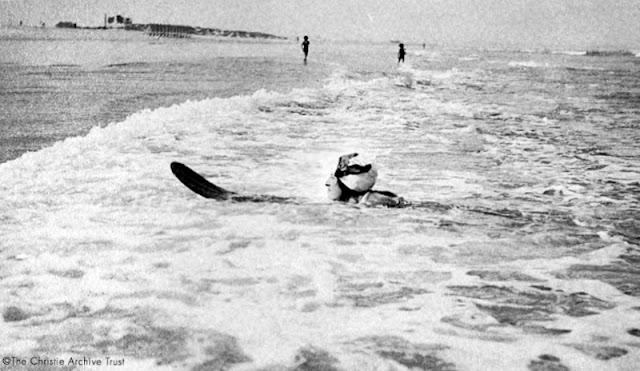
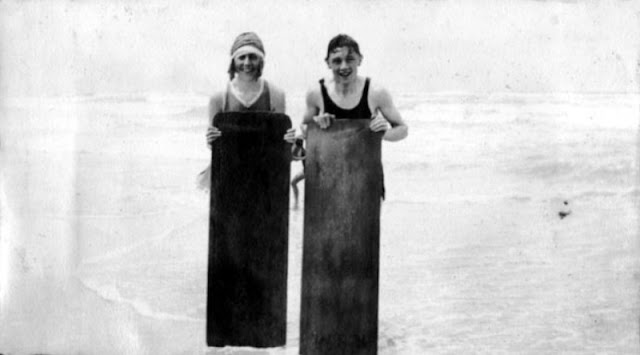
Did You Know Agatha Christie Was a Keen Surfer?

Agatha Christie (1890–1976), the best-selling novelist of all time, creator of such characters as Miss Marple and Hercule Poirot, was also one of England’s first woman surfers.


When asked about surfing, Agatha replied, “Oh it was heaven! Nothing like rushing through the water at what seems to you a speed of about two hundred miles an hour. It is one of the most perfect physical pleasures I have known.”

Agatha was born in Devon in 1890, where she spent her childhood swimming in the sea off the coast around Torquay.

After World War I, Agatha and her husband Archie set off on a year-long round-the-world trip as part of a trade mission of the British Empire Expedition. Their first stop was in South Africa where they took up bellyboarding.


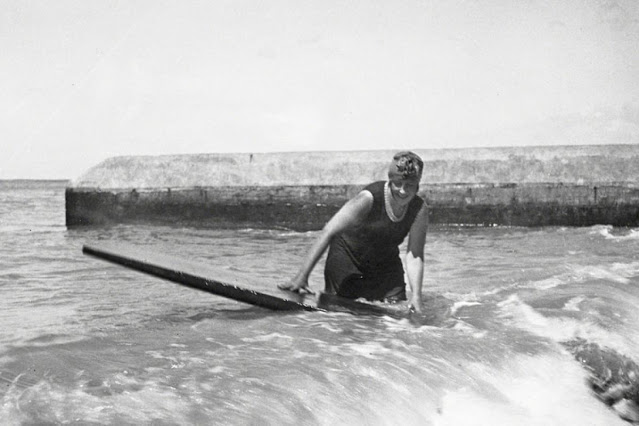
They continued their travels, stopping in Australia and New Zealand, and arriving in Honolulu in August 1922. Agatha and her husband learned to ride surfboards standing up at Waikiki. The boards in the 1920s were more difficult to ride than those of today. They were finless, solid wooden planks around 10 feet long weighing as much as 100 pounds.

Agatha described the first few days surfing as painful, mixed with moments of utter joy. “After ten days I began to be daring. Starting my run I would hoist myself carefully to my knees on the board, and then endeavor to stand up. Oh, the moment of complete triumph on the day that I kept my balance and came right into shore standing upright on my board!”


Agatha and Archie loved surfing so much that they extended their stay in Hawaii for three additional months so they could continue to learn and become proficient at surfing.

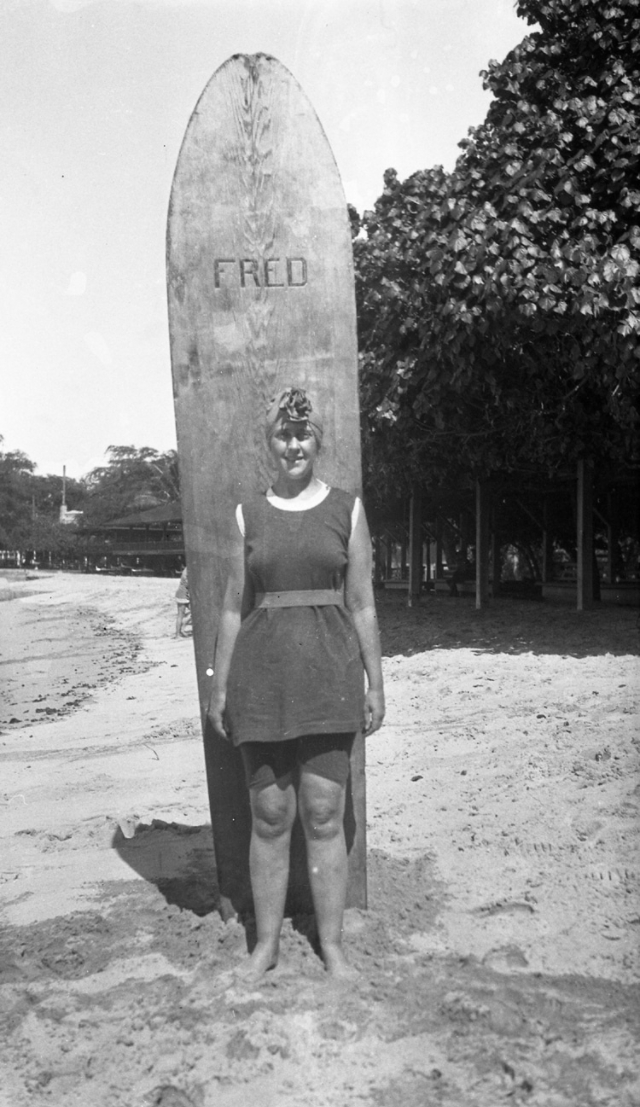
She is seen here at Waikiki Beach, Honolulu in 1922. She borrowed a board from a surfer named Fred. She said it meant a great deal to her because Fred was the name of her father, Frederick Alvah Miller, who died when she was ten years old.

July 29, 2022

40 Fascinating Photos of Honolulu in the Late 1950s

Honolulu is the capital and largest city of the U.S. state of Hawaii, which is located in the Pacific Ocean. It is an unincorporated county seat of the consolidated City and County of Honolulu, situated along the southwest coast of the island of Oʻahu, and is the westernmost and southernmost major U.S. city.

Honolulu is Hawaii’s main gateway to the world. It is also a major hub for business, finance, hospitality, and military defense in both the state and Oceania. The city is characterized by a mix of various Asian, Western, and Pacific cultures, as reflected in its diverse demography, cuisine, and traditions.

Honolulu’s favorable tropical climate, rich natural scenery, and extensive beaches make it a popular global destination for tourists. These fascinating color photos from DAvdW captured life of Honolulu in 1958.


May 5, 2022

Vibrant Kodachrome Photos of Hawaii in the 1950s

These gorgeous Kodachrome photos of Hawaii are from the terrific collection of ElectroSpark, who has a particular fondness for original Kodachromes.

Travel back to 1950s Hawaii through these 30 stunning color pictures. For more fascinating photographs, visit ElectroSpark's brilliant Flickr site.

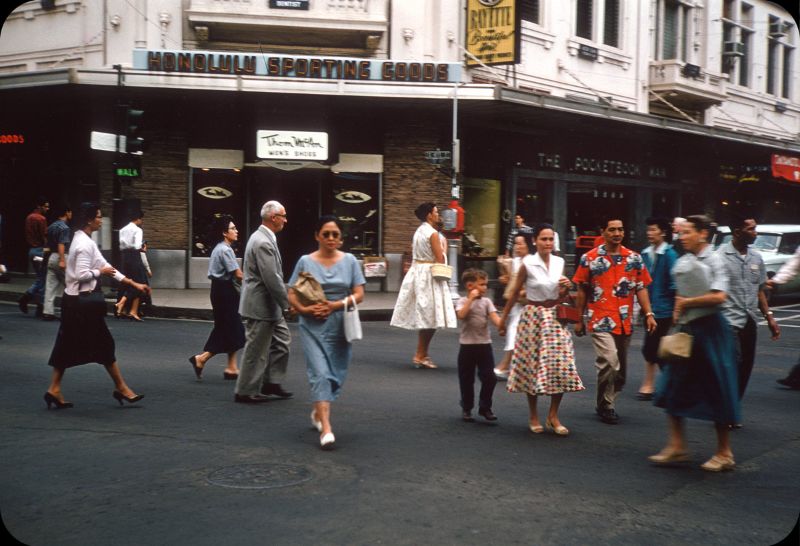
Honolulu Sporting Goods

Downtown Honolulu

Hawaiian Beach

Royal Hawaiian, Waikiki, Honolulu

Miss Surf Queen

April 27, 2022

Just After WWII, Here Is What Hawaii Looked Like in the Late 1940s and Early ’50s

Hawaii is a state in the Western United States, located in the Pacific Ocean about 2,000 miles from the U.S. mainland. It is the only state outside North America, the only state that is an archipelago, and the only state in the tropics. Hawaii is also one of four U.S. states that were once independent nations along with Vermont, Texas and California.

Hawaii is among the country’s most diverse states, owing to its central location in the Pacific and over two centuries of migration. As one of only six majority-minority states, it has the nation’s only Asian American plurality, its largest Buddhist community, and the largest proportion of multiracial people. Consequently, it is a unique melting pot of North American and East Asian cultures, in addition to its indigenous Hawaiian heritage.
Historically dominated by a plantation economy, Hawaii remains a major agricultural exporter due to its fertile soil and uniquely tropical climate in the U.S. Its economy has gradually diversified since the mid-20th century, with tourism and military defense becoming the two largest sectors. The state attracts tourists, surfers, and scientists from around the world with its diverse natural scenery, warm tropical climate, abundance of public beaches, oceanic surroundings, active volcanoes, and clear skies on the Big Island.

Although its relative isolation results in one of the nation’s highest costs of living, Hawaii is the third-wealthiest state. These amazing photos from jcator that show what Hawaii looked like in the late 1940s and early 1950s.

At the Royal Hawaiian Hotel on Waikiki Beach, Honolulu, Hawaii. Outrigger Canoe Club (center left); Moana Hotel (on the right)

"Hawaii Calls" radio show being performed on stage at the Banyan Court of the Moana Hotel, Waikiki, Honolulu, Hawaii

Ala Wai Boulevard next to Ala Wai Canal, Waikiki, Honolulu, Hawaii

Dillingham Transportation Building on Bishop Street (left), downtown Honolulu, Hawaii

Fort Ruger on the slopes of Diamond Head (foreground); Leahi Hospital in right distance


FOLLOW US:
Facebook • Tumblr • Pinterest • Instagram

CONTACT US


Browse by Decades

Popular Posts

Advertisement

09 10