Bring back some good or bad memories


ADVERTISEMENT
Showing posts with label Greece. Show all posts

February 16, 2026

Corfu in the 1980s Through Fascinating Photos

Corfu in the 1980s was a decade of vibrant transformation, marking the island's transition from a sleepy Mediterranean secret to a premier destination for European sun-seekers. This era was defined by the raw, burgeoning energy of the “package holiday” boom, where the narrow streets of Corfu Town and the olive-strewn hillsides of Kavos began to buzz with the sounds of mopeds and disco music.

Despite the rapid influx of tourism, the island retained a rustic charm. It was a time of unfiltered freedom, characterized by long summer nights, the scent of wild sage and sea salt, and a local hospitality that remained authentic even as the world began to rush in. These photos, via Paul Clarke, capture life in Corfu during his parents’ trip in the 1980s.


October 3, 2025

Rare Photos From the 19th Century Show the Depth of the Foundations of the Parthenon at the Acropolis of Athens

These rare photographs of Parthenon’s foundations, revealed in an unbelievable depth. Although the temple that stands on them is now known as Parthenon III, yet these foundations of the Acropolis of Athens were built approx 50 years earlier to keep Parthenon II on them, a temple that was never completed due to the Persian invasion in Athens in 480 BC. The foundations depth is 1.5 times the height of this very heavy building.


In the late 19th century (specifically 1885-1890), the Parthenon’s foundations were extensively excavated by archaeologists Panagiotis Kavvadias and Georg Kawerau, who worked under the supervision of Wilhelm Dörpfeld. This crucial excavation uncovered the foundations of an earlier temple, the Older Parthenon (or Parthenon I), revealing that the existing structure (Parthenon III) was built atop the substantial, though unfinished, foundations of a preceding building (Parthenon II) that was destroyed by the Persian invasion of 480 BCE. The findings, including architectural elements and artifacts like archaic marble Kores, provided essential insights into the history of the Acropolis and its construction sequence.

The excavations revealed that the Parthenon's foundation is a true engineering marvel. It is a massive platform, or stylobate, made up of hundreds of carefully carved limestone blocks. These blocks were laid side-by-side in interlocking layers, stacked up to 22 layers deep, creating an incredibly dense and cohesive mass. This construction method, combined with the materials used, is believed to have given the Parthenon a natural seismic buffer, protecting it from significant earthquake damage for millennia.

The Parthenon’s foundations are also part of the temple's subtle optical refinements. It was discovered that the floor of the Parthenon bulges slightly upward in the middle. This subtle curvature, which also exists in the entablature above the columns and even in the buried foundations, was a deliberate design choice to counteract the optical illusion of sagging that would occur with a perfectly straight line.

The excavation of the Parthenon’s foundations was a pivotal moment in Greek archaeology, not only for what it revealed about the temple itself but also for establishing a deeper understanding of the history of the Acropolis and ancient Greek civilization.


August 30, 2025

Ancient Greek Sandals With Hidden Messages

In ancient Greece, prostitution was a legally recognized and regulated profession. Among the many ingenious methods used to attract clients, one of the most memorable was the use of footwear that left messages in the dirt. Some prostitutes wore sandals with carved lettering on the soles that spelled out “ΑΚΟΛΟΥΘΙ,” meaning “follow me.” As they walked through dusty city streets, each step impressed the phrase into the ground, creating a literal trail for potential customers.

These sandals served both a practical and symbolic purpose. In a society where visual advertising was limited, this method allowed for a subtle yet direct way of inviting attention. It was also an early form of branding and clever marketing, showing how sex workers in antiquity found ways to control and influence their visibility.


Prostitution in classical Athens was widespread and came in different forms, from street walkers to high-status courtesans known as hetairai. While hetairai were often educated and moved in elite circles, most prostitutes worked in brothels or solicited from the streets. The government taxed brothels, and sex workers were often registered and regulated.

Though their social standing was complicated, prostitutes played a visible role in the urban life of Athens. The “follow me” sandals offer a striking glimpse into how ancient workers used creativity to navigate the public space and promote their services. It is a reminder that even in ancient times, marketing ingenuity could walk hand-in-hand with survival.

August 21, 2025

The Story of Greek Taxi Driver Gregorios Sachinidis and His 1976 Mercedes-Benz 240D, World’s Highest Mileage Mercedes

In 1981, Gregorios Sachinidis, a taxi driver from Thessaloniki, Greece, purchased a used 1976 Mercedes-Benz 240D from Germany. The car already had about 220,000 kilometers (approximately 136,700 miles) on the odometer.

For the next 23 years, he used the Mercedes as his taxi, driving it around the clock. His work wasn’t limited to the streets of Thessaloniki; he undertook countless long-distance journeys across Greece and into surrounding countries like Germany, Turkey, and Bulgaria. He even transported humanitarian aid to war-torn Yugoslavia in 1993.


“When I took the taxi, there were few Mercedes circulating in Greece, while I had the advantage of speaking German, as I lived in Germany for 15 years,” Sachinidis told Greek City Times. “So, I worked with travel agencies, which sent me clients to transport them within Greece, but also to the surrounding countries. I transferred businessmen to Skopje, Germany, Banja Luka, I went eight times to Turkey and more than 90 times to Bulgaria.

“In fact, in 1993, crossing the war-torn Yugoslavia, I accompanied a truck with humanitarian aid to Belgrade, transporting the escort of the mission, businessman Stefanos Milios, the only person who had a permit to enter the country at that time.”

By the time he retired the car in 2004, it had accumulated a staggering 4.6 million kilometers (about 2.85 million miles). This feat earned his car the distinction of being the Mercedes-Benz with the highest recorded mileage to date. To put that in perspective, 4.6 million kilometers is the equivalent of driving around the world 115 times.

December 29, 2024

When David Bowie Visited Apocalypse Island in Greece in the Summer of 1985

David Bowie as captured by Polidoros Anastaselis during his stay at the Apocalypse island of Patmos in the Aegean, Greece, in the summer of 1985. The Thin White Duke visited the island in 1985 as a guest of Aga Khan after his triumphant performance at Live Aid in July and got so mesmerized that he continued to spend many of his summers in Greece.

The discreet presence and friendly disposition of the legendary rock star had left the best impressions on the island’s inhabitants. As noted by radio producer Giannis Petridis: “It is certainly not original that David loved Greece. In the days we hosted him and his friend Iggy Pop, we traveled for three days to the archaeological sites of our homeland and apart from music we talked about our history and how important a role it has played in the history of the whole planet. They were both impressed, as was the secretary who accompanied them and was huddled with them in the back seat of Austin, by the visit to Delphi and the immense peace offered by the landscape and the view of Sounio.”


September 10, 2024

40 Wonderful Photos Capture Everyday Life in Crete, Greece in the 1970s

Crete is the largest and most populous of the Greek islands, the 88th largest island in the world and the fifth largest island in the Mediterranean Sea, after Sicily, Sardinia, Cyprus, and Corsica. It is located about 100 km (62 mi) south of the Peloponnese, and about 300 km (190 mi) southwest of Anatolia.

Crete has an area of 8,450 km2 (3,260 sq mi) and a coastline of 1,046 km (650 mi). It bounds the southern border of the Aegean Sea, with the Sea of Crete (or North Cretan Sea) to the north and the Libyan Sea (or South Cretan Sea) to the south. Crete covers 260 km from west to east but is narrow from north to south, spanning three longitudes but only half a latitude.

The island is mostly mountainous, and its character is defined by a high mountain range crossing from west to east. It includes Crete’s highest point, Mount Ida, and the range of the White Mountains (Lefka Ori) with 30 summits above 2,000 metres (6,600 ft) in altitude and the Samaria Gorge, a World Biosphere Reserve.

These wonderful photos were taken by John Handy that show everyday life in Crete in the 1970s.
“In May 1976, I arrived as a young USAF First Lieutenant at Iraklion Air Station, a now-closed United States Air Force Security Service installation on the Greek island of Crete. I was stationed there through December 1978. These photos are of the base, my house in the nearby village of Kokkini Hani, and of various places I visited on the island of Crete. All photos were taken on the island.”
Anogia street scenes

Anogia street scenes

Anogia street scenes

Agios Nikolaos

Ano Viannos, near the southern coast in the Iraklion Prefecture

March 20, 2024

40 Fascinating Photos Capture Street Scenes of Greece in the 1970s

In the 1970s, Greece experienced significant political and social upheaval. The country was under a military dictatorship from 1967 to 1974, which had a profound impact on Greek society. The dictatorship was marked by censorship, political repression, and human rights abuses. However, after the fall of the dictatorship in 1974, Greece transitioned to a democratic government.

The 1970s also saw Greece’s entry into the European Economic Community (EEC) in 1979, marking an important step in the country’s integration into the European Union.

Economically, Greece faced challenges, including high inflation and public debt, but also experienced periods of growth and modernization in sectors such as tourism and shipping. Culturally, the 1970s were a time of artistic and intellectual creativity, with significant contributions to literature, music, and the arts.

These fascinating photos were taken by wilford peloquin that show street scenes of Greece in August 1977.

Athens. Near Monastiraki, Greece, August 1977

Athens, Greece, August 1977

Athens. Daphne Wine Festival, Greece, August 1977

Athens. Monastiraki, Greece, August 1977.

Athens. Monastiraki, Greece, August 1977

December 18, 2023

Crete in 1977 Through Fascinating Photos

Crete is the largest and most populous of the Greek islands, the 88th largest island in the world and the fifth largest island in the Mediterranean Sea, after Sicily, Sardinia, Cyprus, and Corsica. Crete rests about 160 km (99 mi) south of the Greek mainland, and about 100 km (62 mi) southwest of Anatolia. Crete has an area of 8,450 km2 (3,260 sq mi) and a coastline of 1,046 km (650 mi). It bounds the southern border of the Aegean Sea, with the Sea of Crete (or North Cretan Sea) to the north and the Libyan Sea (or South Cretan Sea) to the south. Crete covers 260 km from west to east but is narrow from north to south, spanning three longitudes but only half a latitude.

Crete and a number of islands and islets that surround it constitute the Region of Crete, which is the southernmost of the 13 top-level administrative units of Greece, and the fifth most populous of Greece's regions. Its capital and largest city is Heraklion, on the north shore of the island. The Dodecanese are located to the northeast of Crete, while the Cyclades are situated to the north, separated by the Sea of Crete. The Peloponnese is to the region’s northwest.

The island is mostly mountainous, and its character is defined by a high mountain range crossing from west to east. It includes Crete’s highest point, Mount Ida, and the range of the White Mountains (Lefka Ori) with 30 summits above 2,000 metres (6,600 ft) in altitude and the Samaria Gorge, a World Biosphere Reserve. Crete forms a significant part of the economy and cultural heritage of Greece, while retaining its own local cultural traits (such as its own poetry and music). The Nikos Kazantzakis airport at Heraklion and the Daskalogiannis airport at Chania serve international travelers. The Minoan palace at Knossos is also located in Heraklion.

These fascinating photos were taken by Johannes Preuß that show street scenes of Crete in 1977.

Kafenio in Lasithi Plateau, Crete, Greece, 1977

Bakery in the market hall, Chania, Crete, Greece, 1977

Chania, Crete, Greece, 1977

Fisherman mending his net, Sitia, Crete, Greece, 1977

Lasithi Plateau, Crete, Greece, 1977

November 6, 2023

Some of the Earliest Photos of Greece and Egypt in 1842 an 1843

Joseph-Philibert Girault de Prangey (1804–1892) was a French scholar and draughtsman whose use of photography while he was active in the Middle East pursuing archaeology and studying ancient architecture has made him recognized as an important early photographer. His daguerreotypes are the earliest surviving photographs of Greece, Palestine, Egypt, Syria, and Turkey. After his death in 1892, his carefully stored photographs were discovered in the attic of his estate in the 1920s and they only became known as important works eighty years later.

Girault first announced his intention to study “monuments” of the Mediterranean and their relationship to medieval architecture at a Parisian meeting of the Société française d'archéologie in 1841. He detailed his itinerary and mentioned his use of the daguerreotype the following year. Although somewhat off the beaten track, his journey was not unprecedented and was partially modeled on that of the artist Prosper Marilhat, a fellow member of his Parisian social club, the Cercle des arts. This group, which included painters familiar with the daguerreotype, might also have served as Girault’s point of introduction to photography.

Girault departed from Paris with more than one hundred pounds of photographic equipment, plates, and chemicals in February 1842. He then sailed by steamship from Marseille to Italy, arriving in the Papal States, by way of Genoa, in April. He traveled by boat as much as possible throughout his journey to ease the transport of his supplies. His Roman sojourn is partially documented in letters written by the director of the Académie de France in Rome, which report that the industrious artist had made more than three hundred daguerreotypes by the time he left the city in mid-July, photographing “everything that passed.”

After leaving Italy, Girault made his way to Athens, where he spent the rest of the summer (about six weeks) before traveling on to Egypt in September. He wrote to a colleague at the Société française d’archéologie with enthusiasm about his work in Athens: “I lost less time [than in Rome], and, by my faith, I left very little behind.”

Girault’s use of plates during this part of his excursion was anything but frugal. He appears to have produced more whole plates in Greece than in any other Mediterranean location. Athens was less familiar to Europeans than Rome, and the French were also fascinated by Greece’s recent revolution: Greeks had won independence from the Ottoman Empire in 1832, and the government moved to Athens in 1834.

Girault concentrated on the area around the Acropolis. He described his demanding work there—from calculating exposure times to manipulating noxious chemicals in variable conditions—as a rewarding yet challenging photographic campaign: “Nothing in the world is as marvelous or perfect as all that is contained by the Athenian acropolis! As you might guess, the strongest battle occurred there, and God knows how I exerted myself to take my share of the spoils.”

Egypt in the early 1840s was still part of the Ottoman Empire, although it had grown increasingly independent under the leadership of the wali (viceroy) Muhammad ‘Ali. French presence in Egypt had been on the rise since Napoleon’s military campaign (1798–1801) and ‘Ali, a renegade commander from the Ottoman army, formed close ties with French military officers and intellectuals as part of his modernizing efforts. Access to the country had improved in 1835, when Alexandria became the port of entry for the first regular Egypt-bound steamer from Europe.

Girault arrived at the port in the autumn of 1842 and, after exploring Alexandria and nearby Rosetta, he settled in Cairo for the rest of the year. He carefully studied the medieval funerary domes and minarets, which had flourished in the Mamluk period (1250–1517), but he also paid special attention to the first mosque built in Egypt, the Mosque of ‘Amr ibn al-‘As. His photographs of its windows relate to a culturally biased debate among European historians at the time about whether the ogive, or pointed arch, was Islamic or French in origin.

Tower of the Winds, Athens

Stoa, Athens

Erechtheion, Athens

Erechtheion, Athens

Tombs, Avilenea

June 12, 2023

35 Amazing Black and White Photos of Athens in the 1970s

Athens is a major coastal urban area in the Mediterranean and it is both the capital and the largest city of Greece, and also the eighth largest urban area in the European Union. Athens dominates and is the capital of the Attica region and is one of the world’s oldest cities, with its recorded history spanning over 3,400 years, and its earliest human presence beginning somewhere between the 11th and 7th millennia BCE. The city was named after a Greek war goddess.

Classical Athens was a powerful city-state. It was a centre for the arts, learning and philosophy, and the home of Plato's Academy and Aristotle's Lyceum. It is widely referred to as the cradle of Western civilization and the birthplace of democracy, largely because of its cultural and political influence on the European continent—particularly Ancient Rome.

In modern times, Athens is a large cosmopolitan metropolis and central to economic, financial, industrial, maritime, political and cultural life in Greece. It is one of the biggest economic centers in Southeastern Europe. It also has a large financial sector, and its port Piraeus is both the 3rd busiest passenger port in Europe, and the 26th largest container port in the world. Athens is also the southernmost capital on the European mainland.

These amazing black and white photos were taken by John Winder that show Athens from 1972 to 1974.

Gate to the Roman Forum and two cool dudes in bell bottoms, Plaka, Athens, summer 1972

Acropolis seen from Philoppapou Hill, Athens, summer 1972

Dome of Church of the Pantanassa, Athens, September 1972

Kaisariani monastery, Athens, October 1972

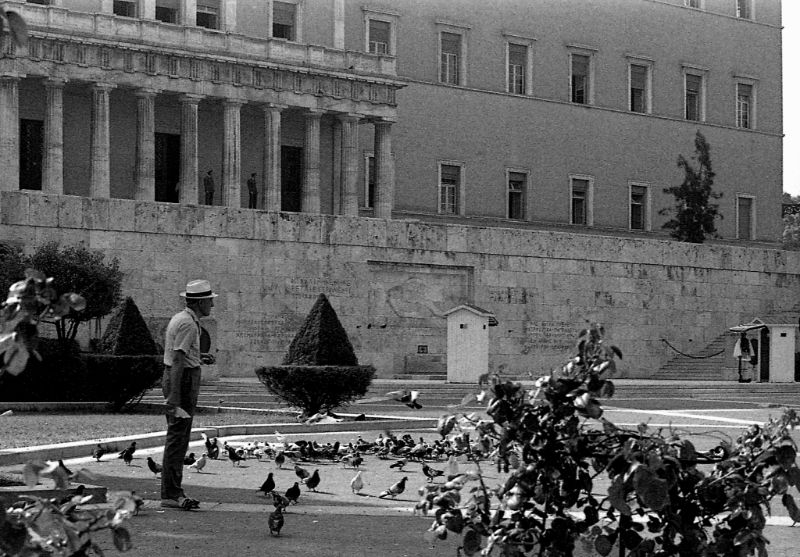
Man and pigeons, in front of the Parliament building, Athens, summer 1972

March 22, 2023

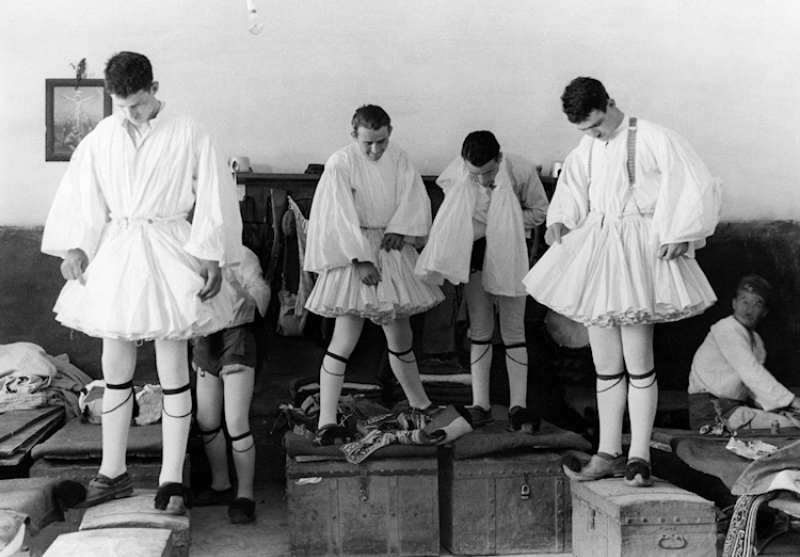
Greek Soldiers of the Evzones Dressing, Captured by Alfred Eisenstaedt in 1935

The Evzones or Evzonoi were several historical elite light infantry and mountain units of the Greek Army. Today, they are the members of the Presidential Guard, a ceremonial unit that guards the Greek Tomb of the Unknown Soldier and the Presidential Mansion in Athens. An Evzone is also known, colloquially, as a Tsoliás.

Evzones are known for their distinctive uniform, which evolved from the clothes worn by the klephts who fought the Ottoman occupation of Greece. The most visible item of this uniform is the fustanella, a kilt-like garment. Their distinctive dress turned them into a popular image for the Greek soldier, especially among foreigners.

During the remainder of the 19th century, the dress of the separate line battalions of Evzones appears to have differed slightly in detail between units. After a few minor changes over the years, it became the familiar uniform seen worn today by the Presidential Guard. In 1910 a new field service uniform was adopted, substituting a khaki farion cap and khaki doulama jacket for the respectively red and dark blue garments previously worn. The long white woolen hose and turned-up tsarouchia shoes were still retained, although sometimes replaced on campaign by the standard khaki trousers and leather boots of the line infantry. The khaki and off-white field uniform of 1910 was still being worn during the Greek-Italian War of 1940-41, although without the red collar piping and shoulder straps of the earlier uniform. The traditional black fez tassel, and large pompoms on the footwear, were usually removed before battle.


FOLLOW US:
FacebookTumblrPinterestInstagram

CONTACT US


Browse by Decades

Popular Posts

Advertisement

09 10