Bring back some good or bad memories


ADVERTISEMENT
Showing posts with label Denmark. Show all posts

January 18, 2026

This Whaling Suit From Greenland, Made Sometime Before 1834

This whaling suit from Greenland, crafted sometime before 1834, reflects the ingenuity and resourcefulness of the Inuit people. Designed for the harsh Arctic environment, it allowed hunters to remain dry and insulated while navigating icy waters during dangerous sea hunts. Every element of the suit was carefully considered for practicality and protection, ensuring the wearer could focus on hunting without succumbing to hypothermia.


Constructed entirely from sealskin, the suit was both flexible and durable. Its central opening allowed the hunter to crawl inside, after which the hole was tightly secured to create a nearly waterproof seal. This simple yet effective design demonstrates a sophisticated understanding of materials and environmental challenges, turning natural resources into life-saving technology.

Today, the suit is preserved at the National Museum of Denmark, serving as a testament to Inuit craftsmanship and survival skills. Beyond its practical use, it offers a glimpse into the daily lives and ingenuity of Arctic communities, highlighting how cultural knowledge and adaptation were crucial for thriving in one of the world’s most extreme climates.

October 25, 2025

Women Shopping for Perfumes and Jewelry at Illum Department Store in Copenhagen, Denmark, 1904

The Illum department store opened in 1891, initially selling sewing supplies. It was founded by a young man named Carl Illum, and its target audience was the wealthy women of Copenhagen, Denmark. Thanks to excellent customer service and a wide product selection, the store did exceptionally well. Seven years later, it was able to move to a much larger location, transforming the small shop into a full-fledged department store. Carl Illum was soon able to purchase a neighboring property, an old Renaissance building. There was a significant amount of protest when Illum demolished the historic building to expand his store.


Carl Illum died in 1938, and his family took over the department store. The company continued to expand throughout the 1950s, 1960s, and 1970s, becoming an even larger department store. In 1972, the family sold the business. Today, Illum department store still exists in central Copenhagen.

June 11, 2025

This is How Ejnar Mikkelsen, a Danish Explorer, Was Photographed in 1912 When He Was Found

This is how Ejnar Mikkelsen, a Danish explorer, was photographed in 1912 when he was found. Ejnar was isolated with Iver Iversen, from the same expedition, for two and a half years in a hut in Greenland waiting to be rescued.


During the Alabama Expedition (1909–1912), Mikkelsen and his crew set out to recover vital records from the ill-fated Denmark Expedition (1906–1908), proving that the Peary Channel did not exist, and Greenland was a single landmass. After their ship, Alabama, got trapped in ice, Mikkelsen and Iversen embarked on a grueling sled journey to retrieve the documents. They succeeded but returned to find their crew had abandoned them in 1910, believing they were dead.

Stranded on Shannon Island, they built a small hut from the ship’s remains and survived for two years on seal and polar bear meat, battling scurvy, frostbite, starvation, and extreme isolation. At one point, Iversen suffered a near-fatal infection that Mikkelsen had to treat. Despite brutal winters and dwindling supplies, they kept their spirits up through routines and sheer determination. Finally, in 1912, a Norwegian whaling ship, Sjøblomsten, miraculously found them, bringing their incredible survival story to an end.

In the picture you can see a photograph on the wall behind Ejnar. It shows the 53 pupils of a home economics school that filled their long arctic days. The photo was so much talked about that it even led to a fight when Iversen dedicated a love song to the girl Mikkelsen had chosen as his girlfriend. Iversen had chosen 4 girlfriends in the picture, so Ejnar got angry when the other tried to take away the one he had chosen. He got so upset that for two days he didn’t speak to Iversen.

Mikkelsen returned to Denmark as a hero as he managed to retrieve the maps from the previous expedition that proved that the Peary Channel did not exist and that Greenland was therefore Danish. He also ended his photographic courtship when he met Naja Marie Heiberg Holm, daughter of another explorer, whom he married a few months later.

November 14, 2024

Copenhagen in the Mid-1980s Through Fascinating Photos

In the mid-1980s, Copenhagen was a vibrant, evolving city marked by a mix of old-world charm and emerging modernity. The city was in the midst of a cultural and economic transition, with a growing focus on design, alternative lifestyles, and counterculture. The Christiania neighborhood, a self-proclaimed anarchist enclave founded in 1971, was a focal point of alternative art, music, and politics.

Copenhagen also became increasingly known for its influence on the design world, particularly in architecture, furniture, and graphic design. The city’s cozy cafes, biking culture, and emphasis on green spaces continued to shape its identity. On the political front, Denmark was navigating its position within the European Economic Community (EEC), a precursor to the European Union.

The city in the 1980s had a relaxed, laid-back atmosphere but was also experiencing rapid urban renewal and a growing international profile. These fascinating photos from Shane Egan that captured street scenes of Copenhagen in 1985.


April 15, 2024

18 Portraits of a Young and Beautiful Tove Ditlevsen, One of Denmark’s Best-Known Authors

Tove Irma Margit Ditlevsen (December 14, 1917 – March 7, 1976) was a Danish poet and author. With published works in a variety of genres, she was one of Denmark’s best-known authors by the time of her death.


Tove Ditlevsen was born in Copenhagen and grew up in the working-class neighbouhood of Vesterbro. Her childhood experiences were the focal points of her work. Ditlevsen was married (and divorced) four times.

In her life, Ditlevsen published 29 books including short stories, novels, poetry, and memoirs. Female identity, memory, and loss of childhood are recurring themes in her work. She began writing poems at the age of ten. Her first volume of poetry was published in her early twenties. In 1947, she experienced popular success with the publication of her poetry collection Blinkende Lygter (Flickering Lights). The Danish Broadcasting Corporation commissioned her to write a novel, Vi har kun hinanden (We only have each other), which was published in 1954 and broadcast as radio installments. Ditlevsen also authored a column in the weekly Familie Journalen, responding to letters from readers.

Three of her books, Barndom (Childhood), Ungdom (Youth), and Gift (meaning both poison and married), form an autobiographical trilogy. The first two books were translated by Tiina Nunnally and published in 1985 by Seal Press under the title Early Spring. The complete trilogy, with the third book translated by Michael Favala Goldman, was published in one volume in 2019 (with the titles Childhood, Youth and Dependency) and referred to as The Copenhagen Trilogy.

Throughout her adult life, Ditlevsen struggled with alcohol and drug abuse, and she was admitted to a psychiatric hospital several times, a recurring theme in her later novels. In 1976, she died by suicide from an overdose of sleeping pills.


February 4, 2024

Denmark in 1980 Through Wonderful Photos

In the 1980s, Denmark experienced a period of economic growth and social change. The country was known for its strong welfare state, high standard of living, and progressive social policies.

Denmark also saw an increase in environmental awareness and activism during this time, as well as the emergence of a vibrant cultural scene, particularly in the fields of design, architecture, and music.

The 1980s also saw Denmark becoming increasingly integrated into the global economy and playing a more active role in international affairs.

These wonderful photos were taken by Simon Barnett that show street scenes of Denmark in 1980.

Hellerup, Denmark, 1980

Bakken, Denmark, 1980

Bakken, Denmark, 1980

Bakken, Denmark, 1980

Boarding the Dana Regina, Denmark, 1980

December 6, 2023

Abandoned WWII Bunkers on the Danish North Sea Coast

During World War II, the Danish coasts were included in the Atlantic Wall. The Atlantic Wall was planned and partially built by the German occupiers in France, Belgium, the Netherlands, Denmark, Norway, the British Channel Islands and the German Reich in the period from 1942 to 1944 during World War II. The Atlantic Wall was supposed to prevent an invasion by the Western Allies. 6,000 of the 7,000 bunkers that the Wehrmacht built on the coast after the occupation of Denmark in 1940 still exist.


Radio measurement location Bovbjerg

The most striking remnant in Bovbjerg of the German occupation is the hexagonal foundation of a marine radar (radar device FuMO 214 “Würzburg Riese”), which stood here from 1944 until the end of the war. An air detection radar had been in operation since 1942, and was later replaced by a larger one in Thyborøn. Furthermore, there was “BOHNE”, the radio measurement and observation position FuMB 21, two small group shelters (R 668) and some concrete foundations for radar systems. For close defense, there were smaller outpost positions and trenches that were connected by trenches. Some trenches can still be seen in the area on the way to the Church of Trans. There was a FuMo 5 “Boulogne” radar on the small hill in front of the lighthouse. But enough of the technical data and the past. The base of the radar was painted blue years ago and looks picturesque right on the cliff. Nestled in front of beach carnations and white clover, in front of the blue sky and the North Sea. Children climb the small rope ladder. A few more decades and the base of the radar crashes into the sea.


The turtle bunker

This bunker is part of the former Thyboron fortress on the Danish North Sea coast. On top of the bunker, a roof made of tiles was installed for camouflage. The building should look like the surrounding farmhouses from the air. For certain reasons, this bunker reminds me of a huge turtle lying on the beach.


June 20, 2023

A 7000-6000 Year Old Burial of a Young Woman and Her Newborn Baby

Discovering ancient burial sites can often reveal fascinating insights into the lives of our distant ancestors. One such discovery is the 7000-6000-year-old burial of a young woman, estimated to be around 20 years old at the time of her death, and her newborn baby, found in Vedbaek, Denmark.


What makes this burial particularly intriguing is the presence of 200 red deer teeth placed by the woman's head, and the newborn being cradled in the wing of a swan with a flint knife placed at its hip. It is believed that the mother and child tragically died together during childbirth.

The exquisite details of this burial paint a vivid picture of the rituals and customs of our ancient forebears. The placement of the red deer teeth and the use of the swan's wing as a cradle suggest a reverence for nature and an appreciation for the beauty of the animal world.

This discovery is a testament to the incredible creativity and resourcefulness of our ancestors, and a reminder that even in the most challenging circumstances, they found ways to express their culture and beliefs. The Vedbaek burial serves as a poignant reminder of the profound connections between life and death, and the enduring legacy of our shared human history.

March 12, 2023

November 10, 2022

Gorgeous Kodachrome Pictures of Denmark, Turkey and the Netherlands in 1958

These gorgeous pictures were taken by Julia Vanderveer Rees (1896 — 1997) during her trip around Europe in 1958. Vanderveer Rees, along with her husband John Owen Rees, traveled the world in the 1940s, 1950s, and 1960s, due to Mr. Rees' position as an economic advisor with the United States government. 

Take a look at Denmark, Turkey and the Netherlands through these beautiful Kodachrome slides taken by Mrs. Rees in 1958. For more fascinating vintage pictures, make sure to visit gbfernie5's brilliant collections on Flickr.

Café Pa Porta, Nytorv 6, Copenhagen, Denmark.

Caritas or 'Fountain of the Golden Apples', Gammeltorv, Copenhagen, Denmark.

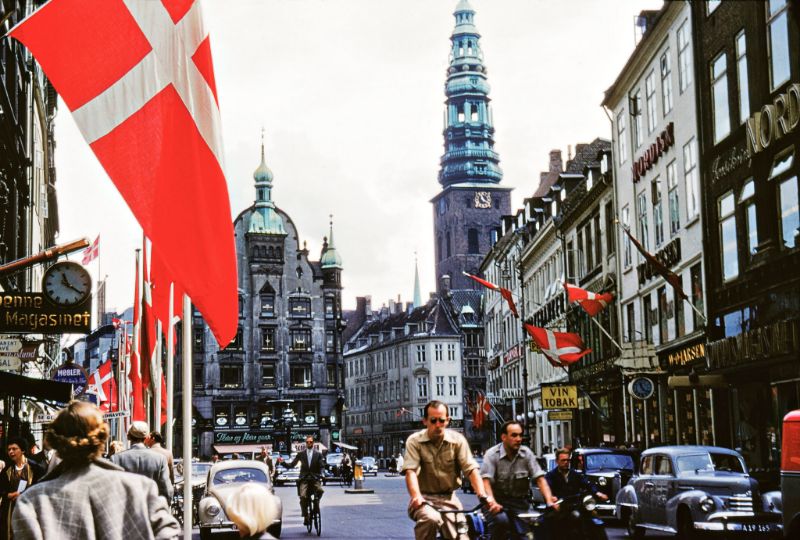
Easterly view along the Amagertorv, Copenhagen, Denmark.

Fishmarkets, Gammel Strand, Copenhagen, Denmark.

Fishmarkets, Gammel Strand, Copenhagen, Denmark.

July 5, 2022

Beautiful Photos of West Zealand County, Denmark in the Late 1930s

West Zealand County (Danish: Vestsjællands Amt) is a former county in the west-central part of the island of Zealand (Sjælland) in eastern Denmark. The county was formed on 1 April 1970, comprising a few former counties. The county was abolished effective January 1, 2007, when it merged into Region Sjælland (i.e. Region Zealand).

The county was responsible for public hospitals, upper secondary schools and schools for Higher Preparatory Examination, public transport and social welfare for the disabled.

The County Hall was located in the town of Sorø, and became the seat of the new region. Sorø is by no means the biggest city in West Zealand, but it has great historical value. It is famed for the Sorø Academy (Danish, Sorø Akademi), an educational institution built in 1140 together with the church where Queen Margaret I of Denmark was buried (later moved to Roskilde Domkirke, Roskilde).

Many people who live in West Zealand commute to the greater metropolitan area of Copenhagen for work.

Here is a set of beautiful black and white photos from ARBaurial that shows countryside scenes of West Zealand County in the late 1930s.

Vestsjælland Lumbsaas, circa 1938

Vestsjælland Asnæs Pynten, circa 1938

Vestsjælland Bramsnæsvig, circa 1938

Vestsjælland Faarsvejle, circa 1938

Vestsjælland Jægerspris, circa 1938

June 20, 2022

40 Beautiful Photographs of Denmark in 1965

Denmark is a Nordic country in Northern Europe. European Denmark is the southernmost of the Scandinavian countries, lying southwest of Sweden, south of Norway, and north of Germany.

Spanning a total area of 42,943 km2 (16,580 sq mi), it consists of the peninsula of Jutland and an archipelago of 443 named islands, of which the largest are Zealand, Funen and the North Jutlandic Island. Denmark’s geography is characterized by flat, arable land, sandy coasts, low elevation, and a temperate climate.

Denmark is a highly developed country with a high standard of living: the country performs at or near the top in measures of education, health care, civil liberties, democratic governance and LGBT equality.

Denmark is a founding member of NATO, the Nordic Council, the OECD, OSCE, and the United Nations; it is also part of the Schengen Area. The country maintains close political, cultural, and linguistic ties with its Scandinavian neighbors, with the Danish language being partially mutually intelligible with both Norwegian and Swedish.

These beautiful photos from Simon Barnett were taken by his father when “my dad and his parents (Fred and Else) went to Denmark for their 1965 summer holiday”.

Hillerod town hall, Denmark, 1965

Hotel Dagmar from Ribe Cathedral Tower, Denmark, 1965

Church near Assens, Denmark, 1965

Den Gamle By, Denmark, 1965

Den Gamle By, Denmark, 1965

June 11, 2021

Patient Receiving Phototherapy via an Arc Light, 1907

This photograph depicts a patient receiving phototherapy treatment via an arc light developed by Niels Ryberg Finsen, the Danish physician who pioneered the treatment of disease (notably lupus vulgaris) through exposure to specific wavelengths of light.

(Osler Library of the History of Medicine, McGill University)

Finsen’s method consists in concentrating actinic light, through rock-crystal lenses, on any desired part, rendered as exsanguine as possible by means of pressure, because the presence of blood acts as a barrier to the passage of the chemical rays to the tissues.


FOLLOW US:
FacebookTumblrPinterestInstagram

CONTACT US


Browse by Decades

Popular Posts

Advertisement

09 10