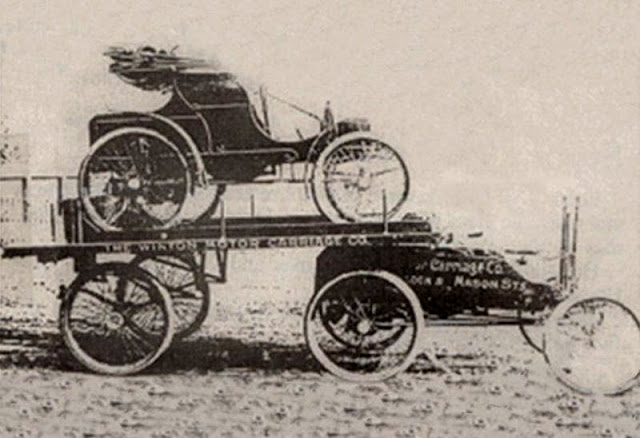
The semi-truck was invented by Alexander Winton in 1898. He lived in Cleveland, Ohio. Winton sold his first semi-truck in 1899 and from that year onward, this product became a symbol of American freight transport.
The story goes that Winton was perfectly happy building cars to sell to people in his home state of Ohio, but realized he could reach more customers if he had some way of easily transporting his product. He didn’t want any wear-and-tear on his new cars before they got to customers, though, so he had to figure out something that didn’t involve driving them.
Winton came up with a way of loading the car onto a flat cart, which he modified to sit on top of the engine of a modified truck platform. The connection was supposedly similar to the removable gooseneck on trucks today. The setup could only transport one car at a time, and it required at least three people to load and unload the vehicle being transported.
Alexander Winton was a serial entrepreneur; his first product was a bicycle. His next product was a car, the Winton Six. The Six was perhaps the first car that crossed the North American continent from the Atlantic to the Pacific coast. To popularize this brand, Winton participated in several car races and even hired acclaimed race drivers.
The year was 1970. Jane Fonda had just finished filming the crime thriller Klute. On her way home from an anti-Vietnam War speaking engagement in Canada—the first on her North American tour—she hopped a flight to Cleveland. In her bag were vitamins. Police seized her luggage at the airport and took her to prison on drug smuggling charges.
“They discovered a large bag containing little plastic envelopes marked (in red nail polish) ‘B’, ‘L’, ‘D’–signifying breakfast, lunch and dinner- that contained the vitamins I took with each meal,” Fonda wrote. “They confiscated that as well as my address book (which was photocopied) and arrested me for drug smuggling. I told them what they were but they said they were getting orders from the White House–that would be the Nixon White House. I think they hoped this “scandal” would cause the college speeches to be canceled and ruin my respectability. I was handcuffed and put in the Cleveland Jail, which is when the mug shot was taken.”
That shot of Fonda – with shaggy bangs and dark hair, her clenched fist raised in power – became iconic.
The unruly haircut was not for Fonda’s fans, boyfriends, husbands, or career—it was for her. And in it she would earn her first Oscar for Best Actress in Klute (from which the haircut gets its name). With this haircut and a single mug shot, she would emblazon herself onto the collective consciousness as a symbol for women who won’t back down.
“Headlines across the country had the story of me being jailed on suspicion of drug smuggling,” she added. “I was released on bond and months later, after every pill had been tested in a lab (with taxpayers money!) The charges were dismissed and there were a few paragraphs hidden in the back of papers that they were vitamins, not drugs.”
Jane Fonda was handcuffed in November 1970 at Cuyahoga County Jail. (Cleveland Plain Dealer)
The Hollywood star was arrested in Cleveland while protesting the Vietnam War.
Two years later, Fonda was dubbed “Hanoi Jane” and roundly criticized after a trip to North Vietnam, when she pleaded for U.S. pilots to stop the bombing on the Voice of Vietnam radio and posed with North Vietnamese troops on an antiaircraft gun.
In July 1977, a young couple was looking to get married. The owner of the McDonald’s where the man worked agreed to have the wedding at his restaurant in Cleveland for free.
However, the store remained open during the ceremony, and it was outside of peak hours, so the couple had most of the outside area to themselves.
“My dad was 20 and spent most of his time managing his afro. My mom was 18 and had recently given birth to my older brother. He had a mini afro.” – Dewan Gibson wrote on his website.
They were married at McDonald’s on the 23rd of that month. Four kids and they’re still together. And of course, the McDonald’s on Lee Road is still there, too.
The 24th World Science Fiction Convention, also known as Tricon, was held 1-5 September 1966 at the Sheraton-Cleveland in Cleveland, Ohio, USA. Officially, the convention was hosted by three cities in the region: Cincinnati, Cleveland, and Detroit, - hence the name “Tricon”.
The three co-chairmen of that Worldcon each represented their city’s fandom; they were Ben Jason of Cleveland, Howard DeVore of Detroit, and Lou Tabakow of Cincinnati. The guest of honor was L. Sprague de Camp and the toastmaster was Isaac Asimov. Of special note: Gene Roddenberry premiered the pilot episode for his TV series Star Trek at Tricon.
This collection is primarily comprised of photographs taken by Jay Kay Klein has he documented Science Fiction & Fantasy fandom at the 24th World Science Fiction Convention in Cleveland, Ohio. The majority of images were taken by Klein while attending Science Fiction & Fantasy conventions and events.
Jay Kay Klein (1931–2012) began reading Science Fiction at a young age and joined the Philadelphia Science Fiction Society at the age of 14. During his lifetime he was an avid photographer and amassed an extensive photograph collection of Science Fiction & Fantasy conventions and events. He was a writer, editor, and photographer for international corporate magazines and wrote missile acquisition radar systems and ICBM launch facilities manuals for the United States Air Force. He was also a member and contributor to First Fandom, Science Fiction & Fantasy Writers of America (SFWA), and Analog. Throughout his life Klein lectured on Science Fiction as literature, social commentary, and as a window into the future.
In 1986, organizers with United Way of Cleveland thought they had the perfect idea to generate a little publicity and create a beautiful spectacle in the process. With a crowd of volunteers working all hours, they filled 1.5 million helium balloons, and released them all at once. Unfortunately, they had no idea the terrible consequences they would unleash by doing so, and their tragic mistake led to the deaths of two people and millions of dollars in damages through lawsuits.
It all began with the awesome, but fundamentally disastrous, goal of setting the world record for the most balloons launched at once. Anaheim, which released 1.2 million balloons the year before, was the previous champion.
On Sept. 27, thousands of volunteers worked for hours filling balloons with helium under a huge tent near Cleveland's Public Square. After 1.5 million balloons were inflated, the net was released and a surreal-looking balloon cloud started to rise over downtown, as seen in this footage.
Photos of Balloonfest '86 were pretty incredible — reds, blues and yellows framed the sky like large-scale confetti. But what was intended to be a harmless fundraising stunt, ultimately led to two deaths, multiple lawsuits and general chaos.
Just after the balloons were released at around 1:50 p.m., a storm began to move in from the Great Lakes. Strong winds pushed the balloons down over the city and to the ground, creating chaos on roadways and shutting down the runway at a local airport.
As the balloons touched down on a pasture in Medina County, several prize-winning horses were spooked and permanently injured. The owner later sued for $100,000.
The Coast Guard said the "asteroid field" of balloons also clogged the skies that day, stalling a helicopter search for two missing boaters. Tragically, the men died when searchers were unable to reach their overturned boat, Cleveland.com reports. When the Coast Guard crew finally could lift off, they said they had trouble differentiating the balloons covering the surface of the water from the missing men.
In the days that followed, even Canadians reported impacts from the event, as deflated (and apparently biodegradable) balloons washed up on the Canadian side of Lake Erie.
While the sight of 1.5 million balloons being released must have been amazing to see, the outcome was far from pleasant. Weather.com meteorologist Nick Wiltgen said a mistake like this probably wouldn't happen today, especially with weather data on smartphones and a much better understanding of the atmosphere's behavior.
In the Depression years, wealthy Cleveland brides-to-be attended bridal fashion shows and dressed like Hollywood stars on their wedding day. But many young couples wore their Sunday best to a simple ceremony at the County Courthouse in Cleveland.